- Focus: Allah’s mercy in revelation, clarity of Tawheed, and Musa’s mission against Pharaoh’s transgression.
- Method: verse-by-verse theme extraction with practical guidance, without external sources.
1. Ta. Ha.
2. We have not sent down to you (Muhammad) the Qur'an that you should be distressed.
3. But as a reminder for those who fear (Allah).
4. A revelation from Him who created the earth and the high heavens.
5. The Beneficent, (He is) on the Throne, established.
6. To Him belongs whatever is in the heavens, and whatever is on the earth, and whatever is between them, and whatever is beneath the soil.
7. And if you speak out aloud, then indeed He knows the secret and (what is yet) more hidden.
8. Allah, there is no god except Him. His are the most beautiful names.
9. And has there come to you the story of Moses.
10. When he saw a fire, so he said to his family: “Wait, indeed, I see a fire, perhaps I may bring to you from it some burning brand, or I may find guidance at the fire.”
11. Then when he came to it, he was called: “O Moses.”
12. “Indeed, I am your Lord, so take off your shoes. Indeed, you are in a sacred valley of Tuwa.”
13. “And I have chosen you, so listen to that which is inspired.”
14. “Indeed, I am Allah, there is no god except Me, so worship Me and establish prayer for My remembrance.”
15. “Indeed, the Hour is coming. I will keep it hidden, so that every soul may be recompensed for what it strives.”
16. “So do not let him turn you away from it who does not believe in it, and follows his desire, lest you then perish.”
20:1 — Ta. Ha.
What is Allah saying?
These are special Arabic letters at the start of some surahs.
Child meaning:
It’s like a special opening Allah uses. We do not know the full secret meaning, but it reminds us:
“This is Allah’s message.”
20:2 — We did not send the Qur’an to make you distressed.
What is Allah saying?
Allah is speaking to Prophet Muhammad.
Child meaning:
“Qur’an is not here to make you sad, stressed, or miserable. It’s not meant to crush you.”
Sometimes people may feel pressure because they want to do everything perfectly. Allah is saying: “This message is not a punishment for you.”

20:3 — But as a reminder for those who fear Allah.
What is Allah saying?
The Qur’an is mainly for people who care about Allah and want to do right.
Child meaning:
“It is a reminder for the people who want to obey Allah.”
Like when a good parent reminds you: “Don’t forget what’s right.” Not to hurt you—just to guide you.

20:4 — A revelation from the One who created the earth and the high heavens.
What is Allah saying?
Allah tells us where the Qur’an comes from.
Child meaning:
“This book is from the One who made everything: the earth under your feet and the huge sky above you.”
So this message is not random. It is from the Creator.

20:5 — The Most Merciful is established on the Throne.
What is Allah saying?
Allah mentions His greatness and authority.
Child meaning:
“Allah is the King over everything.”
Important note (simple and safe):
We do not imagine Allah like a human sitting. Allah is not like creation.
This verse teaches Allah’s power and control, not a human-like picture.

20:6 — To Him belongs whatever is in the heavens and earth… and beneath the soil.
What is Allah saying?
Allah owns it all.
Child meaning:
“Everything belongs to Allah: the stars, the clouds, the oceans, the mountains, animals, people,
and even things underground like seeds and hidden treasures.”
Nothing is outside Allah’s ownership.

20:7 — If you speak aloud, He knows the secret and what is even more hidden.
What is Allah saying?
Allah knows what we say and what we don’t say.
Child meaning:
“Allah knows your loud words, your quiet words, and even the thoughts you didn’t tell anyone.”
Even if you hide something from people, you cannot hide it from Allah.

20:8 — Allah—there is no god except Him. His are the most beautiful names.
What is Allah saying?
Allah reminds us of the main truth: worship only Him.
Child meaning:
“Only Allah deserves worship. And Allah has the best names—like The Merciful, The Wise, The All-Knowing.”
These names teach us what Allah is like: perfect in mercy, knowledge, justice, and power.

20:9 — Has the story of Musa come to you?
What is Allah saying?
Allah now starts a story from history to teach lessons.
Child meaning:
“Let me tell you about Musa (Moses). This story will help you learn.”

20:10 — Musa sees a fire and tells his family to wait.
What is Allah saying?
Musa is traveling and sees a fire far away.
Child meaning:
Musa says: “Wait here. I see a fire. Maybe I can bring you a burning piece to warm up,
or maybe I’ll find someone there who can guide us.”
So Musa is being caring and practical: warmth and directions.

20:11 — Musa is called: “O Musa.”
What is Allah saying?
When Musa reaches the fire, something amazing happens.
Child meaning:
Musa hears a call: “Musa!”
This is Allah calling him—showing Musa he is not alone.

20:12 — I am your Lord. Take off your shoes. You are in a sacred valley.
What is Allah saying?
Allah tells Musa to show respect.
Child meaning:
“This place is special and holy. Take off your shoes as respect, because you are standing in a blessed area.”
Like when you enter a very important place and behave carefully and respectfully.

20:13 — I chose you, so listen to what is revealed.
What is Allah saying?
Allah chose Musa for a special job.
Child meaning:
“Allah picked Musa to be a messenger. So Musa must listen carefully to Allah’s instructions.”
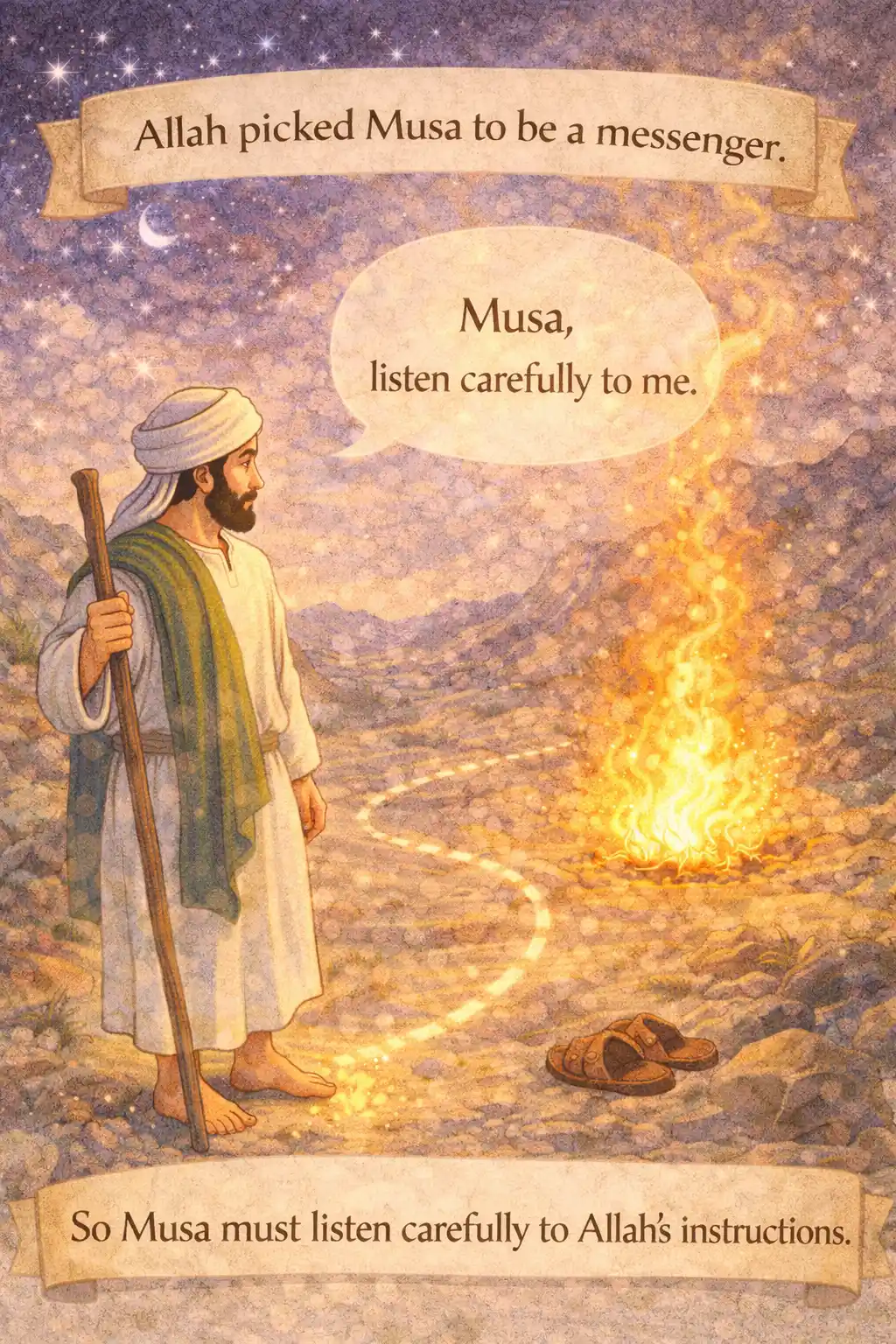
20:14 — I am Allah… worship Me and establish prayer to remember Me.
What is Allah saying?
This is the core message.
Child meaning:
“Only Allah deserves worship. And pray so you stay connected to Allah and remember Him.”
Prayer is like a daily “connection time” with Allah, so your heart doesn’t forget.

20:15 — The Hour is coming… I keep it hidden… so each soul is repaid.
What is Allah saying?
“The Hour” means the Day of Judgment.
Child meaning:
“The Day of Judgment is definitely coming, but Allah did not tell the exact time.
Why? So people stay serious and keep trying to do good.”
- Everyone will be treated fairly.
- Good efforts will be rewarded.
- Bad choices will have consequences.

20:16 — Don’t let someone who doesn’t believe turn you away… or you will perish.
What is Allah saying?
Allah warns Musa not to get distracted by people who reject the truth and just follow their desires.
Child meaning:
“Don’t let a person pull you away from believing in the Judgment Day—especially someone who only follows
what they feel like doing.”
Because if you forget the Judgment Day, you might start living with no fear of consequences, and that can lead you to ruin.

Big simple lesson from verses 1–16
- Qur’an is mercy, not misery.
- Allah owns everything and knows everything—even secrets.
- Worship Allah alone and pray to remember Him.
- Judgment Day is real, so your choices matter.
- Don’t let careless people pull you away from truth.
17. “And what is that in your right hand, O Moses.”
18. He (Moses) said: “This is my staff, I lean upon it, and I shake down leaves with it for my sheep, and I have other uses for it.”
19. He (Allah) said: “Throw it down, O Moses.”
20. So he threw it down, then behold, it was a serpent, moving swiftly.
21. He (Allah) said: “Seize it and have no fear. We shall return it to its former state.”
22. “And draw in your hand to your side, it will come out white without disease, another sign.”
23. “That We may show you of Our greater signs.”
24. “Go to Pharaoh. Indeed, he has transgressed.”
25. He (Moses) said: “My Lord, open up for me my chest.”
26. “And ease for me my task.”
27. “And untie the knot from my tongue.”
28. “That they may understand my speech.”
29. “And appoint for me an assistant from my family.”
30. “Aaron, my brother.”
31. “Increase through him my strength.”
32. “And let him share my task.”
33. “That we may glorify You much.”
34. “And remember You much.”
35. “Indeed, You are ever seeing of us.”
36. He (Allah) said: “Indeed, you have been granted your request, O Moses.”
20:17 — “And what is that in your right hand, O Musa?”
What is Allah saying?
Allah asks Musa a question.
Child meaning:
Allah already knows what it is. But Allah is starting a conversation with Musa and getting his attention, calmly.
It’s like a teacher asking: “What are you holding?”
Not because the teacher doesn’t know—because the teacher is about to teach you something important.

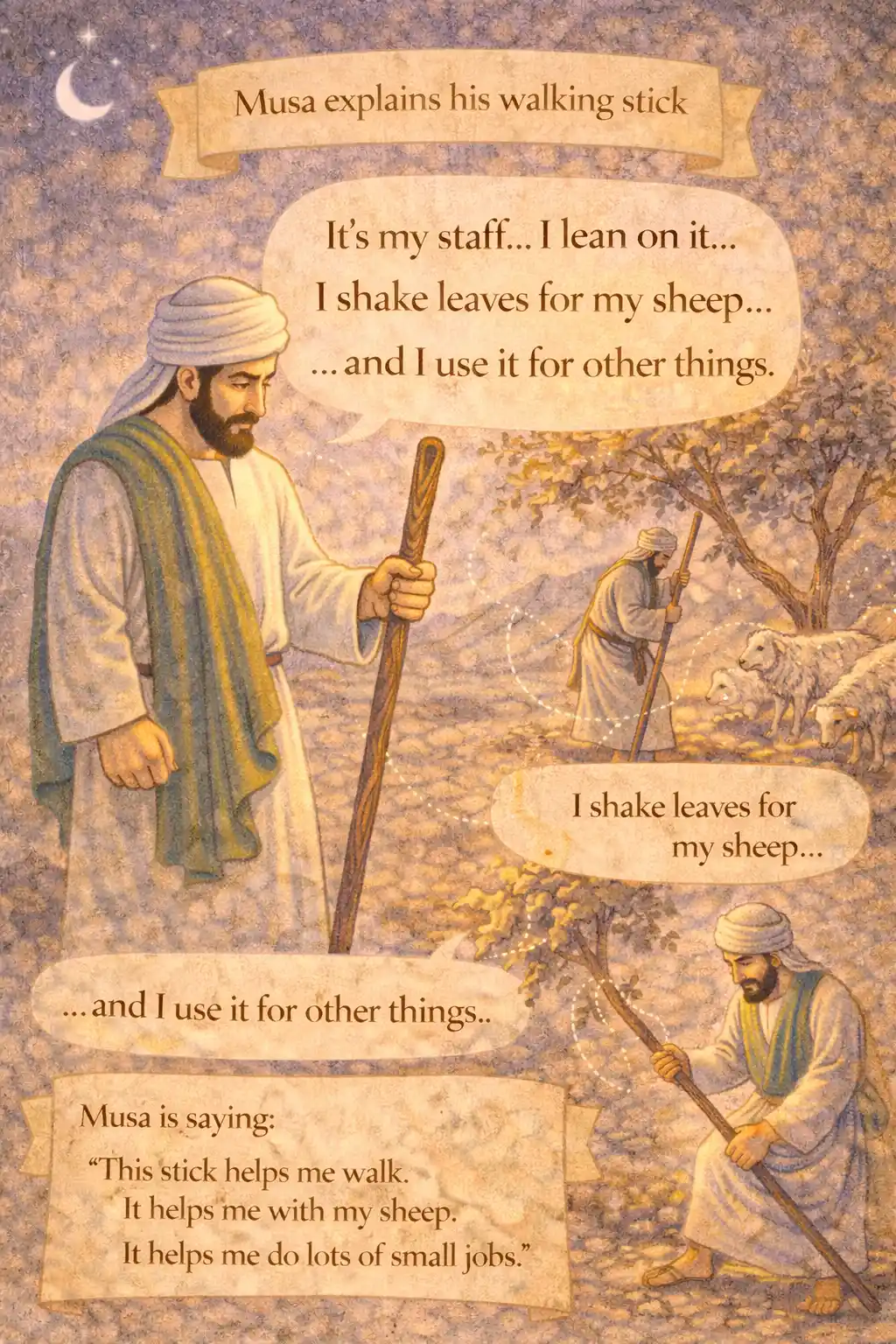
20:18 — Musa says: “It’s my staff… I lean on it… I shake leaves for my sheep… and I have other uses for it.”
What is Allah saying?
Musa explains his walking stick.
Child meaning:
Musa is saying: “This stick helps me walk. It helps me with my sheep. It helps me do lots of small jobs.”
So it’s a normal tool, something ordinary.
20:19–20 — Allah says: “Throw it down.” Musa throws it, and it becomes a fast-moving snake.
What is Allah saying?
This is the first big miracle.
Child meaning:
Allah shows Musa: “I am able to change something ordinary into something amazing.”
Musa’s normal stick suddenly becomes a real snake, moving quickly. This proves to Musa: this is not magic or a trick—this is Allah’s power.

20:21 — Allah says: “Grab it and don’t be afraid. We will return it to how it was.”
What is Allah saying?
Allah teaches Musa courage and trust.
Child meaning:
A snake is scary, so Musa might panic. Allah tells him: “Don’t fear. I am controlling this. Take it.”
Then Allah returns it back into a normal staff. So Musa learns: when Allah commands something, Allah also protects you.

20:22 — “Put your hand to your side; it will come out white, not sick—another sign.”
What is Allah saying?
This is a second miracle.
Child meaning:
Allah gives Musa another proof that this mission is real.
Musa puts his hand near his body (like under his arm), then pulls it out and it looks bright/white—but it’s not illness.
It’s like a shining sign to show people: “This is from Allah.”

20:23 — “So We may show you some of Our greater signs.”
What is Allah saying?
Allah explains why He showed these miracles.
Child meaning:
Allah is preparing Musa. Allah is giving Musa strong evidence and confidence before a hard mission.

20:24 — “Go to Pharaoh. Indeed, he has transgressed.”
What is Allah saying?
Now the mission is given.
Child meaning:
Pharaoh is doing very wrong things—oppressing people, acting like a tyrant, and crossing limits.
Allah tells Musa: “Go to him and deliver the truth.”

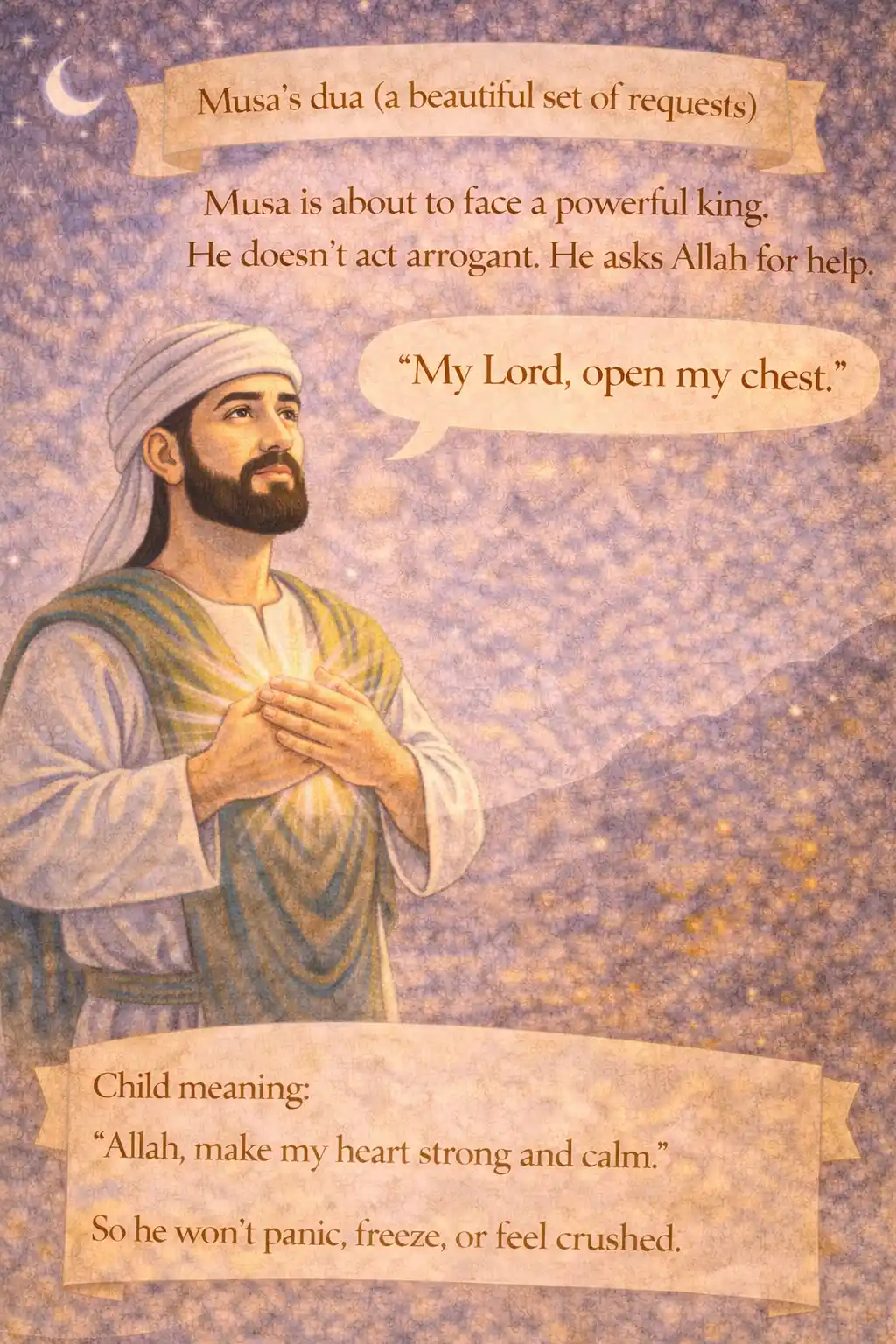
Musa’s dua (a beautiful set of requests) — 20:25–36
Musa is about to face a powerful king. He doesn’t act arrogant. He asks Allah for help.
20:25 — “My Lord, open my chest.”
Child meaning:
“Allah, make my heart strong and calm.” So he won’t panic, freeze, or feel crushed.
20:26 — “And make my task easy.”
Child meaning:
“This job is big. Please help it become manageable.”
20:27–28 — “Untie the knot from my tongue so they understand my speech.”
Child meaning:
“Allah, help me speak clearly.” So people understand the message properly and don’t dismiss him.
20:29–32 — “Give me an assistant from my family—Harun (Aaron), my brother…”
Child meaning:
Musa is asking for teamwork. He wants his brother Harun to help him because:
- It’s easier when you’re not alone.
- Two people can support each other.
- One can speak while the other backs him up.
- They can stay strong together.
20:33–34 — “So we can glorify You a lot and remember You a lot.”
Child meaning:
Musa is saying: “This isn’t about me looking brave or famous. It’s about worshipping You and staying close to You.”
They want to keep Allah in their hearts while doing the mission.
20:35 — “You are always seeing us.”
Child meaning:
“Allah, You see everything we do. You know our effort. You know what happens.”
This gives Musa comfort: Allah is watching and supporting.
20:36 — Allah says: “You have been granted your request, O Musa.”
Child meaning:
Allah is saying: “Yes. I will give you what you asked for.”
So Musa leaves knowing:
- Allah chose him.
- Allah gave him miracles.
- Allah gave him support.
- Allah is with him.


Big simple lessons (for a child)
- Allah can turn ordinary things into miracles.
- When Allah tells you “don’t fear,” He can protect you.
- Big jobs need dua—ask Allah for help.
- Clear speech and teamwork are gifts from Allah.
- The goal is always Allah: remember Him and obey Him.
37. “And indeed, We have done favor upon you another time.”
38. “When We inspired to your mother that which is inspired.”
39. (Saying): “That put him into the chest, then put it into the river, then the river shall cast it onto the bank. There shall take him an enemy to Me and an enemy to him. And I bestowed upon you love from Me, and that you would be brought up under My sight.”
40. “When your sister went and she said: ‘Shall I direct you to someone who will be responsible for him.’ So We restored you to your mother, that she might cool her eyes and she might not grieve. And you did kill a man, then We saved you from great distress, and We tried you with a trial. Then you stayed (some) years among the people of Midian. Then you came (here) as ordained, O Moses.”
41. “And I have chosen you for Myself.”
42. “Go, you and your brother, with My signs, and do not slacken in My remembrance.”
43. “Go both of you to Pharaoh. Indeed, he has transgressed.”
44. “Then speak to him a gentle speech, that perhaps he may take heed or fear (Allah).”
45. They (Moses and Aaron) said: “Our Lord, indeed, we fear that he may commit excesses against us, or that he may transgress all bounds.”
46. He (Allah) said: “Fear not, indeed, I am with you both, I hear and I see.”
47. So go you both to him and say: “Indeed, we are messengers of your Lord, so send with us the Children of Israel, and do not punish them. We have indeed come to you with a sign from your Lord. And peace will be upon him who follows the guidance.”
48. “Indeed, it has been revealed to us that the punishment will be upon him who denies and turns away.”
49. He (Pharaoh) said: “Who then is your Lord, O Moses.”
50. He said: “Our Lord is He who gave to everything its nature, then guided it.”
51. He said: “What then is the state of the generations of old.”
52. He said: “The knowledge thereof is with my Lord in a Record. My Lord does not err, nor does He forget.”
53. “(He it is) who has made for you the earth as a bed (spread out), and made for you in it roadways, and sent down water from the sky.” Then We brought forth through it (many) species of diverse plants.
54. Eat you and pasture your cattle. Surely, there are signs in this for men of understanding.
55. From it (the earth) We created you, and into it We shall return you, and from it We shall bring you out another time.
56. And indeed, We showed him (Pharaoh) Our signs, all of them, but he denied and refused.
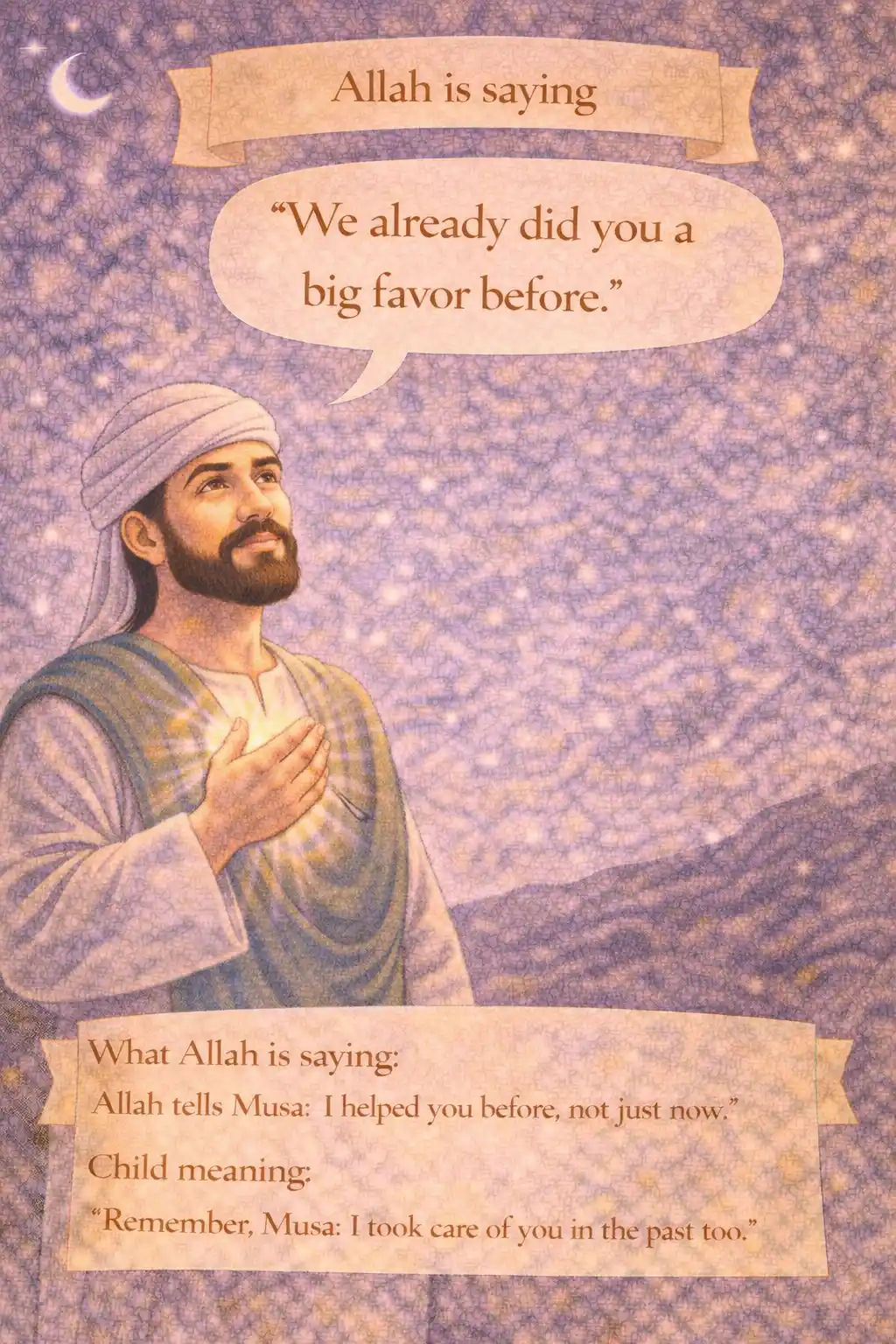
20:37 — “And indeed, We have done favor upon you another time.”
What Allah is saying:
Allah tells Musa: “I helped you before, not just now.”
Child meaning:
“Remember, Musa: I took care of you in the past too.”
20:38–39 — “We inspired your mother… Put him in a chest and put it in the river…”
What happened (story):
- Musa was a baby.
- There was danger around him.
- Allah guided Musa’s mother what to do:
- Put baby Musa in a safe box (like a basket/chest).
- Put it in the river.
- The river would carry it to a place Allah planned.
“An enemy to Me and an enemy to him will pick him up”
That means: Pharaoh (who was an enemy of Allah’s truth) would end up finding Musa.
“I placed love upon you”
Allah made people feel love toward baby Musa so he would be protected, not harmed.
“Raised under My sight”
Meaning: Allah was watching and caring for Musa the whole time.
Child meaning:
“Even when you were a tiny baby and couldn’t protect yourself, Allah protected you and guided everything.”

20:40 — “Your sister followed… We returned you to your mother… We saved you… You lived in Midian… then you came at the right time.”
This verse is like a quick summary of Musa’s life, showing Allah’s help at every stage.
a) “Your sister went…”
Musa’s sister secretly followed the basket to see what would happen.
She spoke wisely and helped arrange a nurse for the baby—so Musa could return to his real mother.
b) “So We returned you to your mother so she wouldn’t be sad.”
Allah reunited baby Musa with his mother.
Child meaning:
Allah calmed the mother’s heart: “Your baby is safe.”
c) “You killed a man… then We saved you from distress.”
Later, Musa accidentally caused a man’s death (in a conflict). Musa became afraid and had to leave.
Allah protected Musa and helped him escape danger.
d) “We tested you with trials.”
Musa went through many hard situations—fear, travel, loneliness, learning, working.
e) “You stayed years in Midian… then you came as ordained.”
Musa lived and worked in Midian for years, then returned at exactly the right time for his mission.
Child meaning:
“Your whole life wasn’t random. Allah was guiding your steps, even during the hard parts.”

20:41 — “And I have chosen you for Myself.”
What Allah is saying:
“I selected you for a special mission.”
Child meaning:
“Allah chose Musa to be a messenger—someone who carries Allah’s message.”

20:42 — “Go, you and your brother, with My signs, and don’t be lazy in remembering Me.”
What Allah is saying:
- Musa and Harun must go together.
- They have miracles/signs from Allah.
- They must keep remembering Allah (stay connected).
Child meaning:
“Go as a team. Take the proofs. And don’t forget Allah while you do the mission.”

20:43 — “Go to Pharaoh. Indeed, he has transgressed.”
What Allah is saying:
Pharaoh crossed all limits—oppression, arrogance, wrongdoing.
Child meaning:
“Go speak to the bully-king who is hurting people.”

20:44 — “Speak to him gently… maybe he will remember or fear Allah.”
Important lesson:
Even though Pharaoh is terrible, Allah tells them to speak calmly and politely at first.
Child meaning:
“Don’t start with shouting. Use gentle words. Sometimes gentle words can wake someone up.”
This does not mean agreeing with Pharaoh—it means delivering truth with good manners.

20:45 — Musa and Harun say: “We’re afraid he will harm us or become even worse.”
Child meaning:
They’re honest: “Allah, Pharaoh is dangerous. We’re scared.”
That’s normal. Even good people can feel fear.

20:46 — Allah says: “Don’t fear. I am with you. I hear and I see.”
Child meaning:
Allah comforts them:
- “I’m with you.”
- “I can hear what he says.”
- “I can see what happens.”
Meaning: Allah is not far away. Allah is aware and in control.
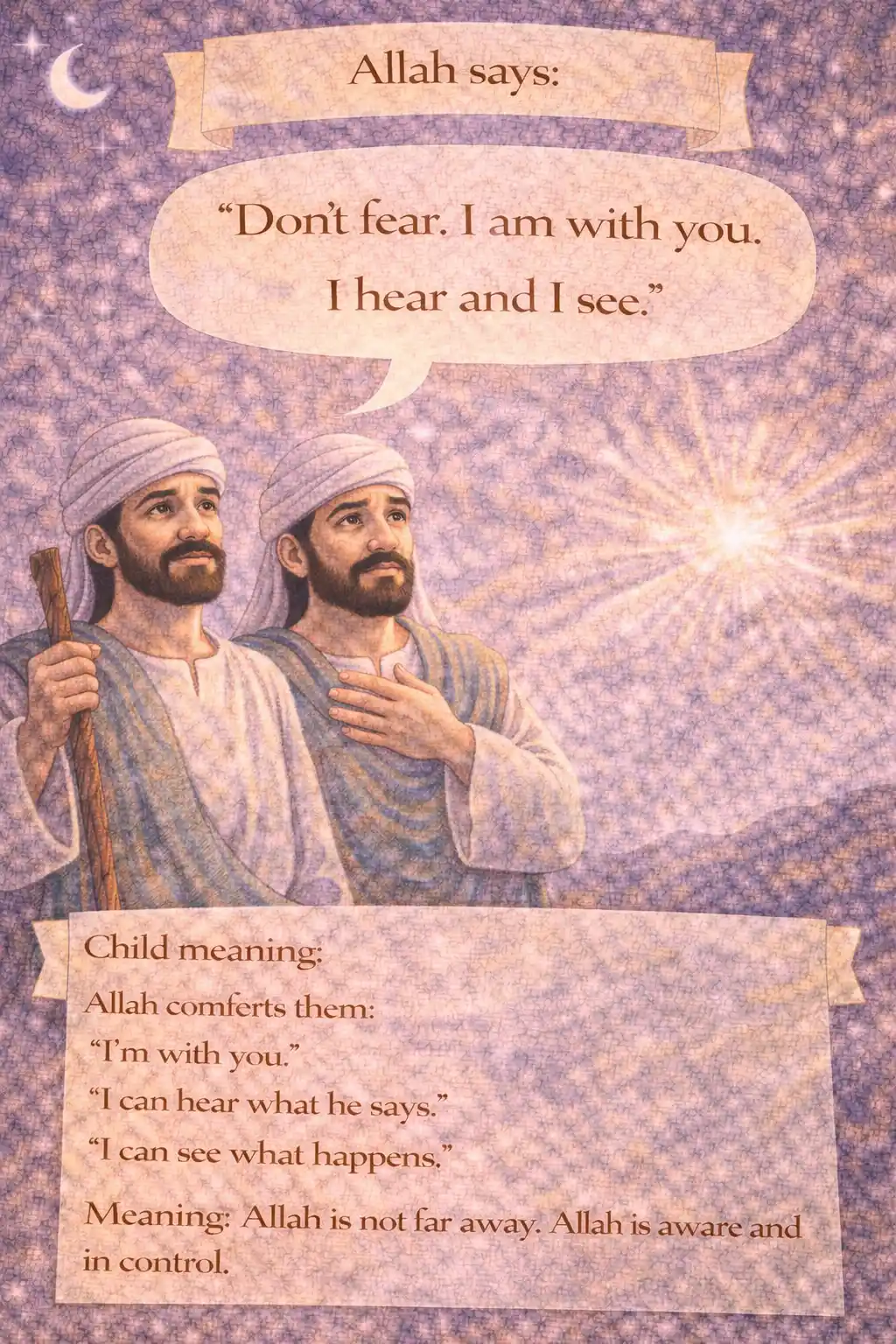
20:47 — “Tell him: We are messengers… let the Children of Israel go… don’t punish them…”
What they must say:
- “We are sent by your Lord.”
- “Release Bani Israel (Children of Israel).”
- “Stop hurting them.”
- “We brought a sign from Allah.”
- “Peace is for the one who follows the guidance.”
Child meaning:
“Stop oppressing these people. Let them be free. If you follow Allah’s guidance, you’ll be safe.”

20:48 — “Punishment is for the one who denies and turns away.”
Child meaning:
“If someone sees the truth clearly and still rejects it stubbornly, that’s very dangerous.”
It’s a warning, not a threat for fun.

20:49–50 — Pharaoh: “Who is your Lord?” Musa: “Our Lord gave everything its nature, then guided it.”
Musa answers with a powerful, simple proof:
What Musa means:
- Allah created everything with a design:
- Eyes for seeing, wings for flying, fins for swimming, instincts and abilities.
- Then Allah guides creation:
- Animals know how to live, plants grow the right way, people are shown right and wrong.
Child meaning:
“Allah is the One who made everything what it is, and taught it how to work.”

20:51–52 — Pharaoh asks about old nations. Musa says: “Allah has that knowledge in a Record. Allah doesn’t forget.”
Child meaning:
Pharaoh tries to distract Musa with side questions.
Musa answers calmly:
- “Allah knows all history.”
- “Allah never makes mistakes.”
- “Allah never forgets anything.”

20:53–54 — “Allah made the earth spread out… made roads… sent rain… brought many kinds of plants…”
Allah points to everyday signs:
- Earth is usable (we can live on it).
- There are paths/roads.
- Rain comes down.
- Plants grow in many types.
Child meaning:
“Look at the world around you. It shows Allah’s care and power.”

20:55 — “From earth We created you, to it you return, and from it We bring you out again.”
This is about life, death, and resurrection.
Child meaning:
- Humans come from materials of the earth.
- When we die, we return to the earth (burial).
- On Judgment Day, Allah will bring people back to life again.

20:56 — “We showed Pharaoh all the signs, but he denied and refused.”
Child meaning:
Pharaoh saw evidence, but he was too proud and stubborn to accept.
So the problem wasn’t “no proof.”
The problem was: refusal.

Big child lesson from 37–56
- Allah protects and plans, even when you can’t see it.
- Hard times can be tests that prepare you.
- Speak truth with gentleness, even to difficult people.
- Allah is with His servants—He hears and sees everything.
- The world (rain, plants, life) is full of signs of the Creator.
- Some people reject truth because of pride, not lack of proof.
57. He said: “Have you come to us that you drive us out of our land with your magic, O Moses.”
58. “Then we will surely bring you magic the like thereof. So make between us and you an appointment, which we shall not fail to keep, (neither) we, nor you, in an open wide place.”
59. He (Moses) said: “Your appointment shall be the day of the festival, and let the people assemble at mid morning.”
60. So Pharaoh withdrew, then he devised his plot, then came.
61. Moses said to them (magicians): “Woe unto you, do not invent a lie against Allah, lest He should destroy you by a punishment. And surely, he will fail who invents a lie.”
62. So they disputed their affair among themselves, and they kept secret the private counsel.
63. They said: “Indeed, these are two magicians who want to drive you out from your land with their magic, and do away with your exemplary traditions.”
64. “So resolve upon your plot, then come in rank. And certainly he will succeed this day who is uppermost.”
65. They said: “O Moses, either that you throw, or that we will be the first who throw.”
66. He said: “Rather, you throw.” Then behold, their ropes and their staffs appeared to him, from their magic, as though they moved (like snakes).
67. So Moses conceived a fear within himself.
68. We said: “Fear not, indeed, it is you who will prevail.”
69. “And throw what is in your right hand, it will swallow up what they have crafted. What they have crafted is only a trick of a magician. And the magician will not succeed wherever he is.”
70. So the magicians fell down in prostration. They said: “We have believed in the Lord of Aaron and Moses.”
71. He (Pharaoh) said: “Believe you in him before that I give permission to you. Indeed, he is your chief who taught you magic. So surely, I shall cut off your hands and your feet on opposite sides, and I shall surely crucify you on the trunks of palm trees, and you shall know for certain which of us is more severe in (giving) punishment and more enduring.”
72. They said: “We shall never prefer you above what has come to us of the clear proofs, and (above) Him who created us. So decree whatever you will decree. You can only decree (regarding) this life of the world.”
73. “Indeed, we have believed in our Lord, that He may forgive us our faults, and that upon which you have compelled us, of the magic. And Allah is better and more enduring.”
74. Indeed, he who comes to his Lord as a criminal, then surely, for him is Hell. He will neither die therein nor live.
75. And he who comes to Him as a believer, who has done righteous deeds, then for such there will be the high ranks (in the Hereafter).
76. Gardens of Eden, beneath which rivers flow, wherein they will abide forever. And that is the reward for those who purify themselves.
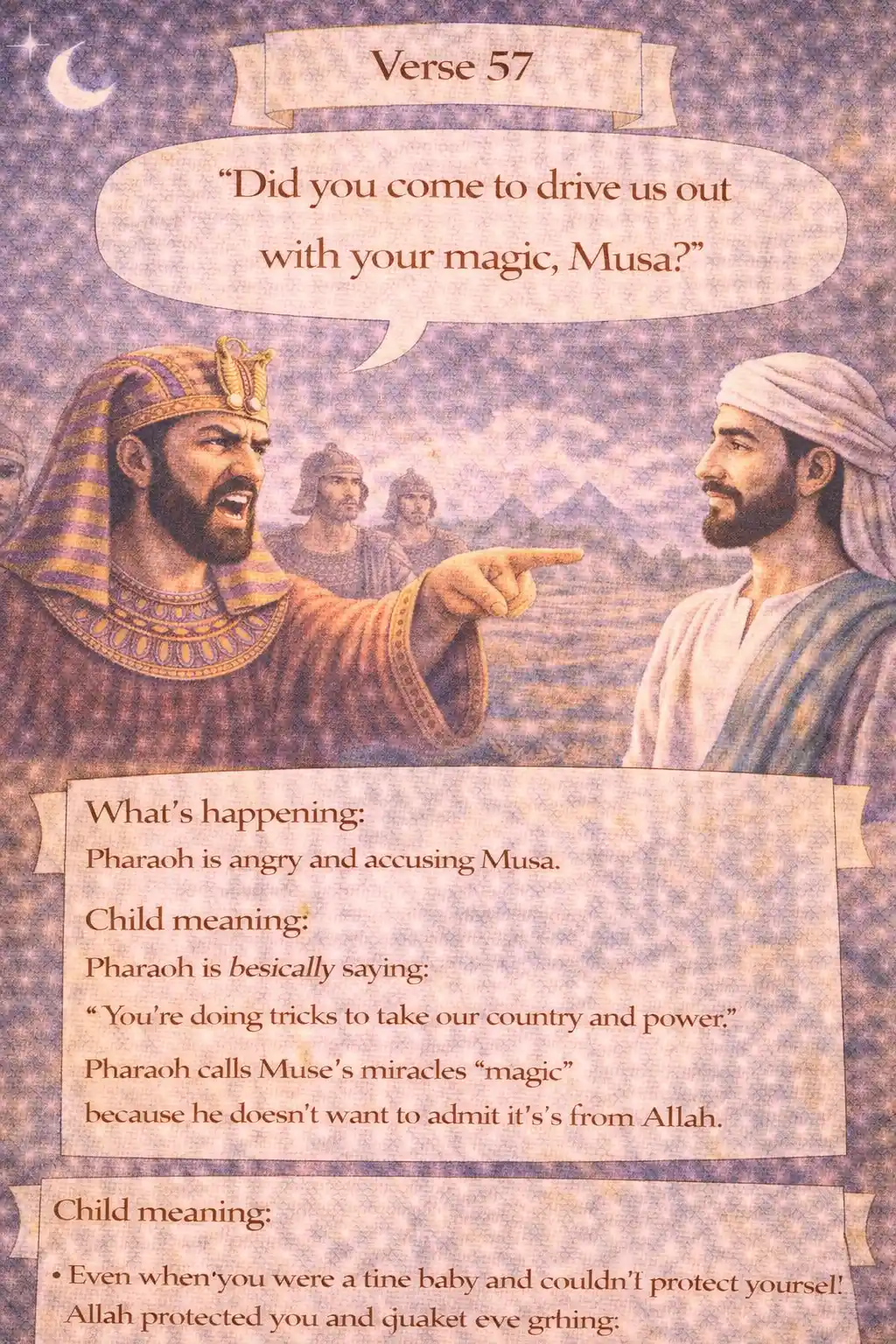
20:57 — Pharaoh says: “Did you come to drive us out with your magic, Musa?”
What’s happening:
Pharaoh is angry and accusing Musa.
Child meaning:
Pharaoh is basically saying:
“You’re doing tricks to take our country and power.”
Pharaoh calls Musa’s miracles “magic” because he doesn’t want to admit it’s from Allah.
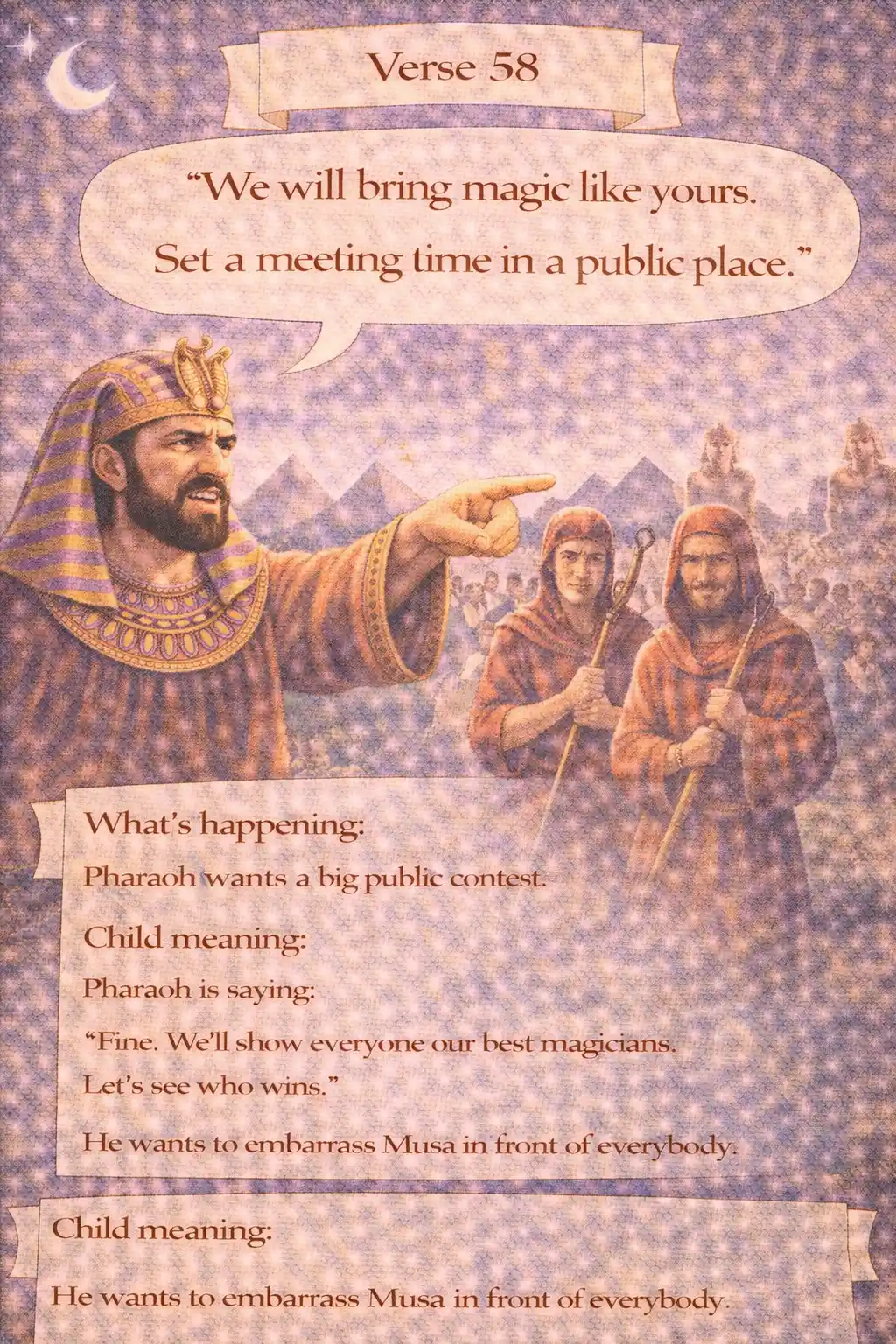
20:58 — “We will bring magic like yours. Set a meeting time in a public place.”
What’s happening:
Pharaoh wants a big public contest.
Child meaning:
Pharaoh is saying:
“Fine. We’ll show everyone our best magicians. Let’s see who wins.”
He wants to embarrass Musa in front of everybody.
20:59 — Musa says: “Let’s do it on festival day, mid-morning, with everyone gathered.”
Why that time matters:
- A festival day means lots of people.
- Mid-morning means clear daylight, no hiding, no tricks.
Child meaning:
Musa wants it to be super public and super clear, so everyone can see the truth.

20:60 — Pharaoh leaves, plans his plot, and returns.
Child meaning:
Pharaoh goes to gather the strongest magicians and plan how to “win” and keep control.

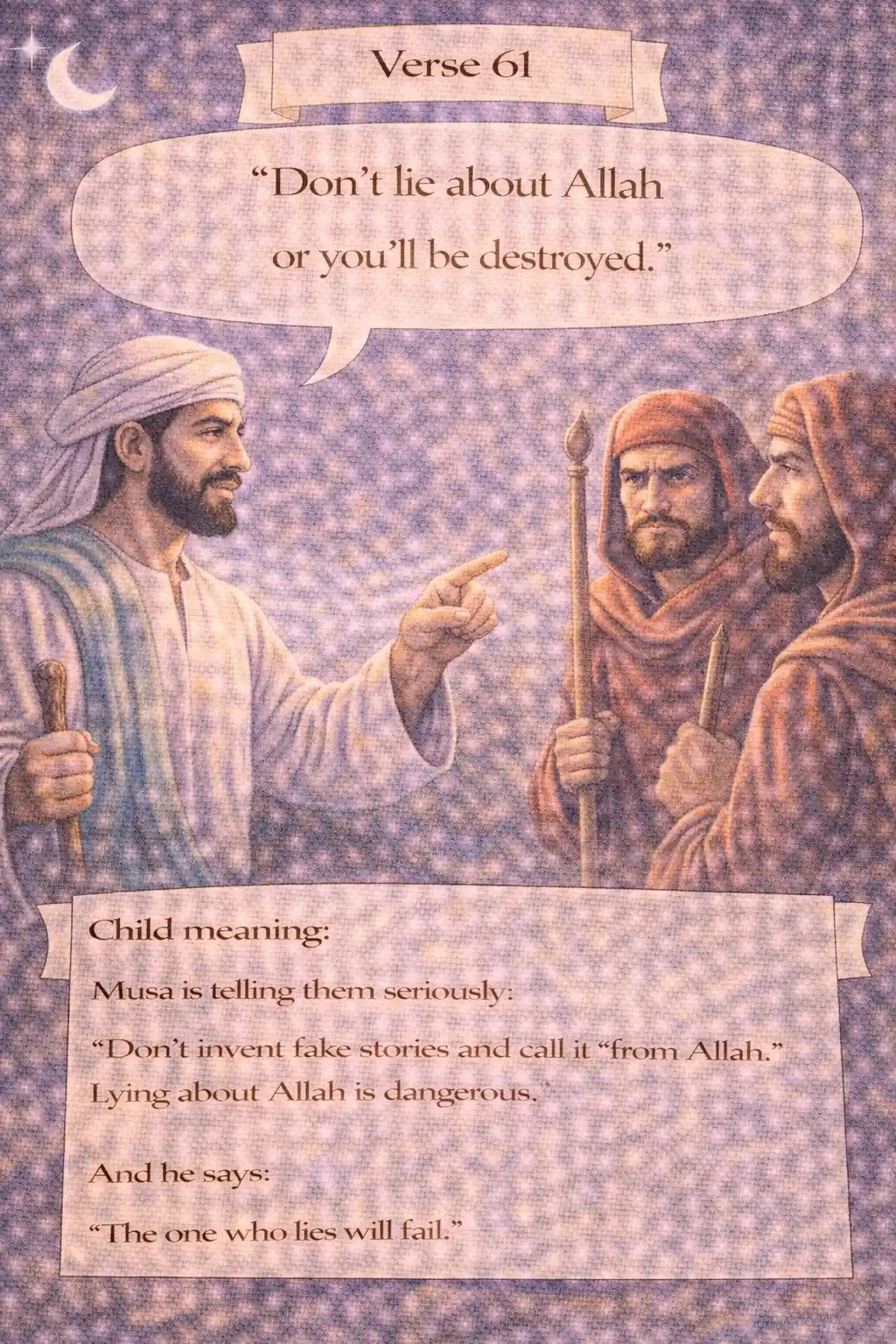
20:61 — Musa warns the magicians: “Don’t lie about Allah or you’ll be destroyed.”
Child meaning:
Musa is telling them seriously:
“Don’t invent fake stories and call it ‘from Allah.’ Lying about Allah is dangerous.”
And he says:
“The one who lies will fail.”
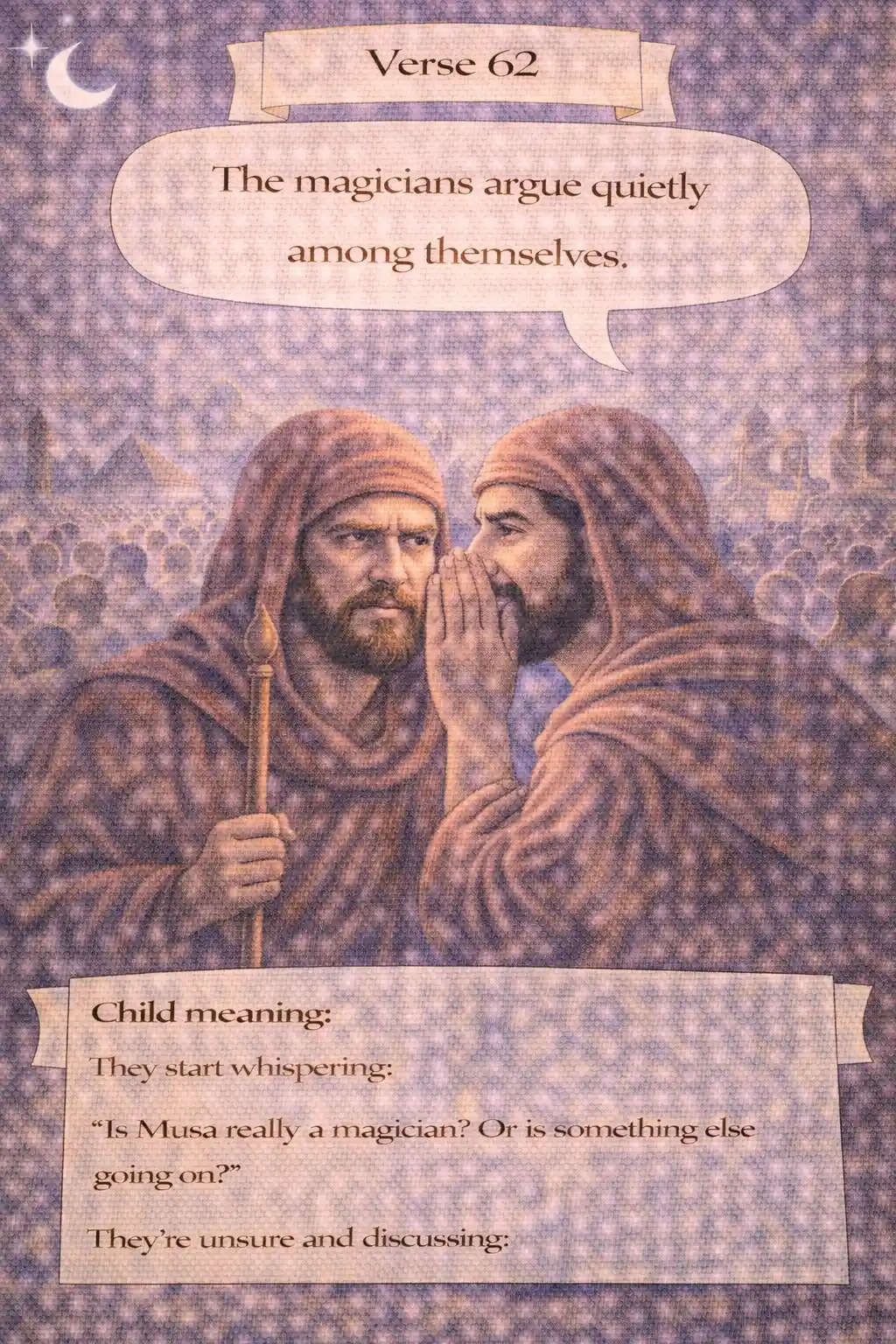
20:62 — The magicians argue quietly among themselves.
Child meaning:
They start whispering:
“Is Musa really a magician? Or is something else going on?”
They’re unsure and discussing.
20:63 — They say: “These two (Musa and Harun) want to kick you out and remove your traditions.”
Child meaning:
They try to scare people:
“If Musa wins, we’ll lose our way of life and our power.”
This is how leaders sometimes control crowds: fear + rumors.

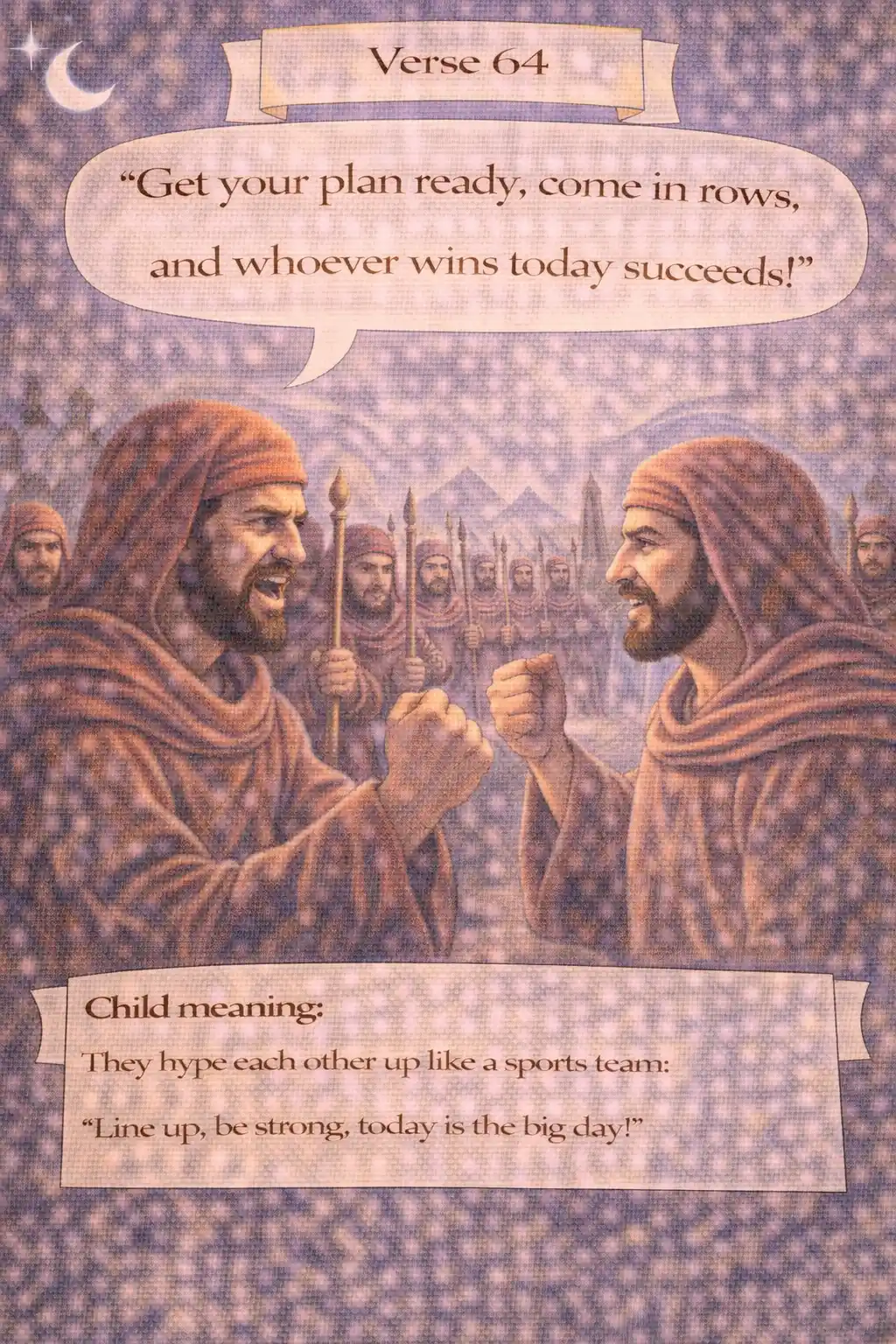
20:64 — They say: “Get your plan ready, come in rows, and whoever wins today succeeds!”
Child meaning:
They hype each other up like a sports team:
“Line up, be strong, today is the big day!”
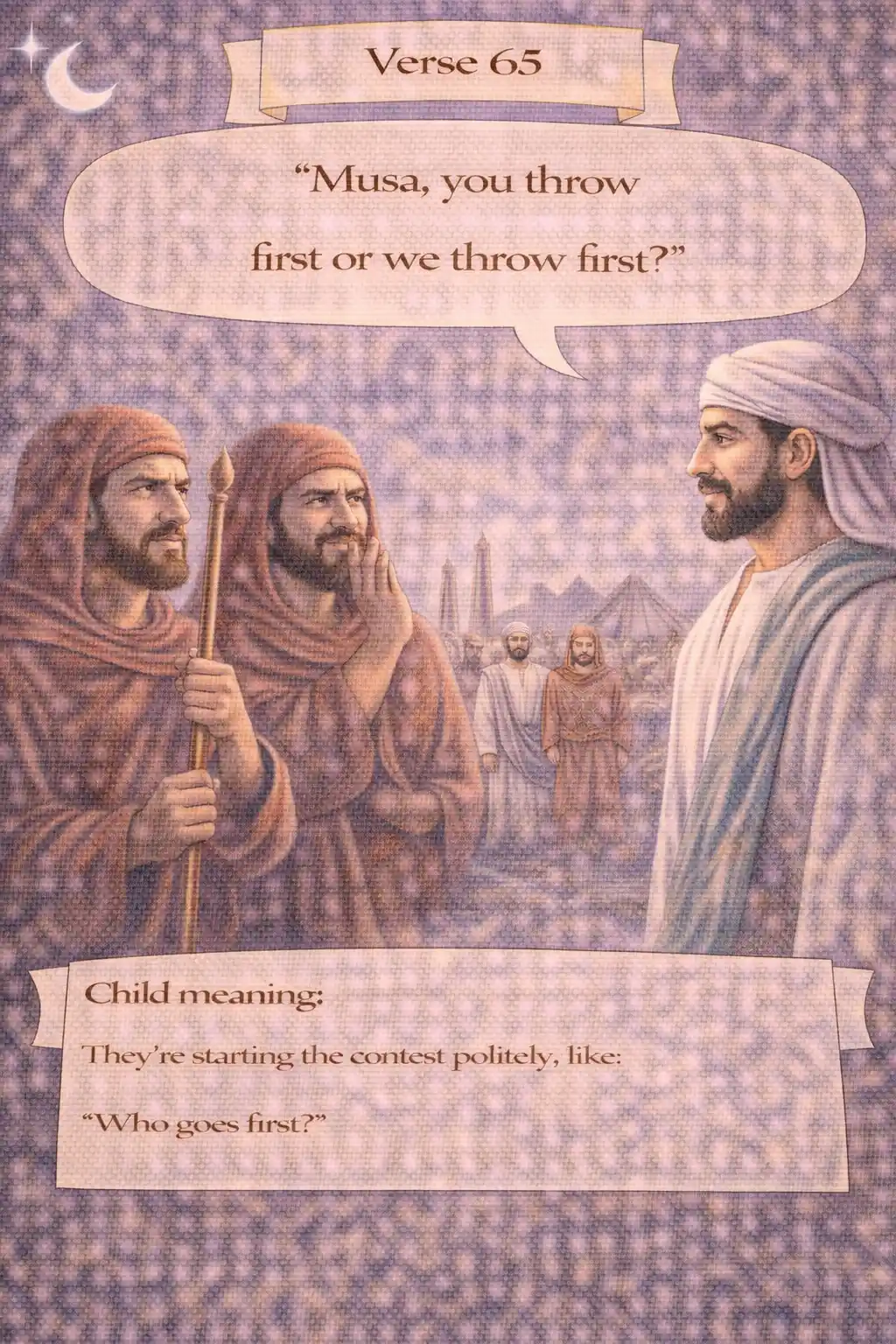
20:65 — They say: “Musa, you throw first or we throw first?”
Child meaning:
They’re starting the contest politely, like:
“Who goes first?”
20:66 — Musa says: “You throw first.” Their ropes and sticks looked like moving snakes.
Important point:
This was magic illusion, not real snakes.
Child meaning:
They used tricks that made Musa’s eyes see movement, like a stage illusion.

20:67 — Musa feels fear inside.
Child meaning:
Even prophets can feel normal human fear for a moment.
Musa sees many “moving” things and feels nervous.

20:68 — Allah says: “Don’t fear. You will win.”
Child meaning:
Allah comforts Musa:
“I am with you. You will not lose.”

20:69 — “Throw what’s in your right hand. It will swallow their trick.”
Child meaning:
Allah tells Musa:
“Throw your staff. Your miracle will destroy their fake tricks.”
Allah also teaches a big lesson:
Magic tricks can fool people, but they can’t beat Allah’s truth.

20:70 — The magicians fall in prostration and say: “We believe in the Lord of Musa and Harun.”
This is huge:
The magicians were experts. They knew the difference between:
- illusion tricks
- a real miracle from Allah
Child meaning:
They realized instantly:
“This is not magic. This is real truth from Allah.”
So they believed right away.

20:71 — Pharaoh gets furious and threatens them.
Pharaoh says:
- “You believed without my permission!”
- “Musa must be your teacher!”
- “I will punish you horribly!”
Child meaning:
Pharaoh is acting like a control freak and a bully:
“If you don’t obey me, I will hurt you.”
He wants fear to stop people from believing.
20:72 — The magicians say: “We will never choose you over clear proof.”
Child meaning:
They’re saying:
“We saw the truth clearly. We cannot pretend now.”
And:
“You only control this world. You can’t control the afterlife.”
This shows real bravery.

20:73 — They say: “We believe so Allah forgives us… and Allah is better and everlasting.”
Child meaning:
They’re saying:
“We want Allah’s forgiveness more than we fear you.”
And:
“Allah’s reward lasts forever. Pharaoh’s power is temporary.”

20:74 — Final lesson: consequences for stubborn denial.
Child meaning (simple, not graphic):
If someone insists on evil and rejects truth, they face serious consequences.
The verse describes it as a terrible place with no comfort.

20:75 — If someone comes as a believer and does good deeds, they get high ranks.
Child meaning:
Believing and doing good leads to great rewards and honor with Allah.

20:76 — Gardens with rivers forever — reward for those who purify themselves.
Child meaning:
Paradise is a beautiful home forever for people who:
- clean their hearts,
- leave evil,
- follow truth,
- try to obey Allah.
“Purify themselves” means they try to become better—inside and outside.

Big child lessons from 57–76
- Some people call truth “magic” because they don’t want to lose power.
- Truth becomes clearer in public and in daylight—no hiding.
- Even a good person can feel fear, but Allah gives strength.
- Experts recognized the miracle and believed immediately.
- Pharaoh used threats, but the believers stayed firm.
- This life is temporary; Allah’s reward is forever.
77. And indeed, We inspired to Moses, (saying): “Travel by night with My slaves, then strike for them a dry path through the sea, fearing neither to be overtaken, nor being afraid (of drowning).”
78. So Pharaoh pursued them with his forces, then covered them of the sea water that which did cover them.
79. And Pharaoh led his people astray, and he did not guide.
80. O Children of Israel, indeed, We delivered you from your enemy, and We made a covenant with you on the right side of the mount, and We sent down to you the manna and the quails.
81. (Saying): “Eat from the good things with which We have provided you, and do not transgress therein, lest My anger should descend upon you. And he upon whom My anger descends has indeed fallen.”
82. “And indeed, I am Most Forgiving towards him who repents and believes and does righteous deeds, and afterwards keeps to the right way.”
83. (It was said): “And what has made you hasten from your people, O Moses.”
84. He said: “They are close upon my footsteps. And I hastened to You, my Lord, that You might be pleased.”
85. He said: “Then indeed, We have tried your people in your absence, and As-Samiri has misled them.”
86. So Moses returned to his people, angry and sad. He said: “O my people, did your Lord not promise you a fair promise. Did then the promise seem too long to you (in fulfillment), or did you desire that wrath from your Lord should descend upon you, so you broke your promise to me.”
87. They said: “We did not break the promise to you by our own will, but we were laden with burdens of ornaments of the people, so we threw them (in the fire), and that was what As-Samiri suggested.”
88. Then he brought out (of the fire) for them, a statue of a calf, which had a lowing (sound). So they said: “This is your god and the god of Moses, but he (Moses) has forgotten.”
89. Did they not see that it could not return to them a word (for answer), and it had no power for them to harm, nor to benefit.
90. And Aaron indeed had said to them before: “O my people, you are only being tried by this. And indeed, your Lord is the Beneficent, so follow me and obey my order.”
91. They said: “We shall never cease to worship it (the calf) until Moses returns to us.”
92. He (Moses) said: “O Aaron, what prevented you when you saw them going astray.”
93. “That you did not follow me. Have you then disobeyed my order.”
94. He (Aaron) said: “O son of my mother, seize (me) not by my beard nor by my head. Indeed, I feared that you would say, you caused division among the Children of Israel, and you have not respected my word.”
95. He (Moses) said: “Then what have you to say, O Samiri.”
96. He said: “I saw that what they did not see. So I took a handful (dust) from the footprint of the messenger, then I threw it in (the fire). And thus did my soul suggest to me.”
97. He (Moses) said: “So go away. Then indeed, for you in this life it is to say, touch me not. And indeed, there is for you a promise which will not be broken. And look at your god to which you have been devoted. We will certainly burn it, then we will scatter its dust over the sea.”
98. Your god is only Allah, Whom, there is no deity except Him. He has encompassed all things in knowledge.
Qur’an-Only Explanation (20:77–98)
- 77 — Allah tells Musa how to escape

Allah guided Musa clearly to travel by night and cross safely.
- Allah inspired Musa—meaning Allah gave him clear guidance and instruction.
- Allah told him: take your people at night (quietly, so Pharaoh doesn’t stop them).
- Allah told him: when you reach the sea, a dry path will be opened through it.
- Allah told him: do not be afraid—not of Pharaoh catching up, and not of drowning.
Allah is like: “Go now. I will protect you. I will make a safe road for you.”
- 78 — Pharaoh chases, and the sea covers him

Pharaoh pursued with his forces, then the sea covered them completely.
- Pharaoh became furious and chased Musa and the believers with soldiers.
- But Allah stopped the ظلم (oppression): the sea covered Pharaoh and his army.
They tried to harm innocent people, but Allah stopped them in the strongest way.
- 79 — Pharaoh misled his people
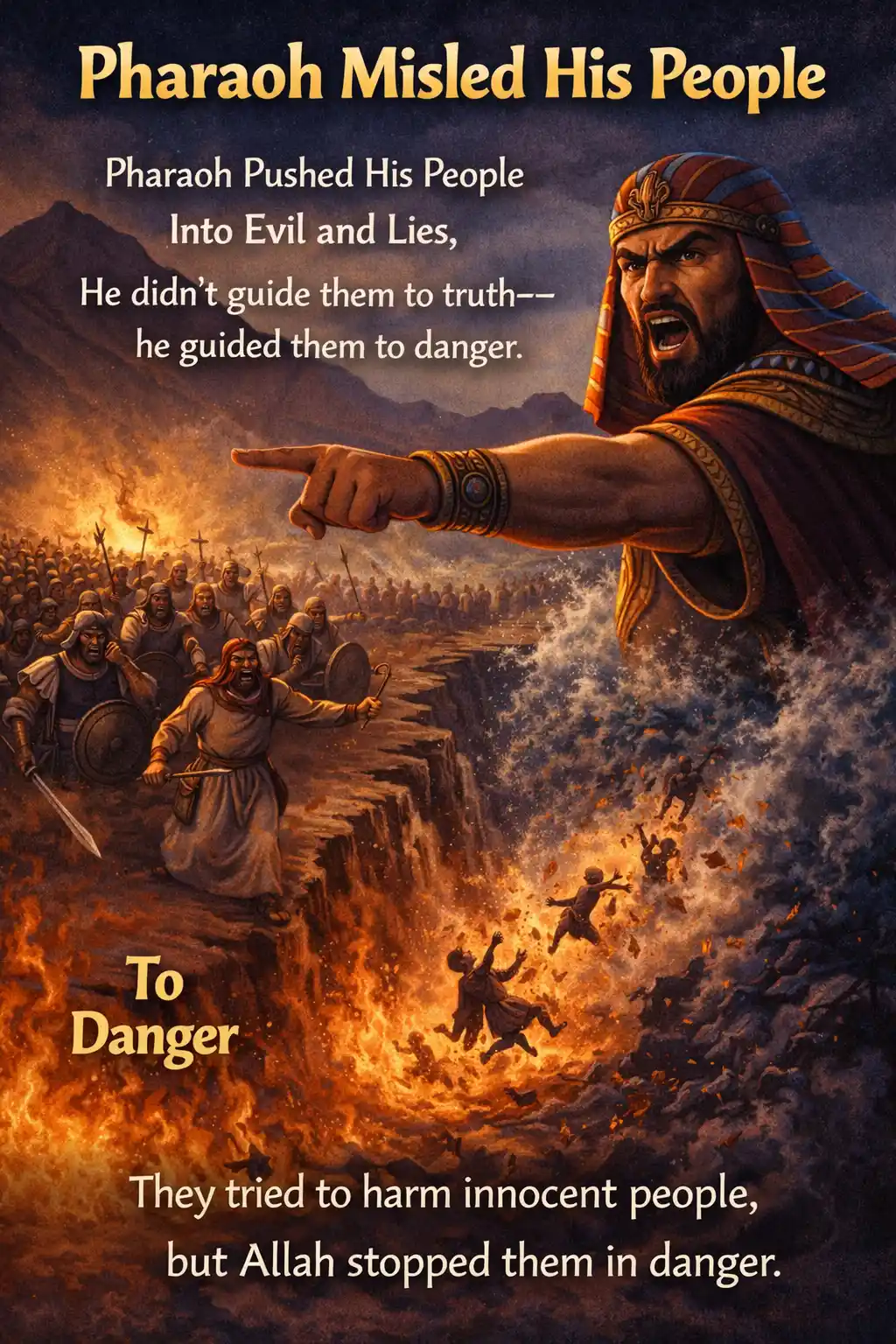
Pharaoh did not guide—he led people into danger.
- Pharaoh was not a truthful leader.
- He pushed his people into lies, arrogance, and ظلم.
- So instead of guiding them to truth, he guided them to destruction.
Pharaoh didn’t guide them to truth—he guided them to danger.
- 80 — Allah saves Bani Israel and gives them food
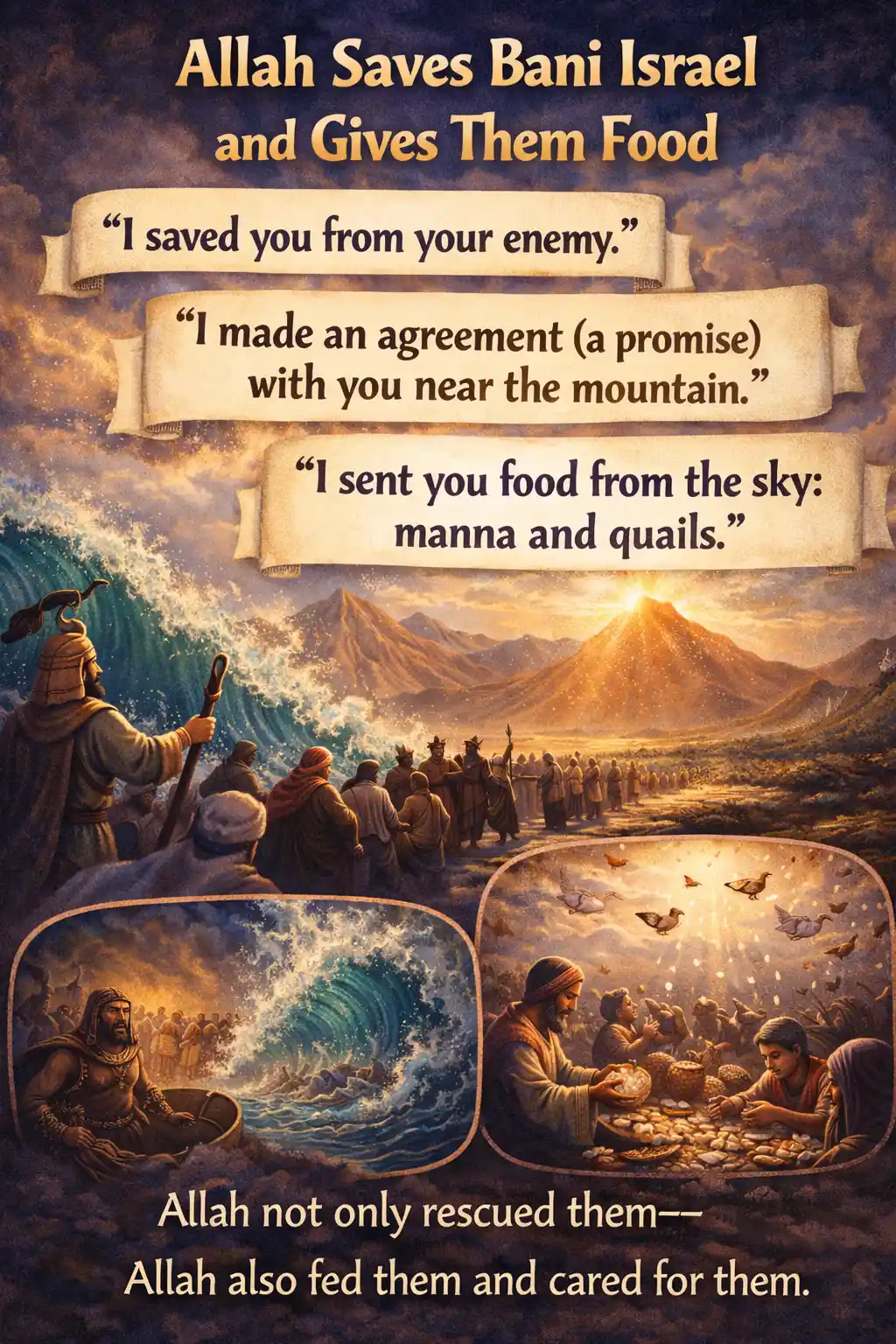
Allah reminds them of rescue, covenant, and provision.
- Allah reminds Bani Israel: “I saved you from your enemy.”
- Allah reminds them: “I made a covenant (promise) with you near the mountain.”
- Allah reminds them: “I sent you food from the sky: manna and quails.”
Allah not only rescued them—Allah also fed them and cared for them.
- 81 — Eat the good food, but don’t become bad
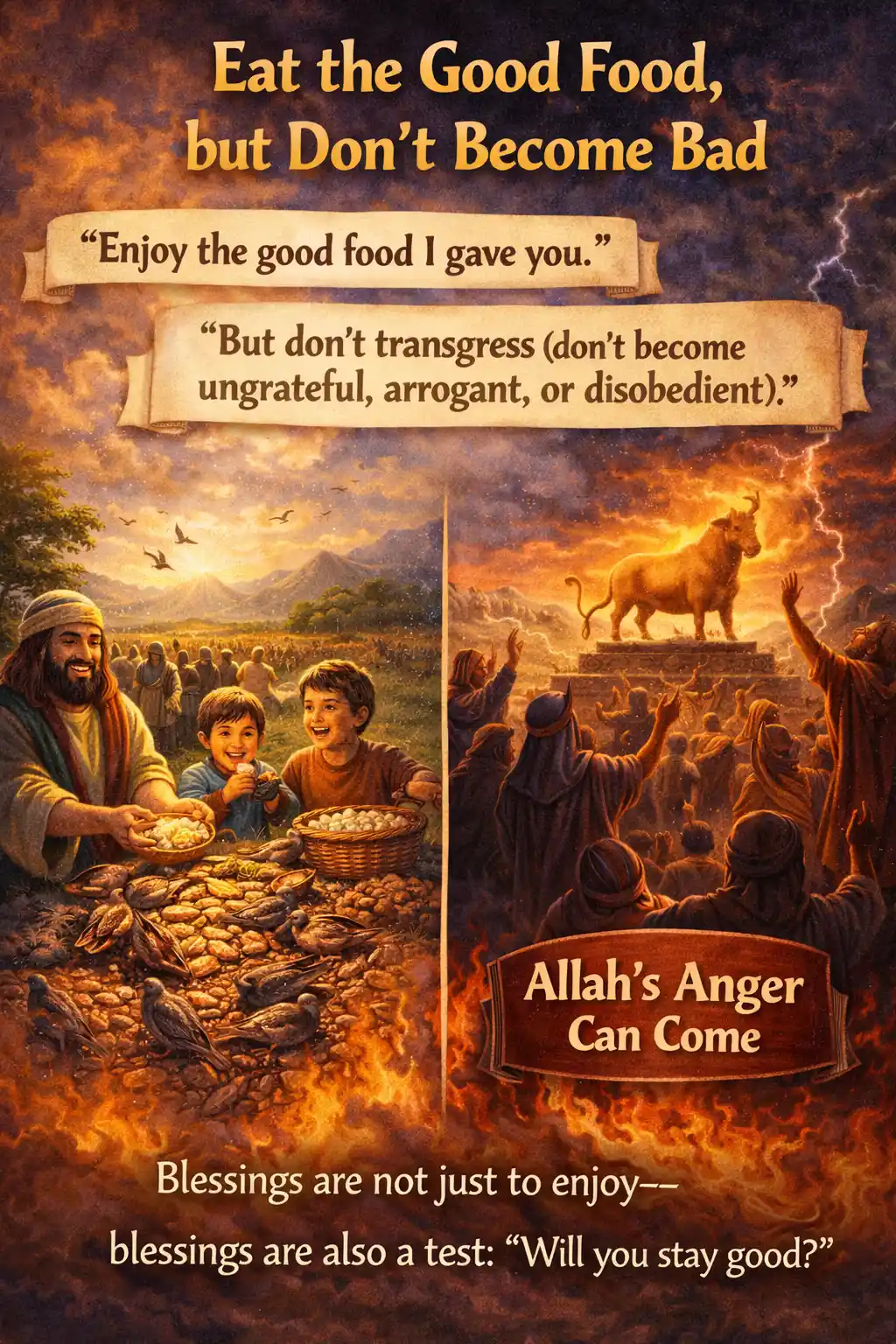
Enjoy the provision, but do not transgress.
- Allah allows them to enjoy good, pure provision.
- But Allah warns: do not transgress—do not become ungrateful, arrogant, or disobedient.
- If they cross the limits, Allah’s anger can descend, and that is serious loss.
Blessings are not just to enjoy—blessings are also a test: “Will you stay good?”
- 82 — Allah forgives those who truly change

Allah is Most Forgiving to the one who returns sincerely and stays upright.
- Allah forgives the one who repents (admits wrong and turns back).
- Then believes.
- Then does righteous deeds.
- Then keeps to the right way after that (not just a moment of regret, but real change).
Allah is not looking for “perfect.” Allah is looking for “honest” and “trying.”
- 83–84 — Allah asks Musa: “Why did you hurry?”

Musa hurried to Allah seeking Allah’s pleasure.
- Allah asks Musa why he came ahead of his people so quickly.
- Musa explains: his people are close behind.
- He says he hurried to Allah so Allah would be pleased with his eagerness to obey.
Musa was eager to obey Allah and do what’s right.
- 85 — A new problem: the people were tested

While Musa was away, the people faced a test, and Samiri misled them.
- Allah tells Musa: your people were tested in your absence.
- And As-Samiri misled them.
When Musa left for a while, someone came and tricked the people.
- 86 — Musa returns angry and sad
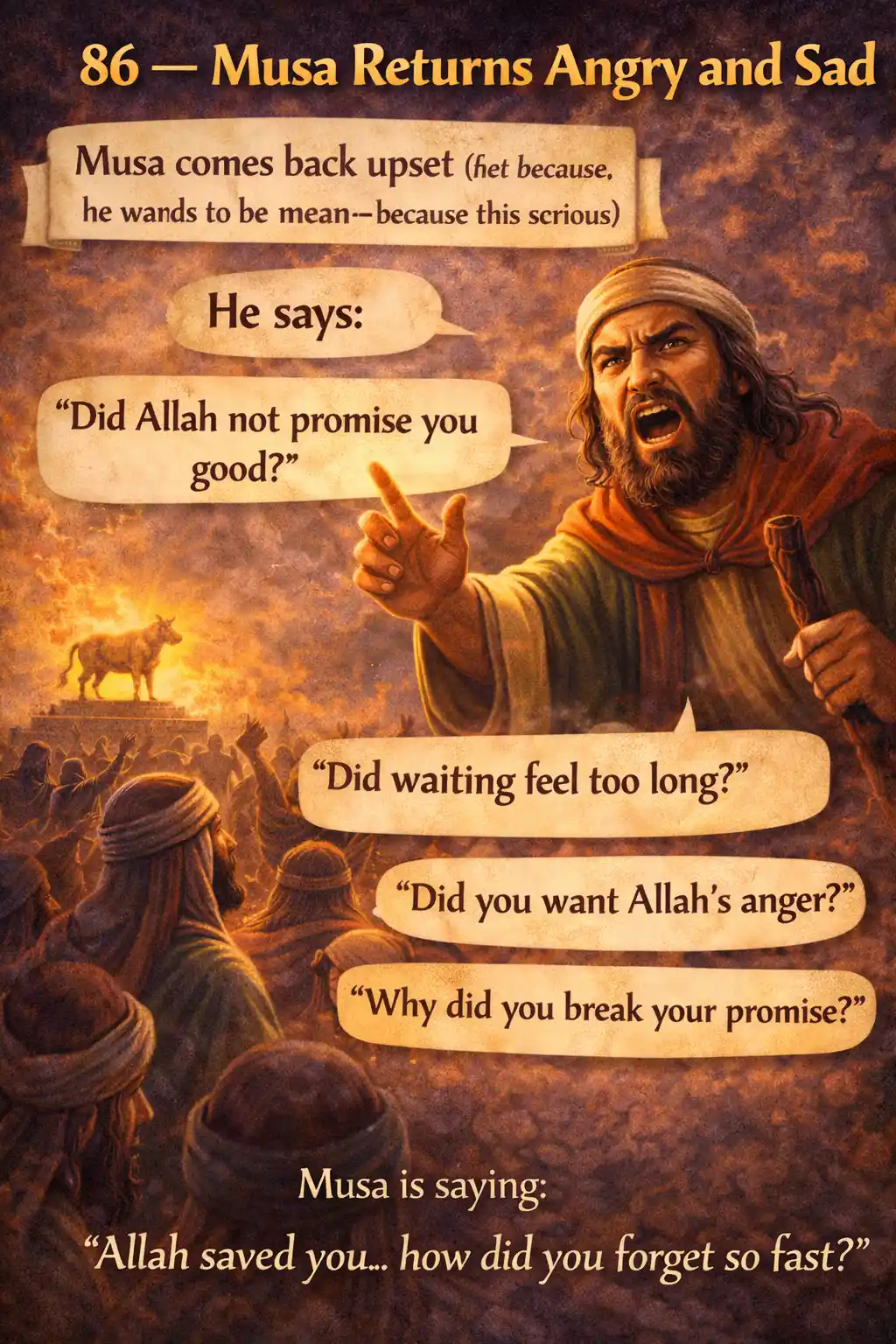
Musa returns upset because the situation is serious.
- Musa is angry and sad—not because he wants to be harsh, but because the people fell into a major wrong.
- He reminds them Allah promised good, and asks why they broke the promise so quickly.
- He challenges them: did waiting feel too long, or did they want Allah’s anger?
Musa is saying: “Allah saved you… how did you forget so fast?”
- 87 — The people explain what happened
They admit they were influenced and followed a bad suggestion.
- They claim they didn’t break the promise “on purpose like that.”
- They mention jewelry/ornaments and say they threw them into the fire.
- They admit: Samiri suggested it—meaning he pushed them into the wrong.
They are basically admitting: “We got pushed into something stupid and wrong.”
- 88 — Samiri makes a calf statue that makes a sound
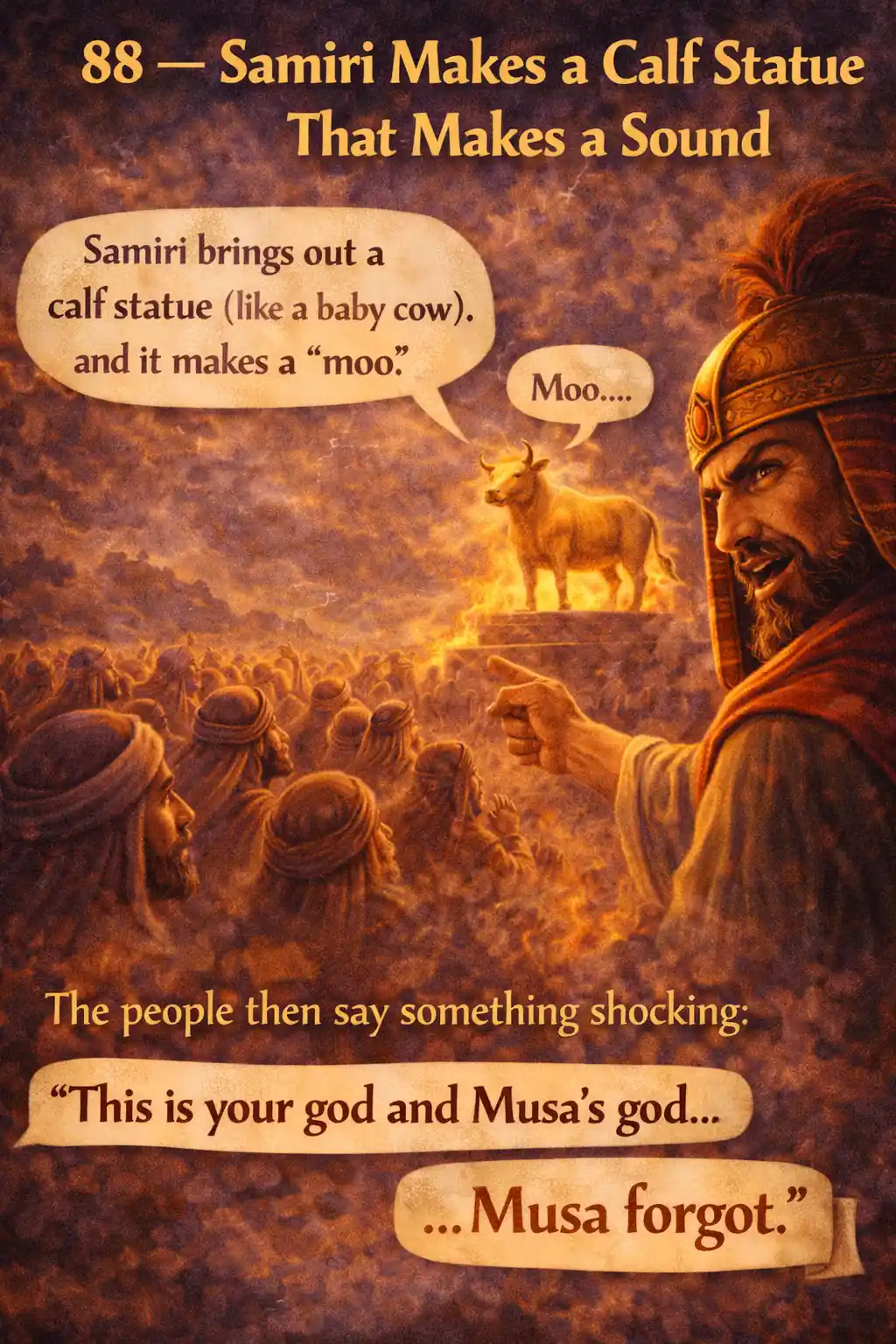
Samiri produces a calf statue, and people commit a huge mistake.
- Samiri brings out a calf statue (like a baby cow) that makes a “moo” sound.
- The people then say something shocking: “This is your god and Musa’s god… Musa forgot.”
- They replaced Allah with a created object and blamed Musa instead of admitting their own failure.
They replaced Allah with a statue. They blamed Musa instead of blaming their own mistake.
- 89 — A simple question: can it even talk or help?

The calf cannot respond or protect—so it cannot be worthy of worship.
- Allah points out the obvious: the statue cannot speak back.
- It cannot help them.
- It cannot harm them either.
- So worshipping it is irrational: it has no power.
If something can’t answer you, can’t protect you, and can’t help you… why worship it?
- 90 — Harun (Aaron) warned them
Aaron tried to stop them and redirect them to Allah.
- Aaron tells them: this is only a test.
- He reminds them: their Lord is the Most Merciful.
- He calls them to obey: “Follow me and obey my order.”
Aaron did the right thing: he warned them clearly.
- 91 — They refuse until Musa returns

They insist on continuing the wrong until Musa comes back.
- They say: “We will keep worshipping it until Musa returns.”
- This shows stubbornness and emotional attachment to the false thing.
They chose feelings and stubbornness over truth.
- 92–93 — Musa questions Aaron

Musa asks why Aaron did not stop the wrong more strongly.
- Musa asks: when you saw them going astray, why didn’t you stop it stronger?
- He asks: why didn’t you follow my instruction?
- He is probing responsibility because the situation became a disaster.
Musa is asking: “Why didn’t you protect the people from this disaster?”
- 94 — Aaron explains why he didn’t use force
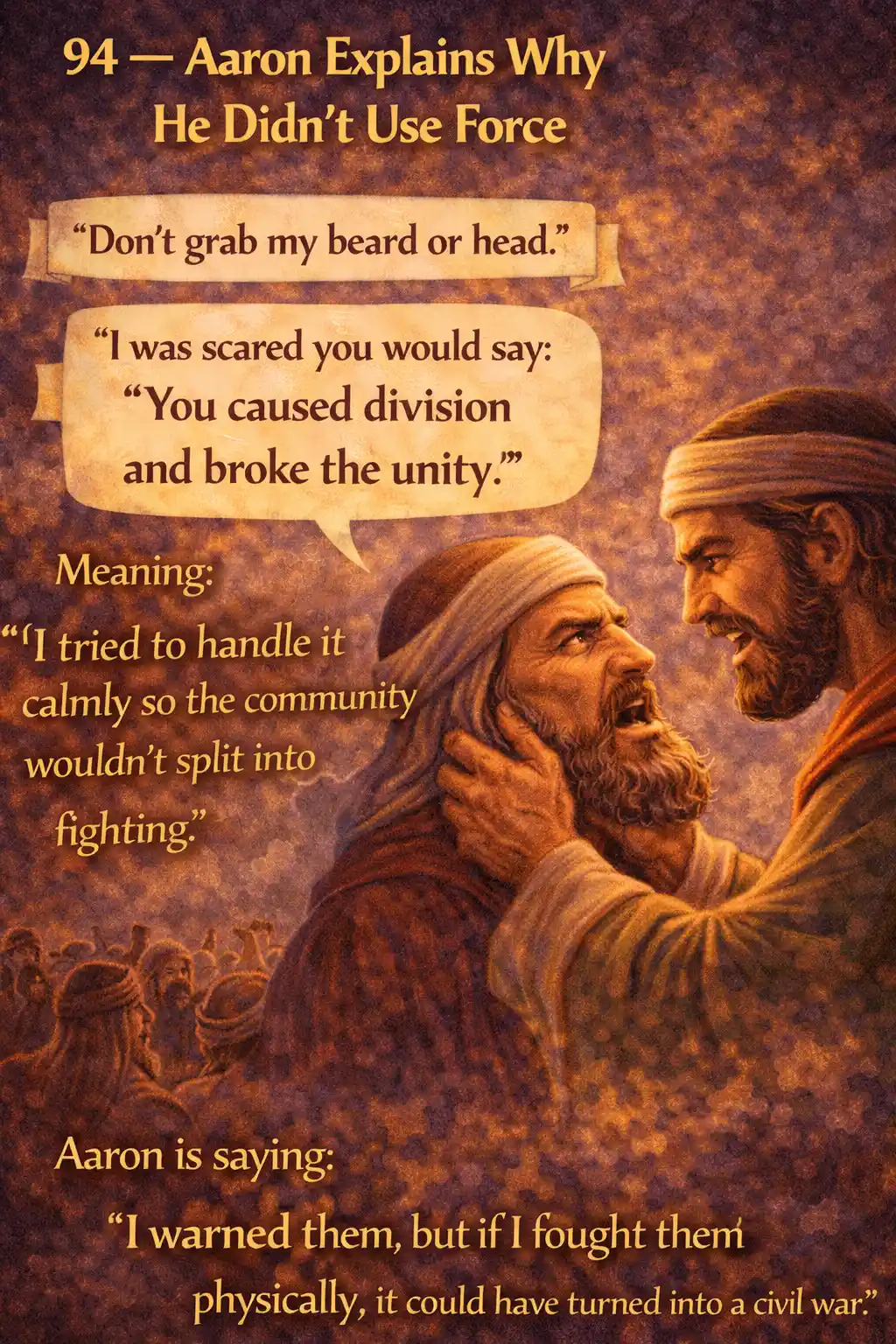
Aaron feared that force would cause a violent split among the people.
- Aaron says: “Don’t grab my beard or head.”
- He explains: he feared Musa would say, “You caused division and broke unity.”
- Meaning: he tried to handle it calmly so the community wouldn’t split into fighting.
Aaron is saying: “I warned them, but if I fought them physically, it could have turned into a civil war.”
- 95 — Musa confronts Samiri

Musa goes directly to the source of corruption.
- Musa asks: “What is your excuse, Samiri?”
- This is accountability: the person who misled others must answer.
Now Musa goes to the real source of the corruption.
- 96 — Samiri gives his strange excuse

He tries to sound special and mysterious, but it’s ego and deception.
- Samiri claims: “I saw what they didn’t see.”
- He claims: “I took a handful of dust from the footprint of the messenger.”
- He claims: “I threw it into the fire.”
- He admits the real driver: “My self told me to do it.”
Samiri is basically saying: “I did something mysterious and followed my ego.”
It’s an excuse that tries to sound special.
- 97 — Musa punishes Samiri and destroys the calf

Samiri is punished, and the false idol is erased completely.
- Musa commands Samiri: “Go away.”
- He is given a social punishment: “Don’t touch me” (isolation and disgrace).
- Musa warns of a final appointment (judgment) he cannot escape.
- Then Musa destroys the calf: it will be burned, and its dust scattered into the sea.
Musa destroys the fake god completely so no one can be fooled again.
- 98 — Final truth: Only Allah is God
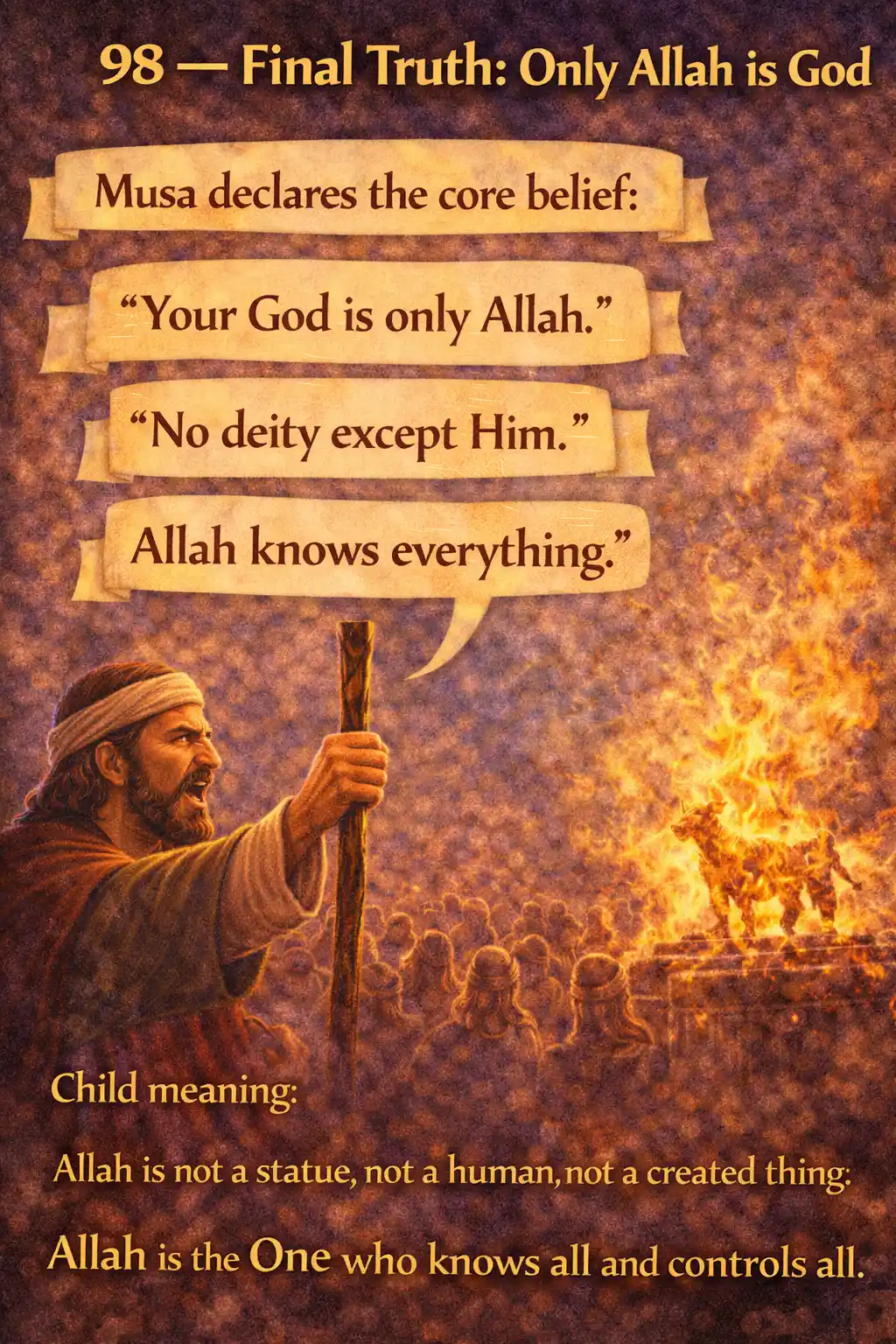
Musa declares the core belief: Allah alone is worthy of worship.
- “Your God is only Allah.”
- “No deity except Him.”
- Allah has encompassed all things in knowledge: Allah knows everything.
Allah is not a statue, not a human, not a created thing.
Allah is the One who knows all and controls all.
Allah saves people who trust Him and obey.
Bad leaders can drag crowds into disaster (like Pharaoh).
Even after miracles, people can still fail a test if they follow peer pressure.
Worship must be based on truth and proof, not hype, emotion, or “cool-looking” things.
Allah forgives when someone truly returns and changes.
99. Thus do We relate to you (Muhammad) from the news of what has preceded of old. And indeed, We have given you from Us a reminder.
100. Whoever turns away from it, then indeed he will bear on the Day of Resurrection a burden.
101. Abiding in it. And evil will be the load for them on the Day of Resurrection.
102. The day when the Trumpet will be blown. And We shall gather criminals that day, their eyes turned blue with terror.
103. They shall whisper among themselves: “You stayed not except ten (days in the world).”
104. We know well what they will say, when the best among them in conduct will say: “You stayed not except a day.”
105. And they ask you about the mountains. Say: “My Lord will blow them away with a blast.”
106. “Then He shall leave them as plains smooth and level.”
107. “Wherein you will see neither curve nor ruggedness.”
108. That Day, they shall follow the summoner, no crookedness (can they show) to him. And the voices shall humble before the Beneficent, so you will hear nothing but a faint murmur.
109. That Day, no intercession shall benefit, except the one for whom the Beneficent has given permission, and whose word is acceptable to Him.
110. He (Allah) knows what is before them and what is behind them, and they cannot encompass it with (their) knowledge.
111. And faces shall be humbled before the Ever-Living, the Eternal. And indeed, he will be a failure who carries (a burden of) wrongdoings.
112. And he who does righteous deeds, and he is a believer then he will have no fear of injustice, nor curtailment (of his reward).
Qur’an-Only Explanation (20:99–112)
- 99 — Allah says: “These stories are real reminders”

Allah tells the Prophet Muhammad that these are true lessons from the past, and the Qur’an is a reminder from Allah.
- Allah says He is sharing news from what came before (real events, real lessons).
- Allah says He has given the Prophet a reminder—meaning the Qur’an, to guide people back to truth.
- This shows the Qur’an is not “just stories”—it is guidance and warning.
Allah is saying: “These stories are not entertainment. They are lessons to wake you up and guide you.”
- 100–101 — If you ignore the reminder, you carry a heavy burden

Whoever turns away from Allah’s reminder will carry a burden on the Day of Resurrection.
- Allah warns: turning away from the reminder is not “neutral”—it has consequences.
- On the Day of Judgment, the person will carry a burden (the weight of their rejection and wrongdoing).
- Allah says it is an evil load—meaning it will be painful and humiliating.
It’s like carrying a heavy backpack full of bad choices—and it hurts you on the final day.
- 102 — The Trumpet is blown, and people are terrified
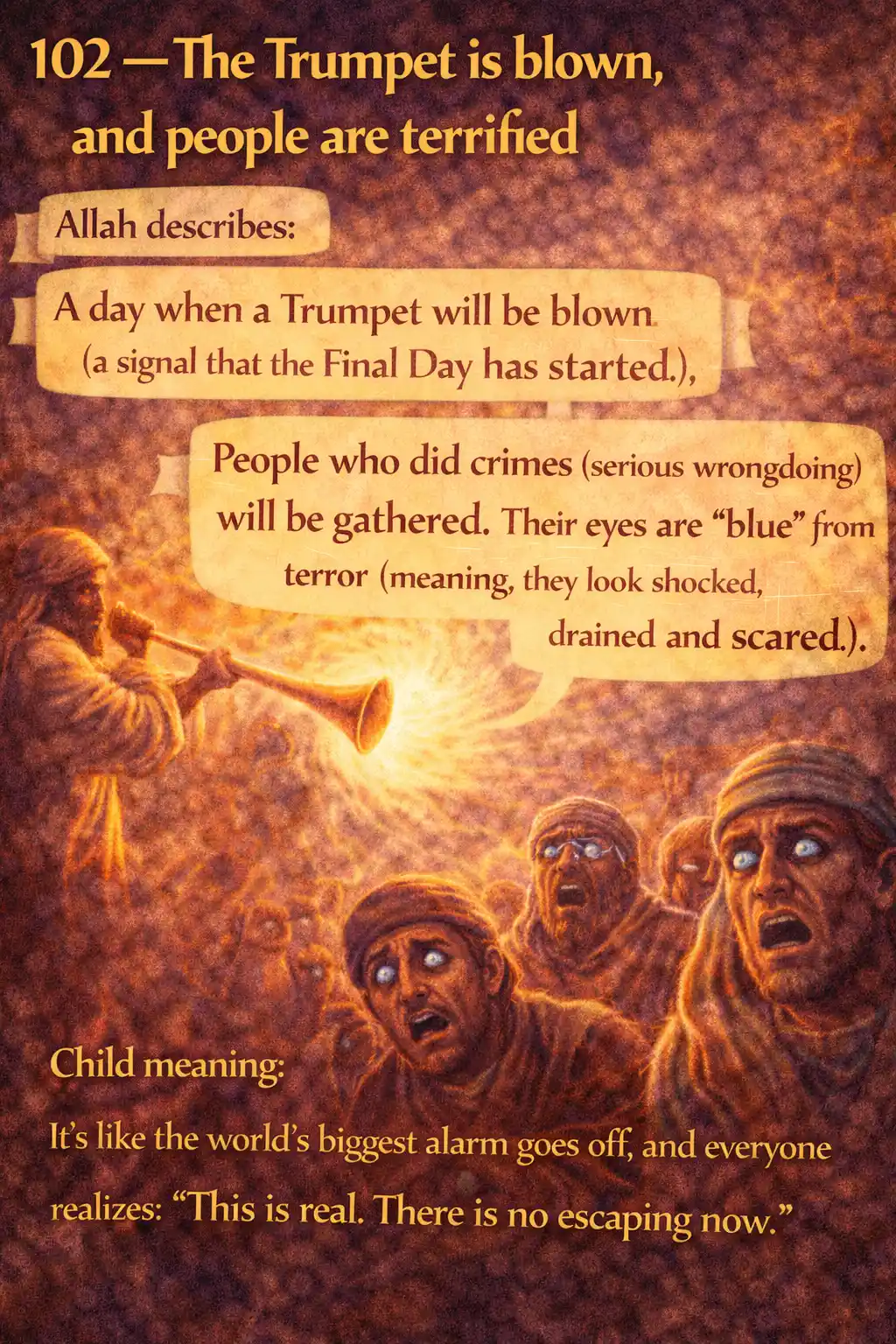
The Trumpet will be blown, and the criminals will be gathered in fear.
- Allah describes the start of the Final Day with the Trumpet being blown.
- Those who lived in major wrongdoing will be gathered together for judgment.
- The verse describes their eyes as “blue” with terror—meaning their faces look shocked, drained, and terrified.
It’s like the world’s biggest alarm goes off, and everyone realizes: “This is real. There is no escaping now.”
- 103–104 — People will feel like life was extremely short

People will whisper that they only stayed a short time in the world.
- People will whisper: “We stayed only ten days.”
- Then the best in judgment among them will say: “No… only one day.”
- This shows how the Hereafter makes the dunya feel tiny and fast—like it passed in a moment.
On Judgment Day, your whole life will feel like a short sleep—because the Hereafter is so real and so huge.
- 105–107 — Mountains will be removed, and the earth will become flat

Allah will remove the mountains and leave the earth smooth and level.
- People ask about the mountains—things that seem the most solid and unmovable.
- Allah answers: He will blow them away (remove them completely).
- Then the earth becomes flat: no hills, no curves, no rough places.
- This shows Allah’s power: what humans think is permanent is easy for Allah to change.
Mountains feel unmovable. Allah is showing: “If I can remove mountains like dust, then nothing is hard for Me.”
- 108 — Everyone will follow the caller, silently

People will follow the summoner, and voices will become quiet before Allah.
- On that Day, people will follow the one calling them forward—no one can refuse.
- No one can dodge, hide, or take another path.
- Voices will be humbled before the Most Merciful: the scene is quiet and heavy.
- You will hear only faint sounds—like whispers or footsteps.
No arguing, no showing off, no loud confidence.
Everyone will be calm, scared, and aware: “I’m standing before Allah.”
- 109 — No one can “save you” unless Allah allows it

No intercession helps unless Allah permits it and accepts it.
- Allah says intercession (someone speaking for you) will not benefit on that Day by itself.
- It only works if Allah gives permission and Allah accepts what is said.
- This removes fake confidence in “connections” and makes the truth clear: Allah is the Judge.
On that Day you can’t rely on “connections.” Only Allah decides what helps, because Allah is the Judge.
- 110 — Allah knows everything; people don’t

Allah knows what is before and behind, and people cannot encompass His knowledge.
- Allah knows everything ahead of people and behind them—past, present, future.
- Allah knows what they did openly and what they tried to hide.
- Humans cannot surround Allah’s knowledge—meaning we are limited, forgetful, and incomplete.
Humans forget things. Humans hide things.
But Allah misses nothing—He knows every secret, every intention, every detail.
- 111 — Faces will be humbled; ظلم makes a person lose

People will be humbled before Allah, and wrongdoing makes a person fail.
- Allah describes faces humbled before the Ever-Living (Allah): no pride remains.
- Whoever carries wrongdoing (ظلم) is described as a failure—because ظلم destroys a person’s outcome.
- ظلم includes: harming others, lying, arrogance, injustice, and giving worship to other than Allah.
Coming with a life full of ظلم is like carrying a bag of poison—it ruins you.
- 112 — Good deeds + belief = no fear of unfairness

Whoever believes and does righteous deeds will not fear injustice or loss of reward.
- Allah joins two things: belief and righteous deeds.
- That person will not fear injustice: Allah will not wrong them.
- They will not fear their reward being reduced: Allah will not “cheat” or erase their good.
- This verse teaches Allah’s perfect fairness in judgment.
Allah is perfectly fair.
If you tried your best, repented, did good, and believed:
• Allah will not cheat you.
• Allah will not forget your good.
• Allah will not reduce your reward.
• The Qur’an is a reminder, not just a book.
• Ignoring truth becomes a heavy burden later.
• Judgment Day will be terrifying for wrongdoers.
• This life will feel very short compared to the next.
• Allah’s power is total: even mountains can vanish.
• No one can help unless Allah allows it.
• Allah is perfectly fair: good will never be lost.
113. And thus have We sent it down as a Qur’an in Arabic, and We have explained in details therein of the warnings, that perhaps they may fear (Allah), or that it may cause them to remember.
114. So exalted be Allah, the Sovereign, the Truth. And hasten not (O Muhammad) with the Qur’an before that its revelation has been completed to you, and say: “My Lord, increase me in knowledge.”
115. And indeed, We made a covenant with Adam before, but he forgot, and We did not find in him determination.
116. And when We said to the angels: “Fall prostrate before Adam.” So they fell prostrate (all) except Iblis. He refused.
117. Then We said: “O Adam, indeed, this is an enemy to you and to your wife. So let him not drive you out from the Paradise, so you may end up in misery.”
118. “Indeed, there is (enough provision) for you, that you will not be hungry therein, nor you will be unclothed.”
119. “And indeed, you will not suffer from thirst therein, nor from the sun's heat.”
120. Then Satan whispered to him, he said: “O Adam, shall I lead you to the tree of eternal life and a kingdom that will never waste away.”
121. Then they both ate of that (tree), so their shameful parts became apparent to them, and they began to cover themselves with the leaves of the Paradise. And Adam disobeyed his Lord, so he went astray.
122. Then his Lord chose him, and turned to him in forgiveness and guided him.
123. He said: “Go down, both of you, from it (Paradise), all together, some of you will be an enemy to others. Then if there comes to you a guidance from Me, then whoever follows My guidance, he will not go astray, nor fall into misery.”
124. And whoever turns away from My remembrance, indeed then for him is a life of hardship, and We shall gather him on the Day of Resurrection blind.
125. He will say: “My Lord, why have you raised me blind, while I had sight.”
126. He (Allah) will say: “Thus did Our revelations come to you, but you did forget them. And thus, this Day you will be forgotten.”
127. And thus do We recompense him who transgresses and does not believe in the signs of his Lord. And the punishment of the Hereafter is far more severe and more enduring.
128. Is it not then a guidance for them (to know) how many of the generations, before them, We have destroyed, in whose dwellings they walk. Surely, in that are indeed signs for those of understanding.
129. And if it was not for a word that went forth before from your Lord, the judgment would have come to pass, and (if not) a term already fixed.
130. So bear patiently (O Muhammad), over what they say, and glorify the praise of your Lord before the rising of the sun and before its setting. And glorify Him some hours of the night and at the two ends of the day, that you may find acceptance.
131. And strain not your eyes towards that by which We have given enjoyment to various groups of them, the splendor of the life of this world, that We may test them thereby. And the provision of your Lord is better and more enduring.
132. And enjoin upon your household prayers, and be steadfast therein. We ask not of you a provision. We provide for you. And the (best) outcome is for righteousness.
133. And they say: “Why does he not bring to us a sign from his Lord.” Has there not come to them the proof of what is in the former scriptures.
134. And if We had destroyed them with a punishment before this, they would assuredly have said: “Our Lord, if only You had sent to us a messenger, we should certainly have followed Your revelations, before that we were humiliated and we were disgraced.”
135. Say: “Each one is waiting, so wait you (too). Then soon you shall know who are the people on the straight path, and those who are guided.”
Qur’an-Only Explanation (20:113–135)
- 113 — The Qur’an is clear guidance
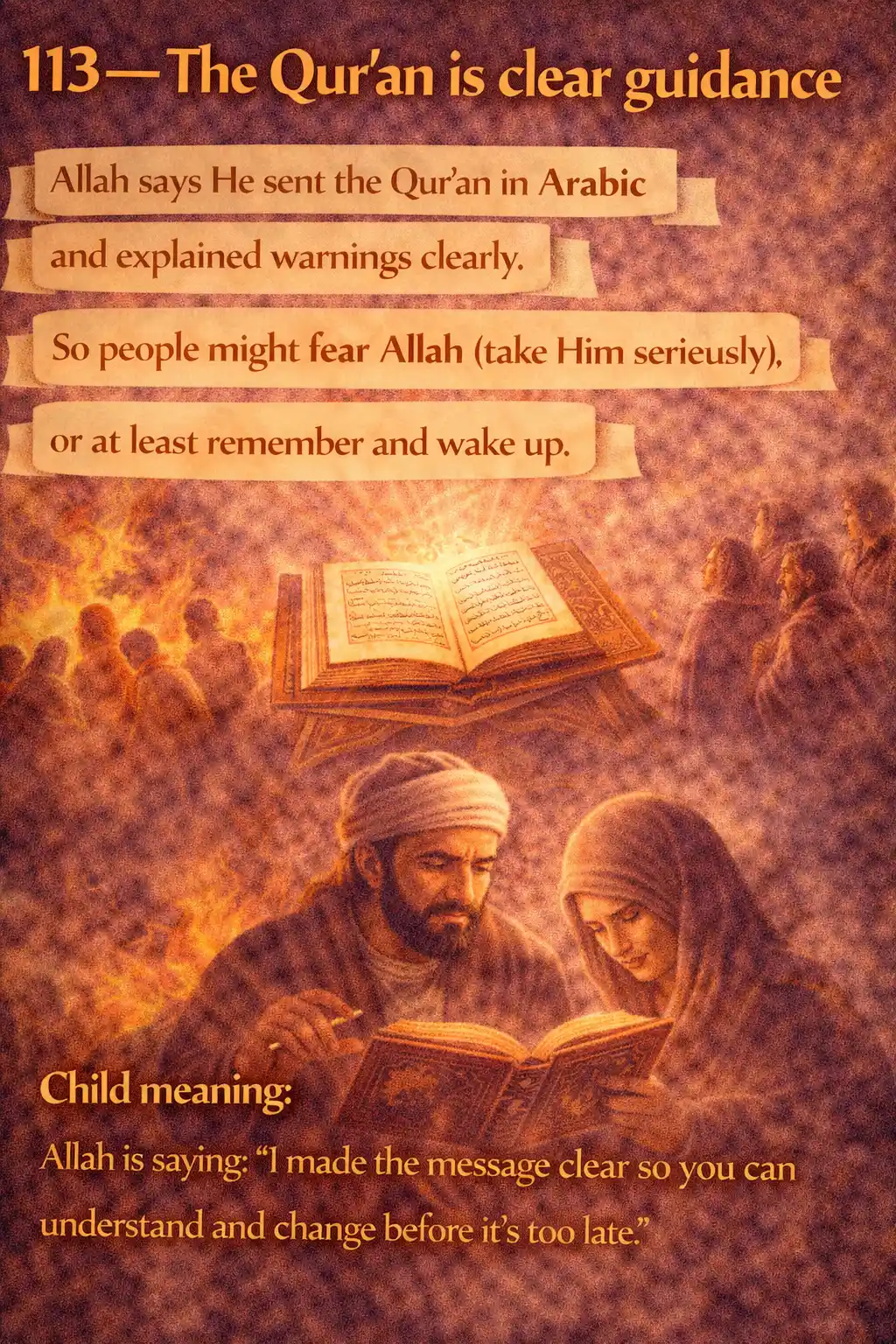
Allah sent the Qur’an in Arabic and explained the warnings clearly so people can wake up and change.
- Allah says the Qur’an was sent down in Arabic so the first audience could understand clearly.
- Allah says He explained warnings in detail—so no one can say: “I didn’t get it.”
- The goal is that people may fear Allah (take Him seriously) or at least remember and return to truth.
Allah is saying: “I made the message clear so you can understand and change before it’s too late.”
- 114 — Don’t rush; ask for more knowledge

Allah is the true King and the Truth. The Prophet is told to be patient with revelation and to ask for knowledge.
- Allah is praised as the Sovereign (the real King) and the Truth.
- Allah tells the Prophet: don’t rush with the Qur’an before it is completed to you.
- Allah teaches a powerful du‘a: “My Lord, increase me in knowledge.”
Be patient, and always ask Allah to teach you more.
- 115 — Adam forgot the covenant

Allah gave Adam an instruction, but Adam forgot and did not stay firm.
- Allah mentions that Adam had a covenant (a command/instruction) before.
- Adam forgot, and Allah says He did not find strong determination in him in that moment.
- This is not to shame Adam—it shows a lesson: humans can slip and need guidance.
Humans can forget and slip, so we must stay careful.
- 116 — Angels prostrated; Iblis refused

Allah commanded the angels to prostrate to Adam. All obeyed except Iblis.
- Allah ordered the angels: “Prostrate before Adam.”
- They obeyed—this shows perfect obedience to Allah.
- Iblis refused, showing arrogance and rebellion.
Pride can make someone disobey Allah, even when the truth is clear.
- 117 — Warning: Satan is your enemy

Allah warns Adam that Satan is an enemy who wants to push him out of Paradise into hardship.
- Allah says clearly: Satan is an enemy to Adam and his wife.
- Allah warns: don’t let him drive you out, or you will fall into misery and hardship.
- This shows Satan’s goal is harm, not “help.”
Allah warned them: “Don’t listen to the enemy.”
- 118–119 — Paradise had no suffering

Allah describes Paradise as a place with no basic pain or struggle.
- No hunger: you are always provided for.
- No nakedness: you are always clothed and protected.
- No thirst: you are always satisfied.
- No harsh heat: no painful sun or suffering.
Paradise was safe, comfortable, and full of care.
- 120 — Satan lies with a tempting promise

Satan whispers to Adam using attractive words: “forever” and “never-ending power.”
- Satan whispers: “Should I show you the tree of eternal life?”
- And: “a kingdom that will never end?”
- This is how deception works: it offers something big, while hiding the danger.
Satan sells lies that sound amazing: “You’ll get everything forever.”
- 121 — They ate; then they felt shame
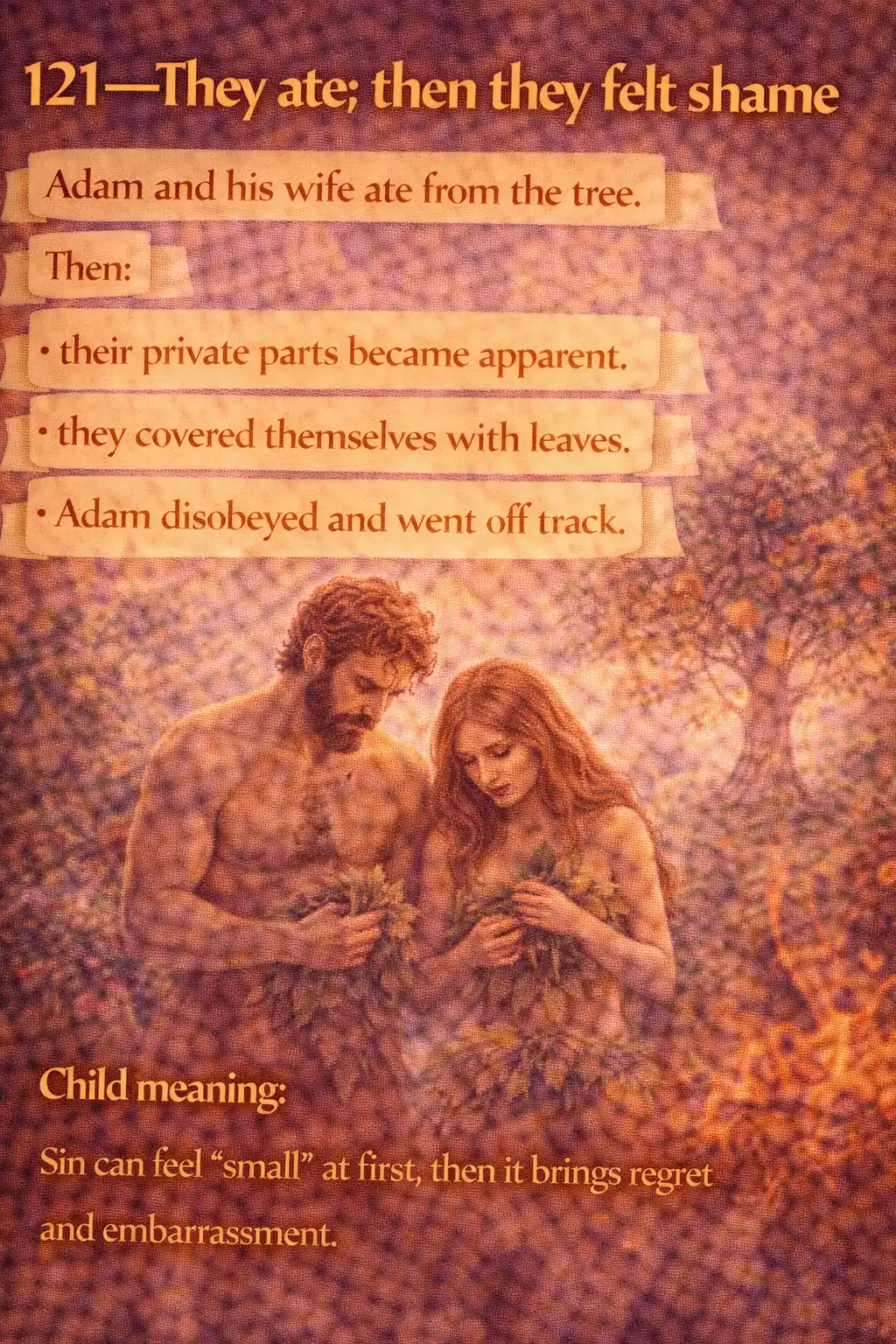
Adam and his wife ate from the tree, and the consequences appeared immediately.
- They ate from the tree (disobedience happened).
- Their private parts became apparent (they felt exposed and ashamed).
- They began covering themselves with leaves—showing regret and embarrassment.
- Allah says Adam disobeyed and went astray in that moment.
Sin can feel “small” at first, then it brings regret and embarrassment.
- 122 — Allah forgave Adam and guided him

Allah did not abandon Adam. Allah chose him, forgave him, and guided him.
- Allah chose Adam again—meaning Adam still has honor and purpose.
- Allah turned to him in forgiveness.
- Allah guided him back to the right way.
If you make a mistake but return to Allah sincerely, Allah can forgive.
- 123 — Guidance comes; follow it and you’ll be safe

Allah sends Adam and his wife down to Earth, where conflict exists—but guidance will protect whoever follows it.
- Allah says: go down from Paradise to Earth together.
- On Earth, some people will be enemies to others—meaning conflict will exist.
- But Allah promises: when guidance comes, whoever follows it:
- will not go astray and will not fall into misery.
Life on Earth is hard, but Allah gives a “map.” Follow it and you’ll be okay.
- 124–126 — Turning away brings hardship and regret

Allah warns that turning away from His remembrance leads to hardship and severe loss in the Hereafter.
- Whoever turns away from Allah’s remembrance will have a life of hardship.
- And Allah will gather them on the Day of Resurrection blind.
- They will ask: “Why am I blind? I used to see.”
- Allah answers: “My revelations came to you, but you forgot/ignored them—so today you are forgotten.”
If you keep closing your heart to truth, you may face darkness later.
- 127 — Punishment is severe for rejection and wrongdoing

Allah describes a rule: transgression plus rejection leads to punishment, and the Hereafter is far more severe.
- Allah recompenses those who transgress (cross limits) and do not believe in His signs.
- The punishment of the Hereafter is more severe and more lasting.
- This is a warning: denial and ظلم are not “free.”
Doing wrong and refusing guidance has serious consequences.
- 128 — Learn from destroyed nations

Allah tells people to learn from the ruins of past generations who were destroyed for wrongdoing.
- Allah reminds: many generations were destroyed before for their wrongdoing.
- People still walk through their lands and see traces of their dwellings.
- These ruins are signs for those who use understanding.
Old ruins are like warning signs: “Don’t repeat their mistakes.”
- 129 — Allah delays judgment for a reason

Allah delays immediate judgment due to a prior decision and a fixed time set by Him.
- Allah says: if not for a prior word/decision from your Lord, judgment would have come already.
- And if not for a fixed term, punishment would have been immediate.
- This shows Allah’s wisdom: delay can be a chance for repentance.
Allah gives time—so people can repent and change.
- 130 — Be patient; worship Allah regularly

Allah tells the Prophet to be patient with insults and to stay firm in worship throughout the day.
- Allah commands patience over what people say.
- Allah commands glorifying Him:
- before sunrise, before sunset, parts of the night, and at the ends of the day.
- This is how a believer stays steady: patience + remembrance + praise.
When people hurt you with words, stay calm and stay close to Allah.
- 131 — Don’t stare at what others have

Allah warns against being dazzled by the temporary luxury of the world.
- Allah says: don’t stretch your eyes toward the fancy life others have.
- That world-enjoyment is a test, not proof of Allah’s love.
- Allah’s provision is better and more lasting than temporary sparkle.
Don’t envy shiny things. Allah’s reward is worth more.
- 132 — Command your family to pray; Allah provides

Allah commands consistent prayer and teaches that Allah is the Provider.
- Allah says: tell your household to pray and be steadfast.
- Allah says: We do not ask you for provision—We provide for you.
- The best outcome is for righteousness: the ending belongs to those who are upright.
Focus on being good and praying—Allah will take care of your needs.
- 133–134 — People demand signs, but signs already came

Some people demand a “new sign,” even though proof has already come, and excuses never end.
- They say: “Why doesn’t he bring us a sign from his Lord?”
- Allah replies: proof has already come—revelation and confirmation from what was before.
- Allah explains their excuse pattern: if punishment came earlier, they would say:
- “Why didn’t You send a messenger first so we could follow before humiliation?”
Some people keep making excuses, even when guidance is right there.
- 135 — Everyone is waiting; truth will become clear
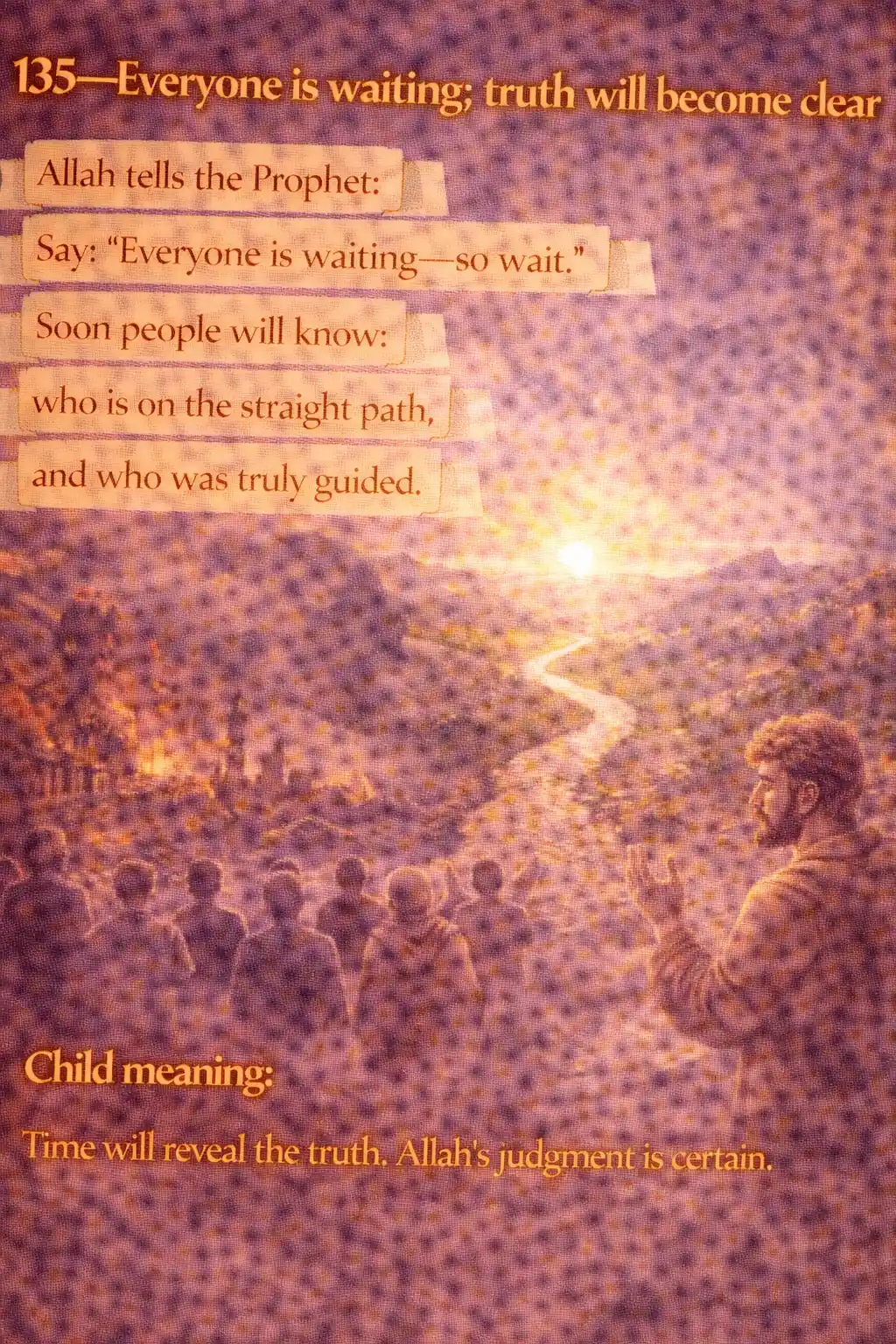
Allah tells the Prophet to wait, because time will reveal who is truly guided.
- Allah says: everyone is waiting—so wait as well.
- Soon people will know who is on the straight path and who was truly guided.
- This is certainty: Allah’s judgment will arrive and clarify everything.
Time will reveal the truth. Allah’s judgment is certain.