- The Qur’an as a straight Book: warning, good tidings, and correction of false claims about Allah.
- The reality that worldly beauty is a temporary test, and that deeds determine rank.
- How Allah supports believers who stand firm under pressure (Companions of the Cave).
- Core principles: tawheed, accountability, patience, humility, and truth over social pressure.
1. All the praises be to Allah, who has sent down upon His slave the Book, and has not placed therein any deviance.
2. (He has made it) straight in order that He may warn (the disbelievers) of a severe punishment from Him, and that He may give good tidings to the believers who do righteous deeds that theirs will be a fair reward.
3. They shall remain therein forever.
4. And He may warn those who say: “Allah has taken a son.”
5. They have no knowledge of it, nor (had) their forefathers. Dreadful is the word that comes out of their mouths. They speak not except a lie.
6. Then perhaps you (Muhammad) would torment yourself to death, following after them, in grief, if they do not believe in this message.
7. Indeed, We have made that which is on the earth an adornment for it, that We may test them, (as to) which of them are best in deeds.
8. And indeed, We shall make that which is upon it (earth) a barren dry soil.
9. Or do you think that the companions of the cave and the inscription were a wonder among Our signs.
10. When the youths retreated to the cave and they said: “Our Lord, bestow on us mercy from Yourself, and facilitate for us from our affair right guidance.”
Surah Al-Kahf (18:1–10) — The Qur’an is a Clear Guide + The Youth in the Cave (Child-Friendly)
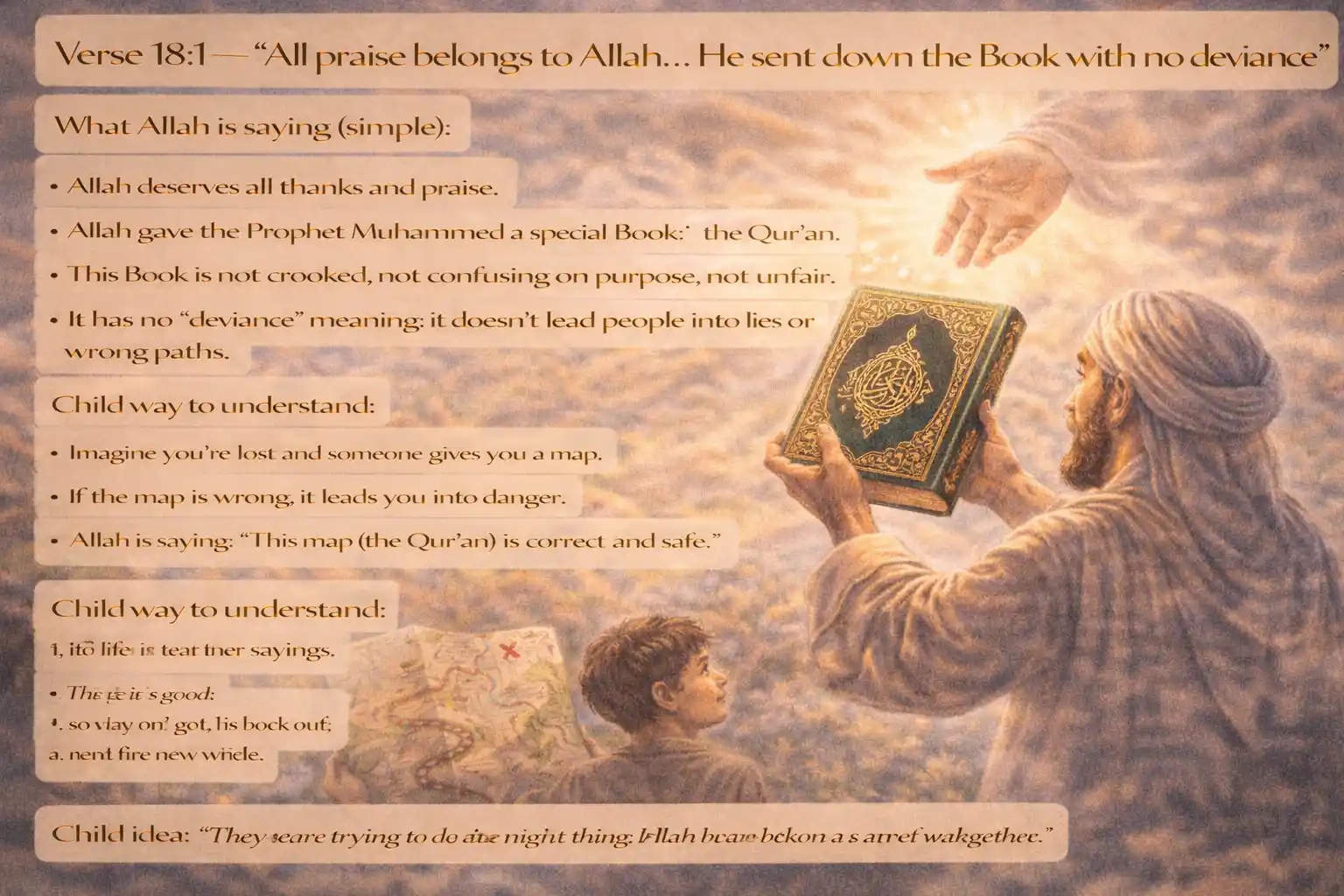
- 18:1 — “All praise belongs to Allah… He sent down the Book with no deviance”
Allah begins by praising Himself and explaining that the Qur’an is a perfect, straight guide.
What Allah is saying (simple)
- Allah deserves all thanks and praise.
- Allah gave the Prophet Muhammad a special Book: the Qur’an.
- This Book is not crooked, not confusing on purpose, and not unfair.
- It has no “deviance” meaning: it does not lead people into lies or wrong paths.
- Imagine you’re lost and someone gives you a map.
- If the map is wrong, it leads you into danger.
- Allah is saying: “This map (the Qur’an) is correct and safe.”
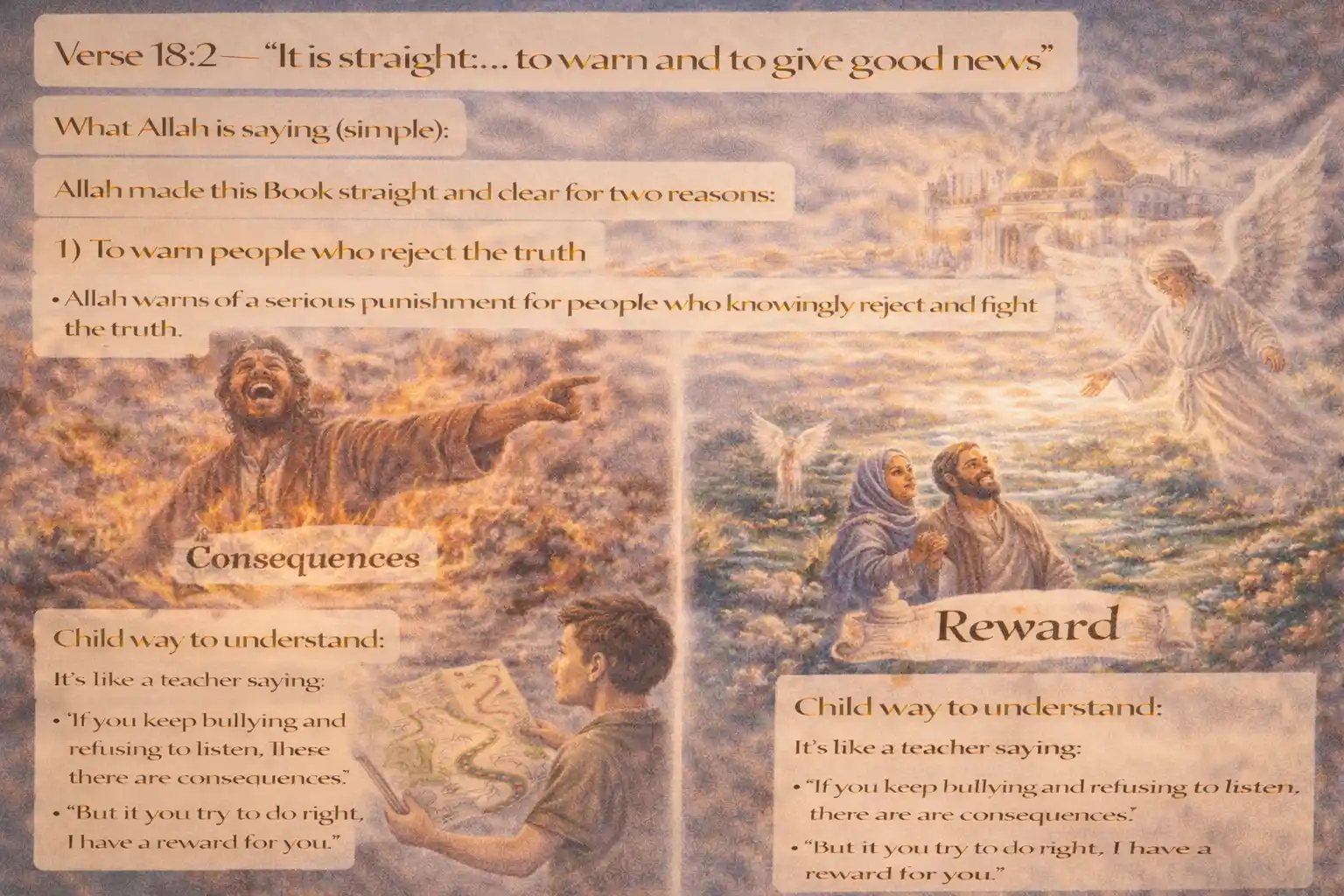
- 18:2 — “It is straight… to warn and to give good news”
Allah explains why the Qur’an was sent: it warns and it gives good news.
What Allah is saying (simple)
- Allah made this Book straight and clear for two reasons:
1) To warn people who reject the truth
- Allah warns of a serious punishment for people who knowingly reject and fight the truth.
2) To give good news to believers who do good deeds
- Allah promises a fair reward for people who:
- believe in Allah,
- and do good actions (righteous deeds).
- It’s like a teacher saying:
- “If you keep bullying and refusing to listen, there are consequences.”
- “But if you try to do right, I have a reward for you.”
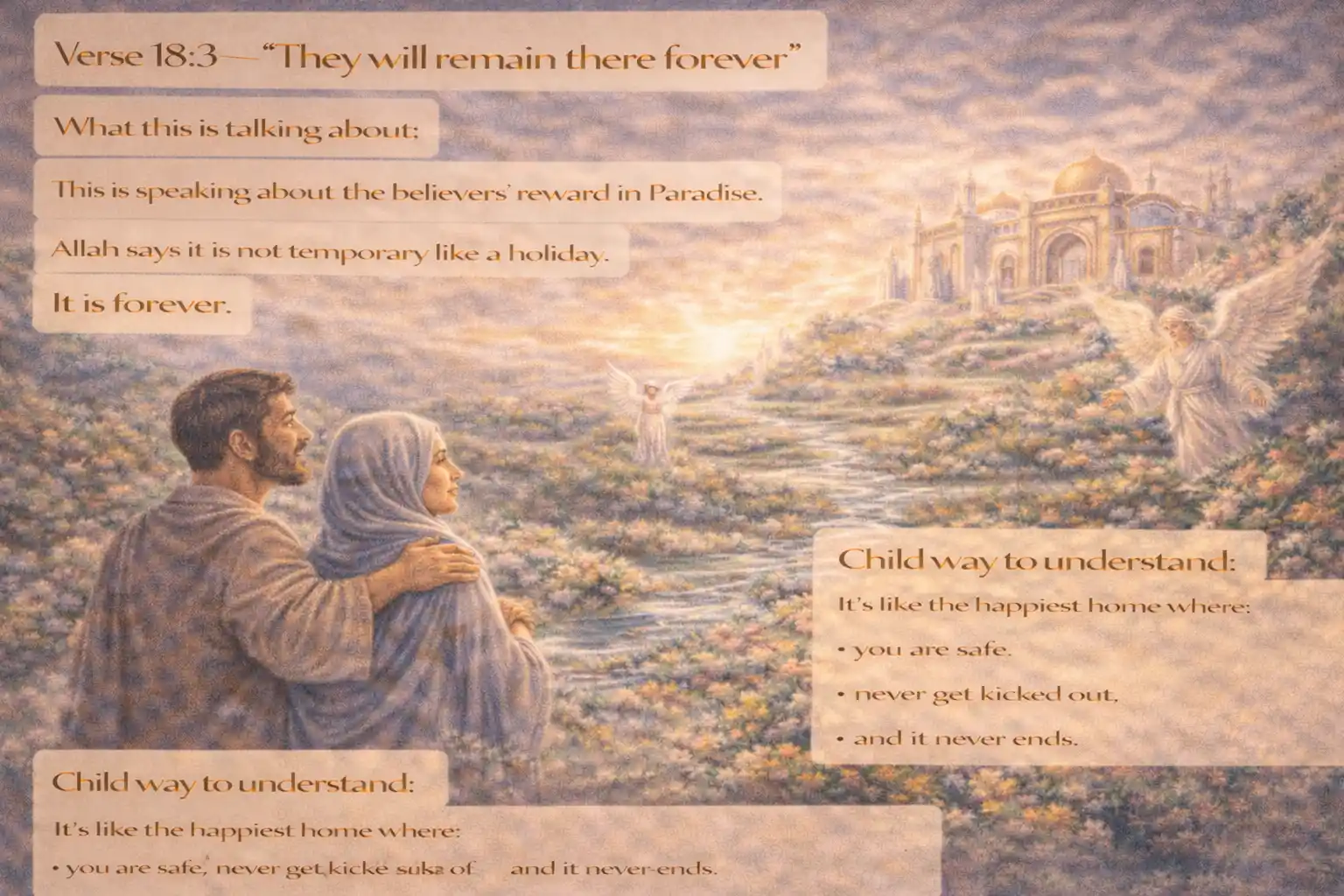
- 18:3 — “They will remain there forever”
Allah explains that the believers’ reward in Paradise is not temporary.
What this is talking about
- This is speaking about the believers’ reward in Paradise.
- Allah says it is not temporary like a holiday.
- It is forever.
- It’s like the happiest home where:
- you are safe,
- you never get kicked out,
- and it never ends.
- 18:4 — “To warn those who say: ‘Allah has taken a son.’”
Allah warns against saying false things about Him.
What Allah is saying (simple)
- Allah is warning people who say something very serious:
- “Allah has a son.”
Why this is a big deal (child-safe)
- Allah is not like humans.
- Humans need families, children, and generations.
- Allah does not need any of that.
- Allah is the Creator, not a creature.
- A child is born because:
- parents are human,
- they grow old,
- they need family.
- But Allah is not like that at all.
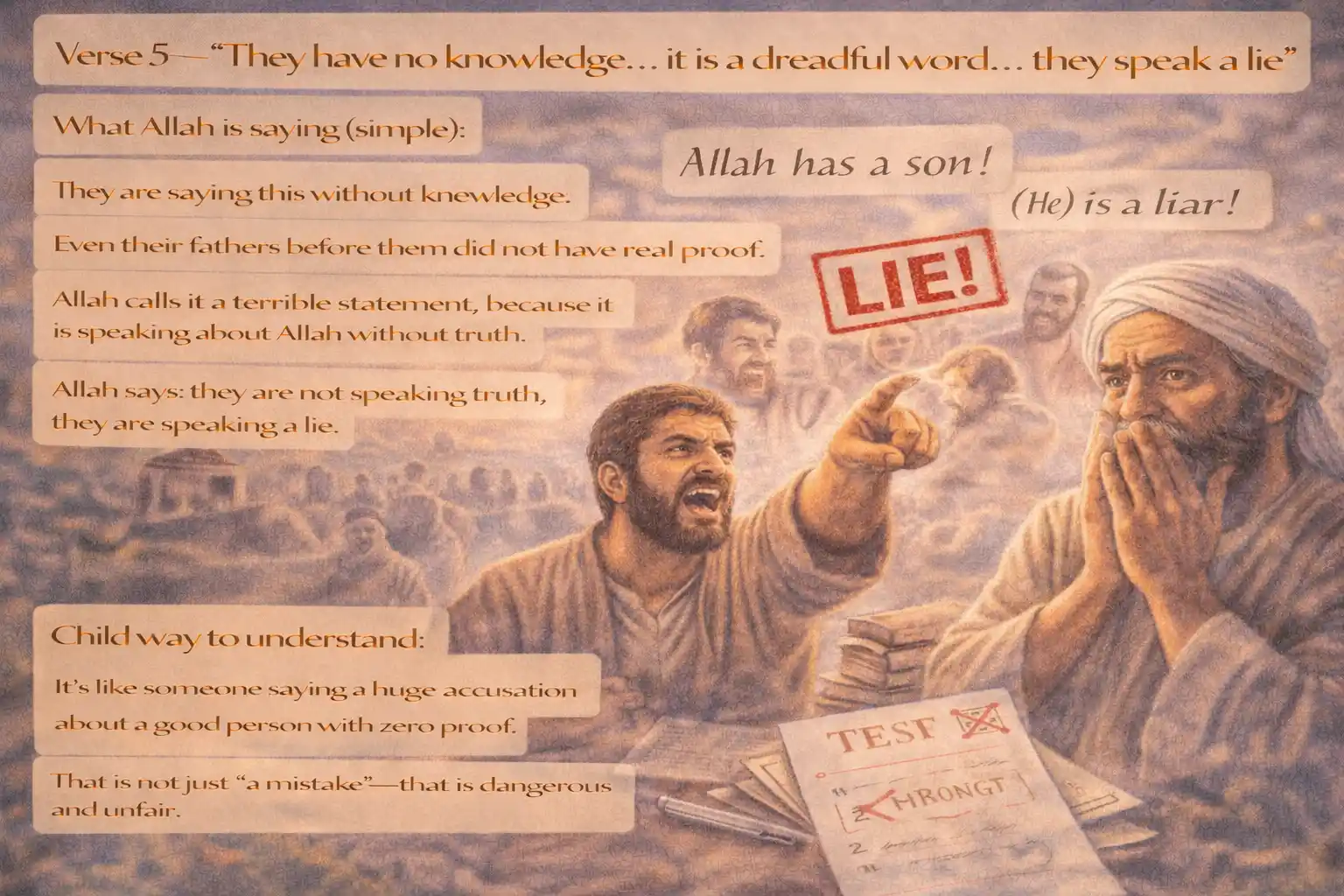
- 18:5 — “They have no knowledge… it is a dreadful word… they speak a lie”
Allah says this claim is made without proof and is a very serious lie.
What Allah is saying (simple)
- They are saying this without knowledge.
- Even their fathers before them did not have real proof.
- Allah calls it a terrible statement because it speaks about Allah without truth.
- Allah says: they are not speaking truth — they are speaking a lie.
- It’s like someone saying a huge accusation about a good person with zero proof.
- That is not just “a mistake” — it is dangerous and unfair.
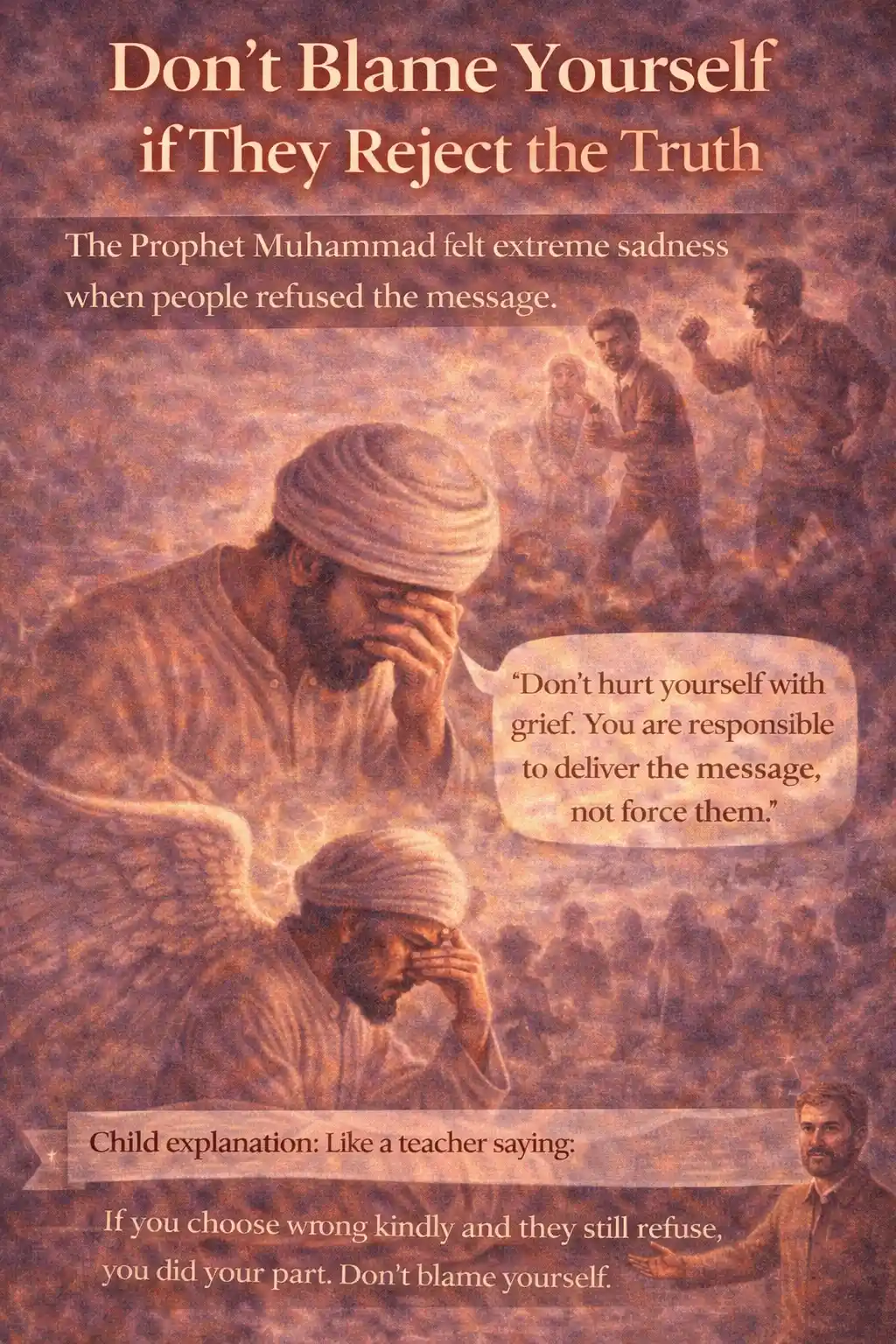
- 18:6 — “You might destroy yourself with grief if they don’t believe”
Allah comforts the Prophet because he cared deeply about people accepting guidance.
What Allah is saying to the Prophet (simple)
- The Prophet Muhammad cared so much that he felt deep sadness when people rejected the message.
- Allah comforts him:
- “Don’t hurt yourself with grief.”
- “You can’t force people to believe.”
- Imagine you try very hard to help someone, but they refuse.
- You feel sad and blame yourself.
- Allah is telling the Prophet:
- “You did your job. Their choice is on them.”
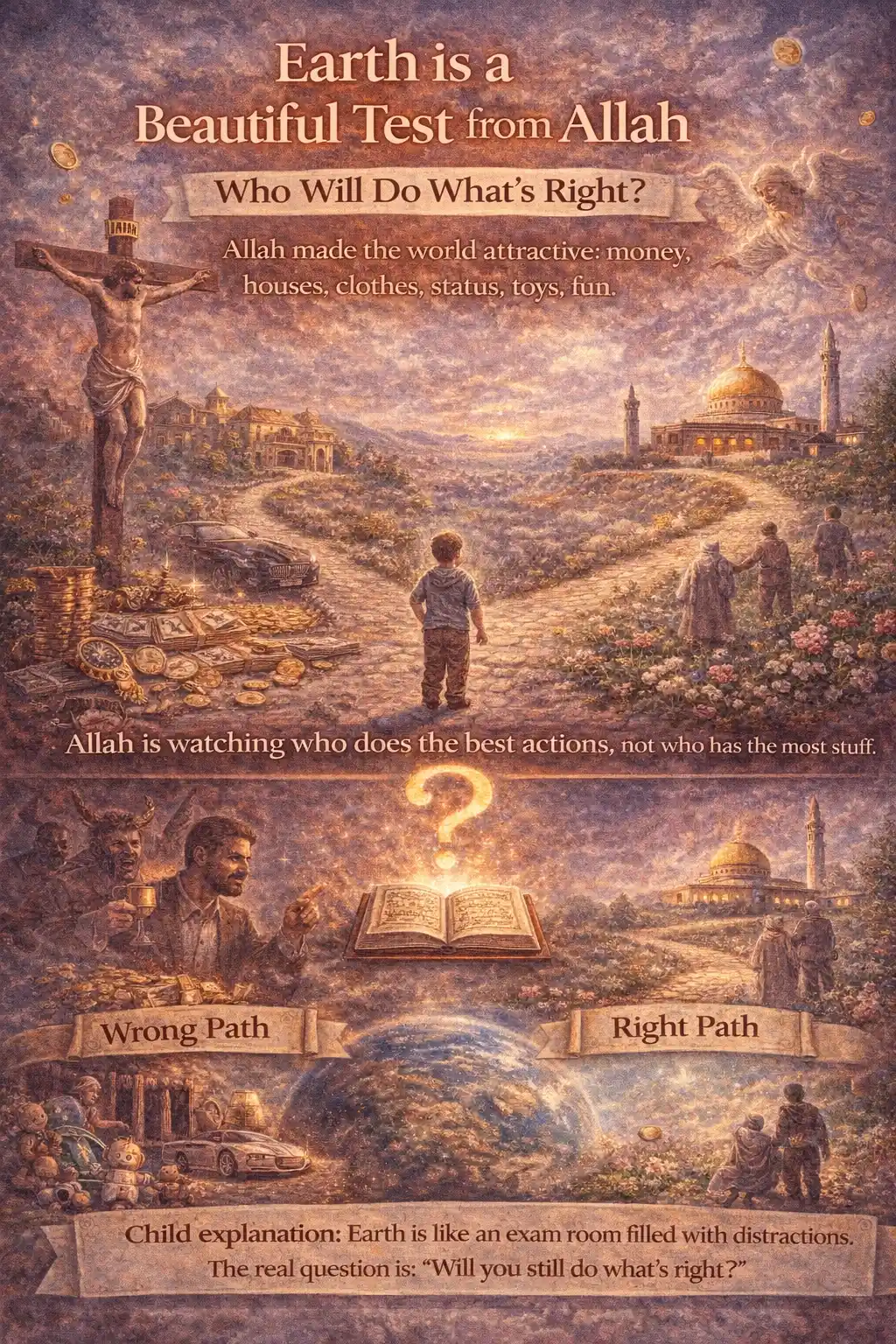
- 18:7 — “Earth’s beauty is a test: who does best deeds?”
Allah explains that the world’s decorations are not the goal—they are a test.
What Allah is saying (simple)
- Allah made things on earth beautiful, like:
- money, clothes, houses, cars, food, status, power, popularity, and decorations of life.
- But Allah says: this beauty is a test.
- The test is: who will do the best deeds, not who has the most stuff.
- It’s like Allah put toys and candy in a room and says:
- “Let’s see who stays kind, honest, and obedient—even when tempted.”
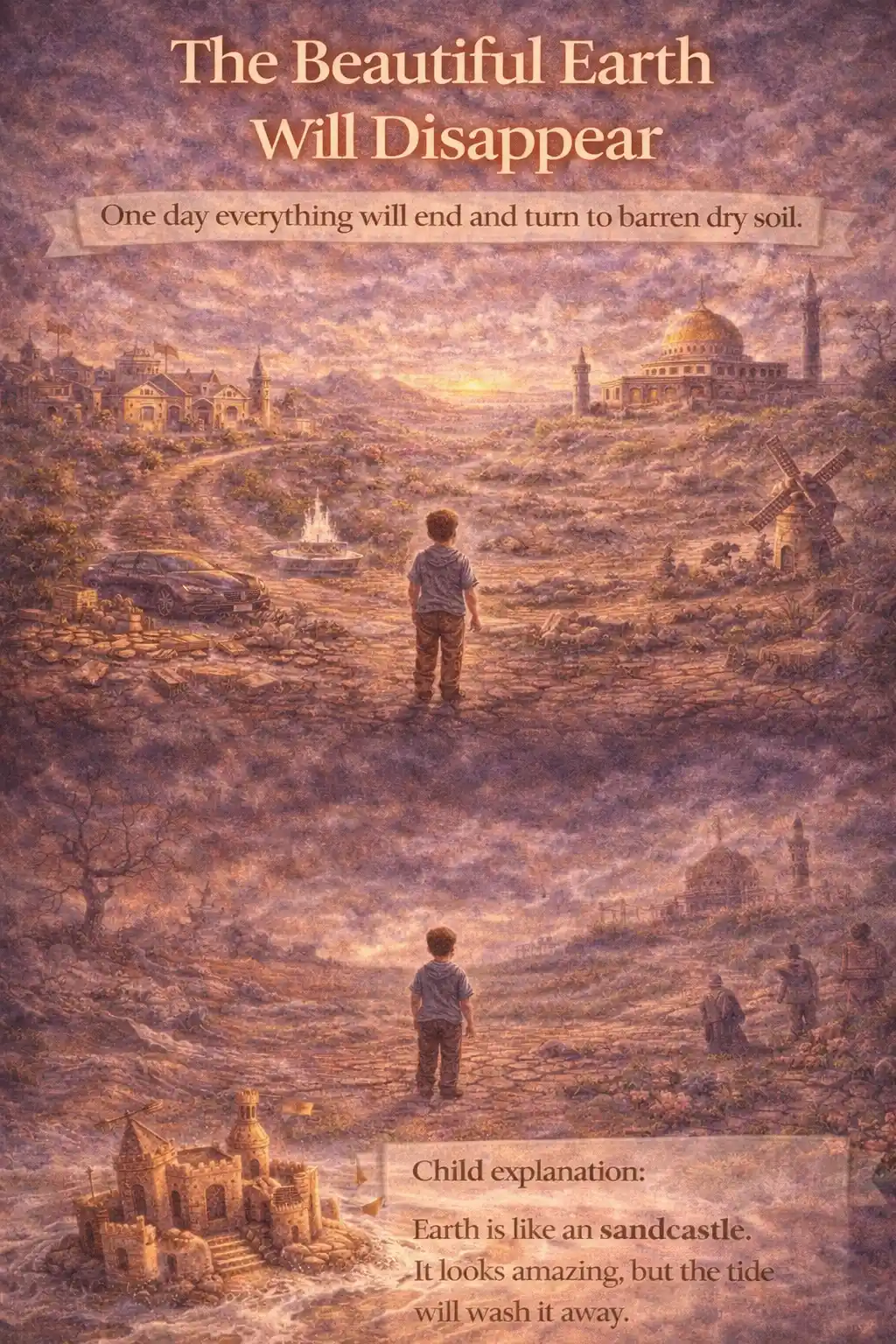
- 18:8 — “Allah will make it dry barren soil”
Allah reminds us that the world’s beauty will not last forever.
What Allah is saying (simple)
- All the beauty on earth is temporary.
- One day, Allah can make it all disappear.
- The earth can become dry and empty.
- Like flowers that look beautiful today…
- but after some time they become dry.
- Allah is teaching: “Don’t think this world lasts forever.”
- 18:9 — “Do you think the people of the cave were the most amazing sign?”
Allah introduces the Cave story by reminding us that His signs are many.
What Allah is saying (simple)
- Allah is saying: “You’re amazed by the story of the cave? Yes, it’s amazing…”
- “But it’s not the only amazing thing Allah can do.”
- Allah has many signs.
- It’s like Allah saying:
- “That story is incredible, but don’t think it’s the only miracle I can do.”
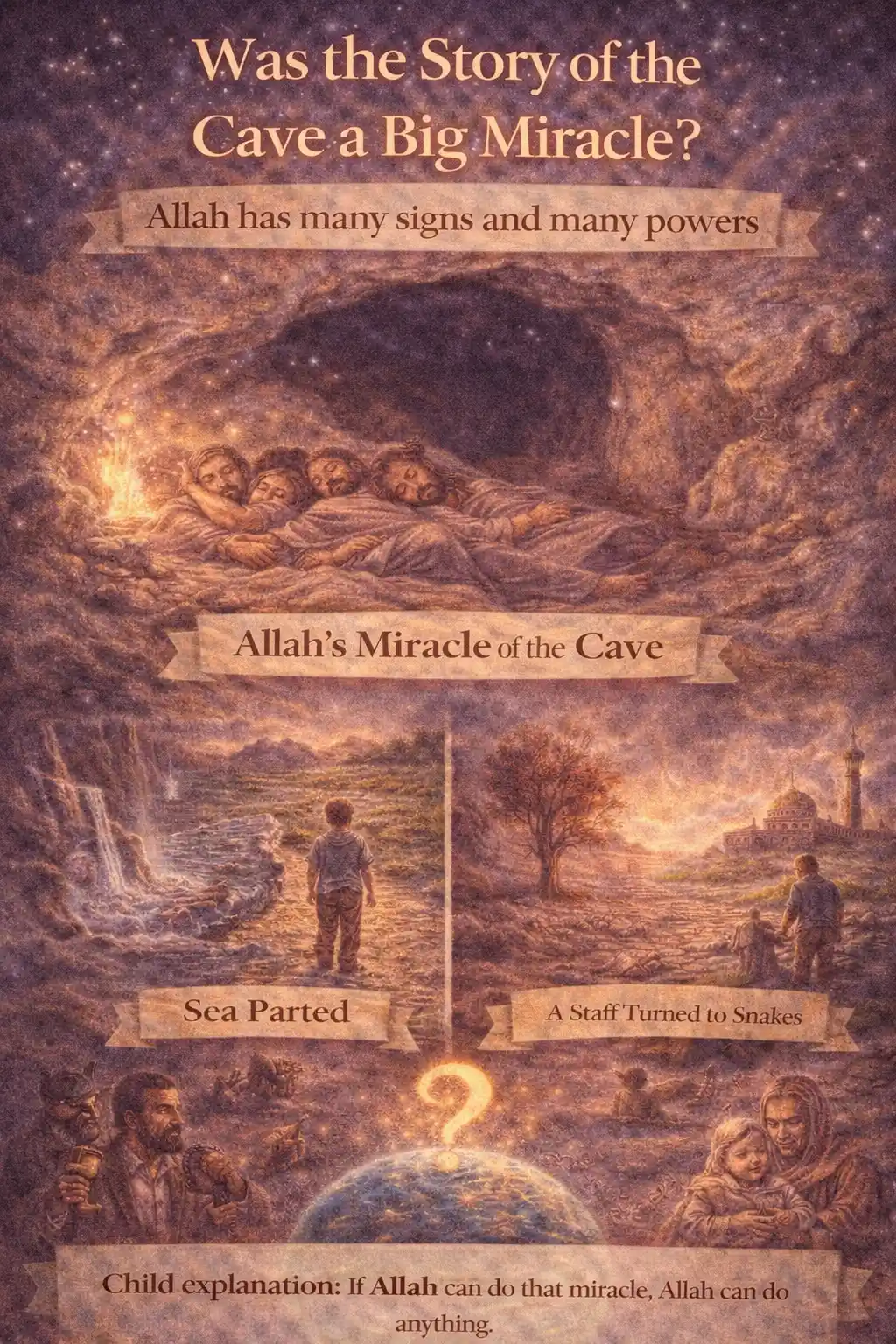
- 18:10 — “The young people ran to the cave and made a du‘a”
The story begins: young believers escape danger and ask Allah for mercy and guidance.
What happens (simple story)
- A group of young people lived among people who pressured them to do wrong.
- So they escaped to a cave to protect their faith.
- They made a beautiful du‘a (prayer).
Their du‘a has 2 parts
- “Our Lord, give us mercy from You.”
- Meaning: “Help us, protect us, forgive us, and take care of us.”
- “Make our situation guided and correct.”
- Meaning: “Show us the right steps and make our outcome good.”
- They were like:
- “Allah, we’re trying to do the right thing. Please help us and guide us.”
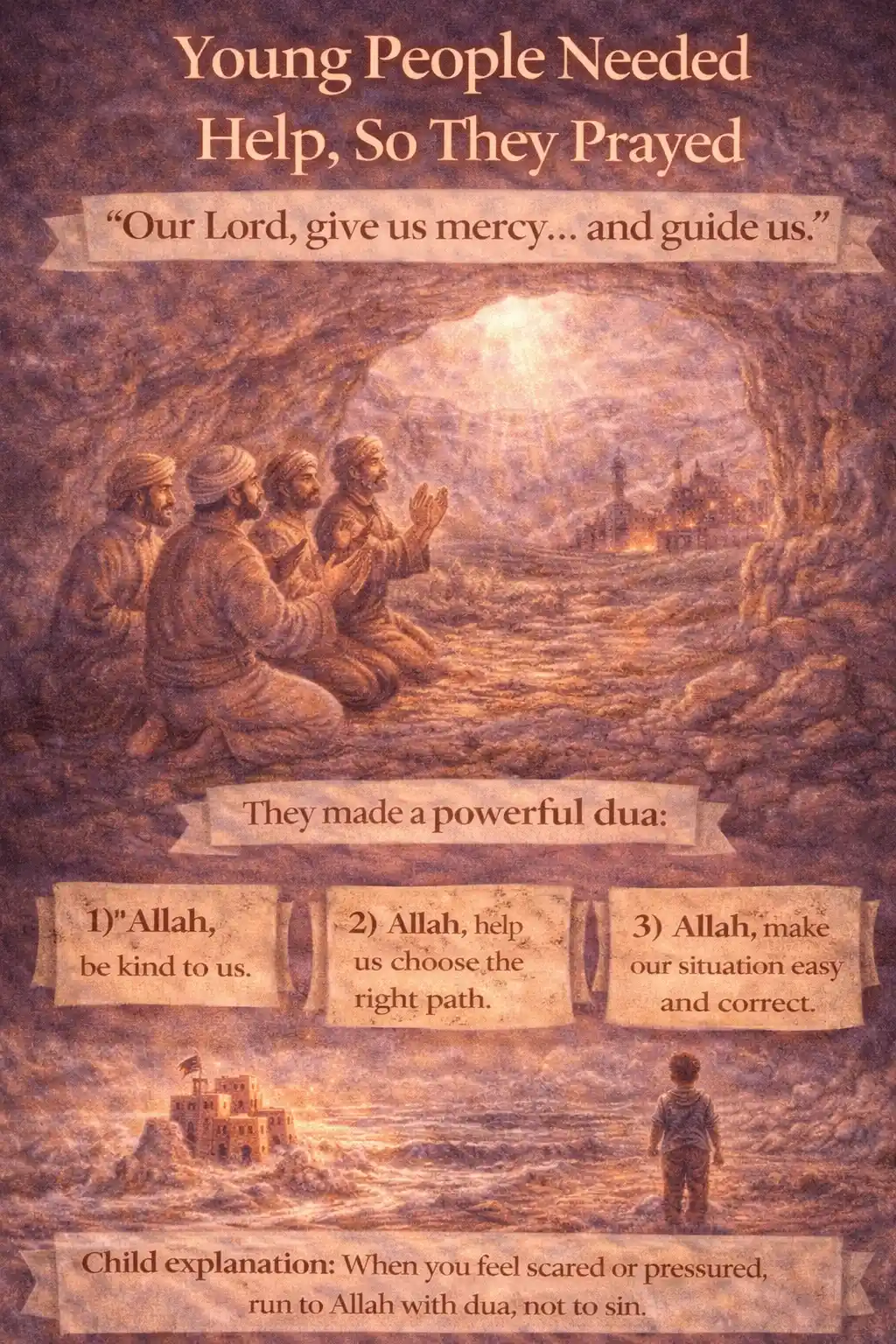
Allah gave the Qur’an as a straight, clear guide. It warns people who reject truth and gives good news to those who believe and do good. Paradise is forever. Allah warns against saying false things about Him, like claiming He has a son, because that is speaking without knowledge. The Prophet was very sad when people refused to believe, so Allah comforted him. Allah also reminds us that the beauty of the world is a test and it will not last. Then Allah introduces the story of the young people who ran to a cave to protect their faith, and they made a du‘a asking Allah for mercy and guidance.
11. So We cast (a cover of sleep) over their ears in the cave (for) a number of years.
12. Then We raised them up that We might know which of the two factions would best calculate the time that they had tarried.
13. We narrate unto you (O Muhammad) their story with truth. Indeed, they were youths who believed in their Lord, and We increased them in guidance.
14. And We made their hearts firm when they stood and said: “Our Lord is the Lord of the heavens and the earth. Never shall we call upon any god other than Him. Certainly, we would then have uttered an enormity.”
15. “These our people, have taken gods other than Him. Why do they not bring for them a clear authority. So who does greater wrong than he who invents against Allah a lie.”
16. “And when you have withdrawn from them, and that which they worship except Allah, then retreat to the cave, your Lord will spread out for you of His mercy, and will make easy for you of your affair.”
17. And (if you were there) you would see the sun when it rose, moving away from their cave on the right, and when it set, passing away from them on the left, while they were (laying) in the midst of it. That was from the signs of Allah. He whom Allah guides, so he is (rightly) guided. And he whom He sends astray, then for him you will never find a guiding friend.
18. And you would have thought them awake while they were asleep. And We turned them to the right and to the left. And their dog stretched out his forelegs at the entrance. If you had looked at them, you would have turned back from them in flight, and would certainly have been filled with awe of them.
19. And in like manner, We awakened them that they might question one another. A speaker from among them said: “How long have you stayed.” They said: “We have stayed a day or some part of a day.” (Others) said: “Your Lord best knows how long you have stayed. So send one of you with this your silver coin to the city, then let him see what food is purest there and bring you a provision from it. And let him be careful, and let no one know of you.”
20. Indeed, if they come to know of you, they will stone you or they will turn you back to their religion, and you will never then be successful, ever.
21. And in like manner, We made their case known to them (people of the city) that they might know that the promise of Allah is true. And that, (as for) the Hour, there is no doubt about it. When they disputed among themselves of their affair, they said: “Build over them a building. Their Lord knows best about them.” Those who prevailed in their matter said, “We surely shall make a place of worship over them.”
22. They will say: “(They were) three, their dog the fourth of them.” And (others) will say: “Five, their dog the sixth of them.” Guessing at the unseen. And (still others) will say: “Seven, and their dog the eighth of them.” Say (O Muhammad): “My Lord is best aware of their number. None knows them but a few.” So debate not about them except with the clear proof. And do not inquire, about them, anyone of these (speculators).
23. And do not say of anything: “I shall surely do that tomorrow.”
24. Except if Allah wills. And remember your Lord when you forget, and say: “It may be that my Lord will guide me unto a nearer way of truth than this.”
25. And they stayed in their cave three hundred years and add nine.
26. Say: “Allah knows best how long they stayed. With Him is (the knowledge of) the unseen of the heavens and the earth. How well Seeing is He, and how well Hearing. They have no protecting friend other than Him, and He does not share in His authority anyone.”
People of the Cave (18:11–26) — Simple Explanation
- 18:11 — Allah made them sleep for many years
“We cast sleep over their ears in the cave for a number of years.”
- Allah made the young believers fall into a very deep sleep inside the cave.
- “Over their ears” means: they would not hear noises that could wake them up.
- Allah protected them while they slept.
Allah pressed the “sleep button” so they could rest and be protected.
- 18:12 — Allah woke them up later to show a lesson
“Then We raised them up… which group would best calculate the time.”
- After many years, Allah woke them up.
- People would wonder and argue: “How long were they asleep?”
- Allah allowed this to show a big truth: Allah controls time.
Allah made a miracle so people learn: “Only Allah truly knows time.”
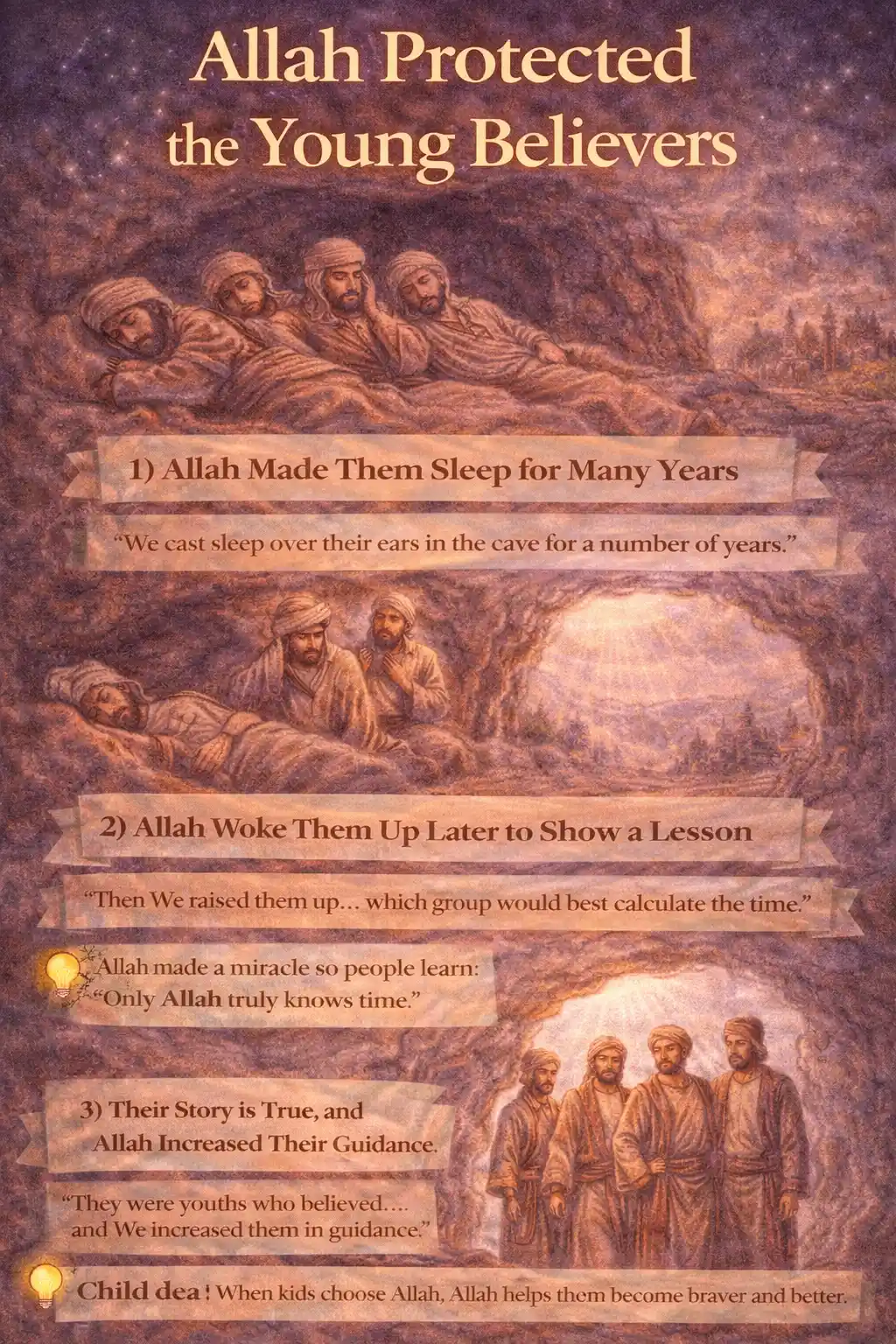
- 18:13 — Their story is true, and Allah increased their guidance
“They were youths who believed… and We increased them in guidance.”
- Allah says this story is true—not a made-up tale.
- They were young people who believed in Allah sincerely.
- Because they were sincere, Allah gave them more guidance and strength.
When kids choose Allah, Allah helps them become braver and better.
- 18:14 — Allah made their hearts firm when they stood up for truth
“We made their hearts firm… Our Lord is Lord of the heavens and earth…”
- Allah made them strong on the inside so they could speak the truth.
- They stood up and said: “Only Allah is our Lord.”
- They refused to worship anything else.
When you are scared but do the right thing, Allah can give you courage.
- 18:15 — They said: “Our people worship other gods with no proof”
“These people have taken gods other than Him… who is worse than someone who invents a lie about Allah?”
- They said: our people worship many things besides Allah.
- But they have no clear proof that any of those “gods” are real.
- Making up claims about Allah without knowledge is a huge wrong.
Don’t invent stories about Allah. If you don’t know, don’t claim it.
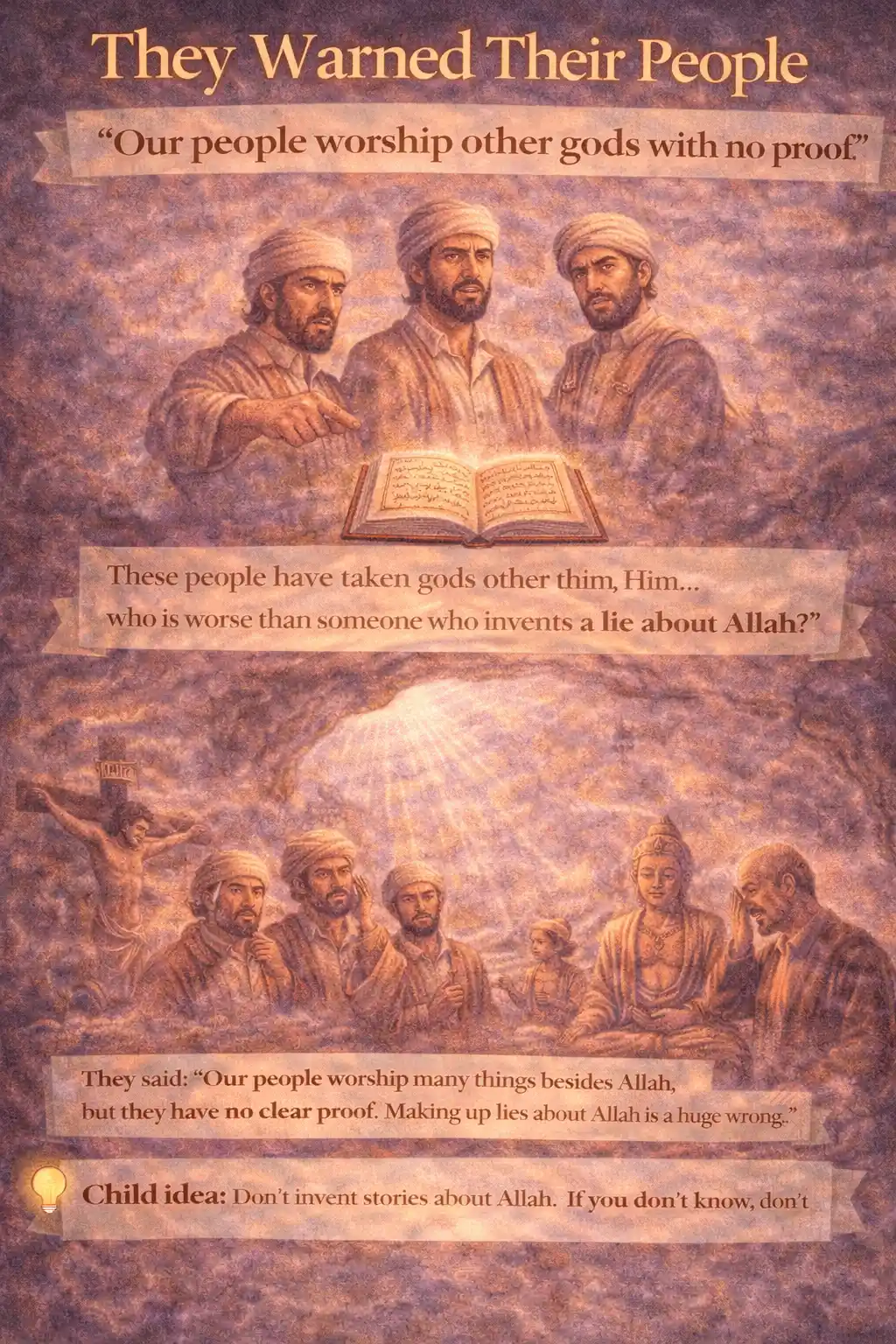
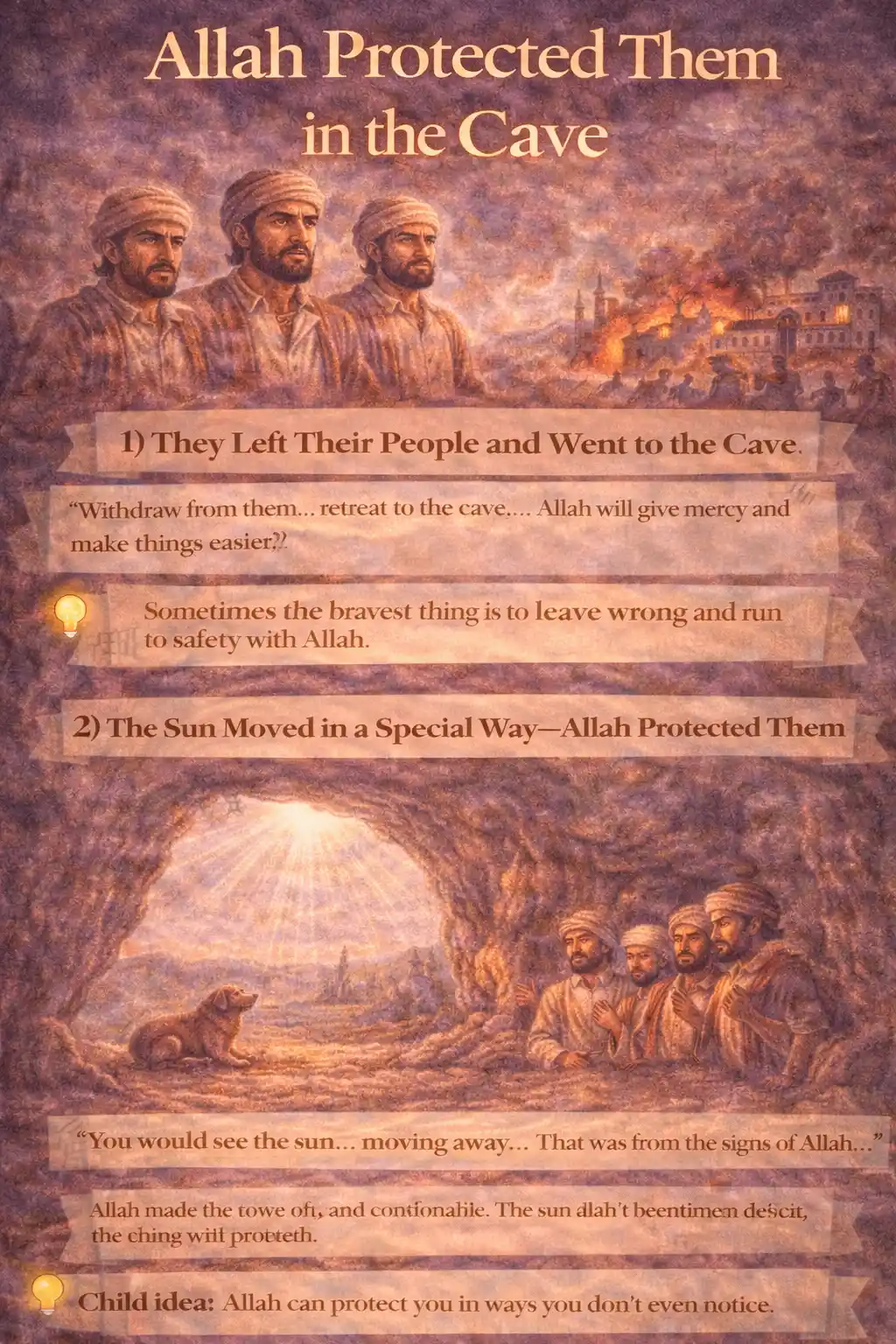
- 18:16 — They left their people and went to the cave
“Withdraw from them… retreat to the cave… Allah will give mercy and make things easier.”
- They chose to leave the dangerous place to protect their faith.
- They hid in a cave, trusting Allah: “Allah will take care of us.”
- Allah promised them mercy and help.
Sometimes the bravest thing is to leave wrong and run to safety with Allah.
- 18:17 — The sun moved in a special way—Allah protected them
“You would see the sun… moving away… That was from the signs of Allah…”
- Allah made the cave safe and comfortable.
- The sun did not burn them directly—Allah protected their place.
- Allah teaches a rule:
- If Allah guides someone, they are truly guided.
- If someone rejects Allah, no one can guide them without Allah.
Allah can protect you in ways you don’t even notice.
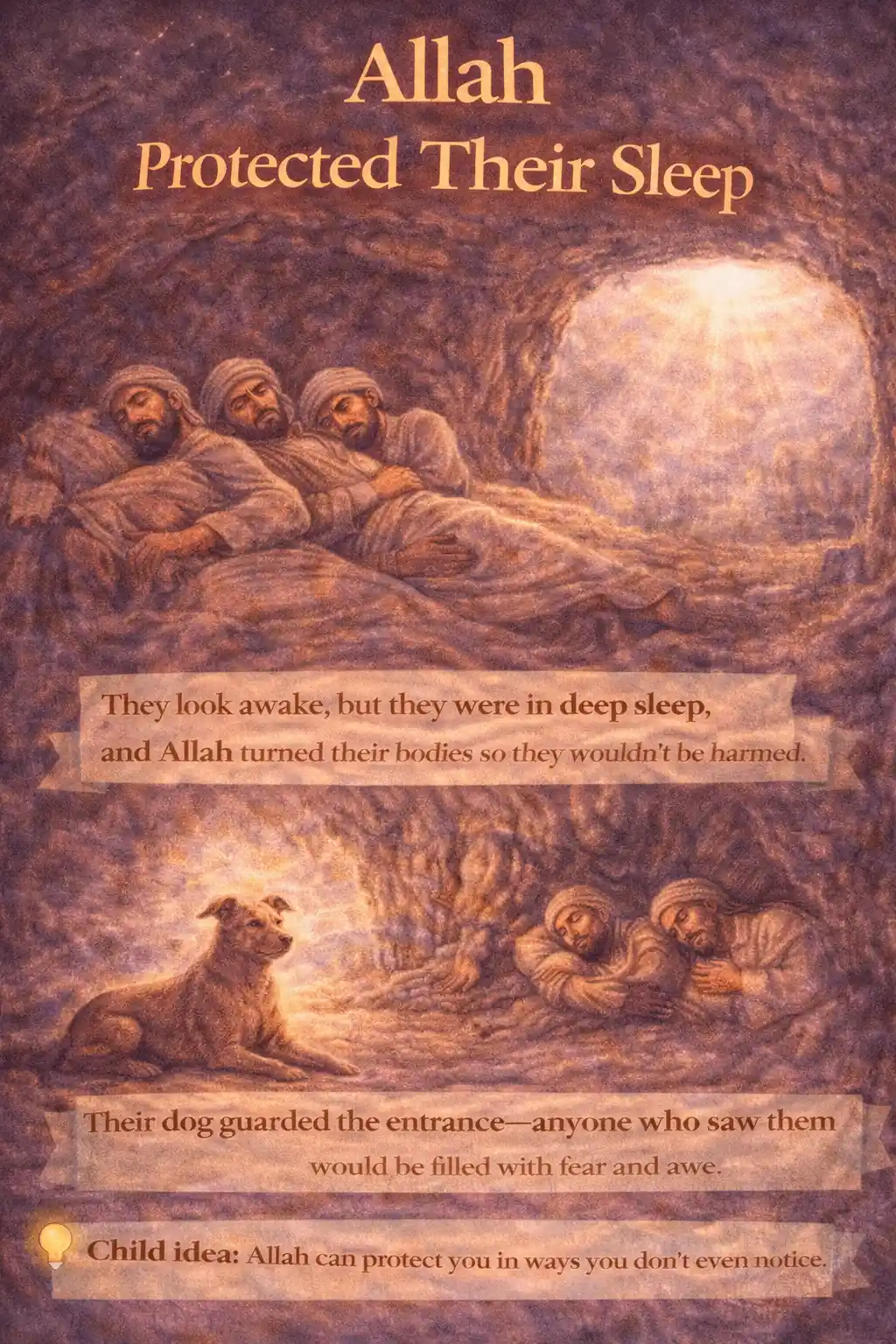
- 18:18 — They looked awake but were asleep, and their dog guarded the entrance
“You would think them awake… We turned them… their dog stretched at the entrance…”
- They looked like they might be awake, but they were sleeping.
- Allah turned them to the right and left so their bodies would not be harmed from lying still too long.
- Their dog stayed at the entrance like a guard.
- If someone saw them, they would feel fear and run away—Allah protected them with awe.
Allah protected them with sleep, movement, and even a guarding dog.
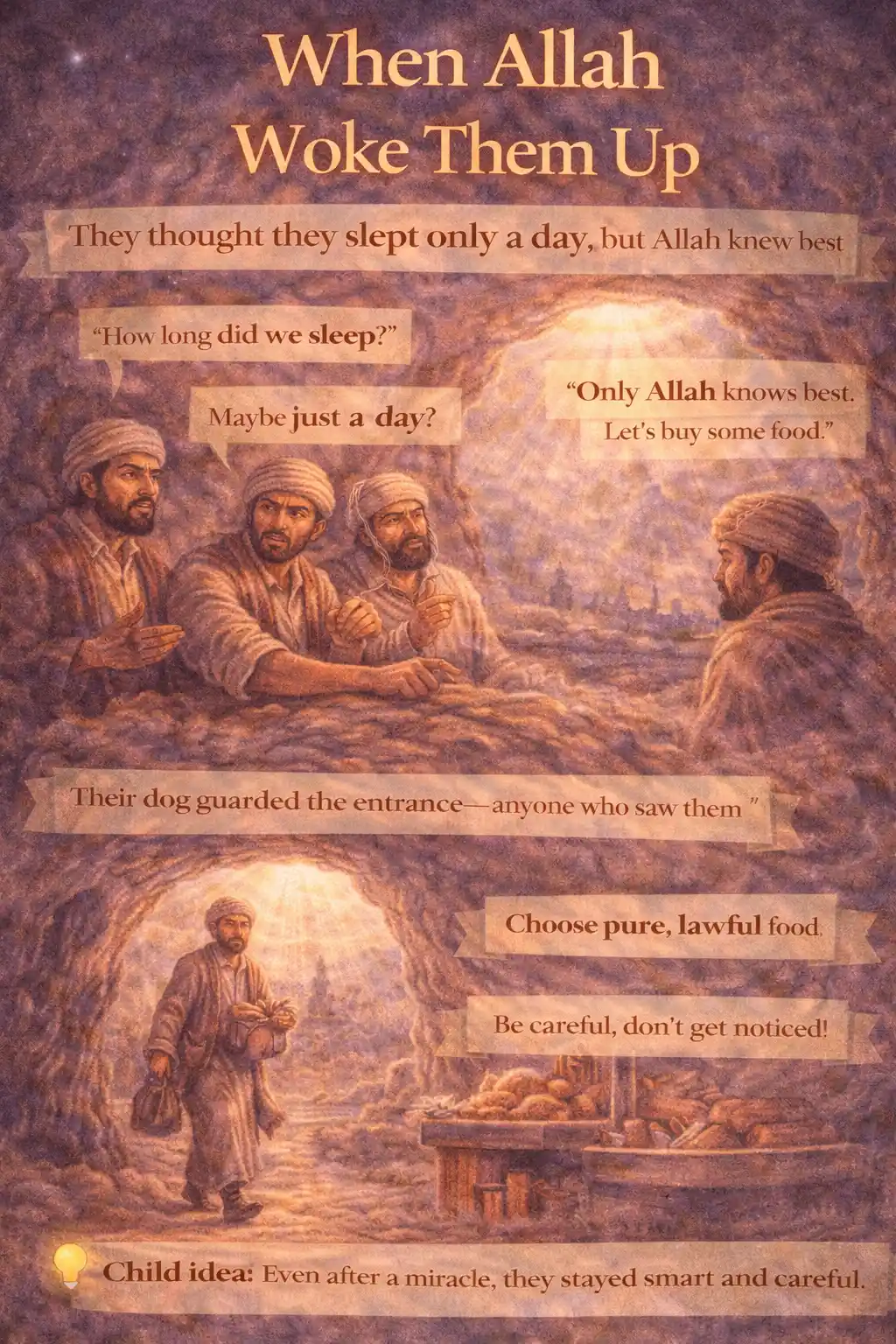
- 18:19 — Allah woke them; they thought it was only a day
“We awakened them… How long stayed? A day or part of a day…”
- When they woke up, they guessed: “Maybe we slept one day.”
- Then they said the best answer: “Allah knows best.”
- They planned wisely: send one person with money to buy food quietly.
- They said: choose the purest/best food (clean and lawful) and don’t get noticed.
Even after a miracle, they stayed smart and careful.
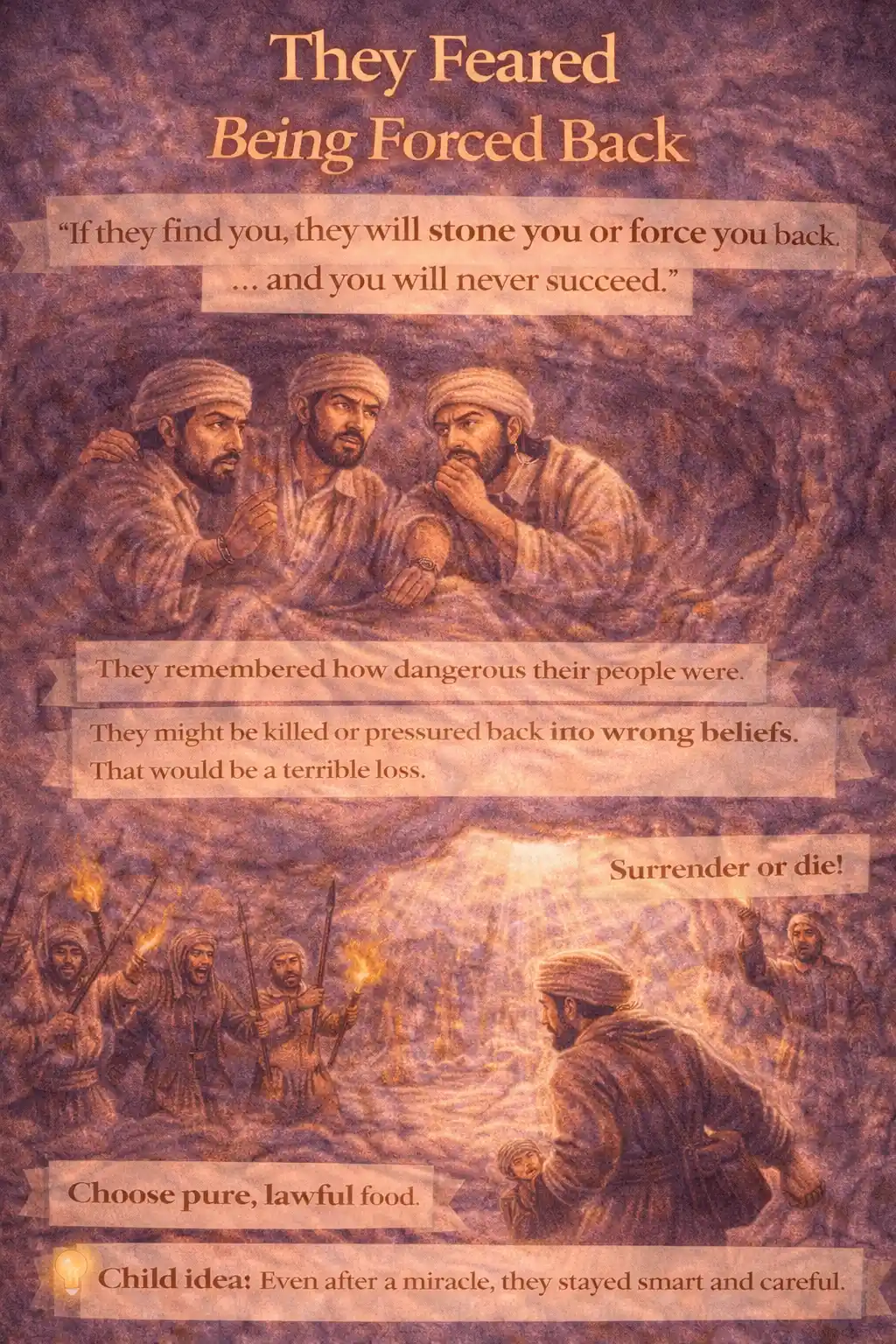
- 18:20 — They feared being forced back or killed
“If they find you, they will stone you or force you back… and you will never succeed.”
- They remembered their people were dangerous and harsh.
- They feared being killed or pressured back into wrong beliefs.
- They knew losing faith just to “fit in” would be a terrible loss.
They didn’t want to lose their faith just to fit in.
- 18:21 — Allah made the people discover their story as proof
“We made their case known… so they may know Allah’s promise is true… and the Hour has no doubt…”
- Allah let the people of the city discover what happened.
- Allah did this to prove two big truths:
- Allah’s promise is true.
- The Resurrection (Last Day) is real—Allah can bring people back.
- Then people argued what to do: some wanted a building, others wanted a place of worship.
Allah used their story to prove: “Life after death is real.”
- 18:22 — People guessed their number—Allah says: don’t argue without knowledge
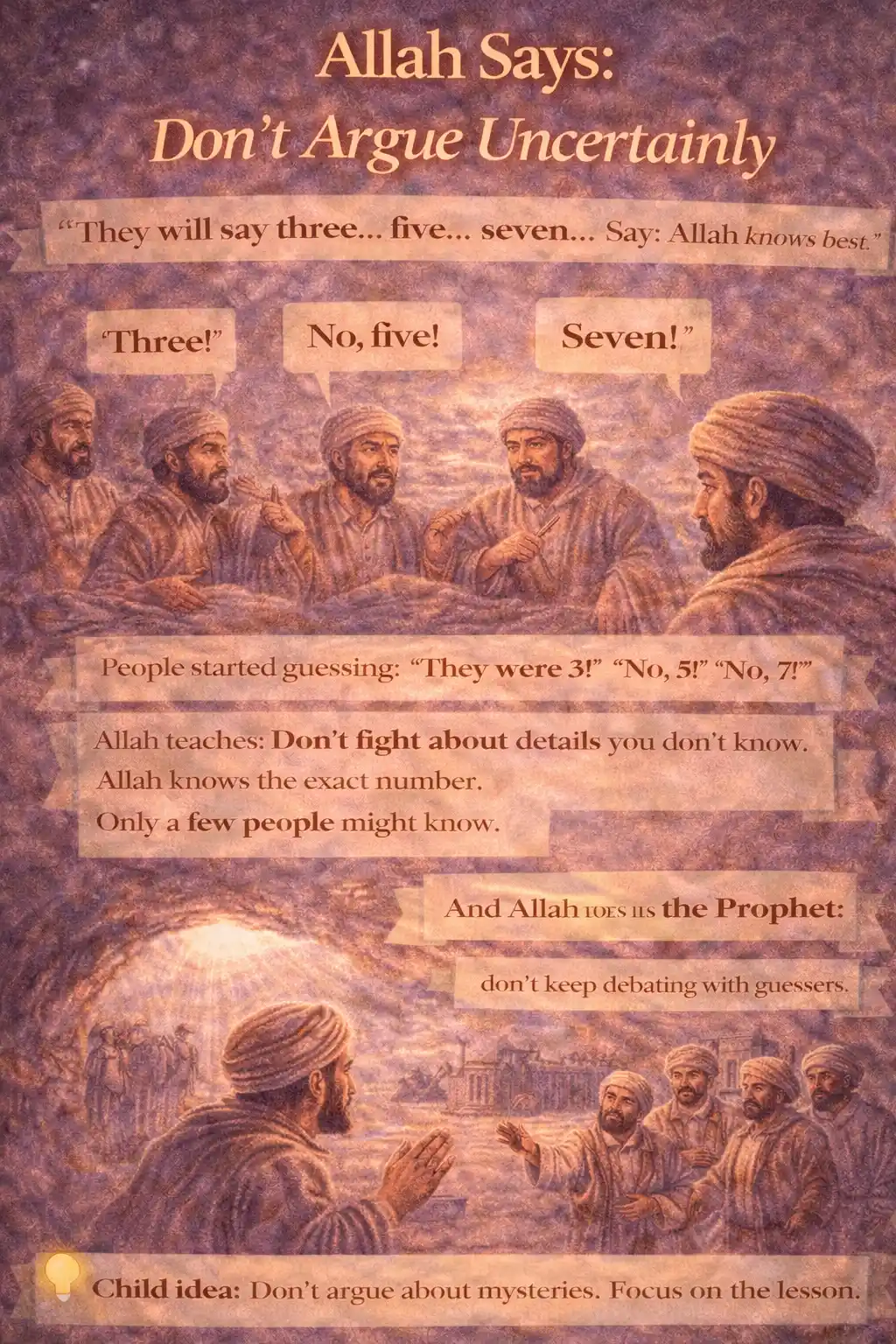
“They will say three… five… seven… Say: Allah knows best…”
- People started guessing their number and arguing.
- Allah teaches: don’t fight over details you do not know.
- Allah knows the exact number, and only a few people might know.
- Allah told the Prophet: don’t keep debating with guessers.
Don’t argue about mysteries. Focus on the lesson.
- 18:23–24 — Don’t say “tomorrow” without “If Allah wills”
“Do not say: I will do that tomorrow—except if Allah wills…”
- Allah teaches manners and humility.
- You can plan, but only Allah controls tomorrow.
- So you should say: “If Allah wills” (In shaa Allah).
- If you forget, remember Allah again and ask Him to guide you better.
Tomorrow is not guaranteed. Always include Allah in your plans.
- 18:25 — Their time in the cave: 300 years + 9
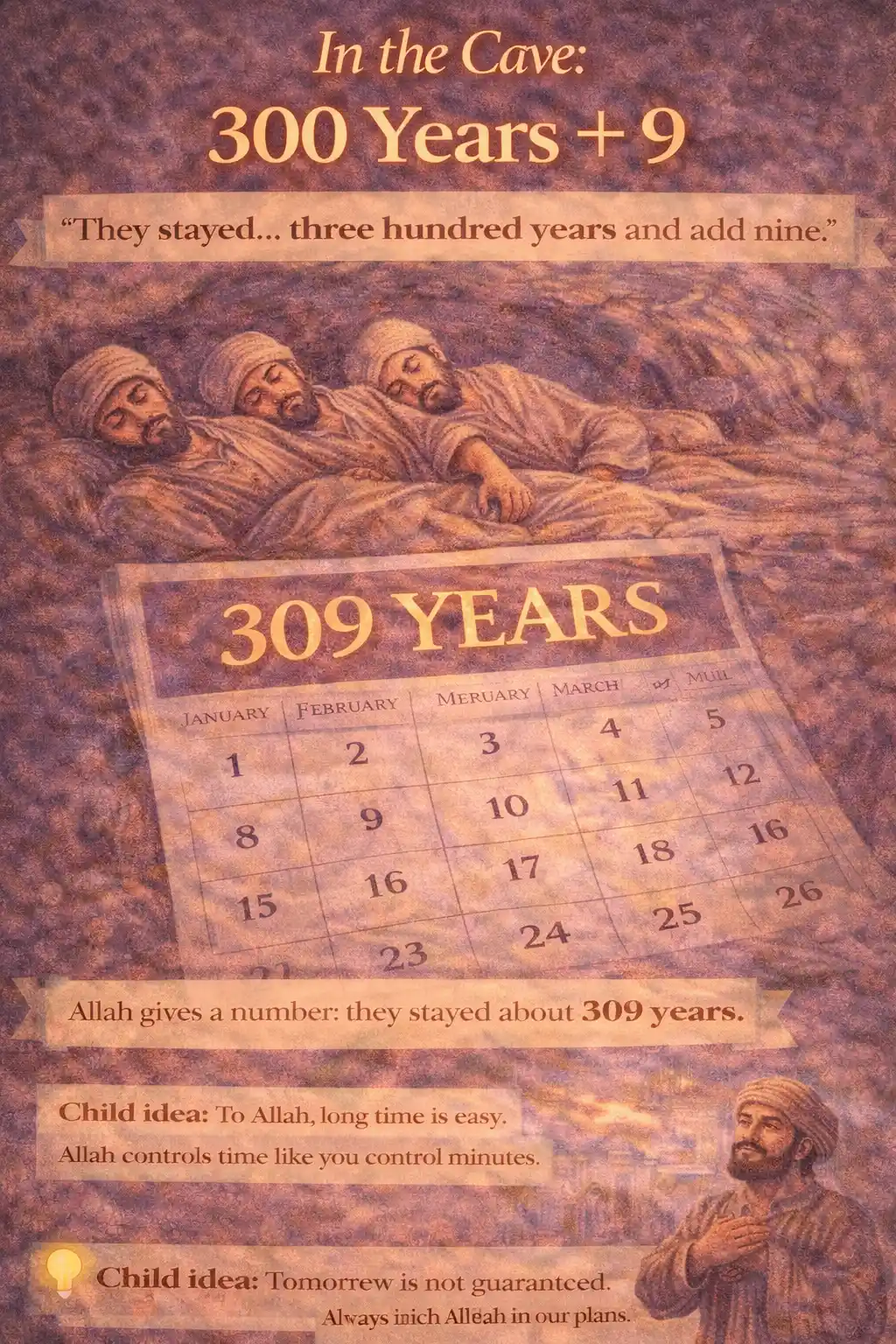
“They stayed… three hundred years and add nine.”
- Allah gives a clear number: they stayed about 309 years.
- This shows: long time is easy for Allah.
To Allah, long time is easy. Allah controls time like you control minutes.
- 18:26 — Allah knows the unseen; He alone has full authority
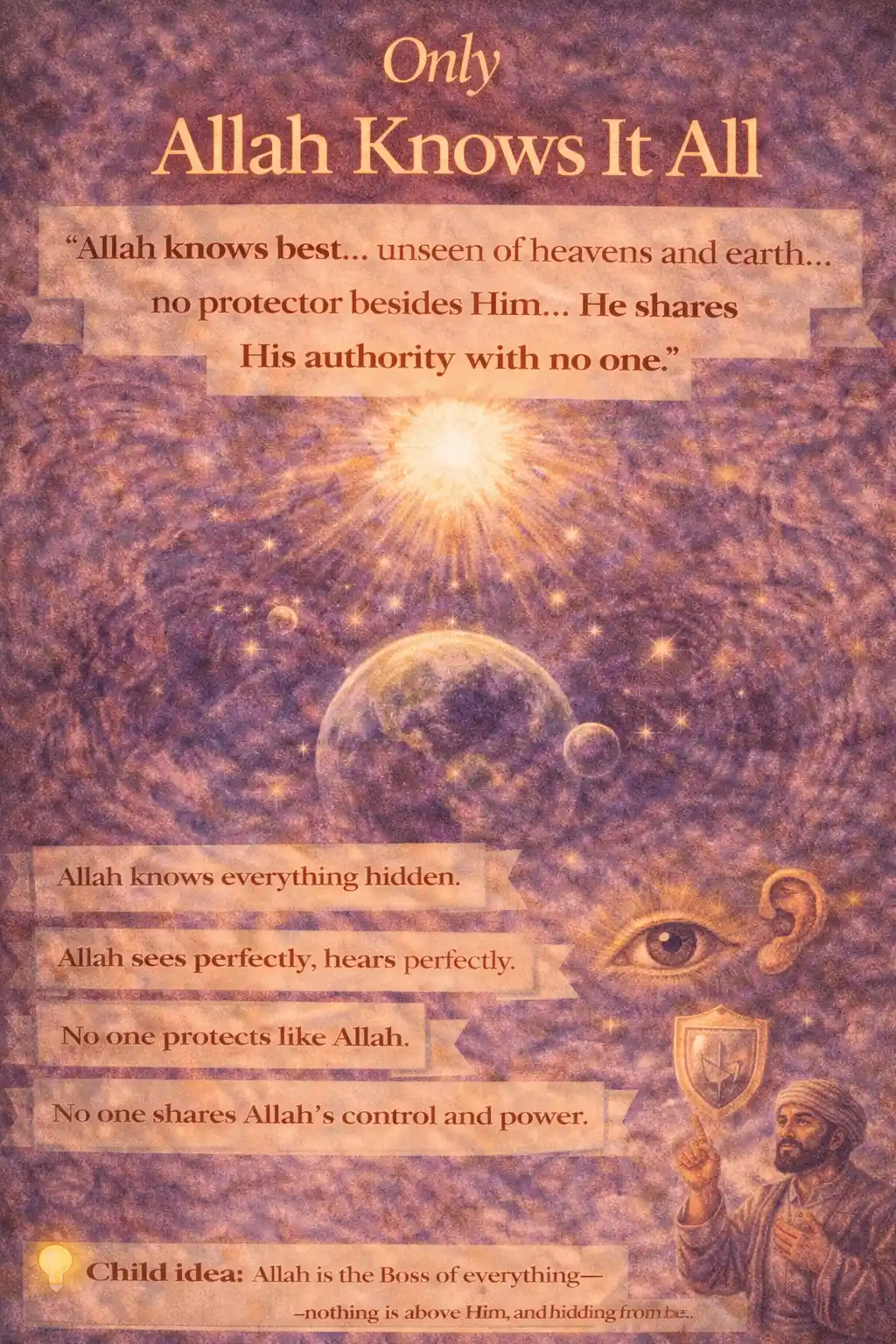
“Allah knows best… unseen of heavens and earth… no protector besides Him… He shares His authority with no one.”
- Allah reminds us: He knows everything hidden (the unseen).
- Allah sees perfectly and hears perfectly.
- No one protects like Allah.
- No one shares Allah’s control and power.
Allah is the Boss of everything—nothing is above Him, and nothing is hidden from Him.
- Be brave for Allah, even if you are young.
- Allah can protect you in amazing ways.
- Don’t guess and argue about things you don’t know.
- Say “In shaa Allah” because Allah controls tomorrow.
- This world and time are in Allah’s hands—the Last Day is real.
27. And recite that which has been revealed to you of the Book of your Lord. There is none who can change His words, and never will you find in other than Him a refuge.
28. And keep yourself patient with those who call upon their Lord in the morning and the evening, seeking His countenance. And let not your eyes overlook them, desiring adornments of the life of the world. And obey not him whose heart We have made heedless of Our remembrance, and who follows his own desire and whose affair has been abandoned.
29. And say: “The truth is from your Lord. Then whoever wills, let him believe, and whoever wills, let him disbelieve.” Indeed, We have prepared for the wrongdoers a fire, its walls will be surrounding them. And if they ask for water, they will be showered with water like molten lead which will burn the faces. Dreadful is the drink and evil is the resting place.
30. Indeed, those who believe and do righteous deeds, certainly We shall not cause to be lost the reward of those who do good.
31. (For) such, theirs will be Gardens of Eden, beneath them rivers will flow. They will be adorned therein with bracelets of gold and they will wear green garments of fine silk and gold embroidery, reclining therein upon thrones. Excellent is the reward, and good is the resting place.
Surah Al-Kahf (18:27–31) — Simple Explanation (Child-Friendly)
- 18:27 — Hold tightly to Allah’s Book
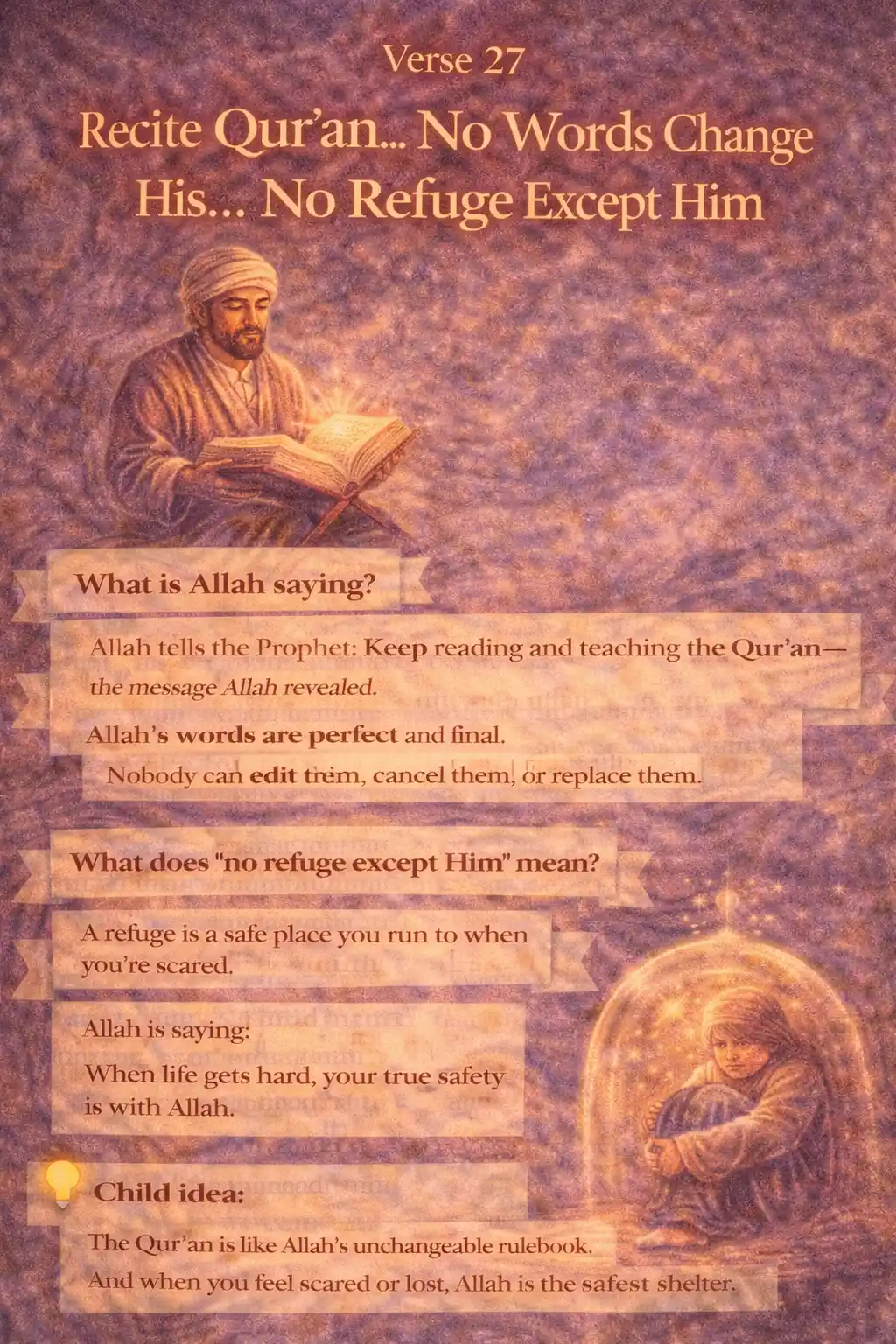
Allah tells the Prophet: Read and teach what Allah revealed to you.
- Allah is telling the Prophet to stick to the revelation and deliver it clearly.
- No one has the authority to change Allah’s words.
- If someone tries to run away from Allah’s truth, they will find no safe hiding place from Allah.
“Stick to Allah’s message. It is true, and nobody can rewrite it.”
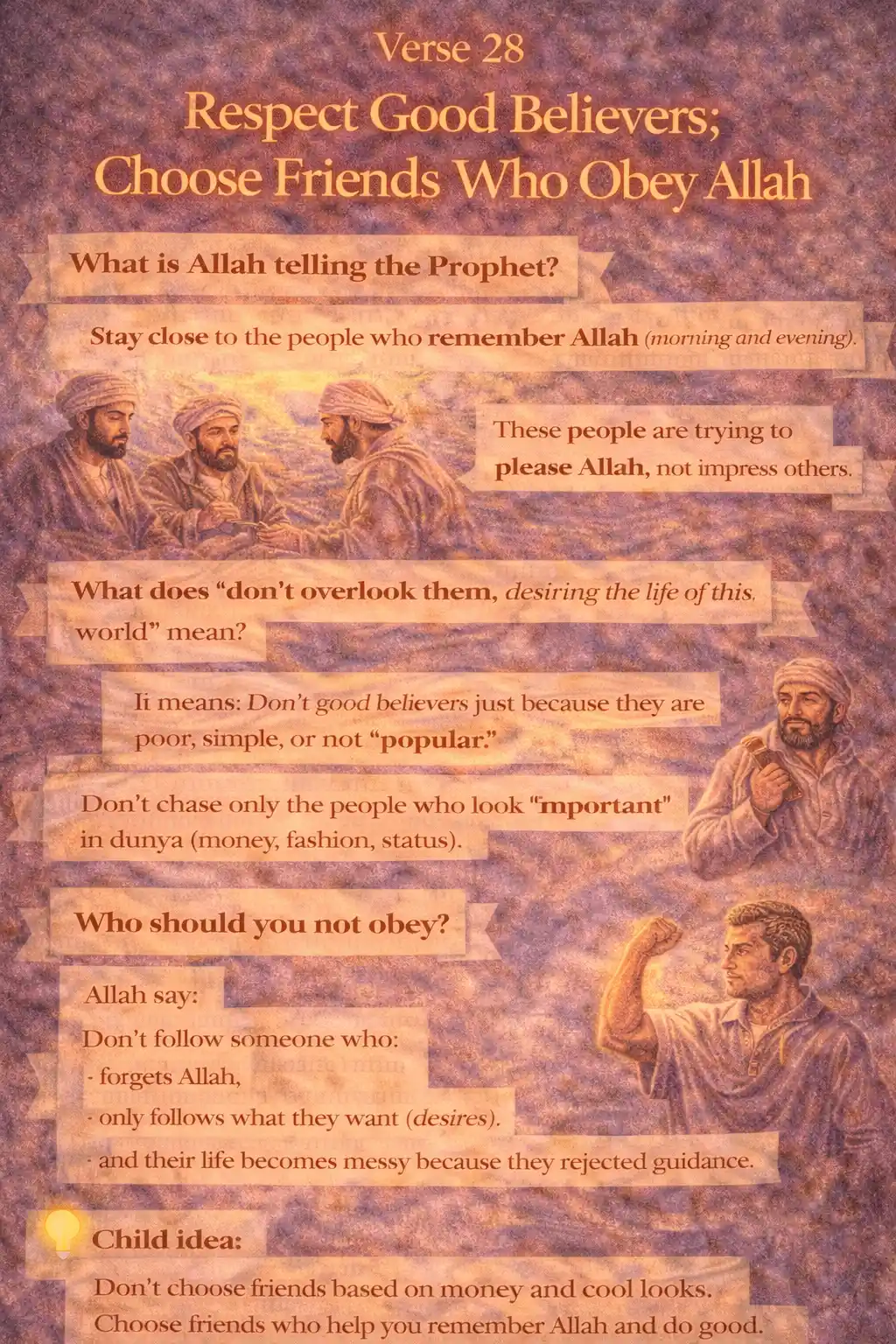
- 18:28 — Stay with sincere believers, not with prideful people
Be patient and stay with the people who call on Allah morning and evening.
- Allah tells the Prophet to stay close to sincere believers—people who remember Allah regularly.
- Do not ignore them just to chase the “fancy” people of the world.
- And do not obey someone whose heart is careless about Allah, who follows desires, and whose life becomes messy and extreme.
“Choose good friends who remember Allah—even if they are not rich or popular.”
- 18:29 — The truth is clear; people choose their response
Allah says: The truth is from your Lord.
- Allah makes the truth clear.
- Whoever wants to believe can believe, and whoever wants to reject can reject—Allah does not force people like robots.
- But Allah warns: those who do ظلم (wrong themselves and others) and reject truth will face punishment.
- The punishment is described as something that surrounds them, and even if they beg for relief, what they receive is terrible.
“Allah tells the truth openly. People choose—but choices have consequences.”
- 18:30 — Allah never wastes good deeds
Those who believe and do good deeds—Allah will never let their good work be lost.
- Allah promises that real good deeds are never wasted.
- Even if people don’t notice your good actions, Allah notices and rewards them.
“Allah counts every good thing you do, even small ones.”
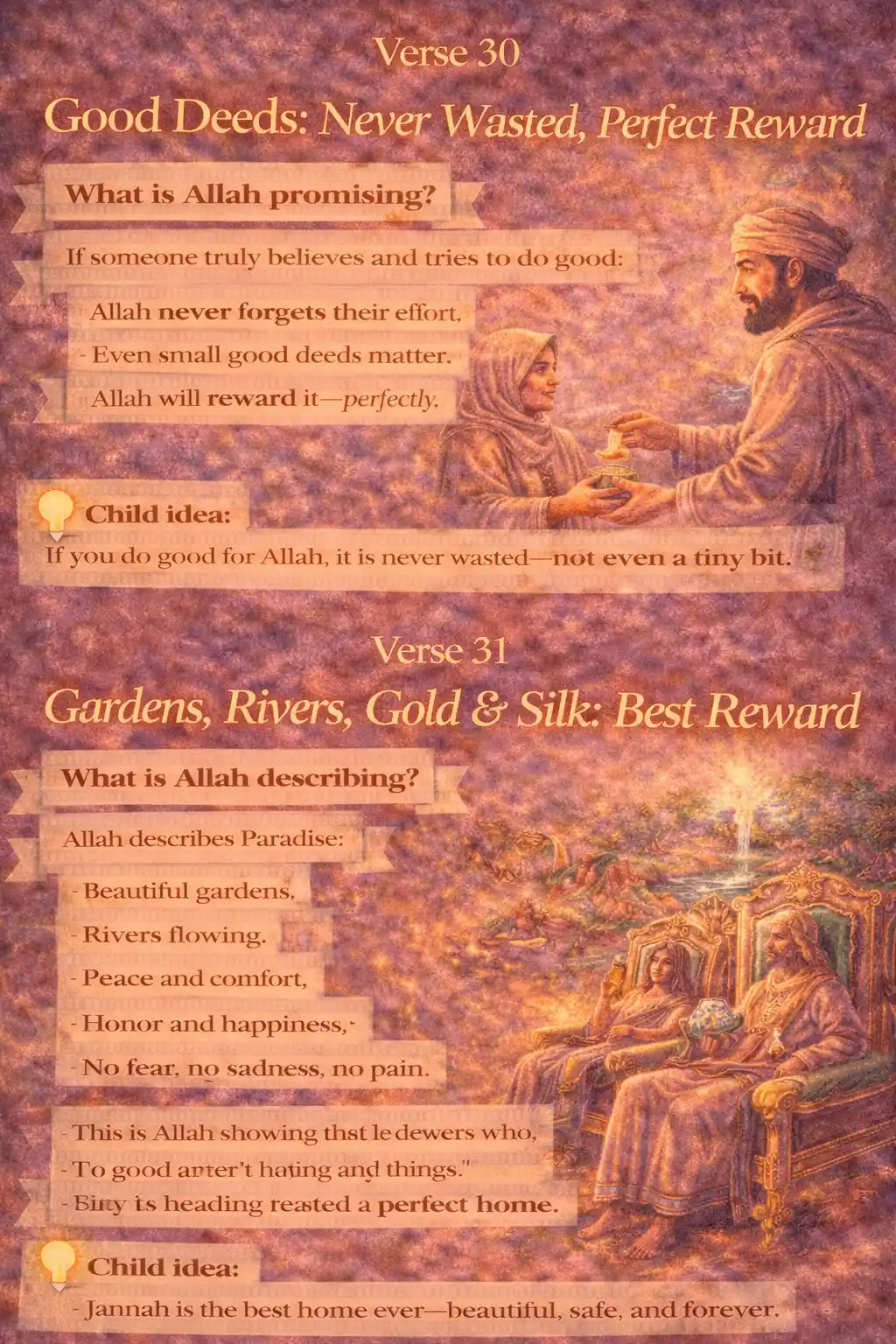
- 18:31 — The reward: real success in Paradise
Allah describes the reward for believers: Gardens of Eden, with rivers flowing.
- Believers who keep faith and do good are promised Gardens of Eden.
- There are rivers flowing—a picture of comfort, life, and peace.
- They will be honored and happy, with beautiful clothing and comfort, sitting peacefully.
- Allah closes it by showing: this is the best reward and the best final home.
“The best ending is with Allah—safe, beautiful, and forever.”
Hold tight to Allah’s truth, stay with sincere people, and remember: Allah never wastes good deeds—and the best reward is with Him.
32. And set forth to them the parable of two men. We had provided, to one of them, two gardens of grapes, and We had surrounded both with date palms and We had placed between them green crops.
33. Each of the gardens brought forth its produce, and failed not short thereof in anything. And We caused to gush forth in the midst of them a river.
34. And (abundant) was the fruit he had. So he said to his companion, while conversing with him: “I am more than you in wealth, and stronger in (number of) men.”
35. And he entered his garden while he was unjust to himself. He said: “I do not think that (all) this will ever perish.”
36. “And I do not think that the Hour will ever come. And if I am brought back to my Lord, I surely shall find better than this as a return.”
37. His companion said to him, while conversing with him: “Have you disbelieved in Him who created you from dust, then from a sperm drop, then proportioned you (as) a man.”
38. But He is Allah, my Lord, and I do not associate anyone (as partner) with my Lord.
39. And why did you not say, when you entered your garden: “What Allah wills (comes to pass). There is no power except with Allah. If you see me less than you in wealth and children.”
40. “So it may be that my Lord will give me better than your garden, and He will send on it a bolt from heaven so it will become a barren dusty ground.”
41. “Or the water of it (garden) will be drained deep (into the ground) so you would never be able to seek it.”
42. And his fruit were encircled (with destruction). Then began he turning his hands over what he had spent on it, and which had (now) tumbled to pieces upon its foundations. And he could only say, “Would that I had not associated anyone (as partners) with my Lord.”
43. And he had no troop of men to help him against Allah, nor could he defend himself.
44. There, the authority is with Allah, the True One. He is the Best for reward, and the Best for the final end.
The Story Allah Tells: Two Men and a Garden (Verses 32–44)
- Verse 32 — A lesson story (a “parable”)
Allah says: “Tell them a story to teach them.”
- Allah is teaching people using a real-life type of example, so the lesson becomes easy to understand.
- There were two men.
- One of them was given something amazing:
- Two beautiful grape gardens, surrounded by date palm trees, with green crops growing in between.
- Verse 33 — Everything worked perfectly
- The gardens gave lots of fruit every year.
- Nothing failed or went missing.
- Allah even made a river flow inside the gardens, so there was always water.
- Verse 34 — The rich man becomes proud
He said: “I have more money than you… and more people and helpers than you.”
- Because he had so much fruit and money, he started speaking in a rude, proud way.
- He didn’t just feel happy—he felt better than the other person.
- This is the beginning of the problem: he turned a blessing into arrogance.
- Verse 35 — He enters the garden with a wrong attitude
He said: “I don’t think this will ever be destroyed.”
- He walked into his garden feeling full of pride.
- Allah says he was “unjust to himself”—meaning he was harming his own soul by thinking wrongly.
- He was forgetting Allah and acting like the garden was his own power, not Allah’s gift.
- Verse 36 — He even doubts the Day of Judgment
He said: “I don’t think the Hour (Judgment Day) will come… and if I return to my Lord, I’ll surely get even better than this.”
- He assumed: “Because I’m rich here, I must be special.”
- He assumed: “Even in the next life, I’ll automatically get better.”
- This is a big mistake: thinking money proves Allah loves you and guarantees Paradise.
- Verse 37 — The poor man replies: Allah created you
He said: “Are you disbelieving in the One who created you?”
- The other man answered calmly and wisely.
- He reminded him how humans begin:
- From dust (a humble origin), then from a tiny drop, then Allah shaped you into a full human.
- Meaning: You didn’t create yourself. Allah made you—so don’t act independent and arrogant.
- Verse 38 — He states his belief clearly
“Allah is my Lord, and I do not make anyone a partner with Him.”
- Meaning: I worship Allah alone.
- I do not treat money, power, or people like they are the real “god” in my life.
- Verse 39 — What the rich man should have said
“Whatever Allah wills happens. There is no power except with Allah.”
- This is the correct attitude when you see a blessing.
- It means: this garden exists because Allah allowed it.
- If Allah wants, it stays. If Allah wants, it can disappear.
- And he teaches a key point: Don’t look down on me if I have less—what you have is not proof you’re better.
- Verse 40 — Allah can replace your garden with something better for me
“Maybe my Lord will give me something better than your garden.”
- The poor man is not jealous.
- He is saying: Allah decides who gets what, and Allah can change things at any time.
- Then he warns: Allah could send a disaster from the sky, and the garden could become dry and dusty.
- Verse 41 — Or the water could disappear
“Or its water could sink deep into the ground, so you cannot reach it.”
- Even if a garden looks strong, it depends on things Allah controls:
- Rain, soil, water, safety, and weather.
- So the garden is not “guaranteed.”
- Verse 42 — Destruction comes, and regret begins
He said: “I wish I had not associated anyone with my Lord.”
- Allah says the garden’s fruit was surrounded by destruction—meaning it got ruined.
- The rich man became shocked and full of regret:
- “All the money I spent…”
- “All my work…”
- “It’s gone.”
- He finally realized his mistake: he treated wealth like it made him safe and acted like he didn’t need Allah.
- Verse 43 — His people and helpers can’t save him
- Before, he bragged: “I have more men and supporters.”
- Now, he had no group that could help him against Allah, and he couldn’t defend himself.
- Money can’t stop Allah’s decision.
- Friends can’t protect you from Allah’s judgment.
- Power disappears when Allah removes it.
- Verse 44 — The final lesson
- Allah concludes: real authority belongs only to Allah, the True One.
- Allah is the best to reward (for gratitude and humility).
- Allah is the best for the final outcome (the ending that matters is the one Allah gives).
Don’t be proud when you have blessings. Say “Alhamdulillah,” remember Allah gave it, and know Allah can take it away.
45. And set forth to them the parable of the life of this world: it is like water which We send down from the sky, so the vegetation of the earth mingles with it, then it becomes dry stalks, scattered by the winds. And Allah is Ever Able to do all things.
46. Wealth and children are the adornment of the life of this world. But the enduring righteous deeds are better with your Lord for reward and better for hope.
47. And (remember) the Day when We shall cause the mountains to pass away, and you will see the earth as a level plain; and We shall gather them, so We will not leave behind from them anyone.
48. And they shall be presented before your Lord in rows: “Indeed, you have come to Us just as We created you the first time. But you claimed that We would never appoint for you a meeting.”
49. And the Book will be placed, and you will see the criminals fearful of what is in it. And they will say: “Woe to us! What is this Book that leaves neither small nor great except that it has recorded it?” And they will find what they did present (before them). And your Lord does injustice to no one.
Surah Al-Kahf (18:45–49) — Simple Explanation (Child-Friendly)
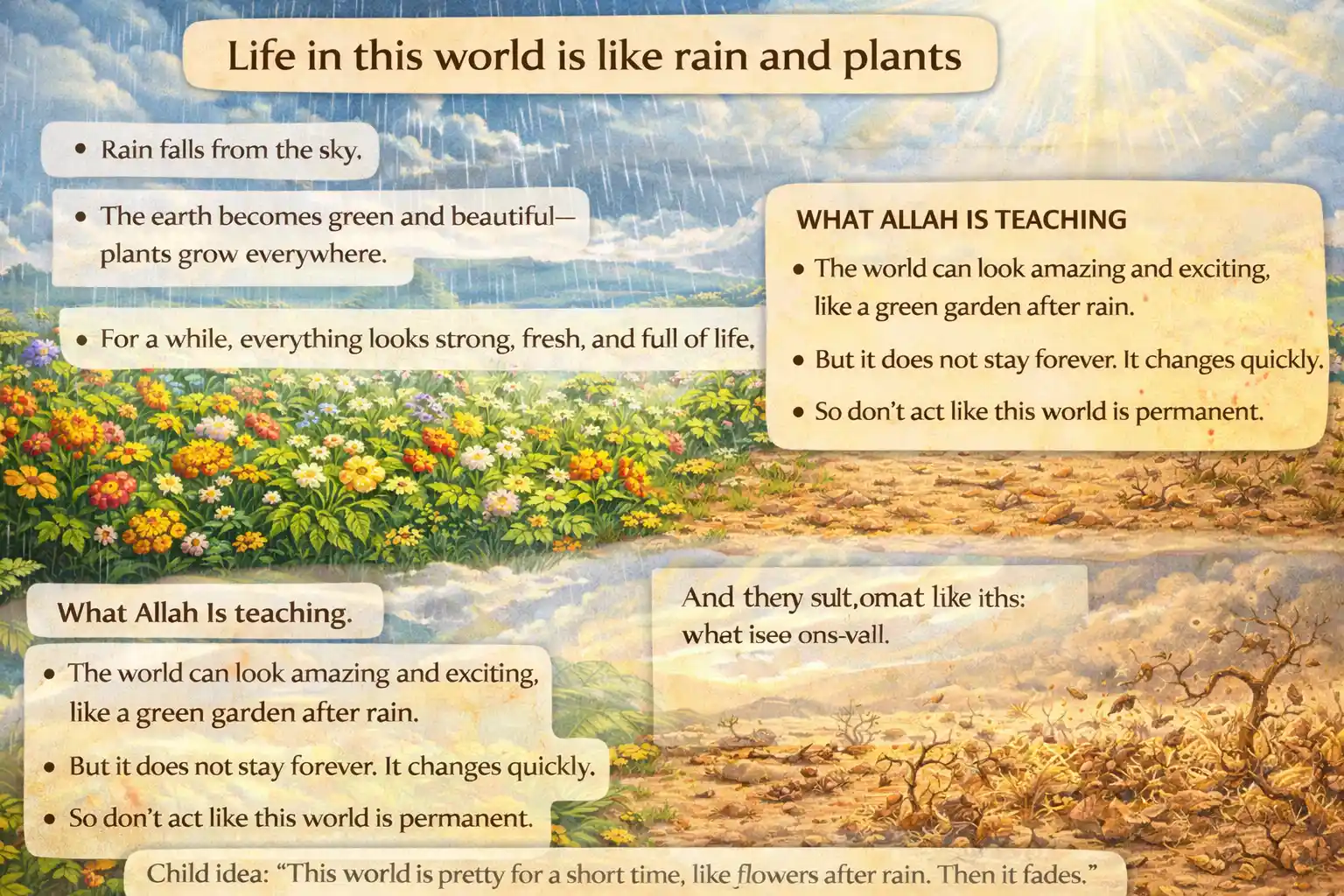
- 18:45 — Life in this world is like rain and plants
Allah says the life of this world is like rain that makes plants grow… then they dry up and the wind blows them away.
- Rain falls from the sky.
- The earth becomes green and beautiful—plants grow everywhere.
- For a while, everything looks strong, fresh, and full of life.
- Then the plants dry up, become brown and brittle, and the wind blows them away.
The world can look amazing and exciting, like a green garden after rain.
But it does not stay forever. It changes quickly.
So don’t act like this world is permanent.
Allah is able to do anything—He can give, take, grow, dry, and change everything.
“This world is pretty for a short time, like flowers after rain. Then it fades.”
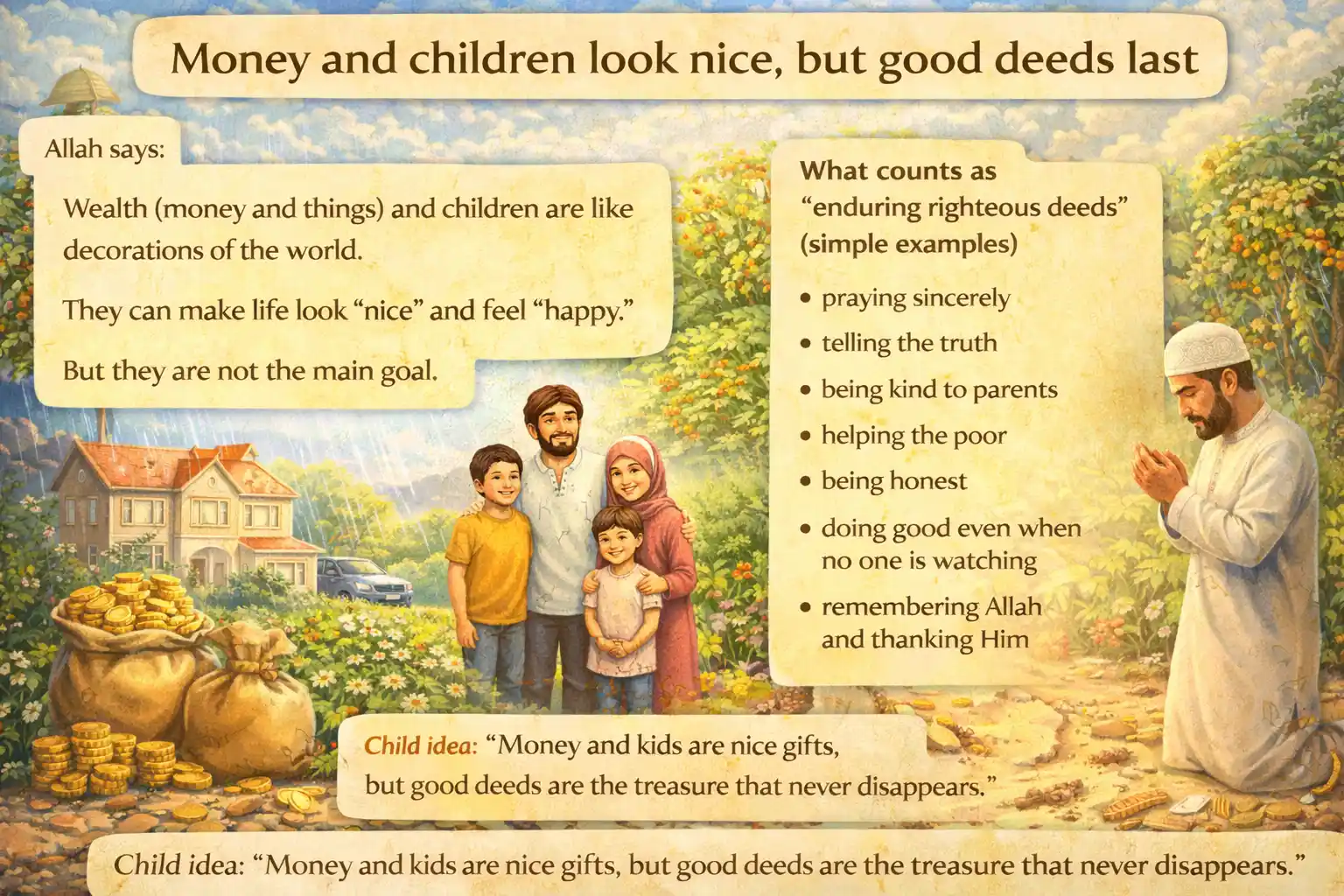
- 18:46 — Money and children look nice, but good deeds last
Wealth and children are decorations of this life, but lasting good deeds are better with Allah.
- Wealth (money and things) and children can make life look “nice” and feel “happy.”
- But they are not the main goal.
- Allah says something better is: enduring righteous deeds—good deeds Allah loves that stay with you forever.
- praying sincerely
- telling the truth
- being kind to parents
- helping the poor
- being honest
- doing good even when no one is watching
- remembering Allah and thanking Him
“Money and kids are nice gifts, but good deeds are the treasure that never disappears.”
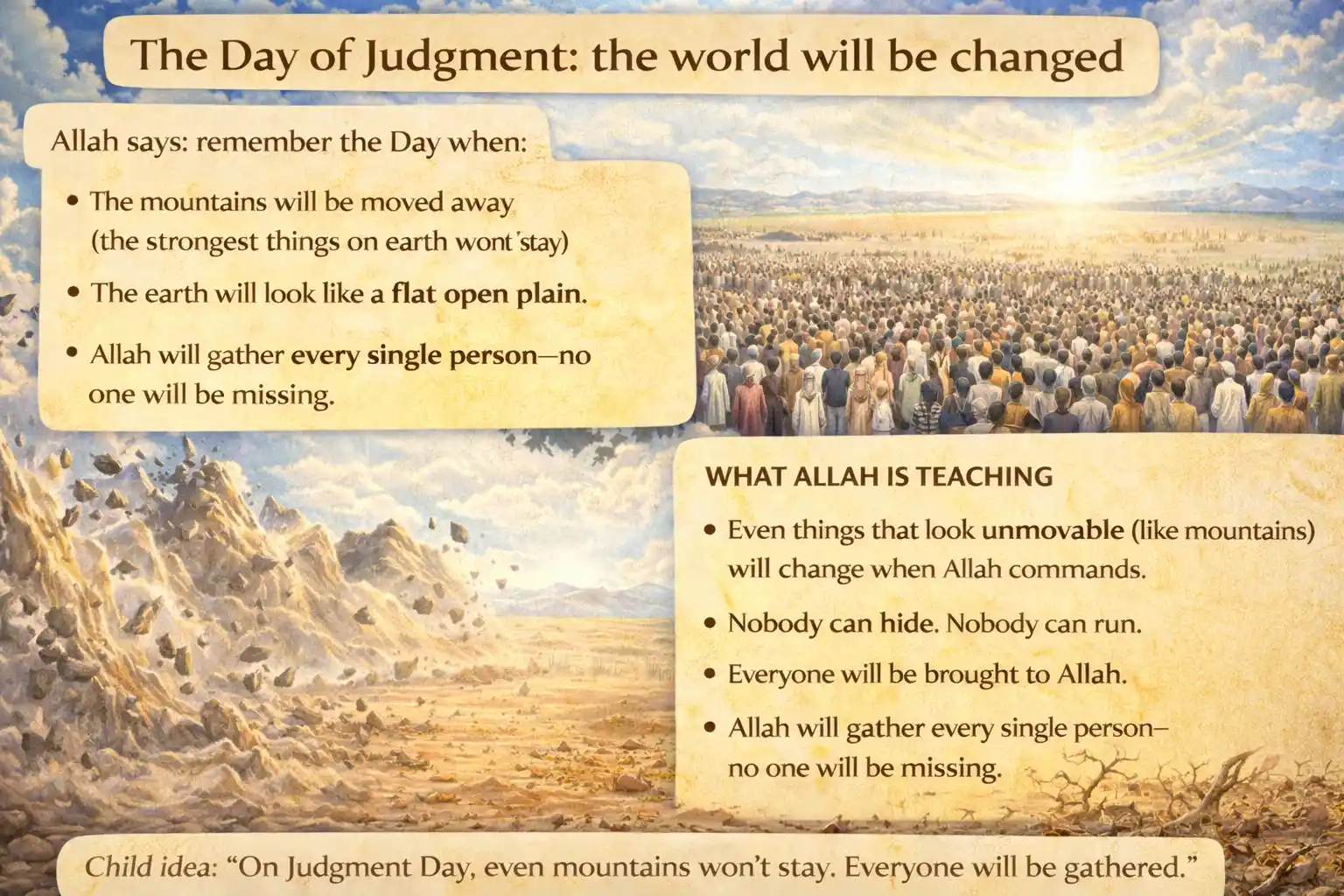
- 18:47 — The Day of Judgment: the world will be changed
Allah says: remember the Day when the mountains move away, the earth becomes flat, and everyone is gathered.
- The mountains will be moved away (even the strongest things on earth won’t stay).
- The earth will look like a flat open plain.
- Allah will gather every single person—no one will be missing.
Even things that look unmovable (like mountains) will change when Allah commands.
Nobody can hide. Nobody can run.
Everyone will be brought to Allah.
“On Judgment Day, even mountains won’t stay. Everyone will be gathered.”
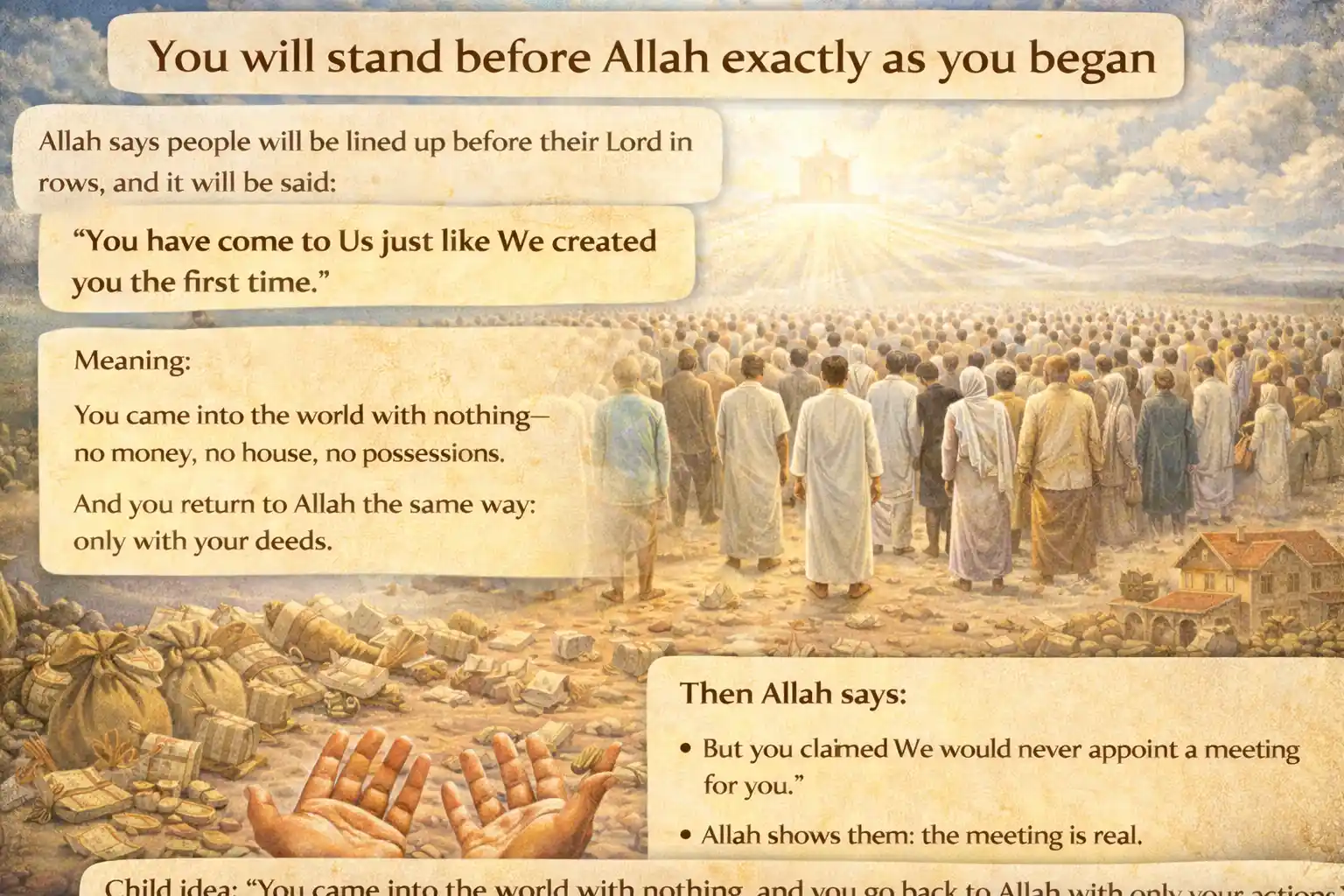
- 18:48 — You will stand before Allah exactly as you began
People will be lined up in rows and it will be said: “You have come to Us just like We created you the first time.”
- You came into the world with nothing—no money, no house, no possessions.
- You return to Allah the same way: only with your deeds.
- Some people acted like Judgment Day would never happen.
- Allah shows them: the meeting is real.
“You came into the world with nothing, and you go back to Allah with only your actions.”
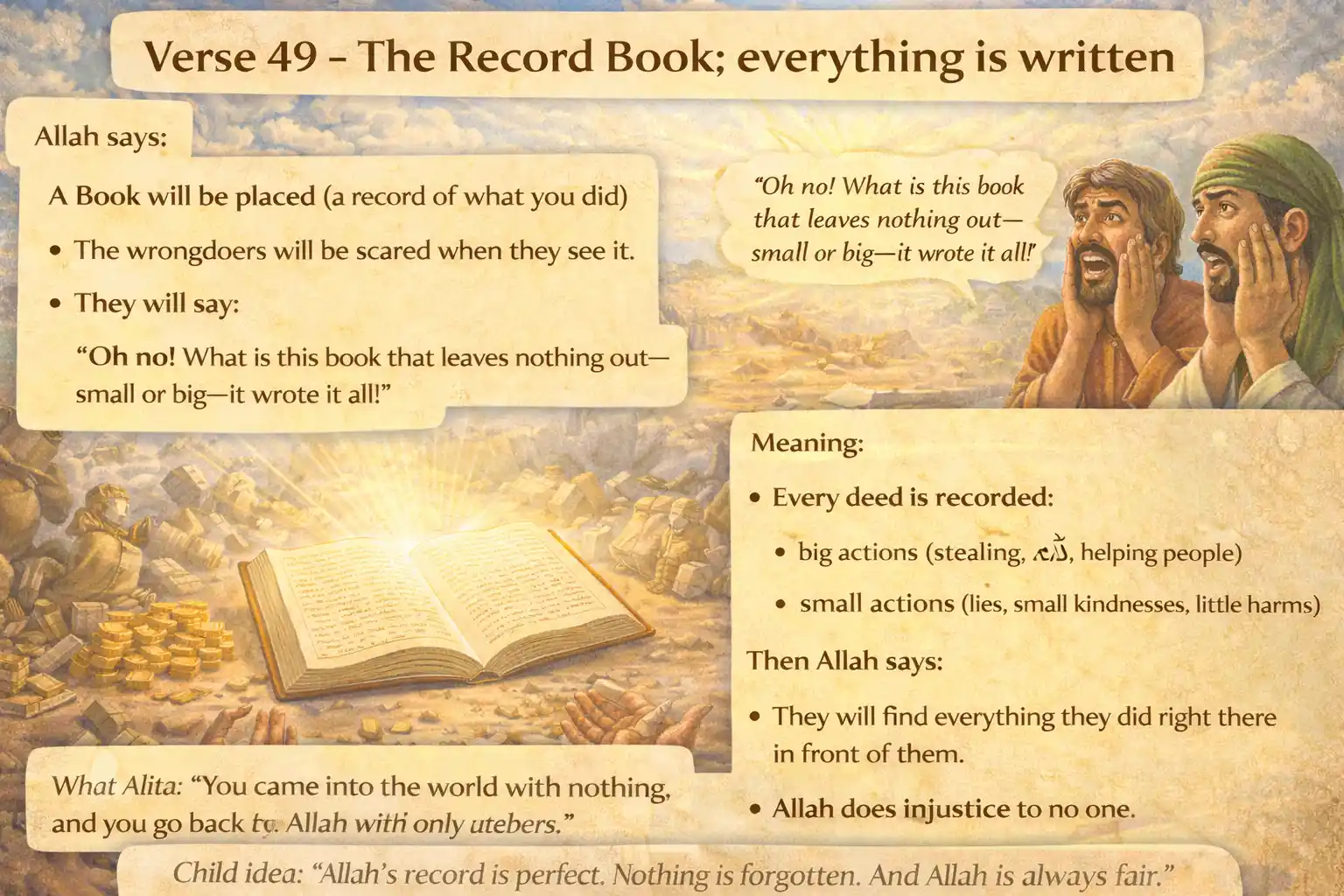
- 18:49 — The Record Book: everything is written
A Book will be placed, and people will be shocked that it recorded everything—small and big.
- A Book will be placed (a record of what you did).
- The wrongdoers will be scared when they see it.
- They will say: “Oh no! What is this book that leaves nothing out—small or big—it wrote it all!”
- Every deed is recorded:
- big actions (stealing, ظلم, helping people)
- small actions (lies, small kindnesses, little harms)
- They will find everything they did right there in front of them.
- Allah does injustice to no one.
- Allah will not blame you for something you did not do.
- Allah will not reduce someone’s good deeds unfairly.
- Allah will judge with perfect fairness.
“Allah’s record is perfect. Nothing is forgotten. And Allah is always fair.”
This world is temporary, like plants after rain.
What lasts is your good deeds.
And on Judgment Day, everyone will stand before Allah, and every action—small or big—will be shown, with complete fairness.
50. And (remember) when We said to the angels: “Prostrate to Adam,” so they prostrated except Iblis. He was of the jinn, so he rebelled against the command of his Lord. Will you then take him and his offspring as protectors besides Me while they are enemies to you? Wretched is the exchange for the wrongdoers.
51. I did not make them witness the creation of the heavens and the earth, nor the creation of themselves, and I would not take those who mislead as helpers.
52. And (remember) the Day He will say: “Call My partners whom you claimed.” Then they will call them, but they will not answer them. And We will place between them a gulf of destruction.
53. And the criminals will see the Fire, and know that they are to fall into it. And they will find no way to escape from it.
54. And indeed We have explained in this Qur’an for mankind every kind of example. But man is, of all things, most contentious.
55. And nothing prevents people from believing when guidance has come to them, and from seeking forgiveness of their Lord, except that the way of the former peoples should come upon them, or that the punishment should come upon them before their very eyes.
56. And We send not the messengers except as bearers of glad tidings and as warners. But those who disbelieve dispute with falsehood to refute the truth thereby, and they take My signs and what they are warned of in mockery.
57. And who is more unjust than one who is reminded of the signs of his Lord, then turns away from them and forgets what his hands have sent ahead? Indeed, We have placed coverings upon their hearts, lest they understand it, and in their ears deafness. And if you call them to guidance, they will never be guided, ever.
58. And your Lord is the Most Forgiving, full of mercy. If He were to take them to account for what they earned, He would surely hasten the punishment for them. Rather, for them is an appointed time, from which they will find no refuge.
59. And those towns—We destroyed them when they wronged, and We made for their destruction an appointed time.
Surah Al-Kahf (18:50–59) — Simple Explanation (Child-Friendly)
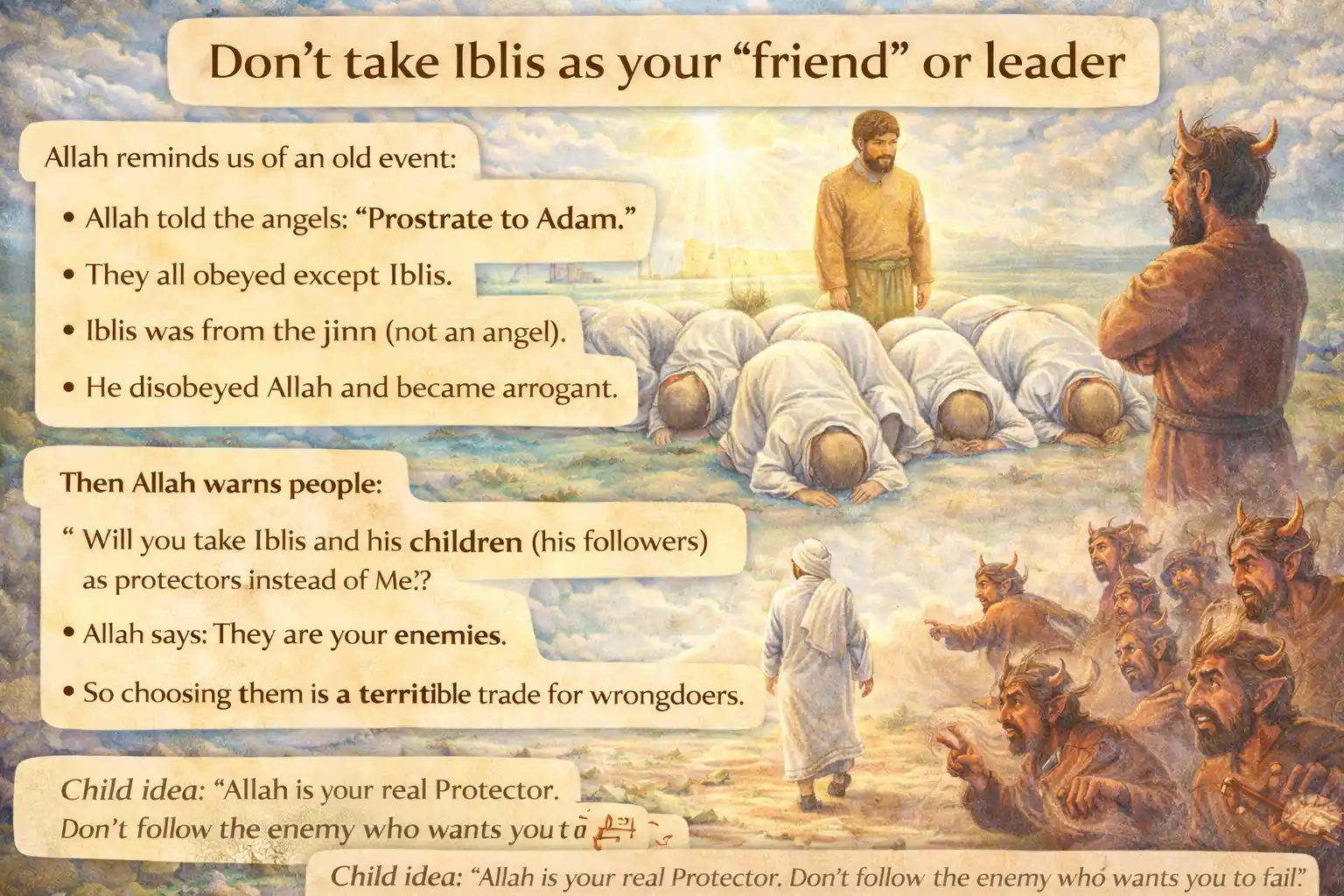
- 18:50 — Don’t take Iblis as your “friend” or leader
Allah reminds us of an old event: the command to prostrate to Adam.
- Allah told the angels: “Prostrate to Adam.”
- They all obeyed except Iblis.
- Iblis was from the jinn (not an angel).
- He disobeyed Allah and became arrogant.
- Allah warns: “Will you take Iblis and his offspring as protectors besides Me?”
- Allah says: They are your enemies.
- So choosing them is a terrible trade for wrongdoers.
“Allah is your real Protector. Don’t follow the enemy who wants you to fail.”
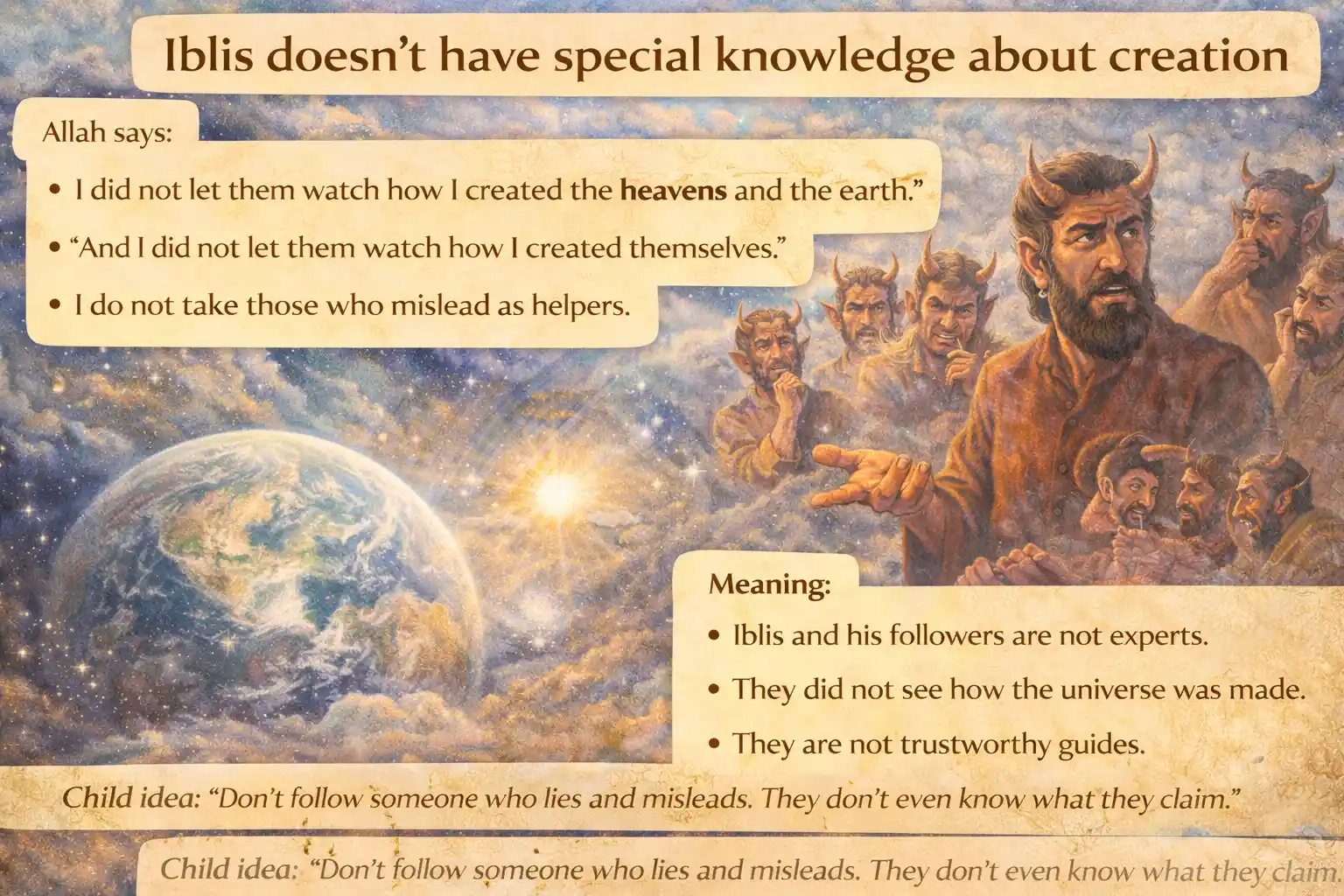
- 18:51 — Iblis doesn’t have special knowledge about creation
Allah says He did not make them witness creation, and He does not take misleaders as helpers.
- Allah says: “I did not let them watch how I created the heavens and the earth.”
- And: “I did not let them watch how I created themselves.”
- And: “I do not take those who mislead as helpers.”
- Meaning: Iblis and his followers are not experts.
- They did not see how the universe was made.
- They are not trustworthy guides.
“Don’t follow someone who lies and misleads. They don’t even know what they claim.”
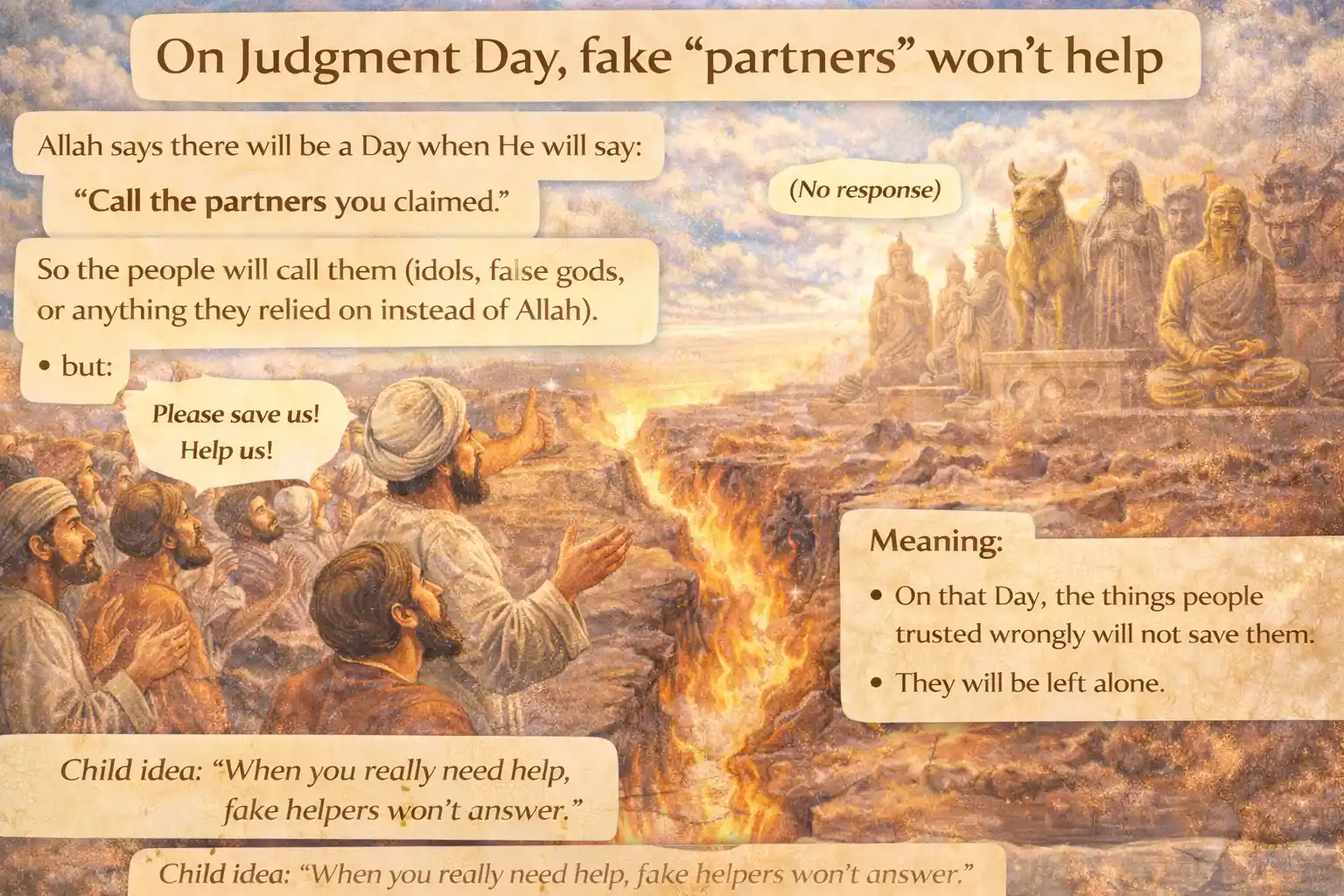
- 18:52 — On Judgment Day, fake “partners” won’t help
Allah will say: “Call My partners whom you claimed.” But they will not answer.
- There will be a Day when Allah will say: “Call the partners you claimed.”
- People will call them (idols, false gods, or anything they relied on instead of Allah)...
- But no one answers.
- And Allah will place between them a gulf of destruction (a huge separation and danger).
- Meaning: what they trusted wrongly will not save them.
- They will be left alone.
“When you really need help, fake helpers won’t answer.”
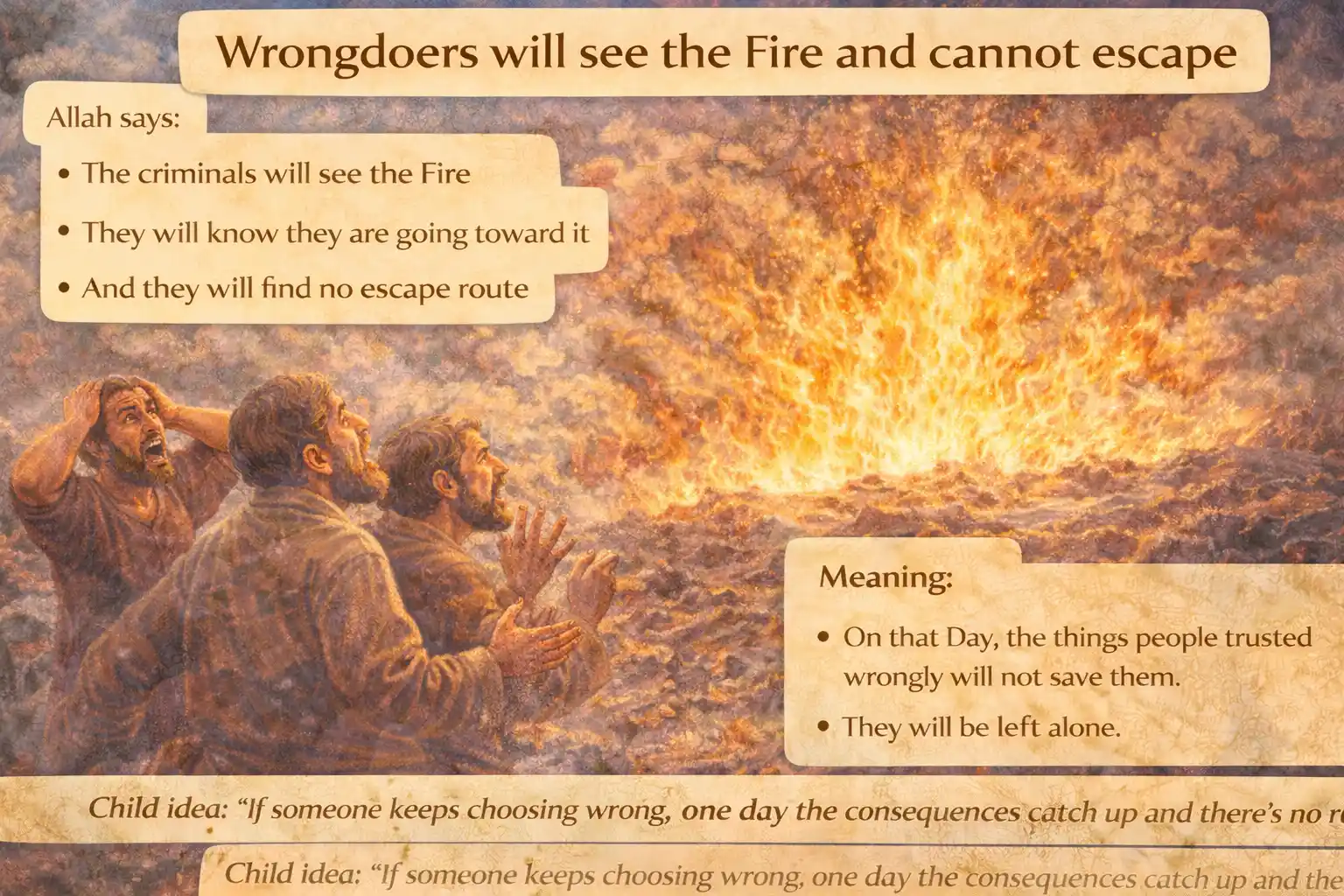
- 18:53 — Wrongdoers will see the Fire and cannot escape
The criminals will see the Fire, know they are heading toward it, and find no escape.
- The criminals will see the Fire.
- They will know they are going toward it.
- And they will find no escape route.
- Meaning: it becomes clear and unavoidable for them because they refused truth repeatedly.
“If someone keeps choosing wrong, one day the consequences catch up and there’s no running.”
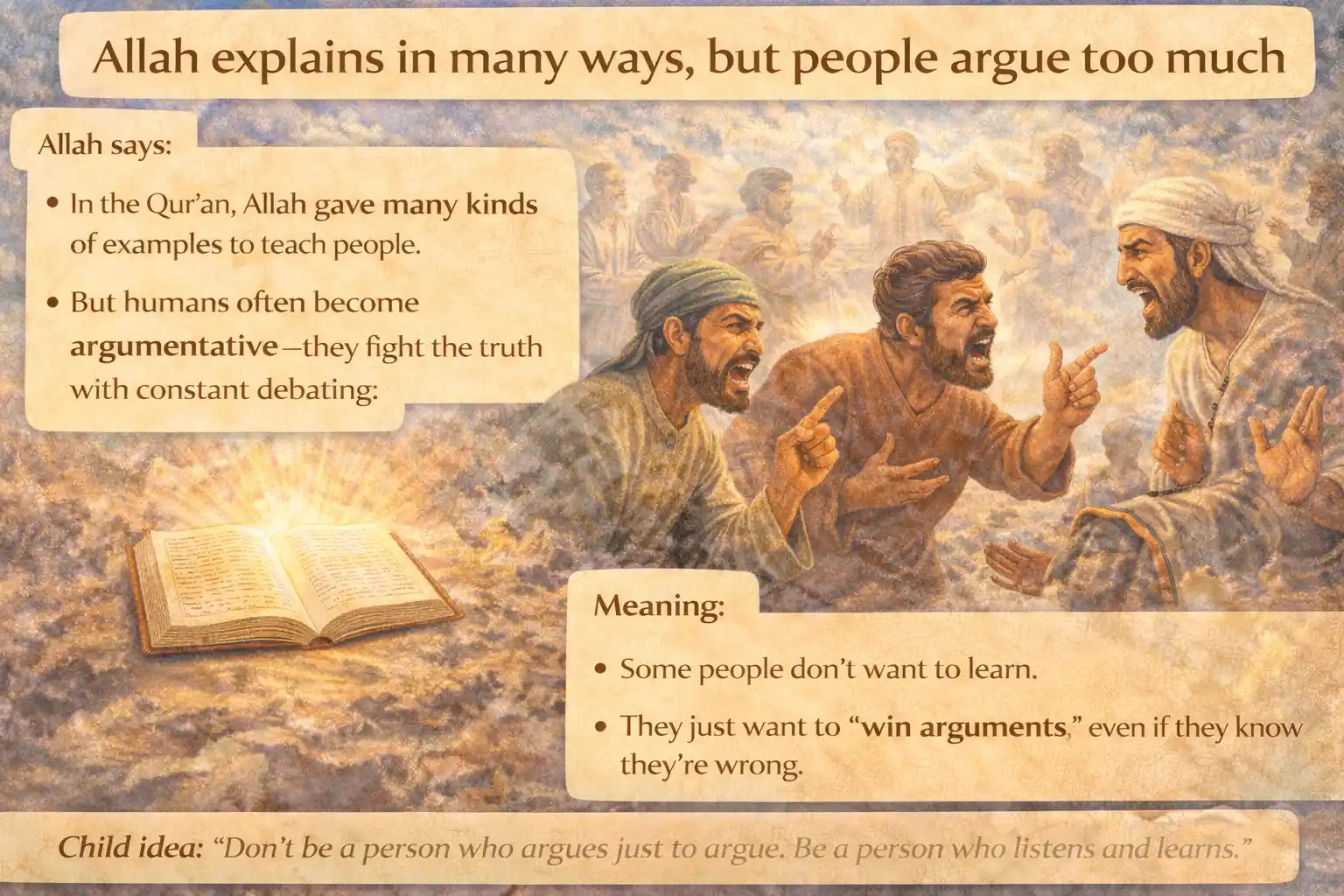
- 18:54 — Allah explains in many ways, but people argue too much
Allah has given many examples in the Qur’an, but humans often become overly argumentative.
- In the Qur’an, Allah gave many kinds of examples to teach people.
- But humans often become argumentative—they fight the truth with constant debating.
- Meaning: some people don’t want to learn; they just want to “win arguments,” even if they know they are wrong.
“Don’t be a person who argues just to argue. Be a person who listens and learns.”
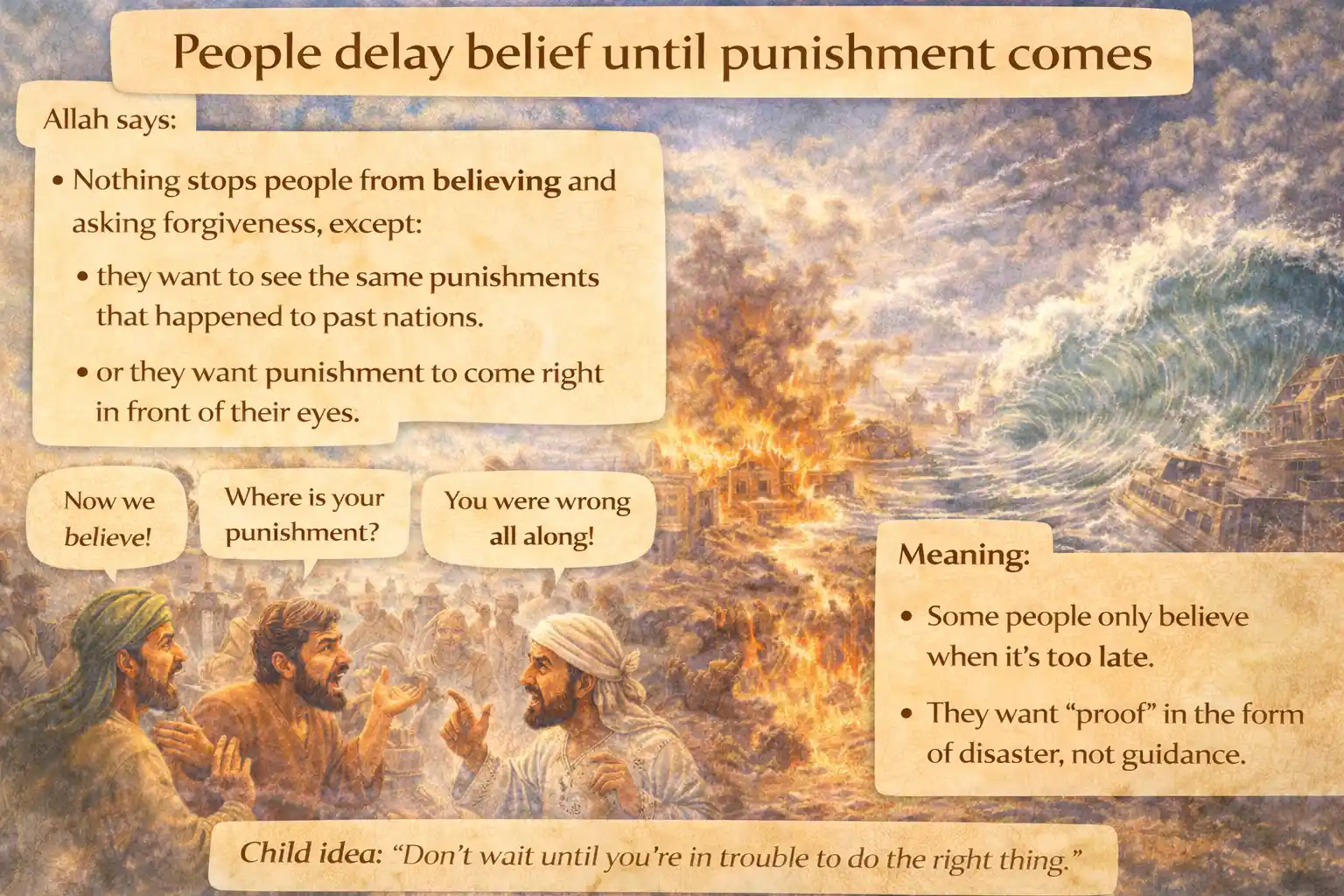
- 18:55 — People delay belief until punishment comes
Some people refuse to believe until they see punishment with their own eyes.
- Nothing stops people from believing and asking forgiveness, except:
- They want to see the same punishments that happened to past nations,
- Or they want punishment to come right in front of their eyes.
- Meaning: some people only believe when it’s too late.
- They want “proof” in the form of disaster, not guidance.
“Don’t wait until you’re in trouble to do the right thing.”
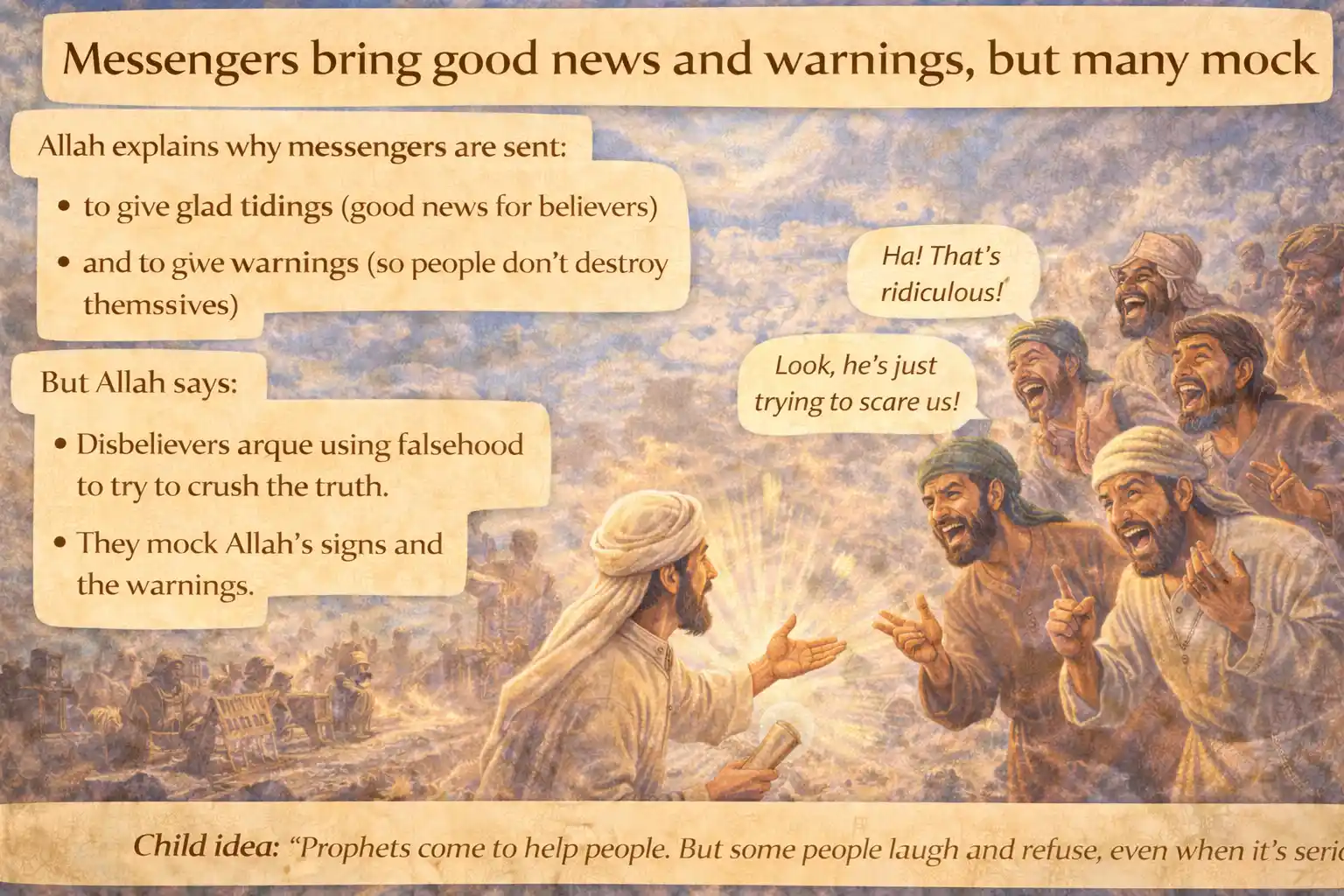
- 18:56 — Messengers bring good news and warnings, but many mock
Allah sends messengers with glad tidings and warnings, but some people argue falsely and mock.
- Allah explains why messengers are sent:
- To give glad tidings (good news for believers),
- And to give warnings (so people don’t destroy themselves).
- But Allah says: disbelievers argue using falsehood to try to crush the truth.
- They mock Allah’s signs and the warnings.
“Prophets come to help people. But some people laugh and refuse, even when it’s serious.”
- 18:57 — The most unjust person: someone who hears truth then turns away
Who is more unfair than someone reminded of Allah’s signs, then turns away and forgets their own actions?
- Allah says the most unfair person is one who:
- Is reminded of Allah’s signs,
- Then turns away,
- And forgets what they have done (their own bad actions).
- Allah describes what happens when someone repeatedly refuses truth:
- It becomes like there are covers over their heart (they don’t “get it” anymore),
- And deafness in their ears (they stop listening).
- Even if you call them, they won’t respond.
This is not about someone who makes one mistake.
This is about someone who keeps rejecting on purpose again and again, until they become spiritually “blocked.”
“If you keep saying ‘no’ to the truth, your heart can become hard and you stop understanding.”
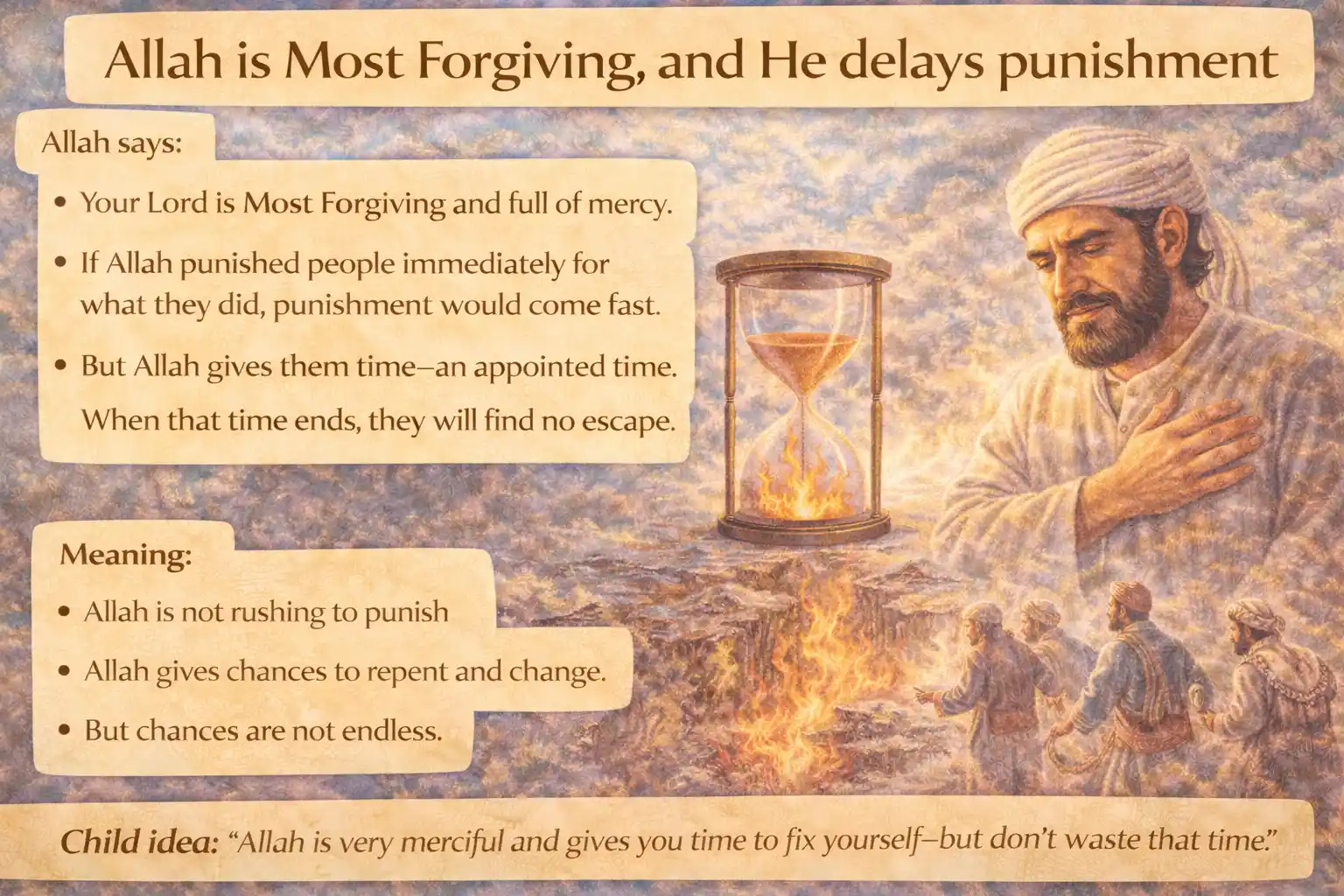
- 18:58 — Allah is Most Forgiving, and He delays punishment
Allah is Most Forgiving and full of mercy. He gives time, but it is not endless.
- Your Lord is Most Forgiving and full of mercy.
- If Allah punished people immediately for what they did, punishment would come fast.
- But Allah gives them time—an appointed time.
- When that time ends, they will find no escape.
- Meaning: Allah is not rushing to punish.
- Allah gives chances to repent and change.
- But chances are not endless.
“Allah is very merciful and gives you time to fix yourself—but don’t waste that time.”
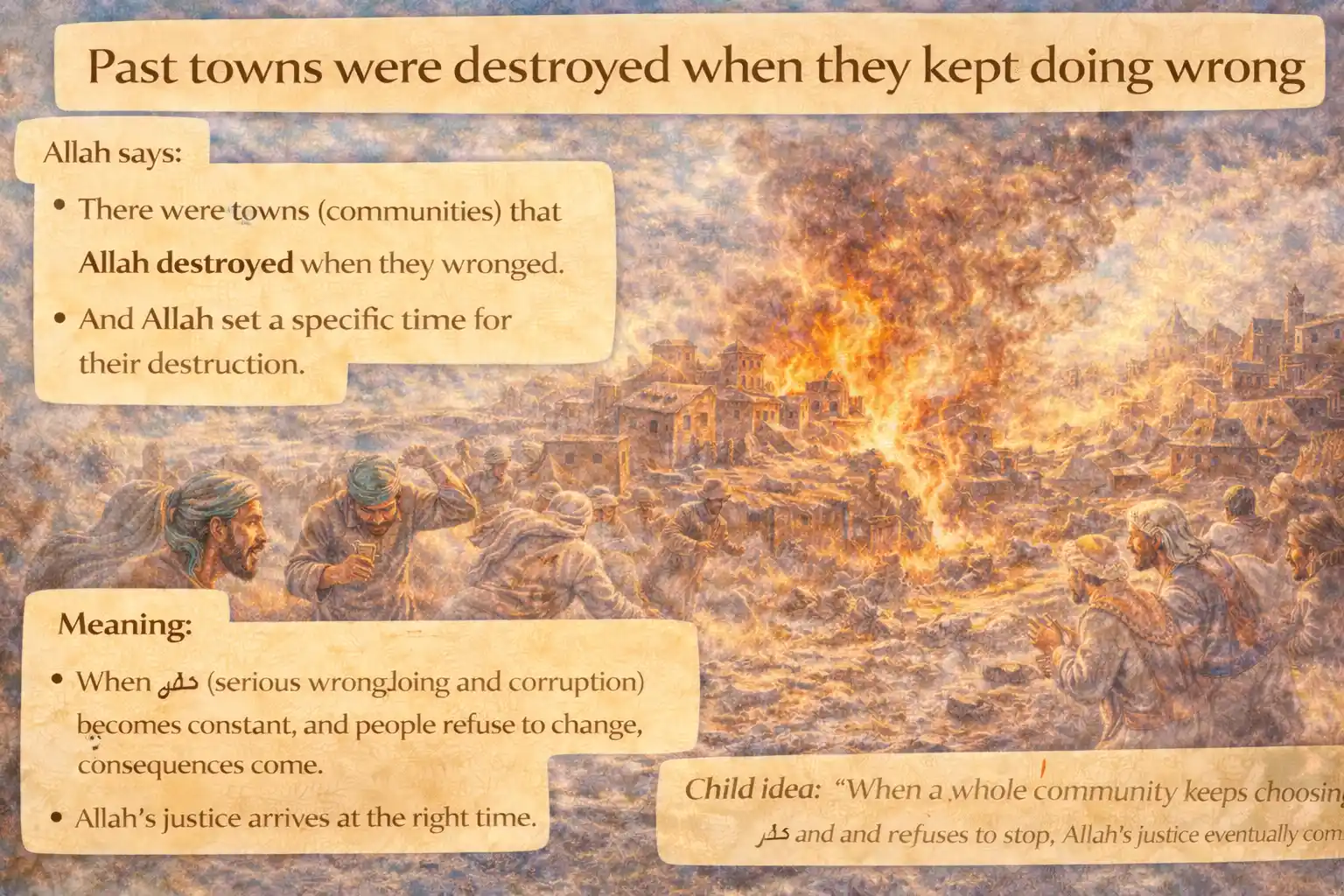
- 18:59 — Past towns were destroyed when they kept doing wrong
Communities were destroyed when they kept wronging, and Allah set a specific time for it.
- There were towns (communities) that Allah destroyed when they wronged.
- And Allah set a specific time for their destruction.
- Meaning: when ظلم (serious wrongdoing and corruption) becomes constant and people refuse to change, consequences come.
- Allah’s justice arrives at the right time.
“When a whole community keeps choosing ظلم and refuses to stop, Allah’s justice eventually comes.”
Don’t follow Iblis—he is an enemy, not a protector.
The Qur’an gives many clear lessons, but some people argue and mock instead of learning.
Allah gives time to repent because He is merciful.
But Judgment Day is real, and every choice has an ending.
60. And (remember) when Musa said to his servant: “I will not cease until I reach the junction of the two seas, or I will continue for a long time.”
61. But when they reached the junction between them, they forgot their fish, and it took its way into the sea, slipping away.
62. So when they had passed on, he said to his servant: “Bring us our morning meal. Indeed, we have suffered in this journey of ours fatigue.”
63. He said: “Did you see? When we took refuge at the rock, I indeed forgot the fish—and none made me forget it except Satan, that I should mention it. And it took its way into the sea in a wondrous manner.”
64. He said: “That is what we were seeking.” So they returned, retracing their footsteps.
65. Then they found a servant from among Our servants, to whom We had given mercy from Us, and We had taught him knowledge from Our presence.
66. Musa said to him: “May I follow you, on the condition that you teach me from what you have been taught of right guidance?”
67. He said: “Indeed, you will not be able to have patience with me.”
68. “And how can you be patient over what you do not encompass in knowledge?”
69. Musa said: “You will find me, if Allah wills, patient, and I will not disobey you in any matter.”
70. He said: “Then if you follow me, do not ask me about anything until I myself mention to you its explanation.”
Surah Al-Kahf (18:60–70) — Musa’s Journey to Learn (Child-Friendly)
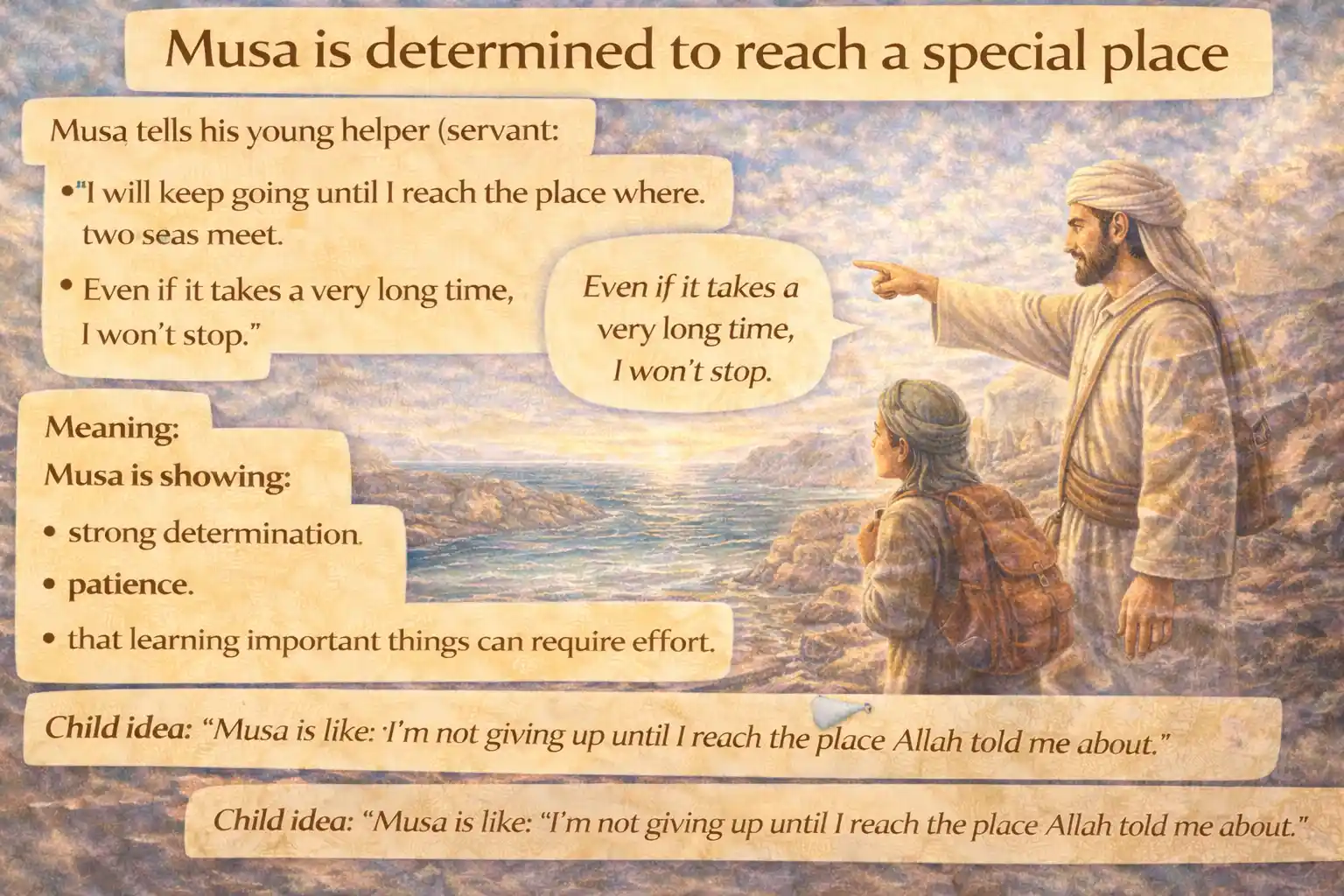
- 18:60 — Musa is determined to reach a special place
Musa says he will keep going until he reaches the place where two seas meet, even if it takes a long time.
- Musa tells his young helper (servant):
- “I will keep going until I reach the place where two seas meet.”
- “Even if it takes a very long time, I won’t stop.”
- Musa is showing strong determination.
- Musa is showing patience.
- He teaches that learning important things can require effort and time.
“Musa is like: ‘I’m not giving up until I reach the place Allah told me about.’”
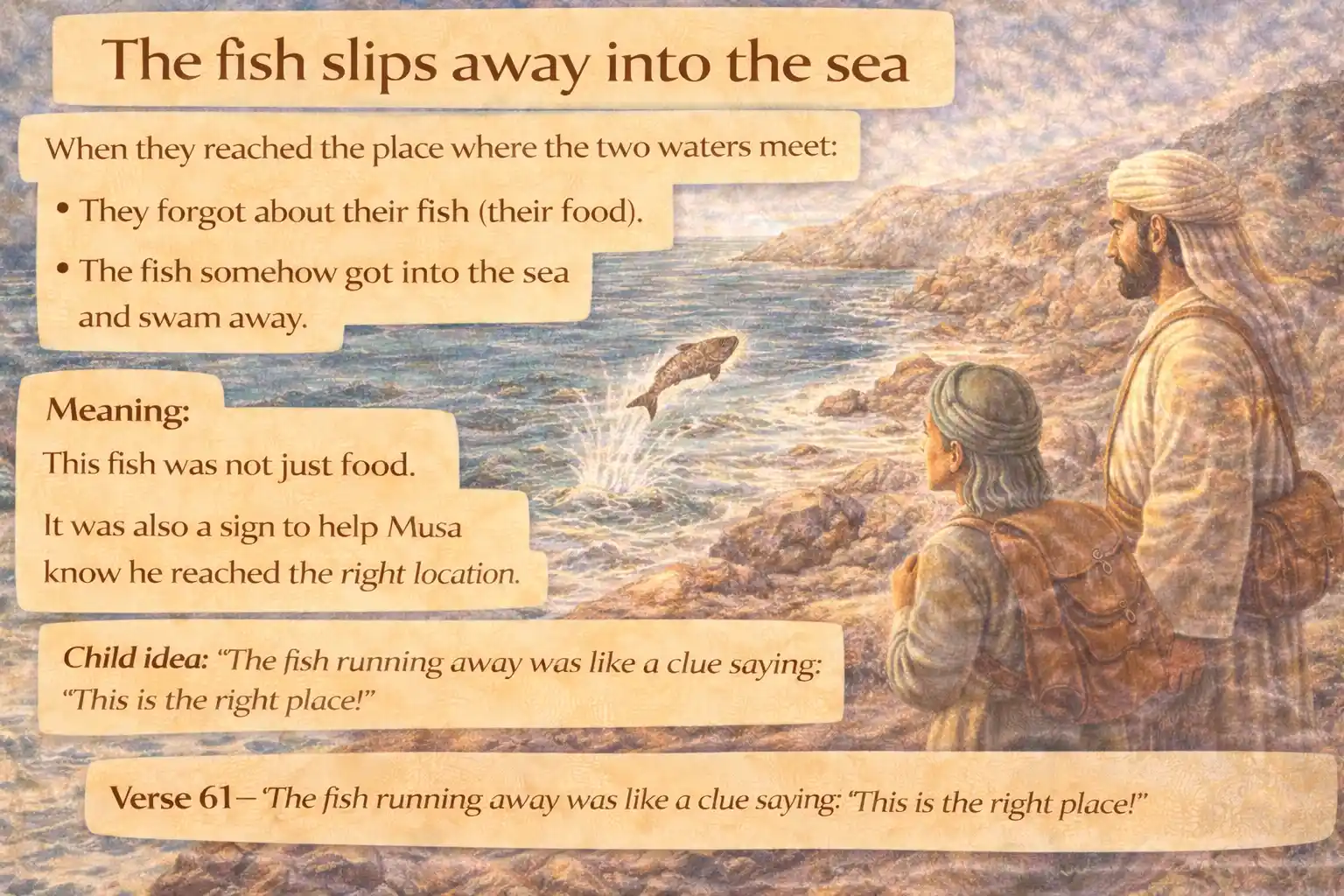
- 18:61 — The fish slips away into the sea
When they reached the meeting place of the two waters, they forgot their fish, and it slipped into the sea.
- When they reached the place where the two waters meet:
- They forgot about their fish (their food).
- The fish somehow got into the sea and swam away.
This fish was not just food. It was also a sign to help Musa know he reached the right location.
“The fish running away was like a clue saying: ‘This is the right place!’”
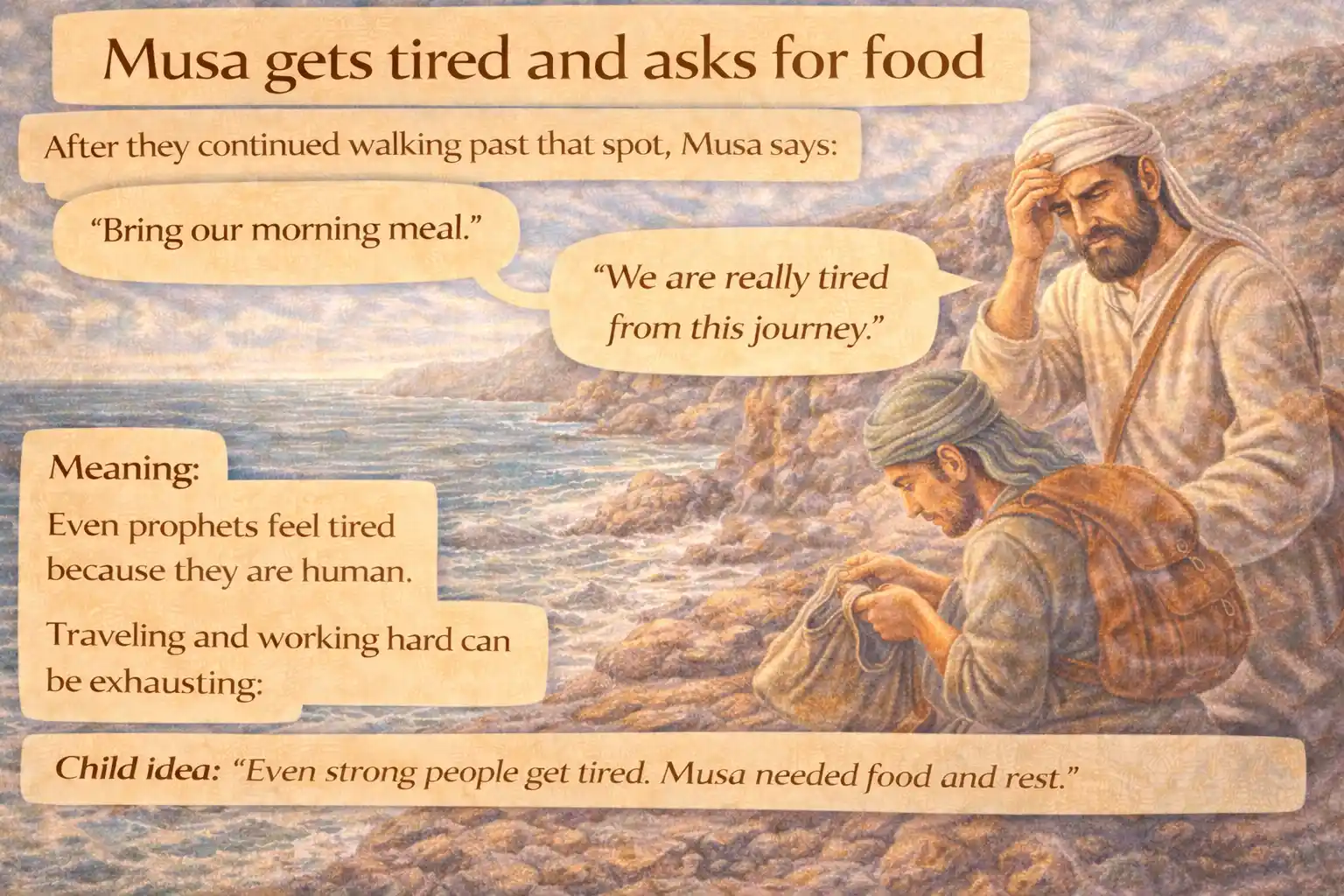
- 18:62 — Musa gets tired and asks for food
After walking further, Musa asks for their morning meal and mentions the journey is tiring.
- After they continued walking past that spot, Musa says:
- “Bring our morning meal.”
- “We are really tired from this journey.”
Even prophets feel tired because they are human. Traveling and working hard can be exhausting.
“Even strong people get tired. Musa needed food and rest.”
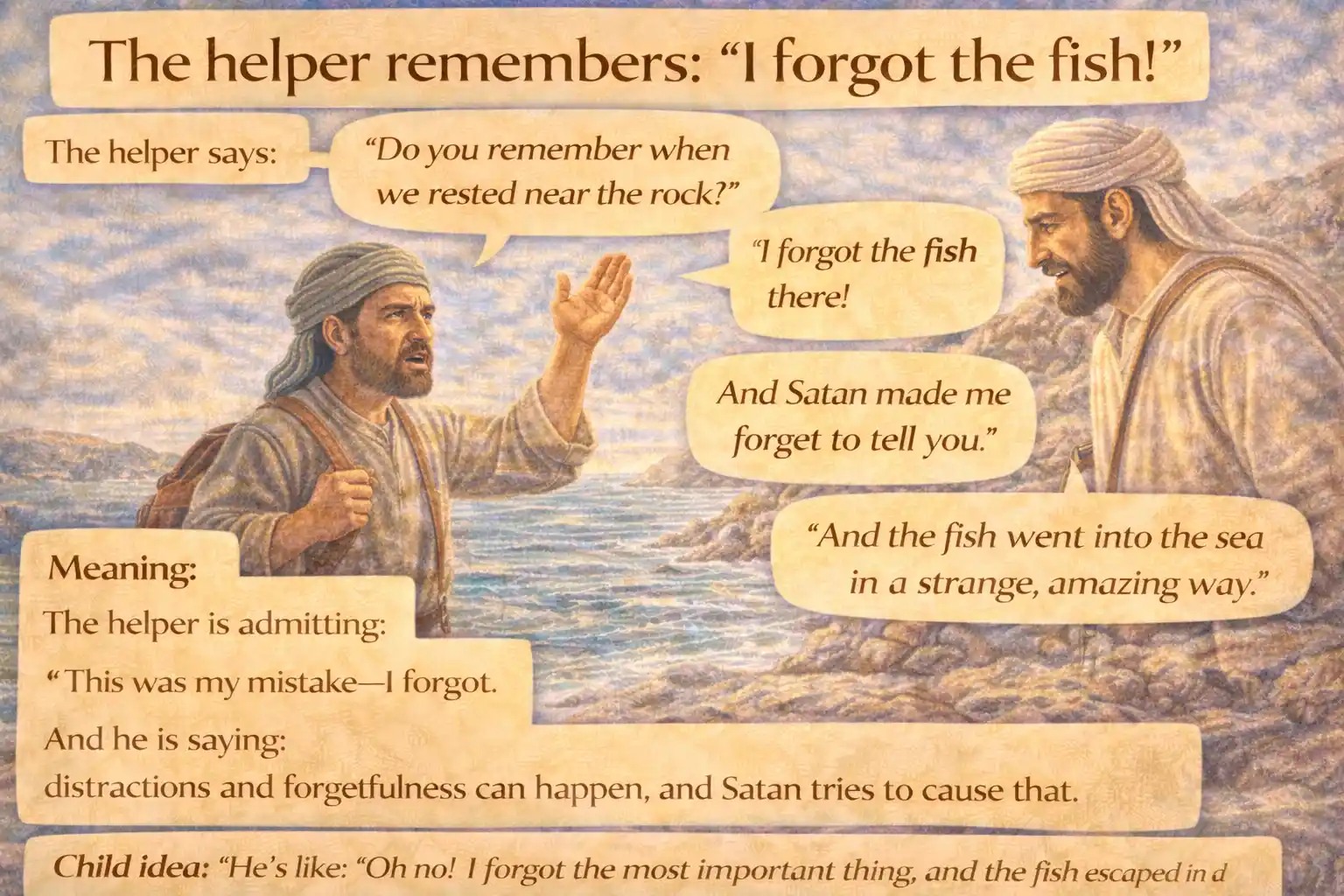
- 18:63 — The helper remembers: “I forgot the fish!”
The helper remembers they forgot the fish near the rock, and that it escaped in a strange way.
- The helper says:
- “Do you remember when we rested near the rock?”
- “I forgot the fish there!”
- “Satan made me forget to tell you.”
- “And the fish went into the sea in a strange, amazing way.”
- The helper is admitting: “This was my mistake—I forgot.”
- He shows that distractions and forgetfulness can happen, and Satan tries to cause that.
“He’s like: ‘Oh no! I forgot the most important thing, and the fish escaped in a weird way!’”
- 18:64 — Musa says: “That’s the sign we were looking for!”
Musa realizes the fish escaping is the sign, so they return and retrace their footsteps.
- Musa immediately says: “That is exactly what we were searching for!”
- Then they:
- Turned back,
- And followed their own footprints to return to the rock area.
- Musa understands the fish escaping was the clue.
- They must go back because they passed the right place.
“Musa is like: ‘That fish escaping is our clue—let’s go back now!’”
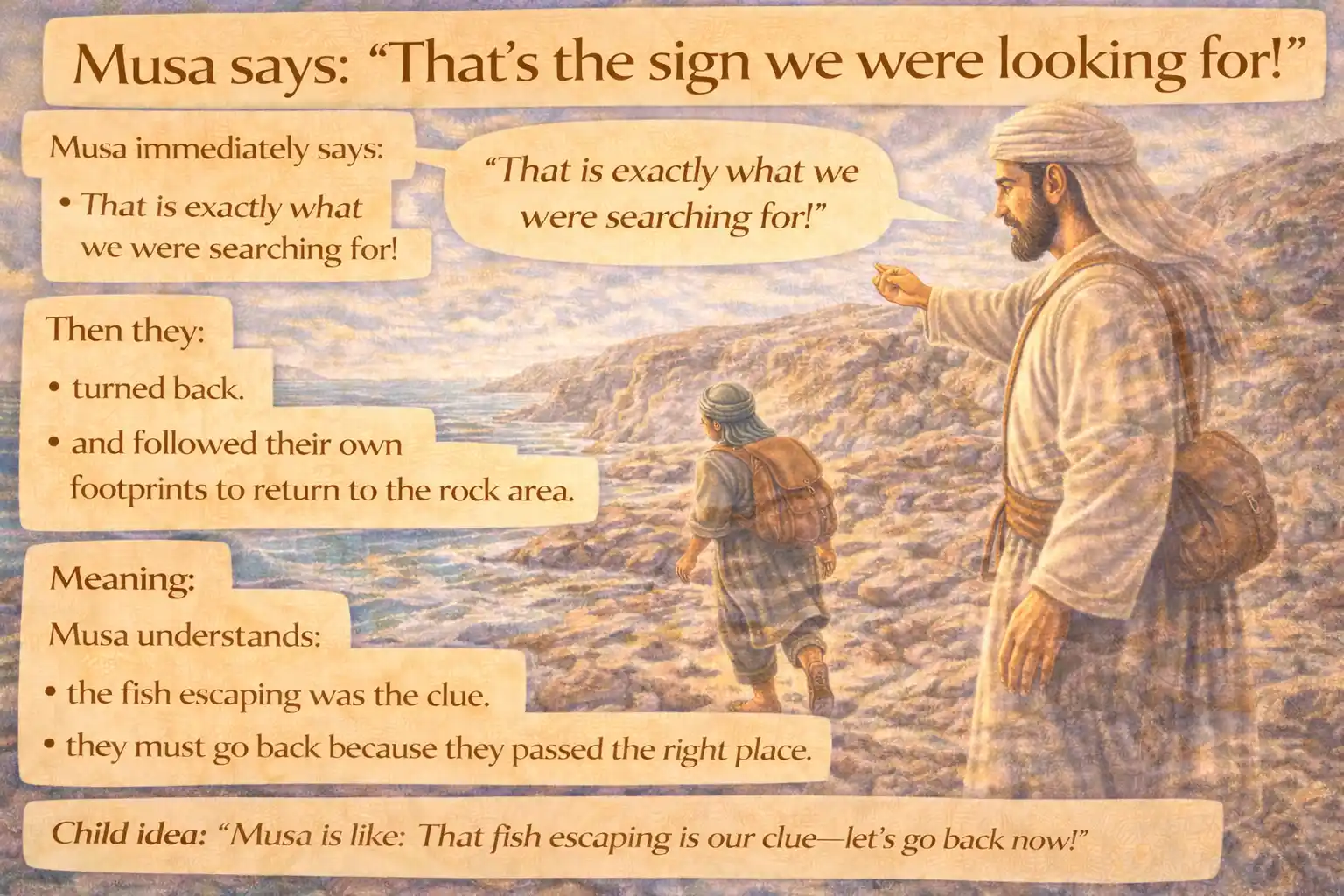
- 18:65 — They meet a special servant of Allah
They find a servant of Allah who was given mercy and taught special knowledge.
- They find a man described as:
- A servant from among Allah’s servants,
- Allah gave him mercy,
- And Allah taught him special knowledge.
- This person is often called Al-Khidr in Islamic tradition, but the Qur’an describes him mainly as a servant given mercy and knowledge.
Allah can give different kinds of knowledge to different people. Musa is a prophet, but Allah still has more things for Musa to learn.
“They met someone Allah taught special lessons to.”
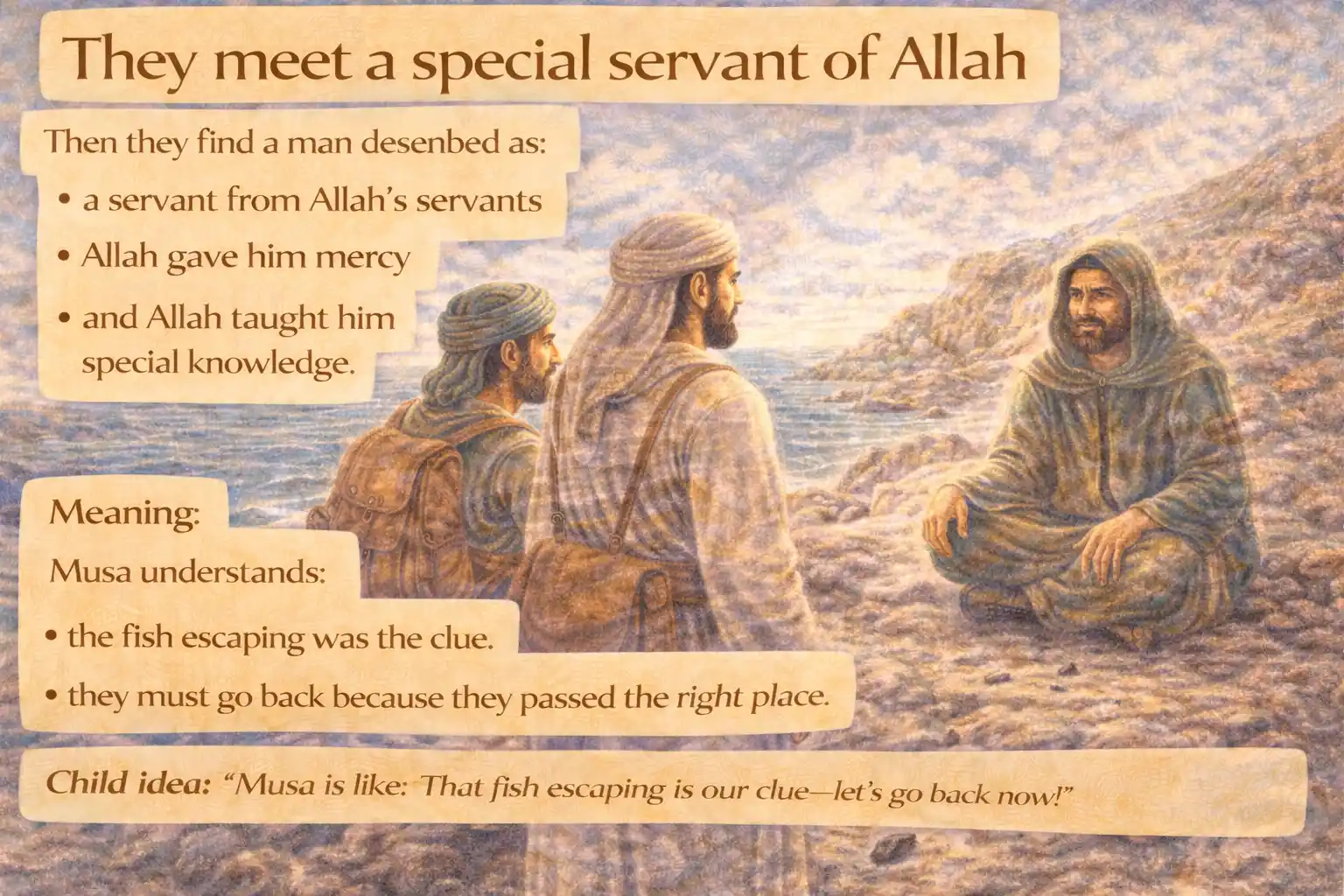
- 18:66 — Musa politely asks to learn from him
Musa asks permission to follow him so he can learn guidance Allah taught him.
- Musa says:
- “May I follow you?”
- “So you can teach me some of the right guidance that Allah taught you?”
- Even though Musa is a great prophet, he shows humility.
- He shows good manners.
- He shows a willingness to learn.
“Musa is basically saying: ‘Can I come with you and learn from you, please?’”
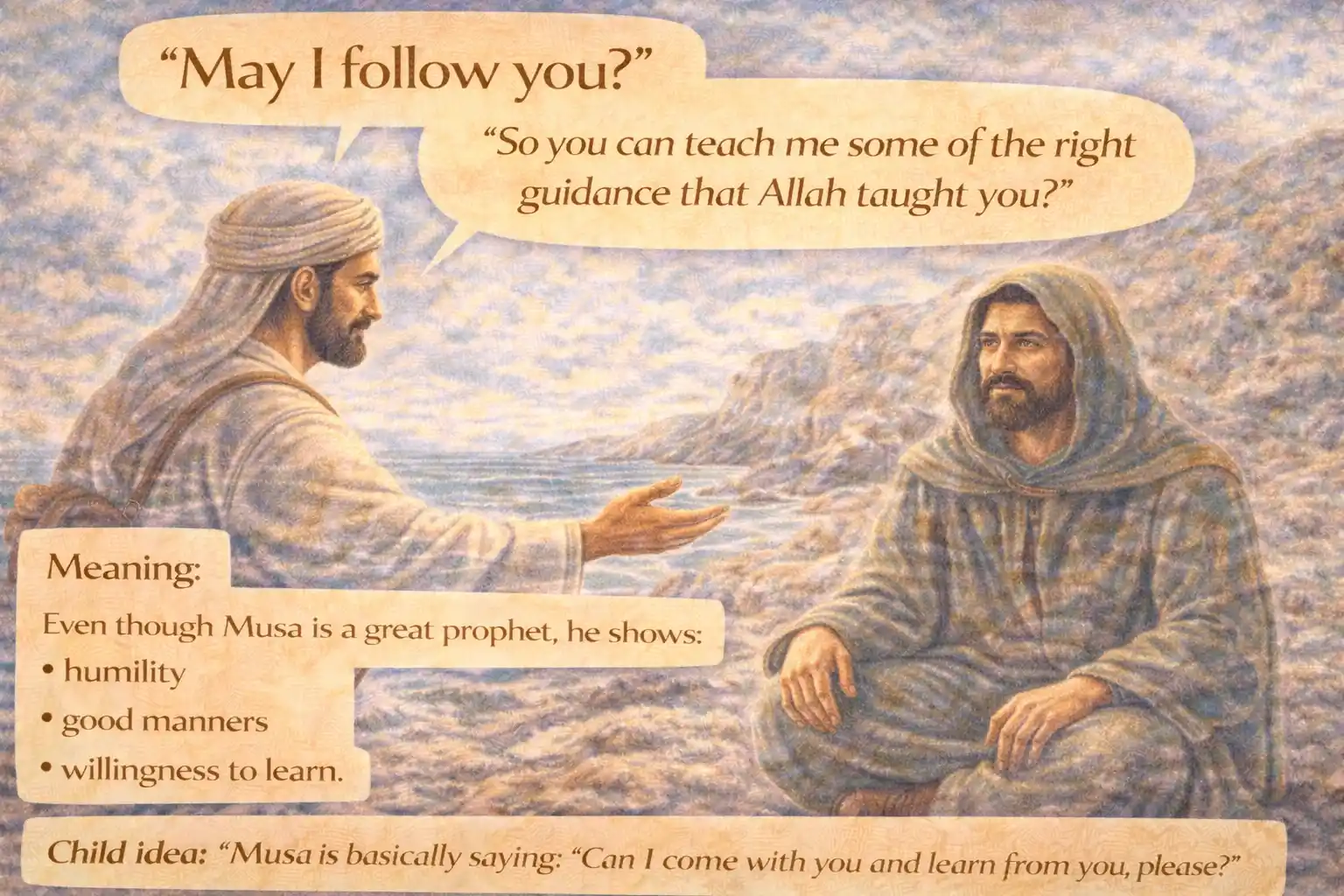
- 18:67 — The man warns Musa: “You won’t be patient with me”
The man says Musa will not be able to be patient with him.
- The man replies: “You will not be able to be patient with me.”
He knows that what he does will look confusing at first.
“He’s like: ‘The things you’ll see will be hard for you to handle.’”
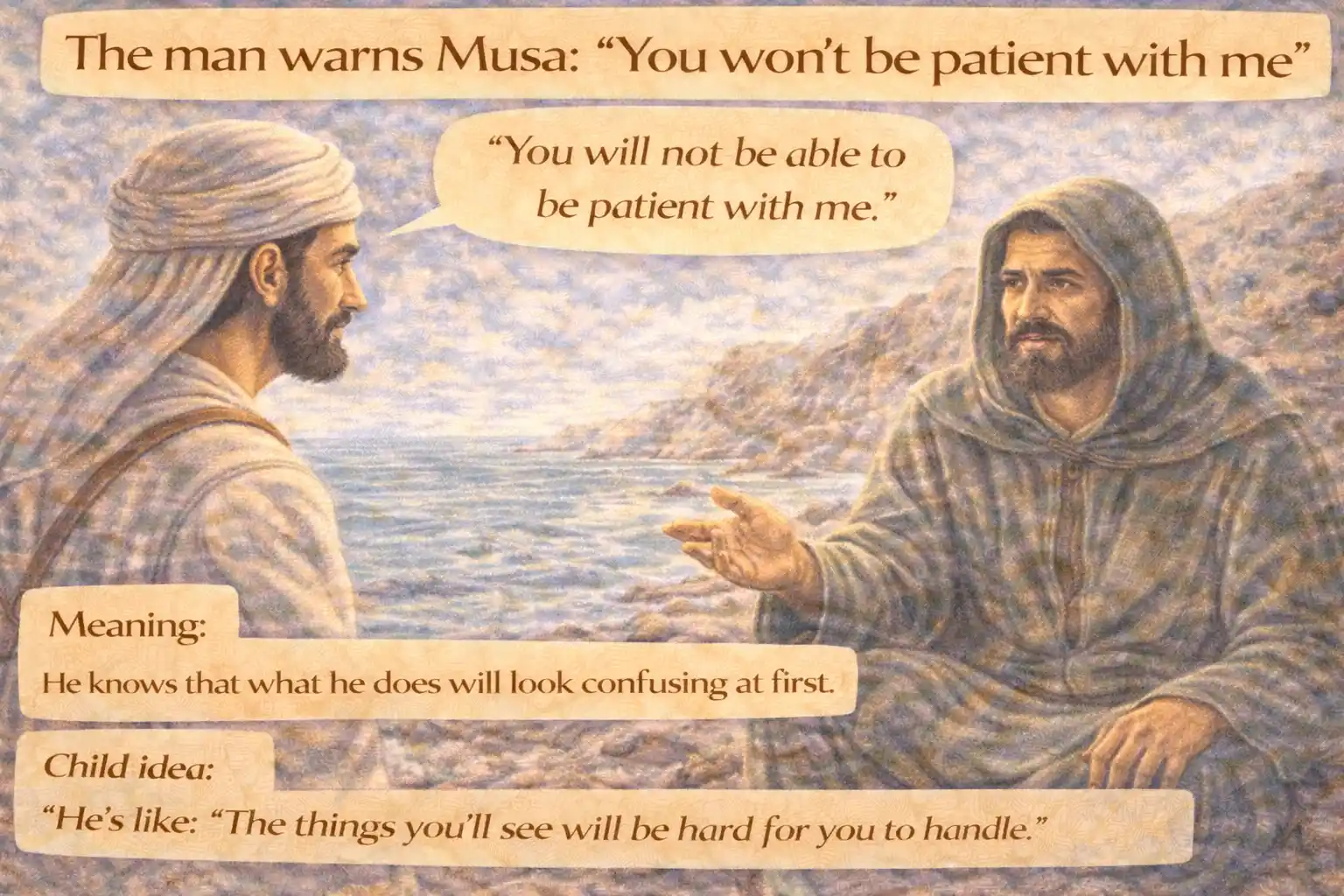
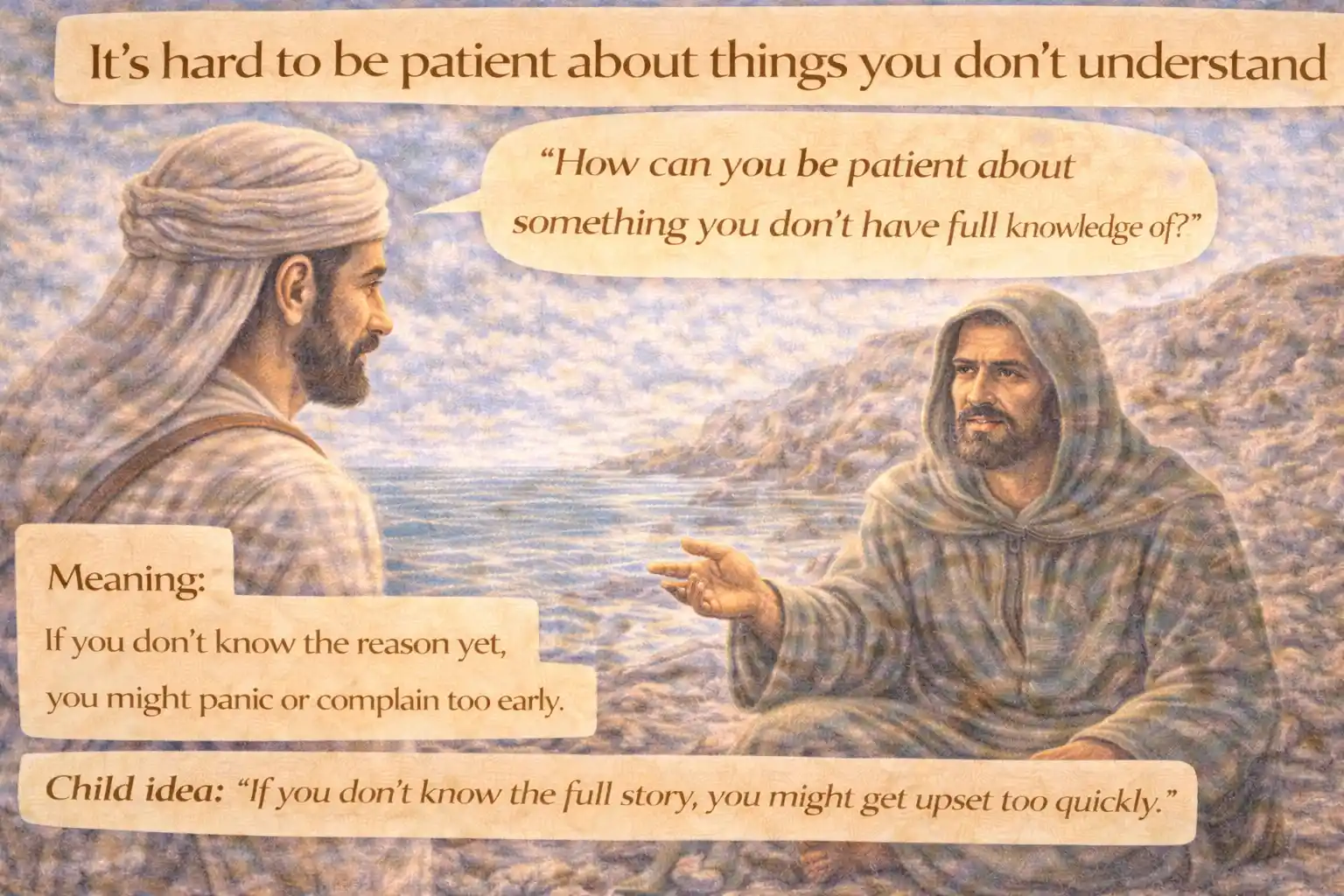
- 18:68 — It’s hard to be patient about things you don’t understand
He explains: it is hard to be patient with something you do not fully understand yet.
- He explains:
- “How can you be patient about something you don’t have full knowledge of?”
If you don’t know the reason yet, you might panic or complain too early.
“If you don’t know the full story, you might get upset too quickly.”
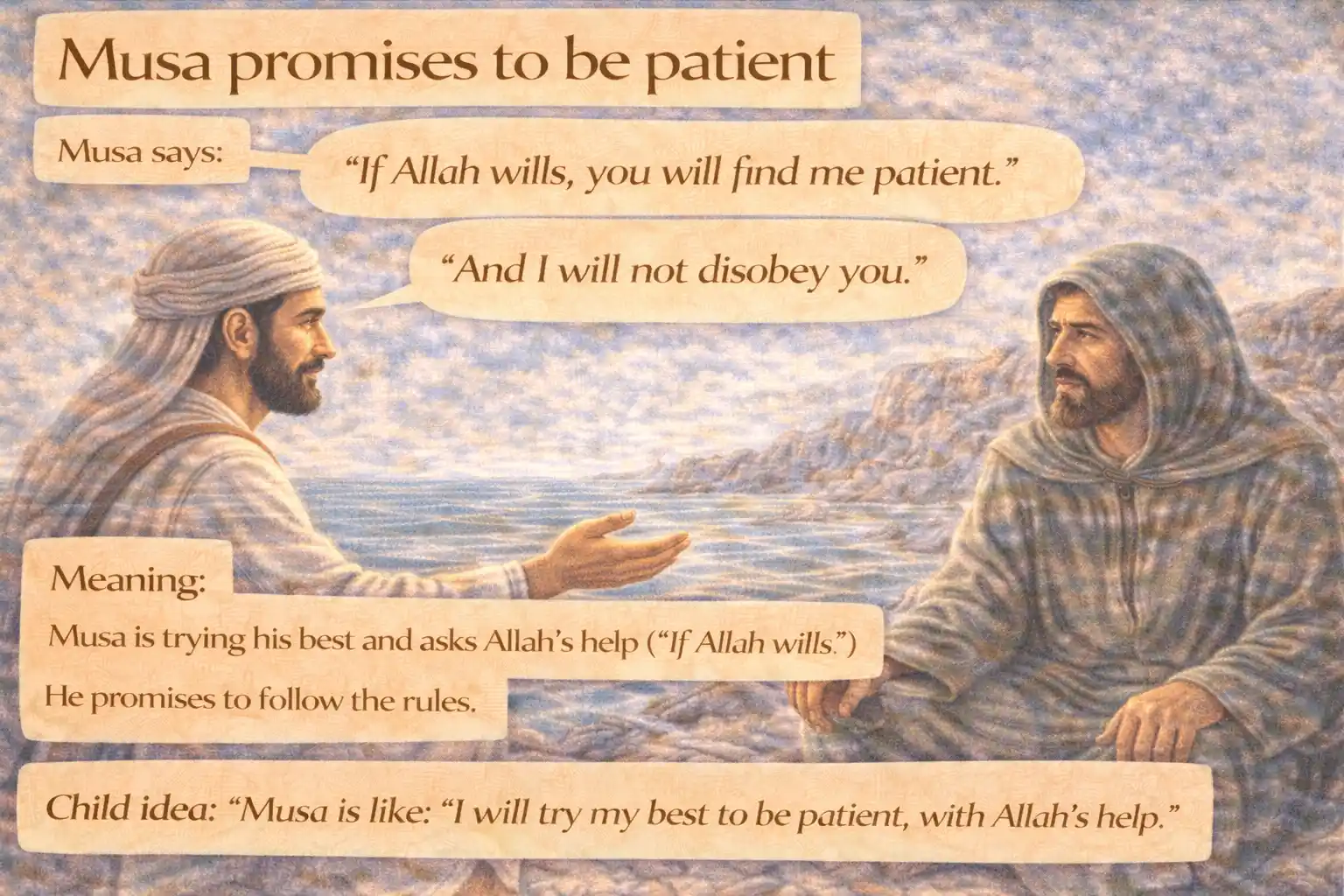
- 18:69 — Musa promises to be patient
Musa promises patience (with Allah’s help) and promises not to disobey.
- Musa says:
- “If Allah wills, you will find me patient.”
- “And I will not disobey you.”
Musa is trying his best and asks Allah’s help (“If Allah wills”). He promises to follow the rules.
“Musa is like: ‘I will try my best to be patient, with Allah’s help.’”
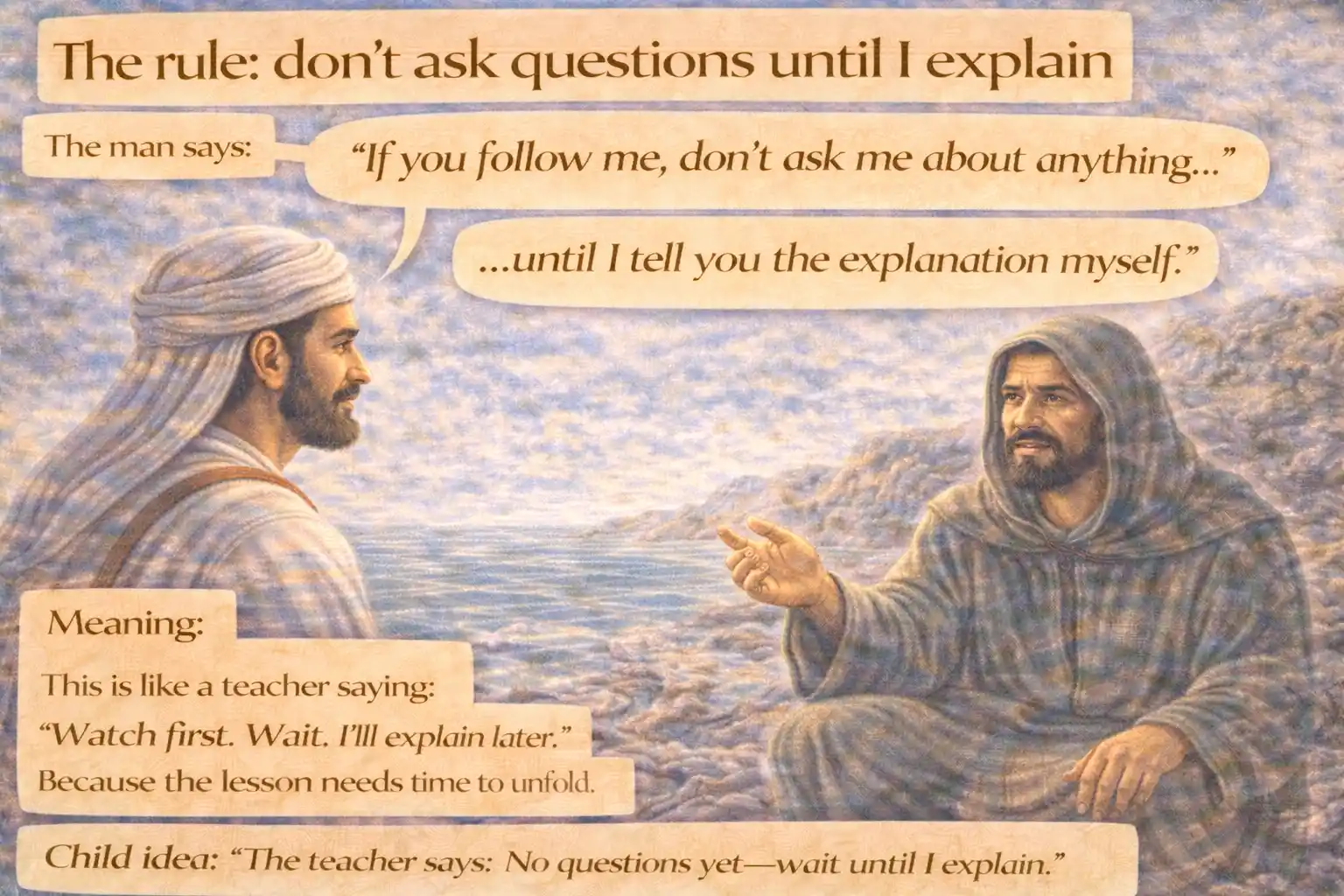
- 18:70 — The rule: don’t ask questions until I explain
The man sets a rule: do not ask questions until he explains later.
- The man says:
- “If you follow me, don’t ask me about anything…”
- “…until I tell you the explanation myself.”
This is like a teacher saying: “Watch first. Wait. I’ll explain later.” Because the lesson needs time to unfold.
“The teacher says: ‘No questions yet—wait until I explain.’”
Musa goes on a long journey to learn.
A fish escaping into the sea is the sign that they reached the right place.
Musa meets a servant of Allah with special knowledge.
Musa asks to learn.
The servant warns: “You won’t understand at first—so you must be patient and not ask until later.”
71. So they set out, until when they embarked on the ship, he made a hole in it. He (Musa) said: “Have you made a hole in it to drown its people? You have certainly done a grave thing!”
72. He said: “Did I not say that you would not be able to have patience with me?”
73. Musa said: “Do not blame me for what I forgot, and do not overburden me in my affair with difficulty.”
74. So they set out, until when they met a boy, he killed him. He (Musa) said: “Have you killed a pure soul for other than a soul? You have certainly done a terrible thing!”
75. He said: “Did I not tell you that you would not be able to have patience with me?”
76. Musa said: “If I ask you about anything after this, then do not keep me as your companion. You have reached from me an excuse.”
77. So they set out, until when they came to the people of a town, they asked its people for food, but they refused to offer them hospitality. Then they found in it a wall that was about to collapse, so he set it upright. He (Musa) said: “If you wished, you could have taken for it a payment.”
78. He said: “This is the parting between me and you. I will inform you of the interpretation of that over which you could not have patience.”
79. “As for the ship, it belonged to poor people working at sea. So I intended to damage it, because there was behind them a king who seized every (good) ship by force.”
80. “And as for the boy—his parents were believers, and we feared that he would overburden them with rebellion and disbelief.”
81. “So we intended that their Lord should replace him for them with one better than him in purity and nearer to mercy.”
82. “And as for the wall, it belonged to two orphan boys in the town, and beneath it was a treasure belonging to them. And their father was righteous. So your Lord intended that they should reach maturity and extract their treasure, as a mercy from your Lord. And I did not do it of my own command. That is the interpretation of that over which you could not have patience.”
Surah Al-Kahf (18:71–82) — Musa Learns Patience and Allah’s Hidden Wisdom (Child-Friendly)
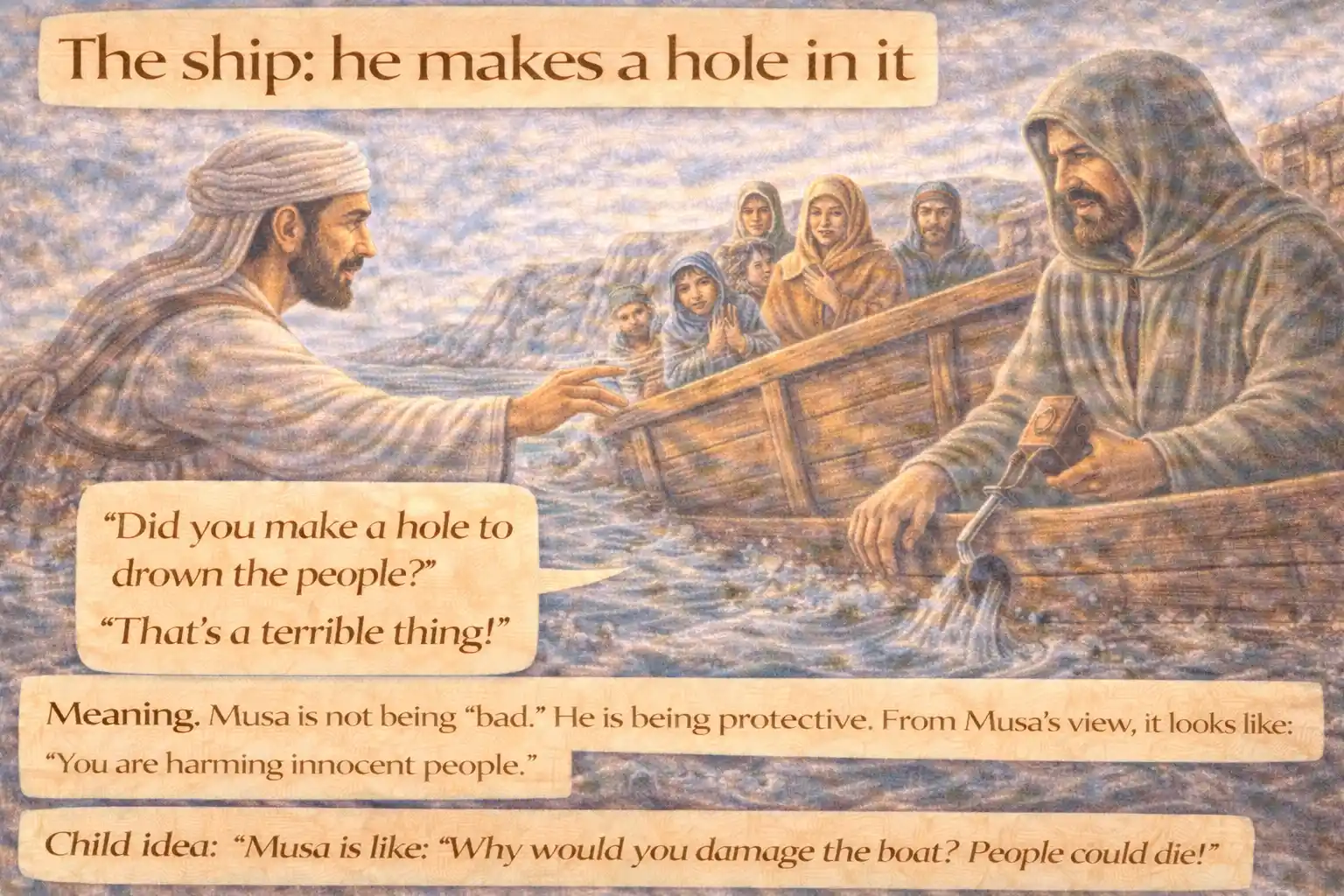
- 18:71 — The ship: he makes a hole in it
They travel and board a ship. Then the special man makes a hole in it.
- They travel and get on a ship.
- Then the special man makes a hole in the ship.
- Musa panics and says:
- “Did you make a hole to drown the people?”
- “That’s a terrible thing!”
- Musa is not being “bad.” He is being protective.
- From Musa’s view, it looks like: “You are harming innocent people.”
“Musa is like: ‘Why would you damage the boat? People could die!’”
- 18:72 — The reminder: “I told you you won’t be patient”
The man reminds Musa about the rule of patience.
- The man says: “Didn’t I tell you that you wouldn’t be patient with me?”
- He warned Musa: “You will see things you don’t understand at first.”
- This is a reminder: don’t judge too early.
“The teacher is like: ‘Remember, I warned you this would be hard.’”
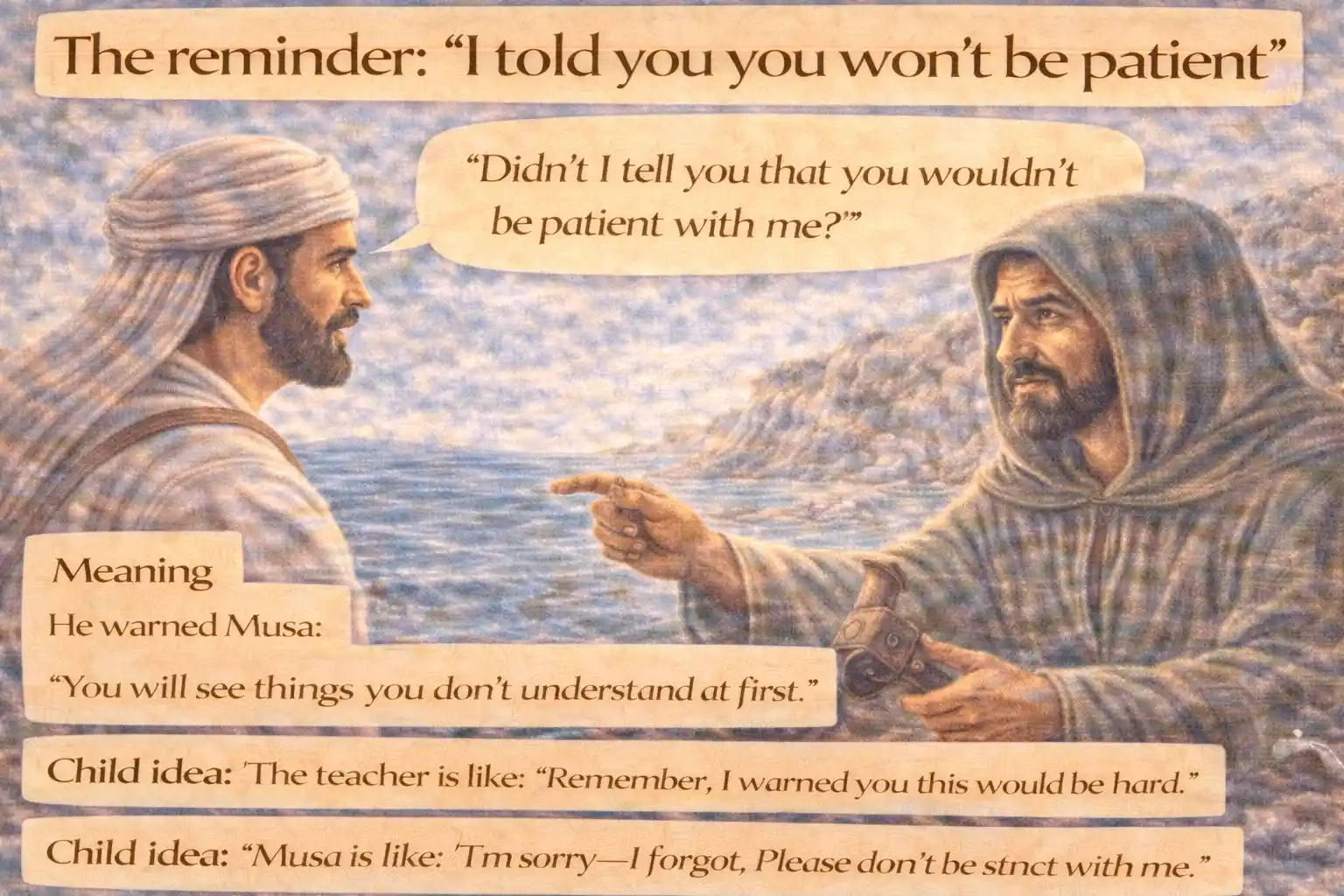
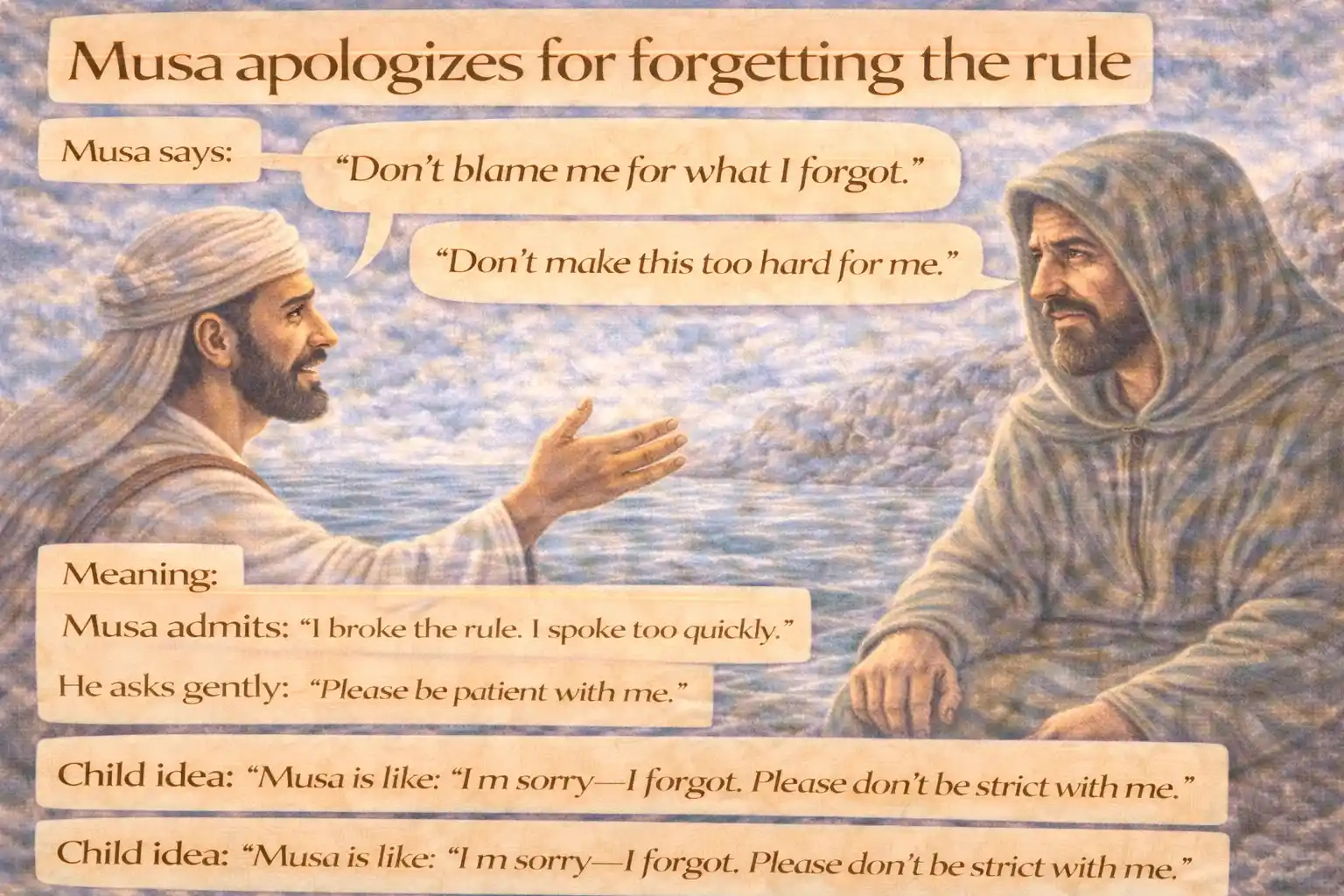
- 18:73 — Musa apologizes for forgetting the rule
Musa admits he spoke too quickly and asks for gentleness.
- Musa says:
- “Don’t blame me for what I forgot.”
- “Don’t make this too hard for me.”
- Musa admits: “I broke the rule. I spoke too quickly.”
- He asks gently: “Please be patient with me.”
“Musa is like: ‘I’m sorry—I forgot. Please don’t be strict with me.’”
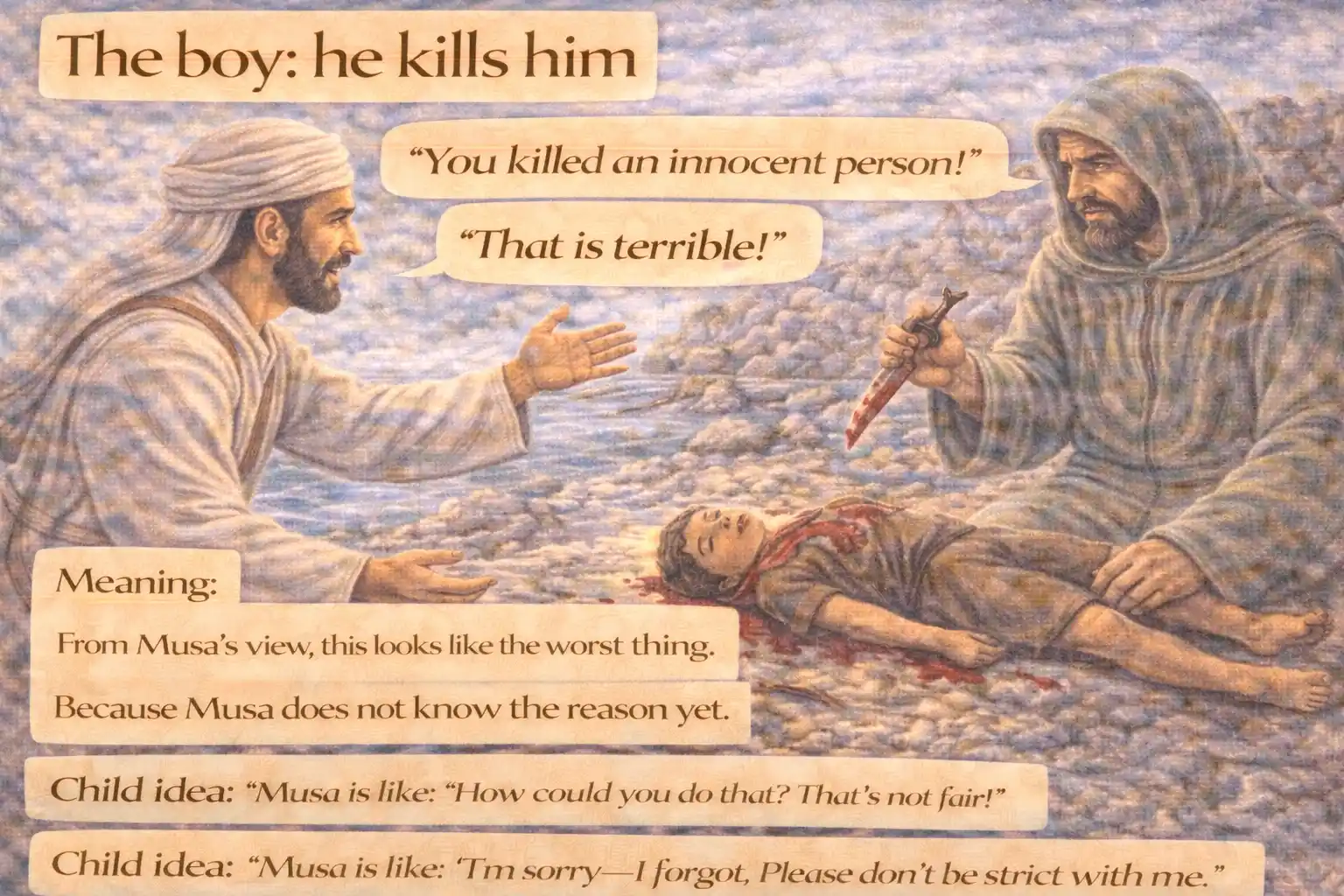
- 18:74 — The boy: he kills him
They meet a boy, and the man kills him. Musa is horrified.
- They walk further and meet a boy.
- The man kills the boy.
- Musa says:
- “You killed an innocent person!”
- “That is terrible!”
- From Musa’s view, this looks like the worst thing.
- This is because Musa does not know the reason yet.
“Musa is like: ‘How could you do that? That’s not fair!’”
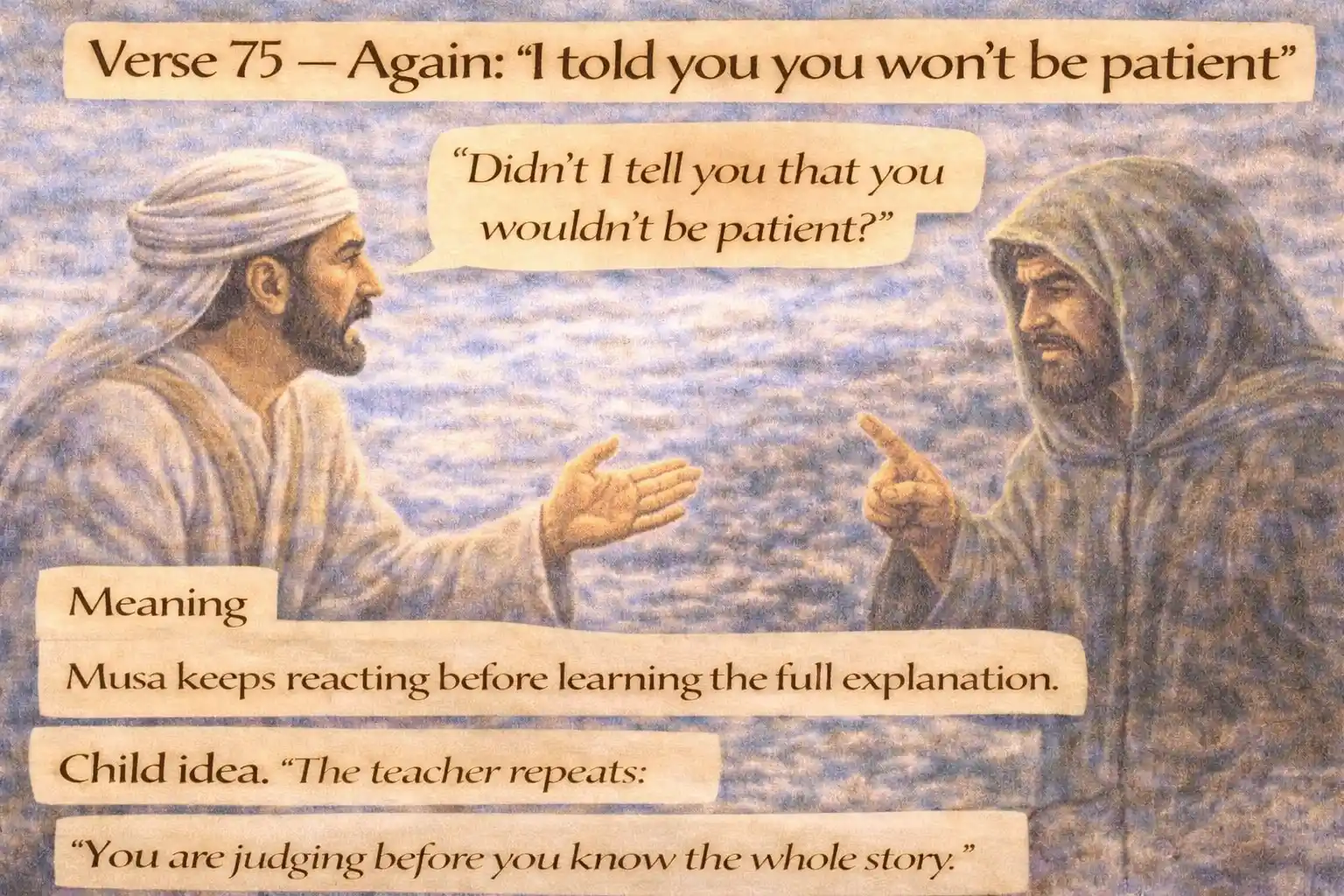
- 18:75 — Again: “I told you you won’t be patient”
The man repeats the same reminder.
- The man says again: “Didn’t I tell you that you wouldn’t be patient?”
Musa keeps reacting before learning the full explanation.
“The teacher repeats: ‘You are judging before you know the whole story.’”
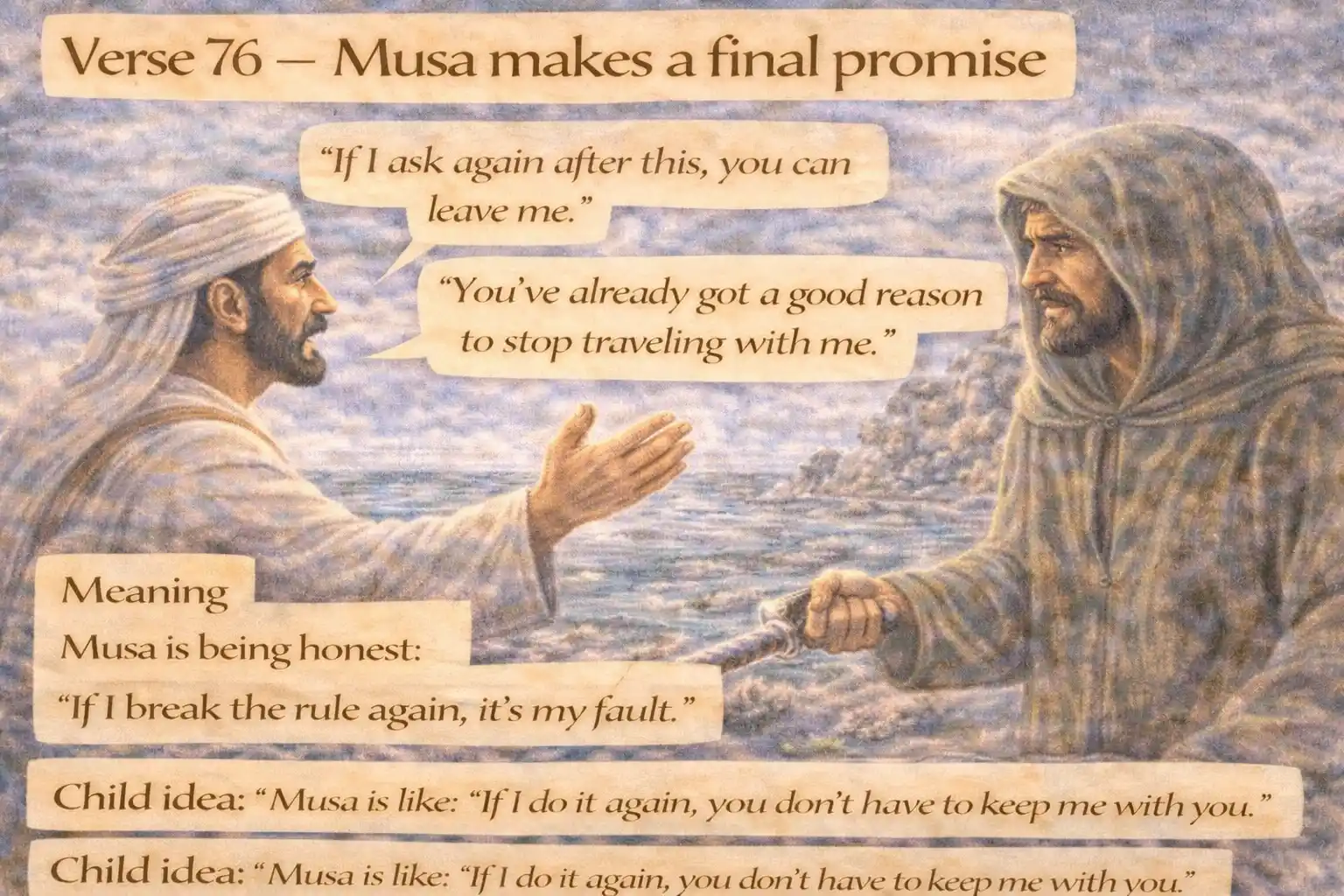
- 18:76 — Musa makes a final promise
Musa promises that if he breaks the rule again, the man can leave him.
- Musa says:
- “If I ask again after this, you can leave me.”
- “You’ve already got a good reason to stop traveling with me.”
Musa is being honest: “If I break the rule again, it’s my fault.”
“Musa is like: ‘If I do it again, you don’t have to keep me with you.’”
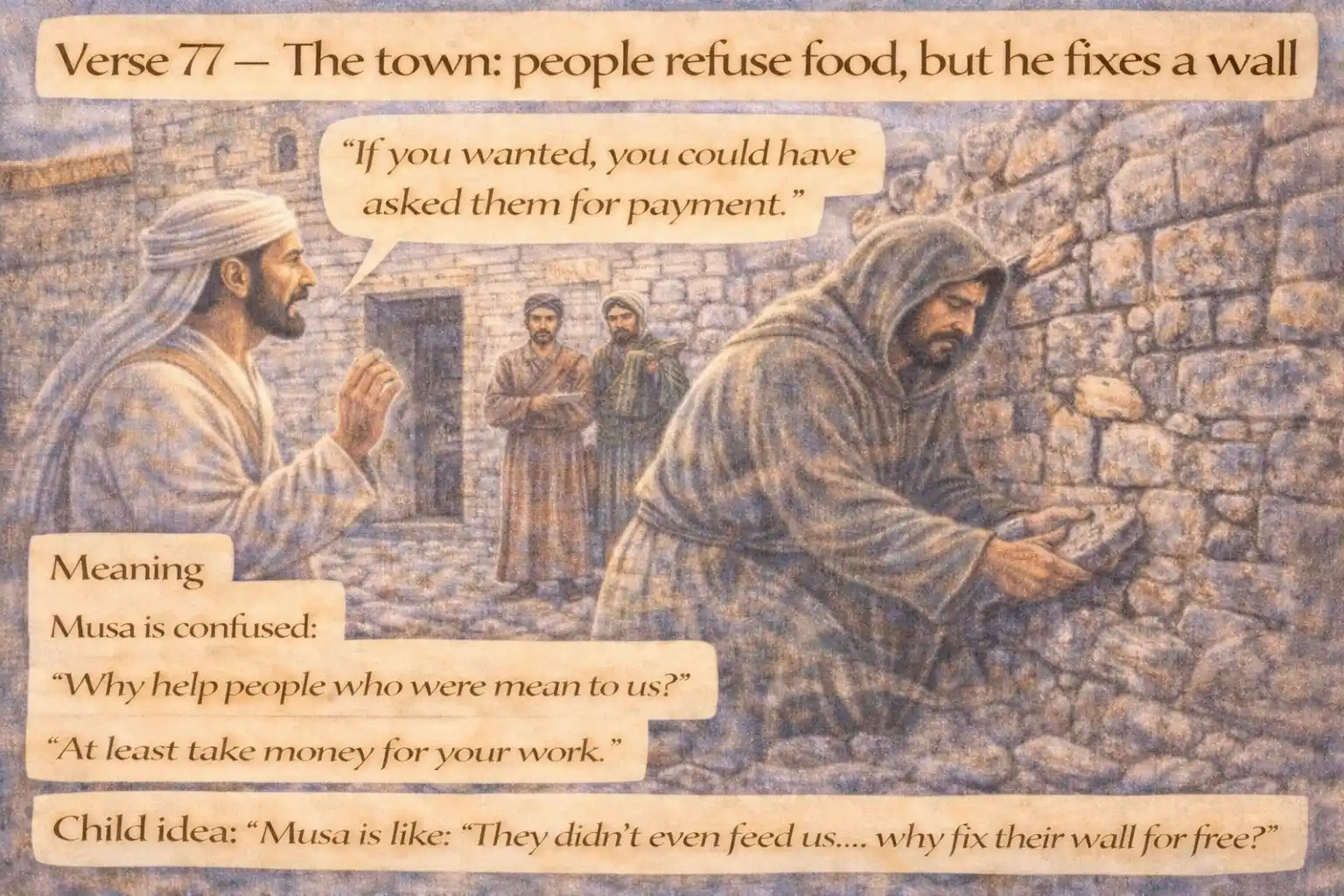
- 18:77 — The town: people refuse food, but he fixes a wall
They ask the town for food, but the people refuse. Yet the man repairs a wall for free.
- They enter a town and ask its people for food.
- The people are rude and refuse to help them.
- Then they find a wall that is about to collapse.
- The man repairs the wall for free.
- Musa says: “If you wished, you could have taken for it a payment.”
- Musa is confused: “Why help people who were mean to us?”
- He thinks: “At least take money for your work.”
“Musa is like: ‘They didn’t even feed us… why fix their wall for free?’”
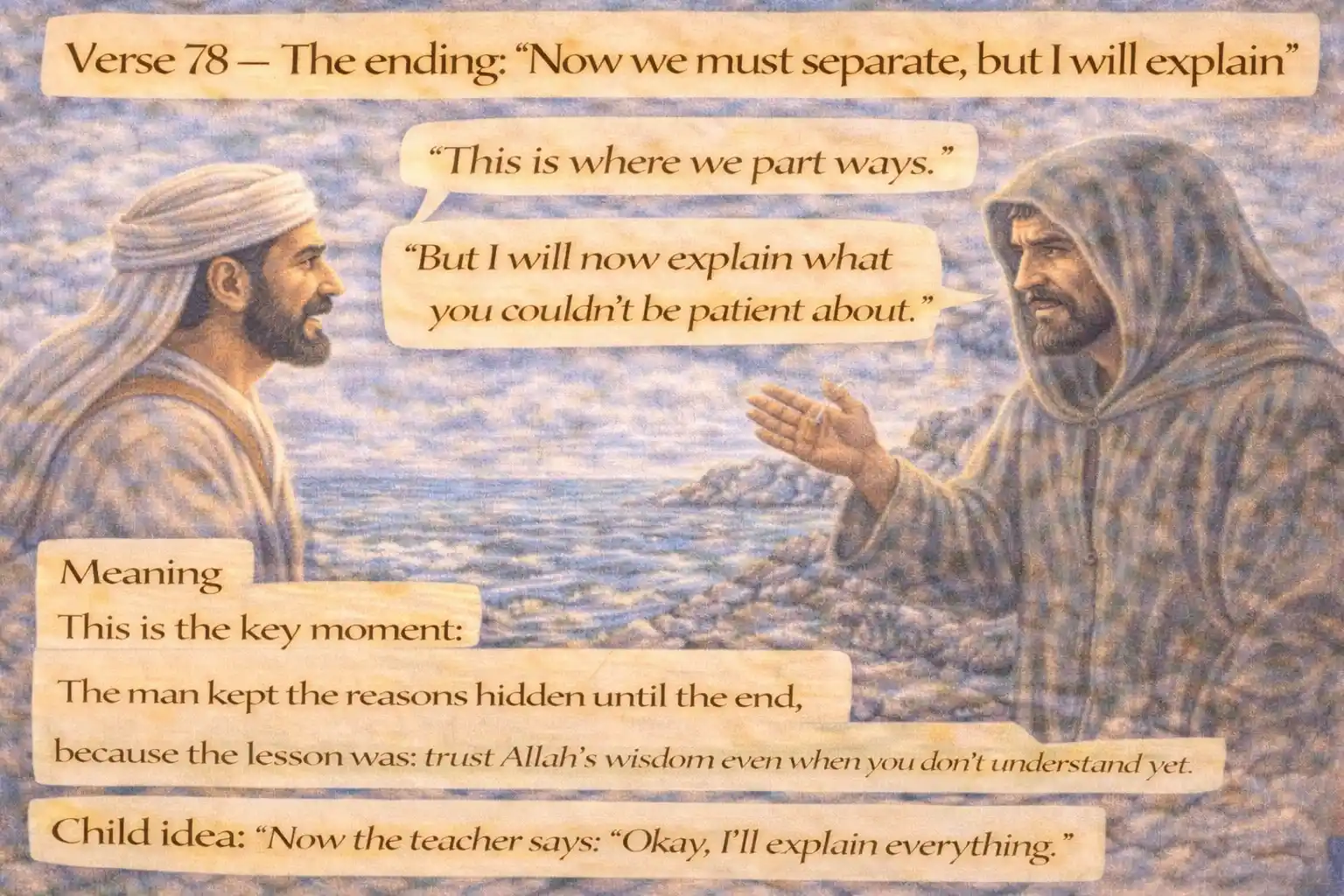
- 18:78 — The ending: “Now we must separate, but I will explain”
The man announces the end of their journey together, and promises the explanations.
- The man says:
- “This is where we part ways.”
- “But I will now explain what you couldn’t be patient about.”
- This is the key moment: the man kept the reasons hidden until the end.
- The lesson is: trust Allah’s wisdom even when you don’t understand yet.
“Now the teacher says: ‘Okay, I’ll explain everything.’”
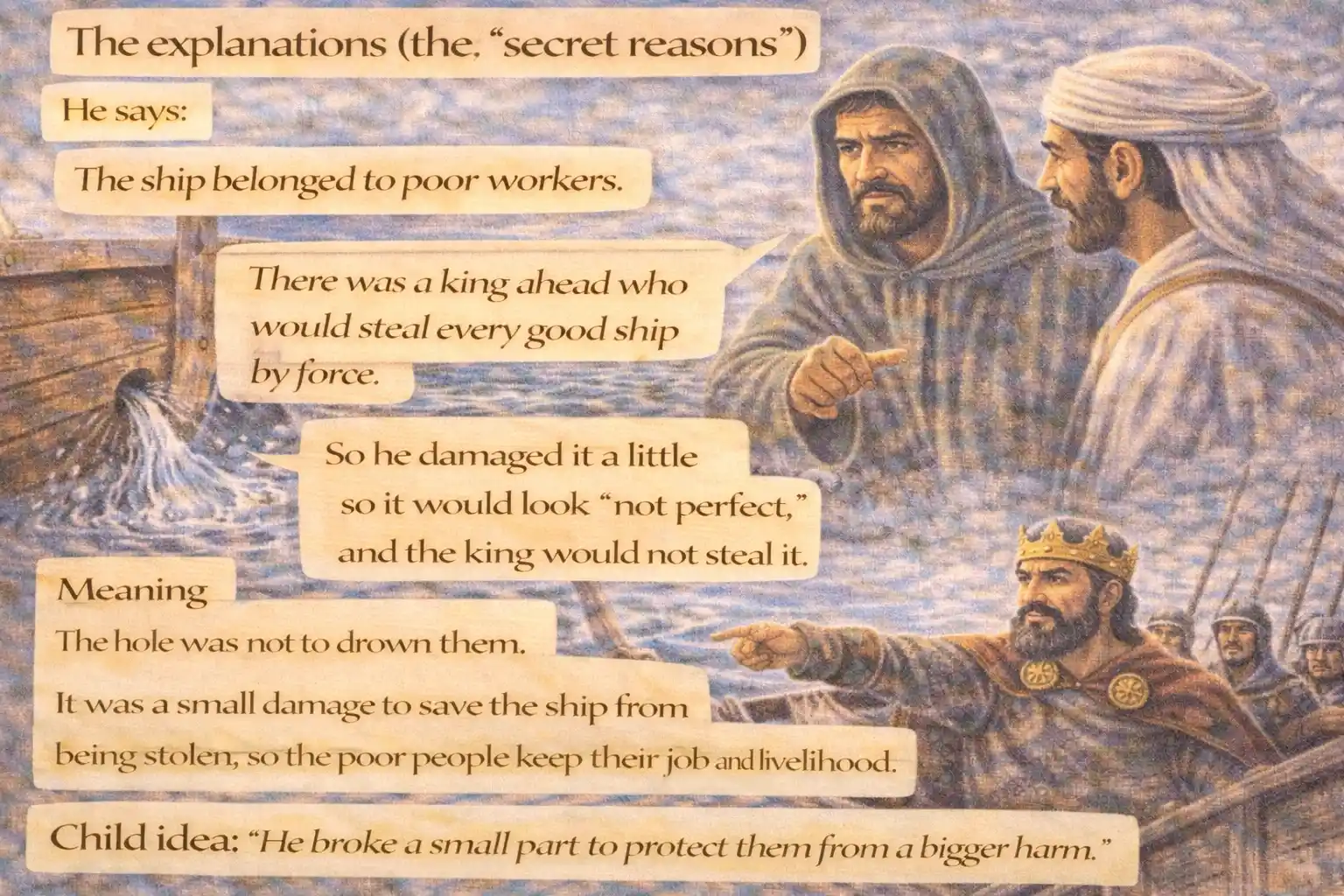
The explanations (the “secret reasons”)
- 18:79 — Why he damaged the ship
The damage was meant to protect poor workers from a king who steals good ships.
- The ship belonged to poor workers.
- There was a king ahead who would steal every good ship by force.
- So he damaged it a little so it would look “not perfect,” and the king would not steal it.
The hole was not to drown them. It was a small damage to save the ship from being stolen, so the poor people keep their job and livelihood.
“He broke a small part to protect them from a bigger harm.”
- 18:80–81 — Why the boy was killed
Allah knew a future harm that Musa could not see, and Allah planned a better replacement for the parents.
- The boy’s parents were believers.
- Allah knew the boy would grow up to become very rebellious and disbelieving, and would cause great pain to his parents.
- So Allah planned to give them another child:
- better in purity,
- and more merciful to the parents.
- This is the hardest part. The lesson is: Allah knows what we don’t know.
- Sometimes Allah removes something early because He sees future harm we cannot see.
- Allah can replace loss with something better.
“Allah knew the future, and Allah was protecting the parents from a huge heartbreak.”
- 18:82 — Why he fixed the wall for free
The wall protected two orphans and their treasure until they were old enough.
- The wall belonged to two orphan boys in the town (their father died).
- Under the wall was a treasure that belonged to them.
- Their father was a righteous man.
- Allah wanted the treasure to stay hidden until the boys grow older and strong enough to take it safely.
- So the wall was fixed to:
- protect the treasure,
- and protect the orphans.
Sometimes Allah protects children in ways they don’t even realize. And sometimes Allah protects people because of the goodness of their parents.
“He fixed the wall so the treasure stays safe until the orphans grow up.”
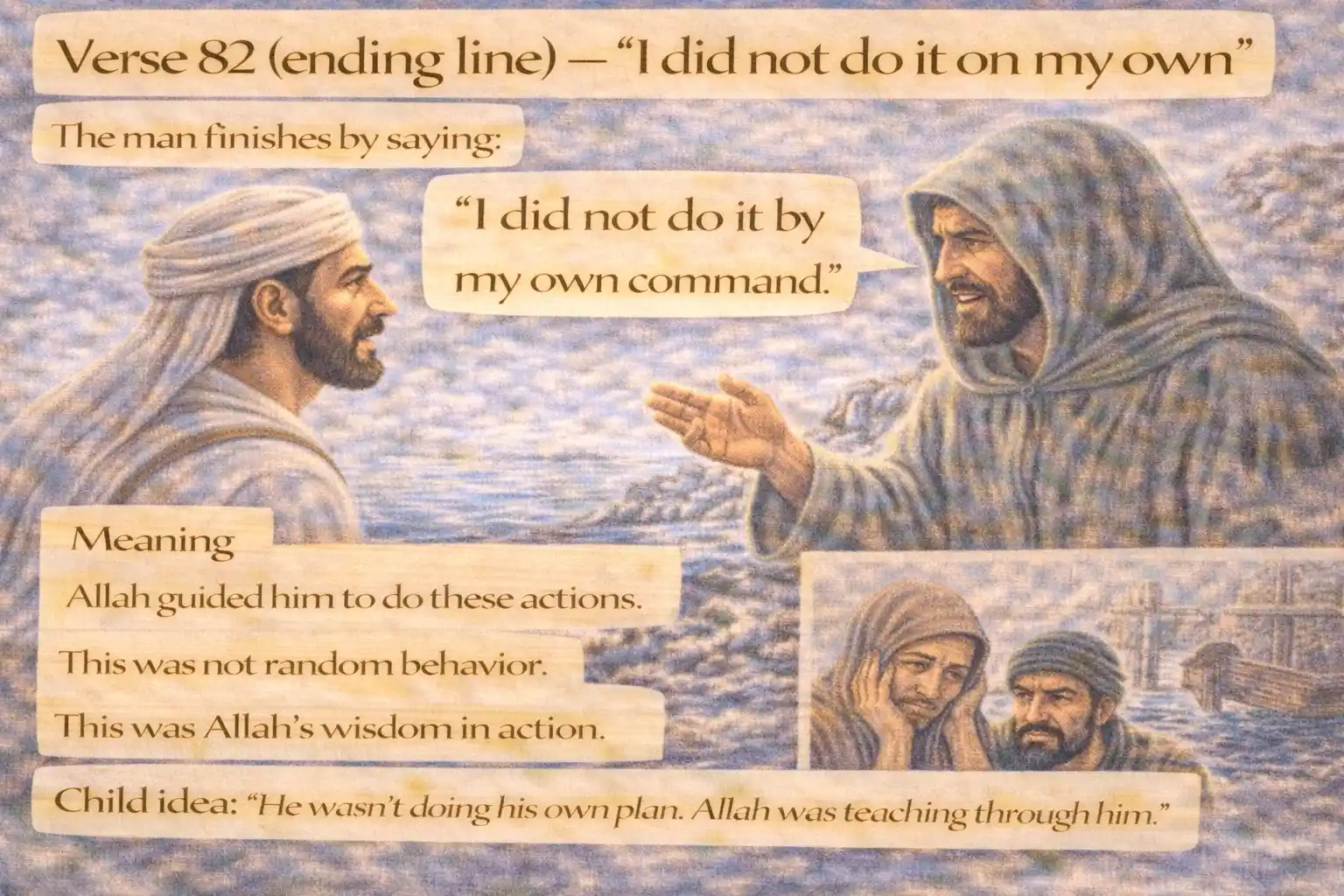
- 18:82 (ending line) — “I did not do it on my own”
The man makes it clear that his actions were guided, not random.
- The man finishes by saying: “I did not do it by my own command.”
- Allah guided him to do these actions.
- This was not random behavior.
- This was Allah’s wisdom in action.
“He wasn’t doing his own plan. Allah was teaching through him.”
Sometimes something looks bad at first… but Allah may be protecting you from something worse.
A small loss can save you from a bigger loss.
Something confusing now may make sense later.
Allah’s wisdom is real, even when we can’t see it yet.
83. And they ask you (Muhammad) about Dhul-Qarnayn. Say: “I will recite to you something of his mention.”
84. Indeed, We established him in the earth, and We gave him of everything a way (means).
85. So he followed a way.
86. Until when he reached the setting place of the sun, he found it setting in a dark muddy spring, and he found near it a people. We said: “O Dhul-Qarnayn, either you punish, or you take with them good conduct.”
87. He said: “As for one who does wrong, we shall punish him, then he will be returned to his Lord, and He will punish him with a terrible punishment.”
88. “But as for one who believes and does righteous deeds, for him will be the best reward, and we shall speak to him from our command with ease.”
Surah Al-Kahf (18:83–88) — Dhul-Qarnayn: Power, Travel, and Justice (Child-Friendly)
- 18:83 — People ask about Dhul-Qarnayn
People ask the Prophet Muhammad about Dhul-Qarnayn, and Allah answers with what matters.
What happens in the verse
- People ask the Prophet Muhammad:
- “Tell us about Dhul-Qarnayn.”
- Allah tells the Prophet to answer:
- “I will recite to you something about him.”
- This is Allah saying: “I will tell you the true part of his story that you need.”
- It also teaches: not every detail is necessary—Allah gives the part that teaches the lesson.
“People asked a question, and Allah said: ‘I will tell you what matters about him.’”
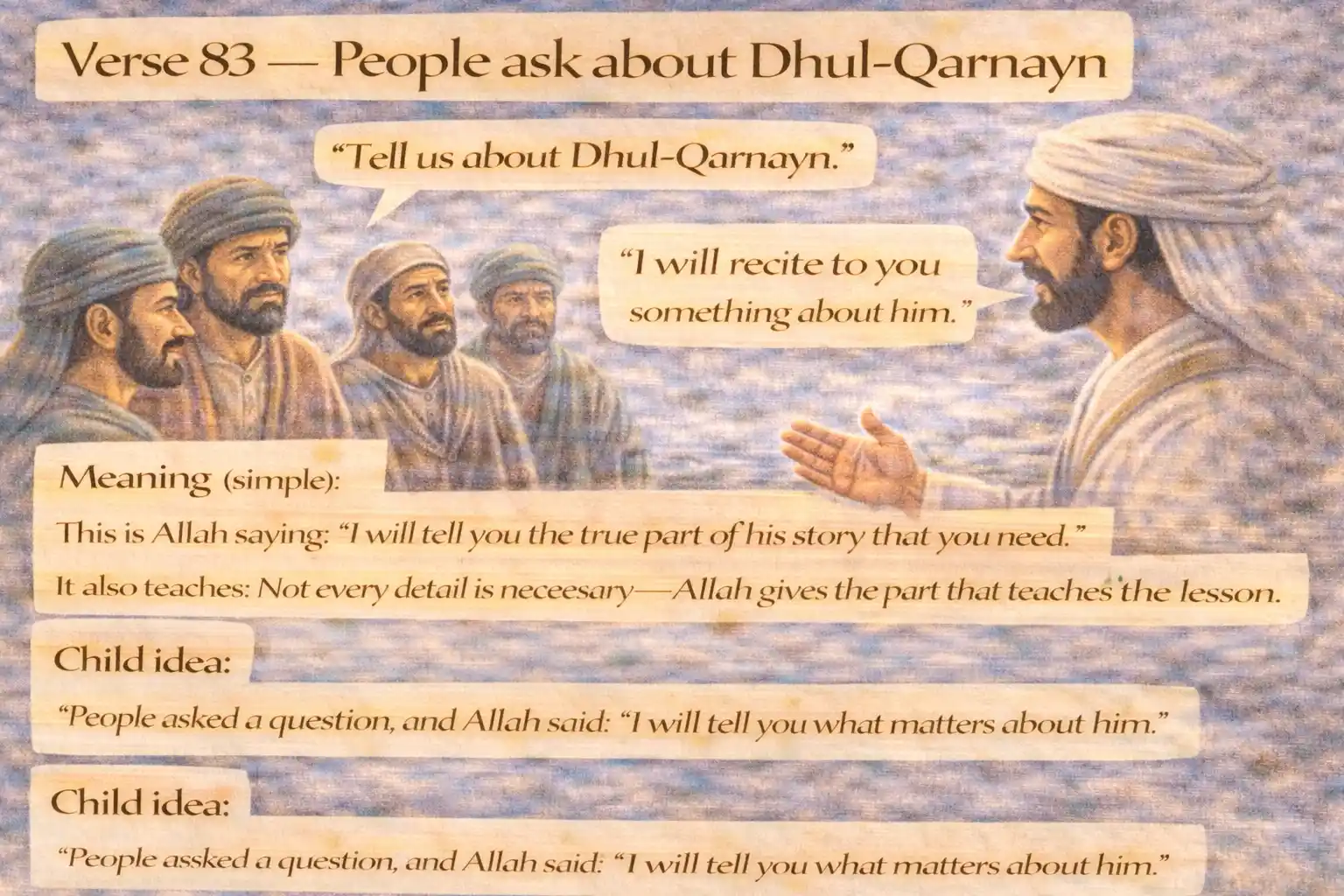
- 18:84 — Allah made him powerful and gave him “ways” to do things
Allah explains that Dhul-Qarnayn’s strength and success came from Allah’s help.
What happens in the verse
- Allah says:
- “We established him in the earth.”
- “We gave him of everything a way (means).”
What “established him in the earth” means
- Allah gave him power (authority).
- Allah gave him stability (a strong kingdom).
- Allah gave him the ability to travel and lead.
- Allah gave him people who listened to him.
It’s like Allah helped him become a very capable leader.
What “We gave him of everything a way” means
- Allah gave him tools and knowledge, like:
- ways to travel (routes, planning, direction)
- ways to govern (rules, leadership)
- ways to protect people (strength, organization)
- ways to build and manage resources
- He wasn’t powerful because he was “magical.”
- He was powerful because Allah gave him:
- opportunities, knowledge, and the means to act.
“Allah gave Dhul-Qarnayn the tools and ability to do big good work on earth.”
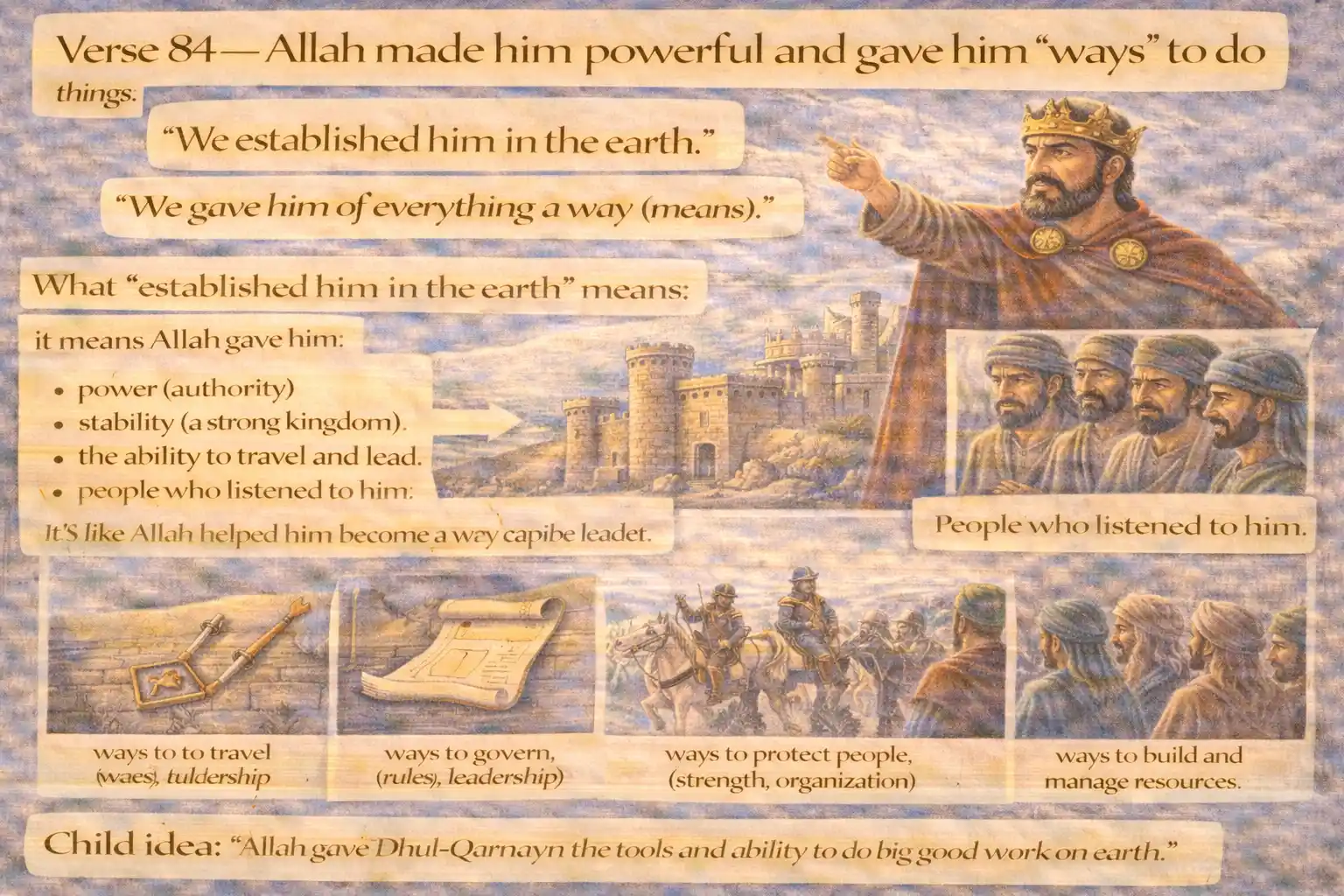
- 18:85 — He used those “ways” and set out on a journey
Dhul-Qarnayn uses what Allah gave him and begins traveling.
What happens in the verse
- The Qur’an says:
- “So he followed a way.”
- Dhul-Qarnayn didn’t waste what Allah gave him.
- He used the paths, plans, and means Allah gave him to travel and do his mission.
“He didn’t sit lazy. He got up and used what Allah gave him.”
- 18:86 — He reaches the far place where the sun “sets,” and meets people there
He travels far and reaches a place where the sun looks like it is going down into dark water. He meets people there.
What happens in the verse
- He reached the “setting place of the sun.”
- He found it “setting” in a dark muddy spring.
- He found a people near it.
- Allah tells him: “You can punish, or you can treat them with goodness.”
Important: What does “he found it setting in a muddy spring” mean?
- This line is describing what Dhul-Qarnayn saw when he traveled far.
- When you stand at the edge of a large sea or a huge body of water:
- the sun can look like it is going down into the water,
- especially if the water looks dark, murky, or muddy,
- because of distance and how the horizon looks.
- So the verse describes the scene from his viewpoint:
- he reached a far western area,
- and it looked like the sun was sinking into dark water.
- He reached a far end of his travels in one direction.
- He met a group of people there.
- Allah gave him a choice in how to deal with them:
- punish wrongdoers, or use good treatment and fairness.
“He traveled very far until the sun looked like it was going down into dark water, and he met people living there.”
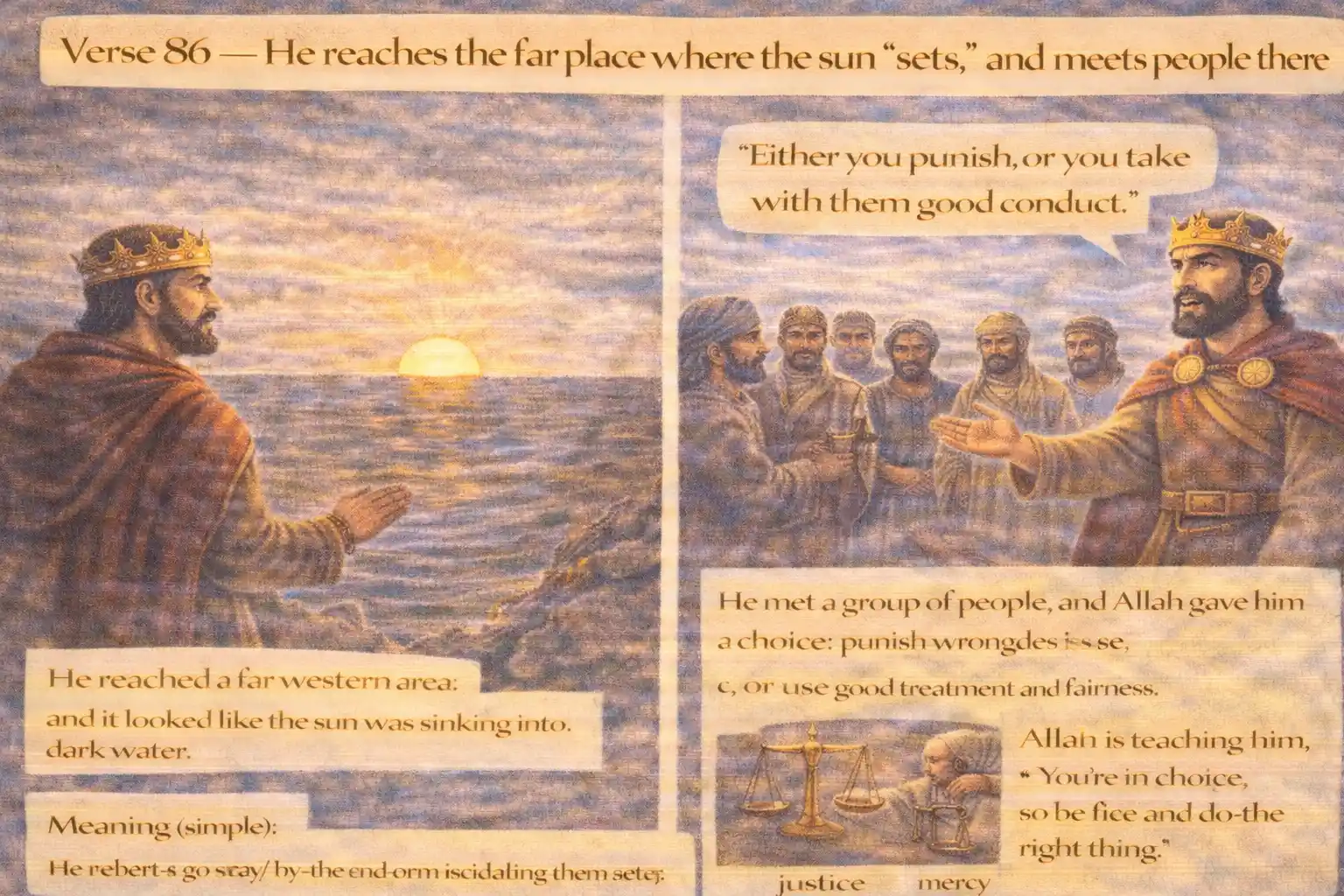
- 18:86 (continued) — Allah gives Dhul-Qarnayn a leadership test
Allah tests his leadership: will he be unfair, or will he be just and kind?
What Allah says
- “Either you punish, or you take with them good conduct.”
- This is a test of leadership:
- Will he be cruel?
- Will he be unfair?
- Or will he be just and kind?
- Allah teaches: power must be used with justice, rules, and mercy.
“Allah is teaching him: ‘You’re in charge, so be fair and do the right thing.’”
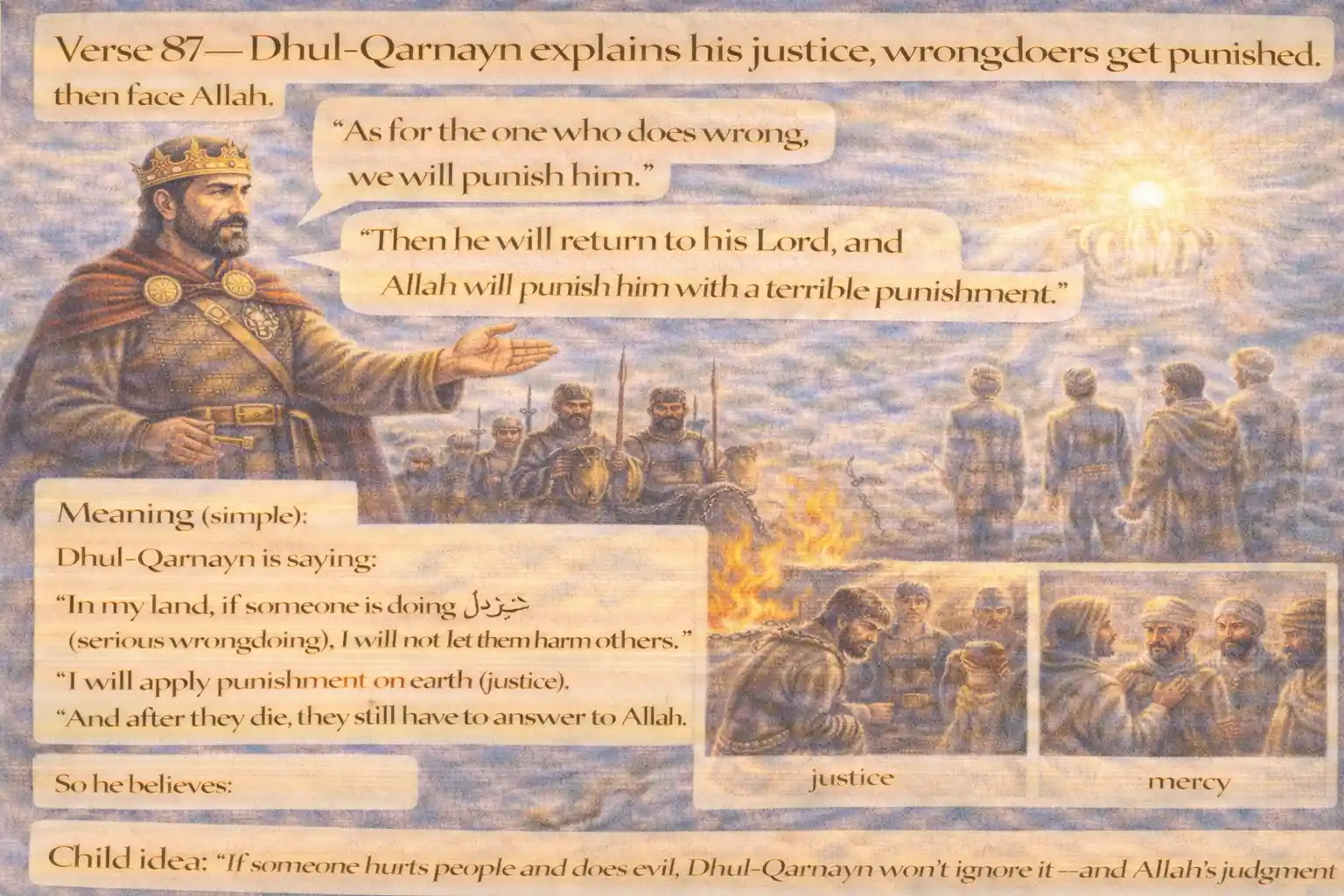
- 18:87 — Dhul-Qarnayn explains his justice: wrongdoers get punished, then face Allah
He says he will stop ظلم on earth, and reminds that Allah is the final Judge.
What he says
- “As for the one who does wrong, we will punish him.”
- “Then he will return to his Lord, and Allah will punish him with a terrible punishment.”
- “In my land, if someone is doing ظلم (serious wrongdoing), I will not let them harm others.”
- “I will apply punishment on earth (justice).”
- “And after they die, they still have to answer to Allah.”
- So he believes: worldly power is not the final court—Allah is the final Judge.
“If someone hurts people and does evil, Dhul-Qarnayn won’t ignore it—and Allah’s judgment is even bigger.”
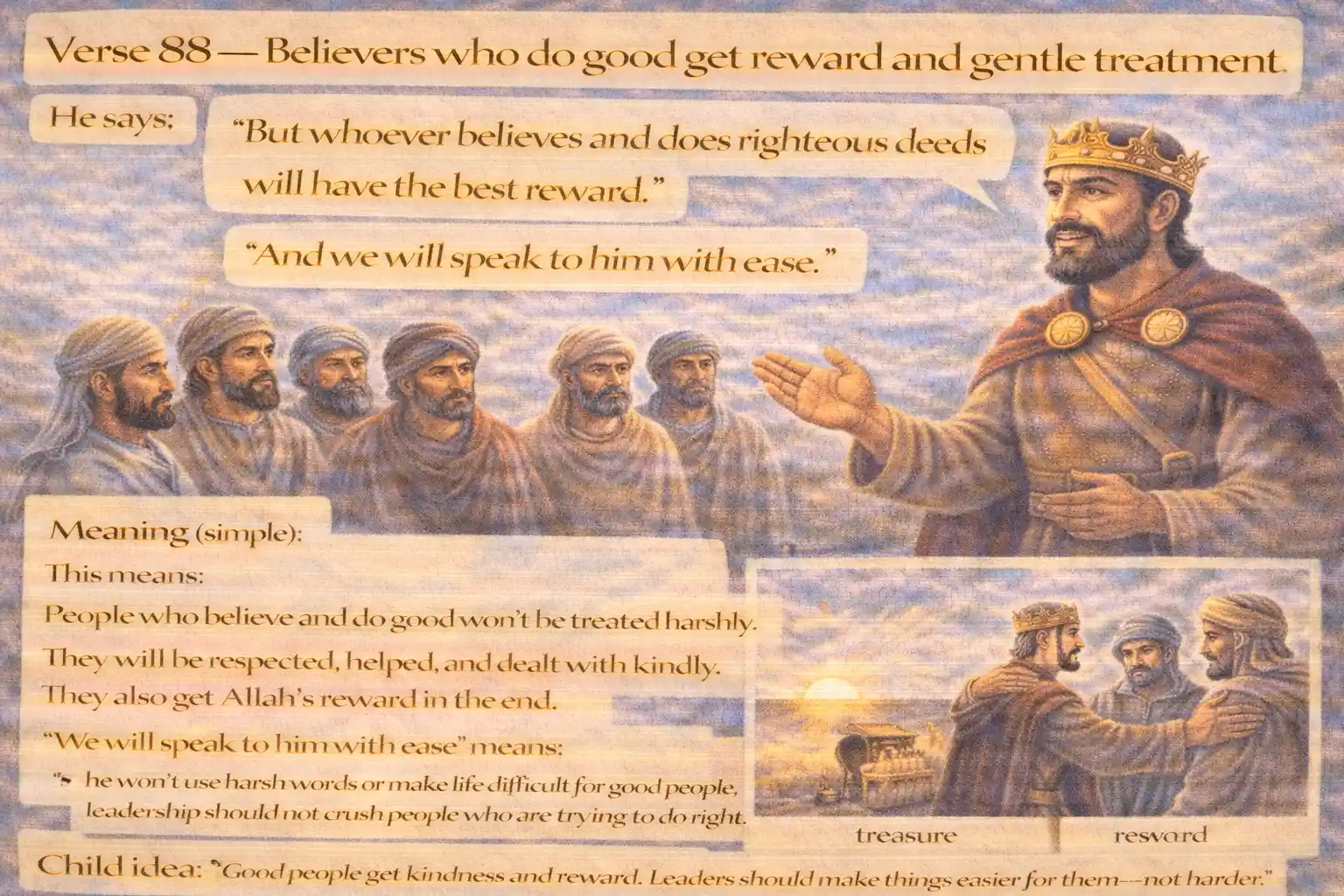
- 18:88 — Believers who do good get reward and gentle treatment
He promises reward and gentle dealing for people who believe and do good.
What he says
- “But whoever believes and does righteous deeds will have the best reward.”
- “And we will speak to him with ease.”
- People who believe and do good won’t be treated harshly.
- They will be respected, helped, and dealt with kindly.
- They also get Allah’s reward in the end.
- “We will speak to him with ease” means:
- he won’t use harsh words or make life difficult for good people,
- leadership should not crush people who are trying to do right.
“Good people get kindness and reward. Leaders should make things easier for them—not harder.”
- Allah gives people power and tools—but that power is a test.
- A good leader uses power with justice and mercy.
- Wrongdoing has consequences—in this life and the next.
- Faith and good deeds lead to reward and gentle treatment.
89. Then he followed a way.
90. Until, when he came to the rising place of the sun, he found it rising upon a people for whom We had not made against it any shelter.
91. Thus. And We had encompassed whatever was with him in knowledge.
92. Then he followed a way.
93. Until, when he reached between the two mountains, he found beside them a people who could scarcely understand speech.
94. They said: “O Dhul-Qarnayn, indeed Ya’juj and Ma’juj are corrupters in the land. So may we assign for you a payment that you make between us and them a barrier?”
95. He said: “That in which my Lord has established me is better. So help me with strength; I will make between you and them a dam.”
96. “Bring me blocks of iron.” Until, when he had leveled (the gap) between the two mountain sides, he said: “Blow (with bellows).” Until, when he made it fire, he said: “Bring me molten copper to pour over it.”
97. So they were not able to scale it, nor were they able to pierce it.
98. He said: “This is a mercy from my Lord. But when the promise of my Lord comes, He will make it level. And the promise of my Lord is true.”
Surah Al-Kahf (18:89–98) — Dhul-Qarnayn’s Journeys and the Great Barrier (Child-Friendly)
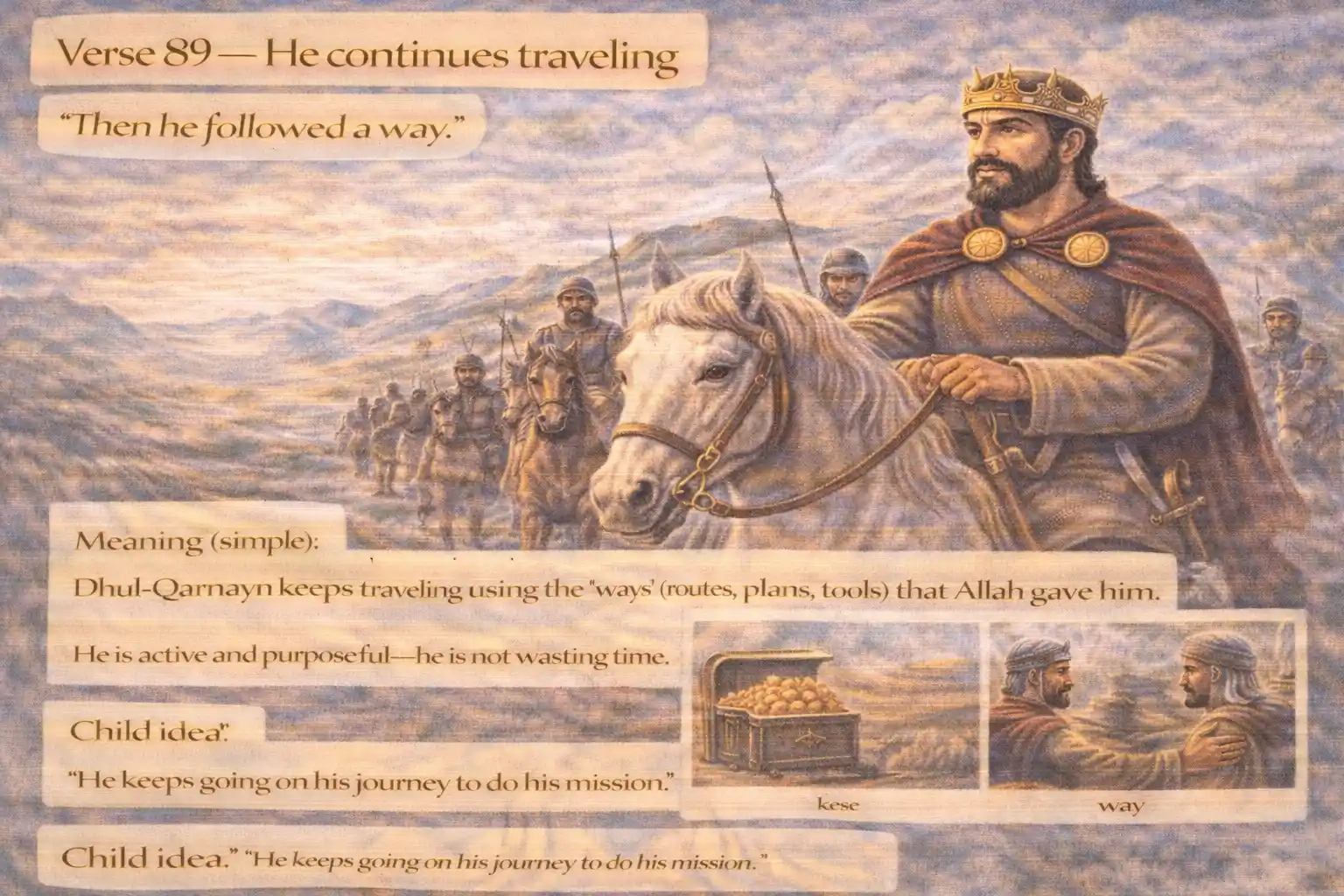
- 18:89 — He continues traveling
Dhul-Qarnayn keeps moving forward, using the paths and tools Allah gave him.
What happens
- The Qur’an says: “Then he followed a way.”
- Dhul-Qarnayn keeps traveling using the “ways” Allah gave him (routes, plans, tools).
- He is active and purposeful—he is not wasting time.
“He keeps going on his journey to do his mission.”
- 18:90 — He reaches a place where the sun “rises” on a people with no shelter
He travels far in the direction of sunrise and finds people living very exposed to the sun.
What happens
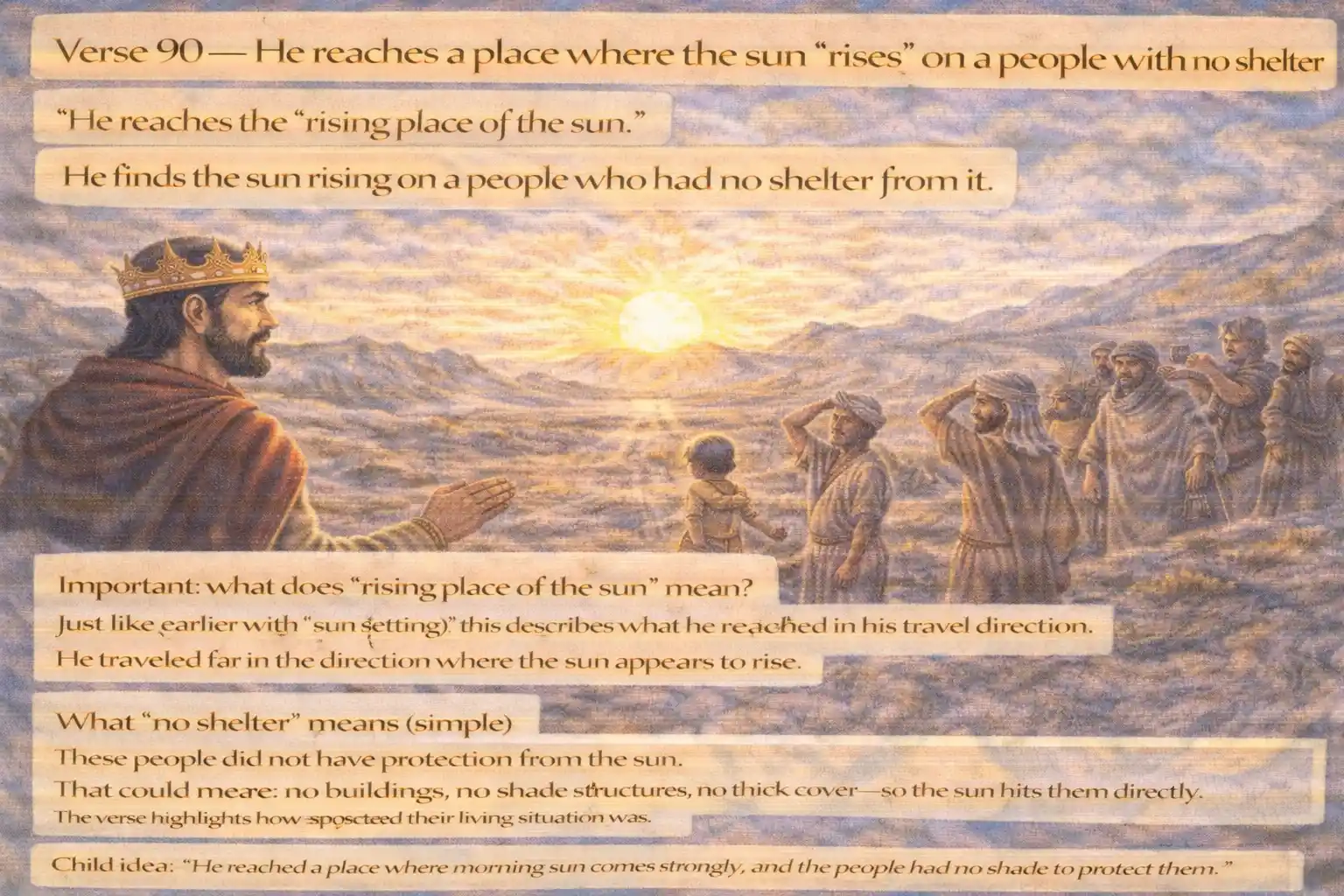
- He reaches the “rising place of the sun.”
- He finds the sun rising on people who had no shelter from it.
Important: What does “rising place of the sun” mean?
- This is like the earlier phrase “where the sun sets.” It describes what he reached in his travel direction.
- He traveled very far toward the direction where the sun appears to rise.
What “no shelter” means (simple)
- They did not have protection from the sun.
- That could mean: no buildings, no shade structures, no thick cover—so sunlight hit them directly.
- The verse highlights how exposed and vulnerable their living situation was.
“He reached a place where morning sun comes strongly, and the people had no shade to protect them.”
- 18:91 — Allah knows everything about him
Allah reminds us that nothing about Dhul-Qarnayn is hidden from Him.
What happens
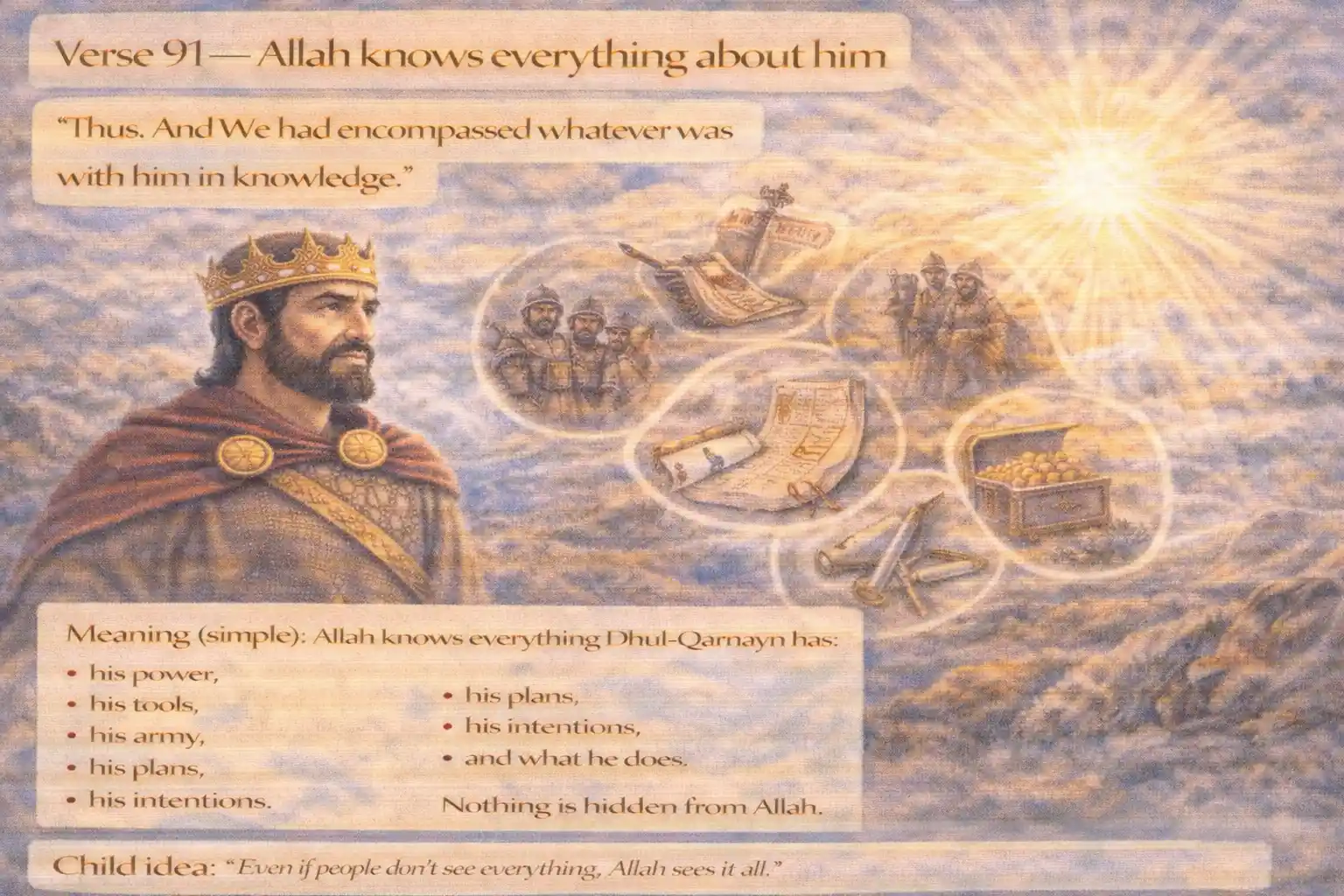
- The Qur’an says: “We had encompassed whatever was with him in knowledge.”
- Allah knows everything Dhul-Qarnayn has and does:
- his power, his tools, his army, his plans, and his intentions.
- Nothing is hidden from Allah.
“Even if people don’t see everything, Allah sees it all.”
- 18:92 — He travels again
His story shows multiple journeys—he keeps going to different places.
What happens
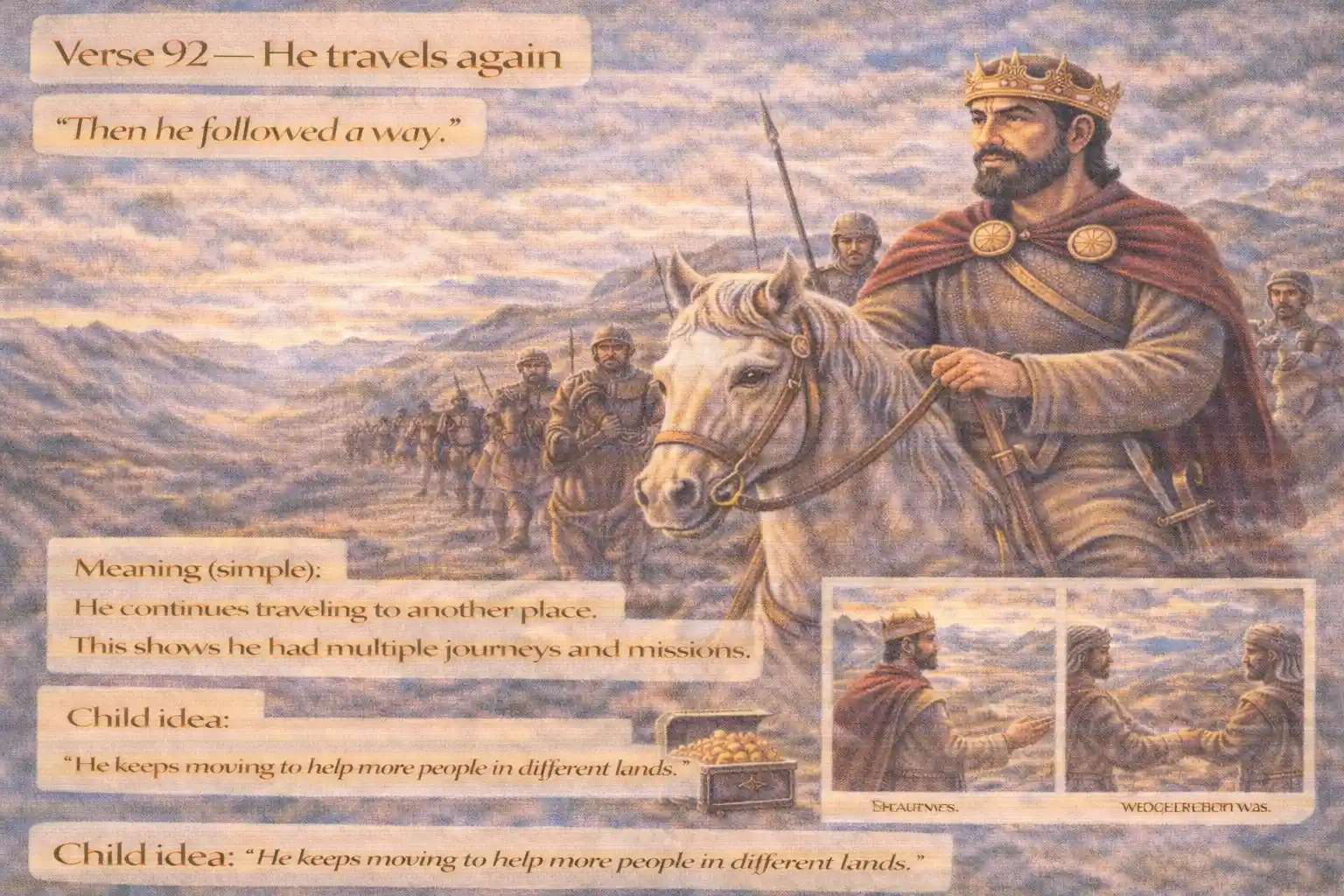
- The Qur’an says again: “Then he followed a way.”
- He continues traveling to another place.
- This shows he had more than one mission—he kept moving to help and manage different situations.
“He keeps moving to help more people in different lands.”
- 18:93 — Between two mountains: people who can barely communicate
He reaches a remote place where language and communication are very difficult.
What happens
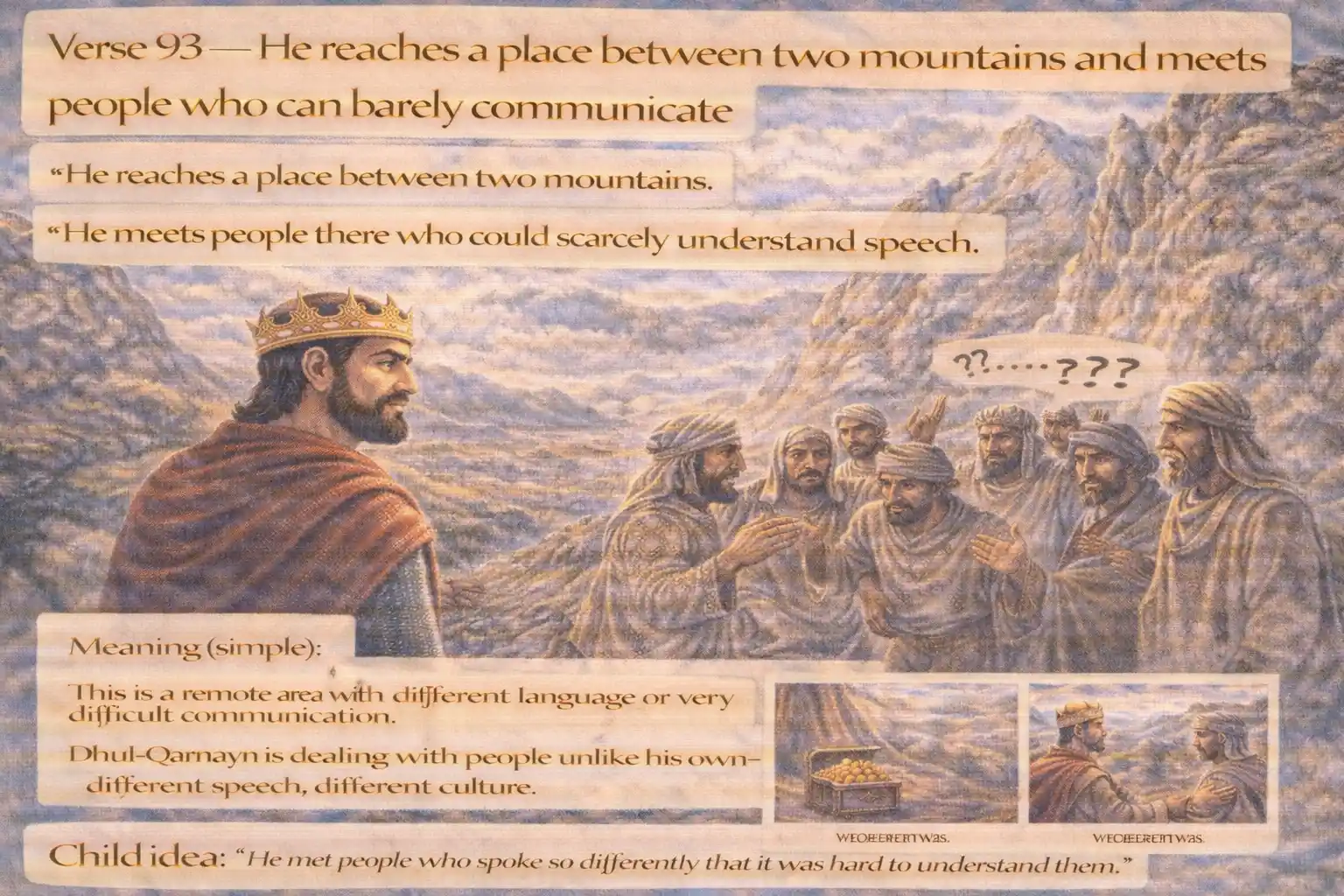
- He reaches a place between two mountains.
- He finds people who could scarcely understand speech (hard to communicate with).
- This is a distant area with a very different language or way of speaking.
- Dhul-Qarnayn is dealing with people unlike his own—different speech, different culture.
- A good leader still tries to understand and help, even when it’s hard.
“He met people who spoke so differently that it was hard to understand them.”
- 18:94 — The people ask for help against Ya’juj and Ma’juj
The people are frightened and ask Dhul-Qarnayn to protect them, even offering money.
What happens
- They say: “Ya’juj and Ma’juj are corrupters in the land.”
- They ask: “Can we pay you to build a barrier between us and them?”
- They are scared because Ya’juj and Ma’juj cause corruption—meaning they ruin things and harm society.
- They offer payment because they desperately want safety and protection.
“They said: ‘We’re being harmed. Please protect us. We’ll pay you.’”
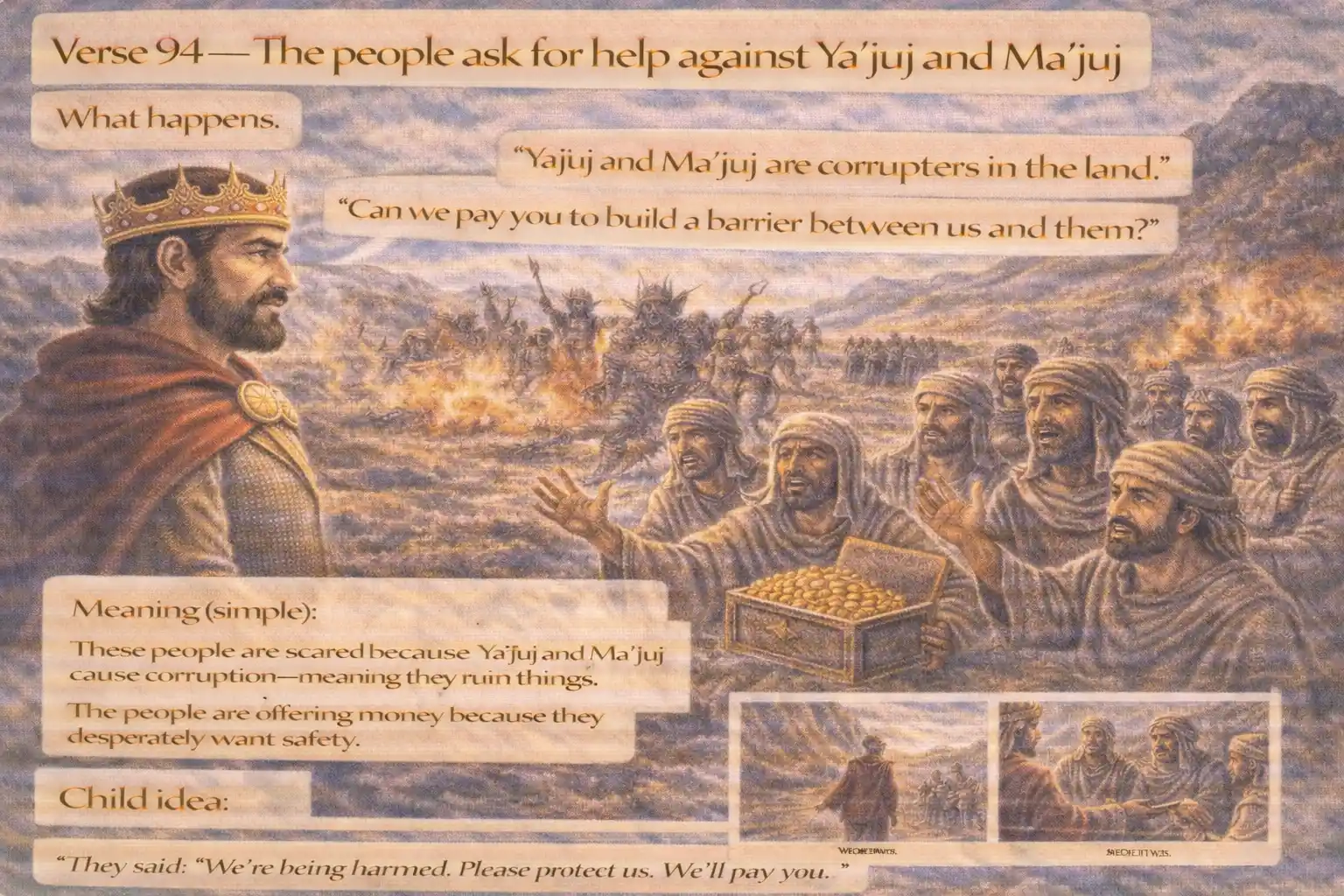
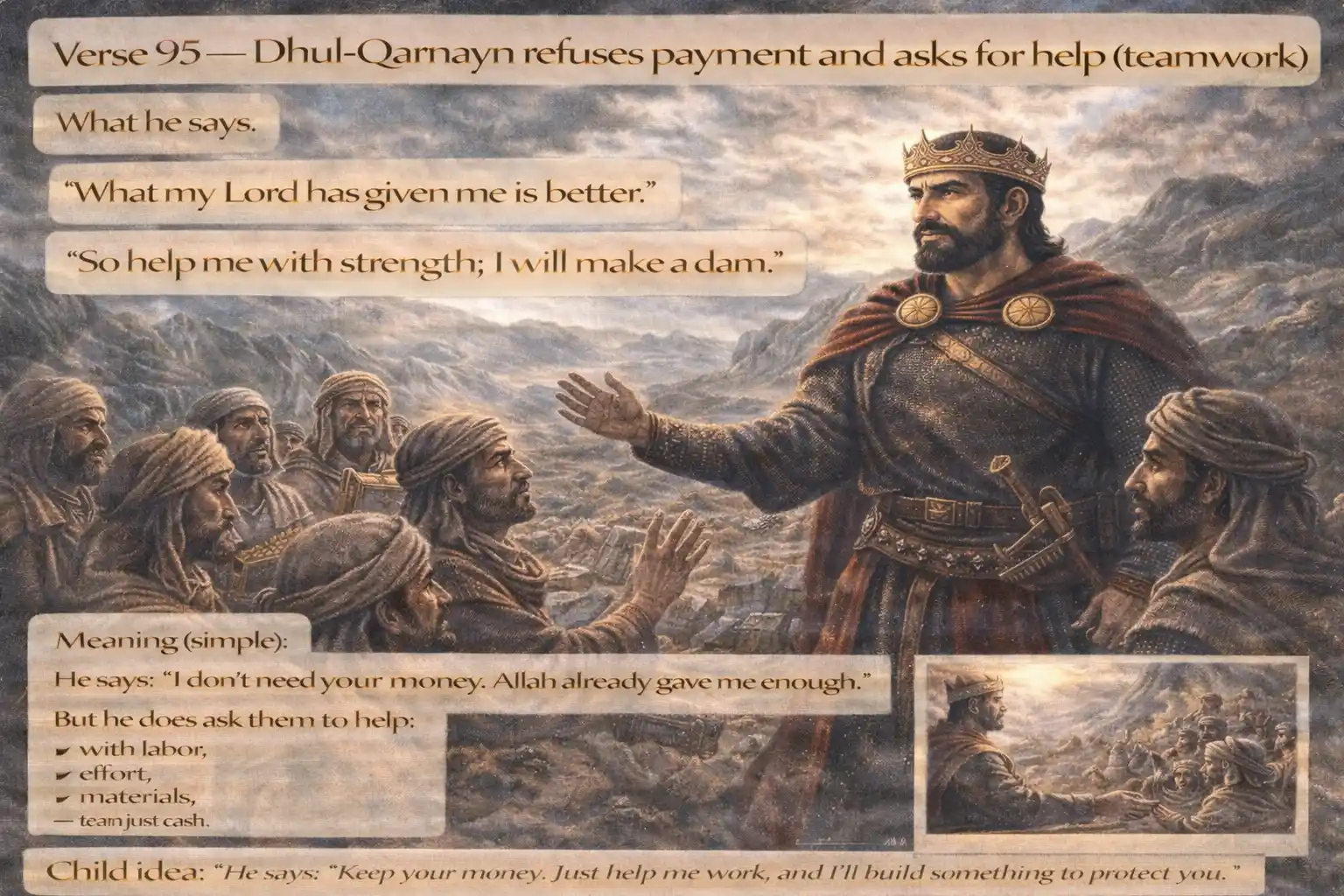
- 18:95 — He refuses payment and asks for help (teamwork)
Dhul-Qarnayn shows humility and teaches that big protection is built by cooperation.
What he says
- “What my Lord has given me is better.”
- “So help me with strength; I will make between you and them a dam.”
- He says: “I don’t need your money. Allah already gave me enough.”
- But he asks them to help with:
- labor, effort, materials, and teamwork.
- He teaches: protection is built with cooperation—not just cash.
“He says: ‘Keep your money. Just help me work, and I’ll build something to protect you.’”
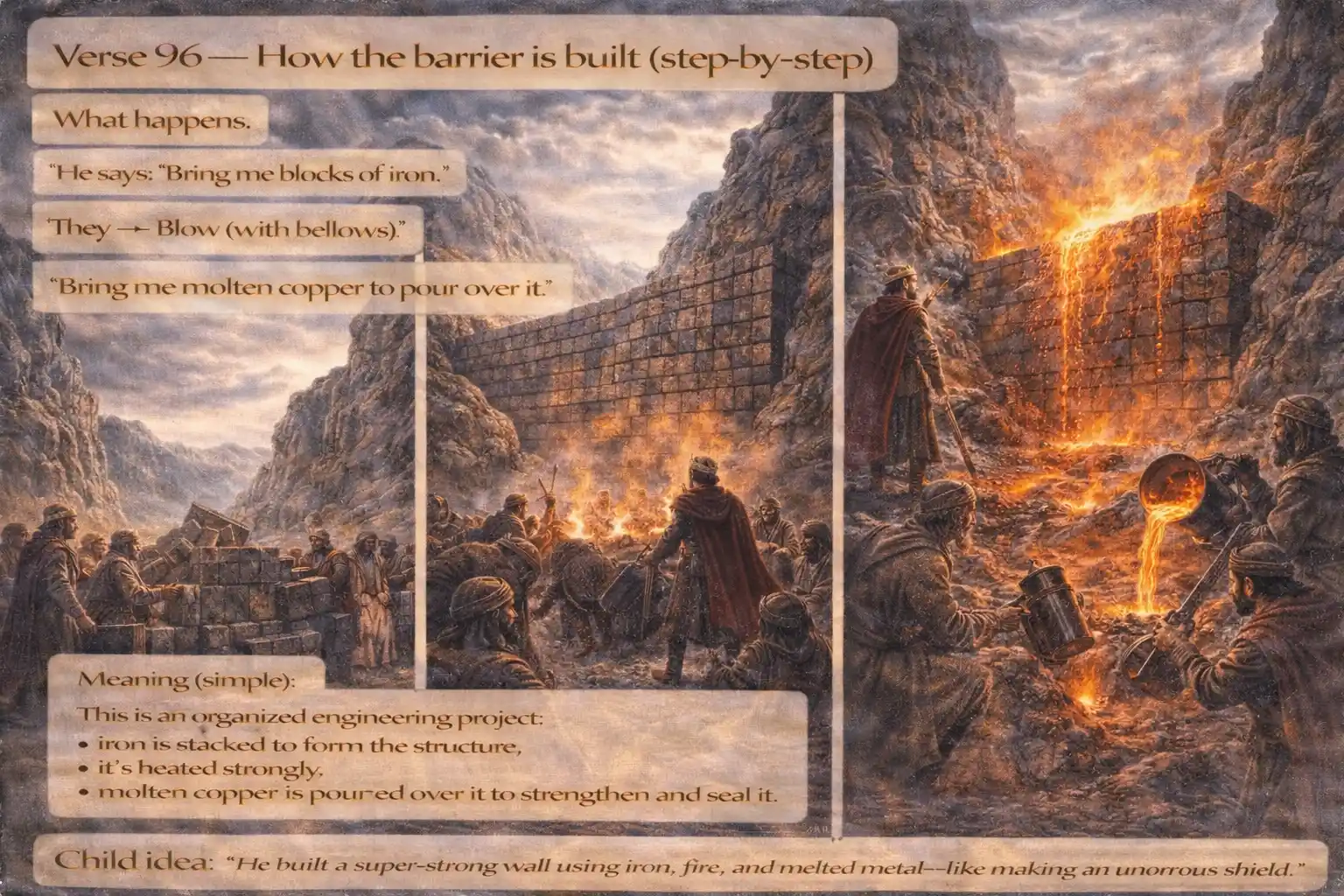
- 18:96 — How the barrier is built (step-by-step)
This is a careful engineering project: iron, heat, and molten copper.
What happens
- He says: “Bring me blocks of iron.”
- They fill the gap between the mountains with iron until it is leveled.
- He says: “Blow (with bellows).” (blowing air to make the fire hotter)
- When it becomes extremely hot, he says: “Bring me molten copper to pour over it.”
- Iron is stacked to form a strong structure.
- It is heated intensely (like blacksmith work, but huge).
- Molten copper is poured over it to strengthen and seal it.
- The result is a very powerful barrier.
“He built a super-strong wall using iron, fire, and melted metal—like making an enormous shield.”
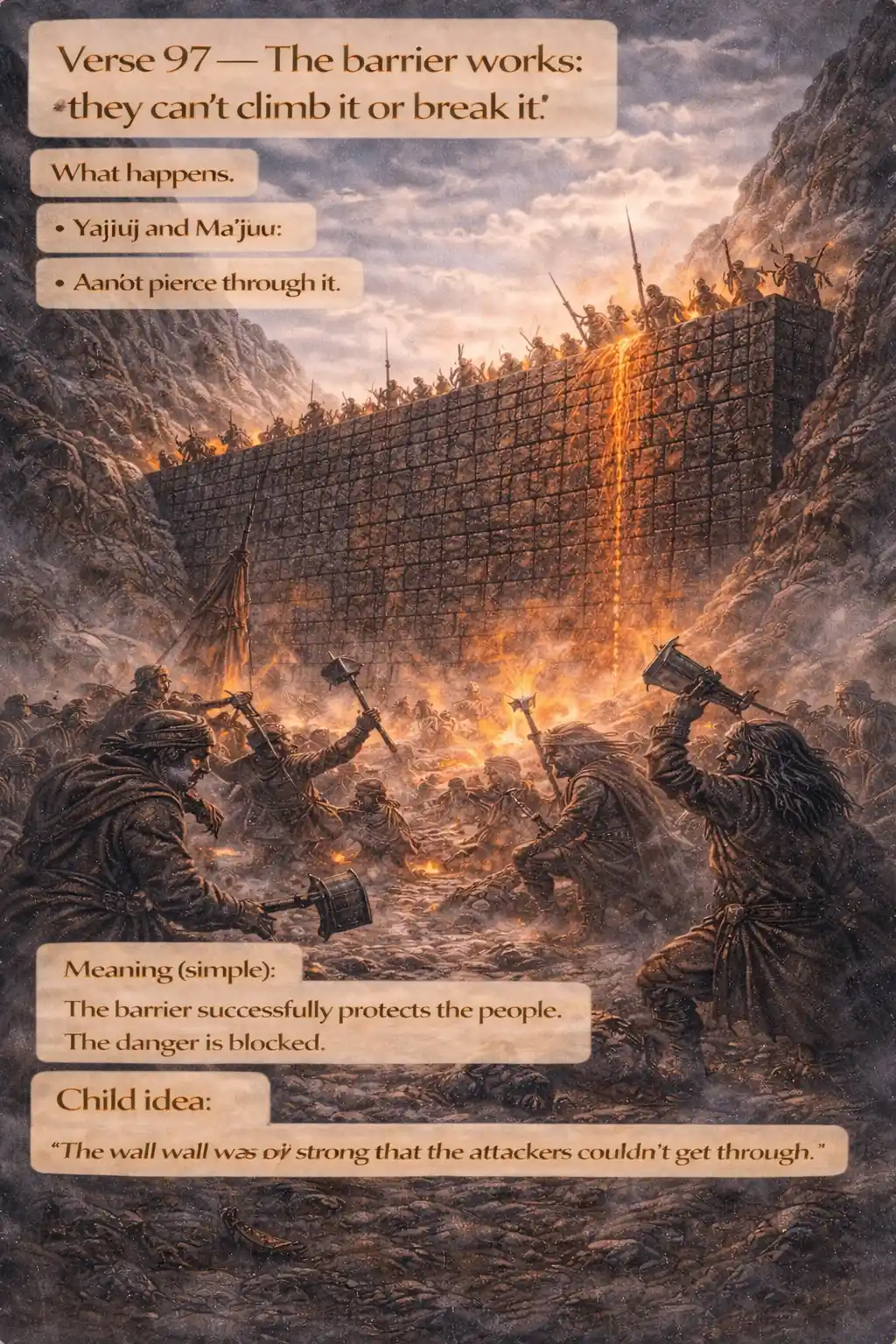
- 18:97 — The barrier works: they can’t climb it or break it
The danger is blocked—Ya’juj and Ma’juj cannot get through.
What happens
- They were not able to scale it (climb over it).
- They were not able to pierce it (break through it).
- The barrier successfully protects the people.
- The attackers cannot climb it and cannot break it.
“The wall was so strong that the attackers couldn’t get through.”
- 18:98 — Dhul-Qarnayn stays humble: “This is Allah’s mercy” and it won’t last forever
He gives credit to Allah and reminds everyone that nothing in this world lasts forever.
What he says
- “This is a mercy from my Lord.”
- “But when my Lord’s promise comes, He will make it level.”
- “And my Lord’s promise is true.”
- He gives credit to Allah and does not boast.
- He says: “Allah was merciful to allow this protection.”
- He reminds people: nothing in this world is permanent.
- Even the strongest barrier exists only as long as Allah wills.
- When Allah’s promised time comes, Allah can flatten it.
- Allah’s promise is always true—what Allah says will happen, will happen.
“This protection is from Allah. But one day, when Allah decides, it can change—because Allah’s promise always comes true.”
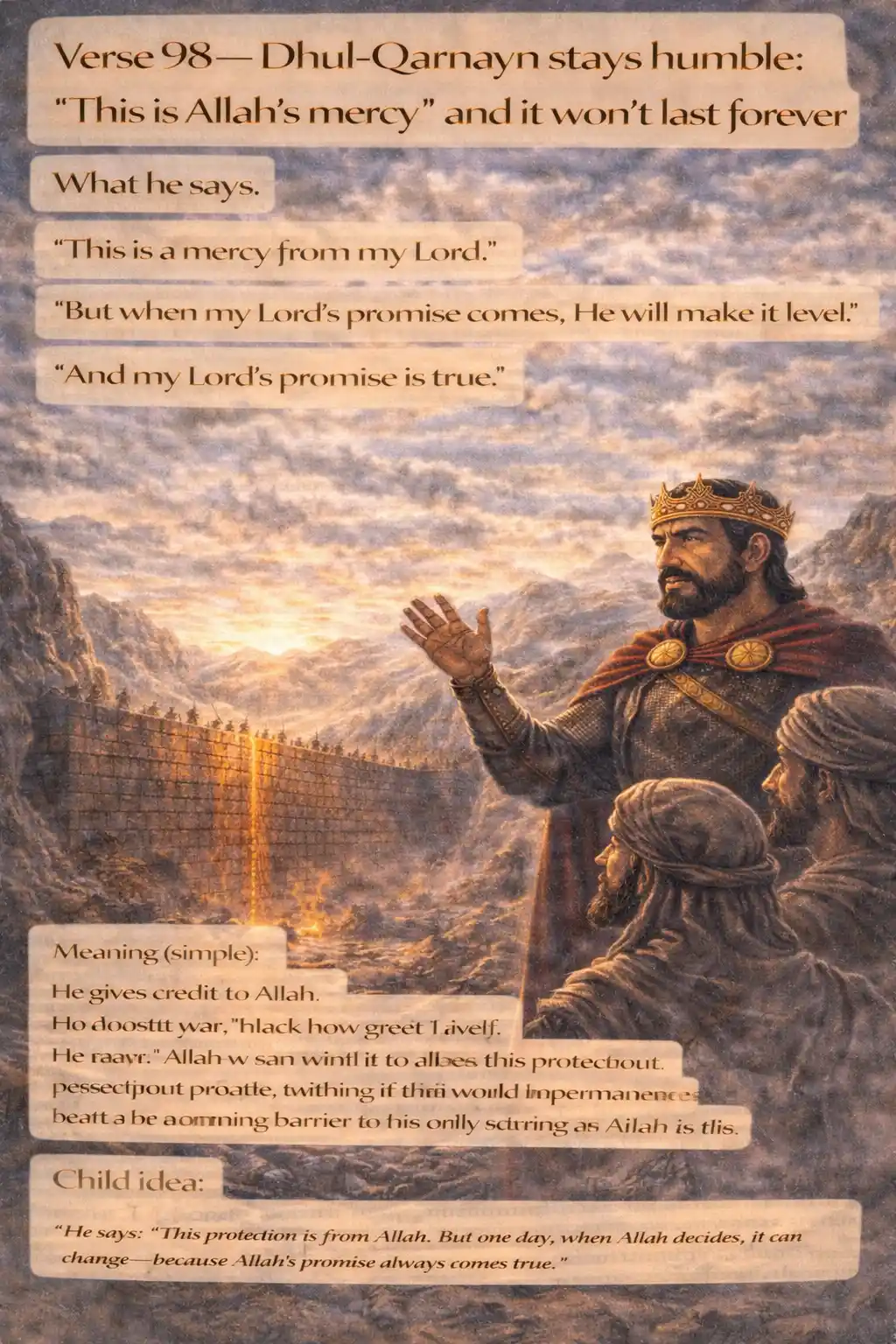
Dhul-Qarnayn kept traveling to different places, using the tools and paths Allah gave him. He reached people who had no shelter from the sun, and Allah knew everything about him. Then he traveled again and reached a place between two mountains where people could barely communicate. They begged him to protect them from Ya’juj and Ma’juj who were causing corruption. They offered money, but he refused and asked them to help with strength. Together they built a powerful barrier using iron, fire, and molten copper, and it worked—no one could climb it or break it. Dhul-Qarnayn stayed humble and said it was Allah’s mercy, and he reminded them that when Allah’s promised time comes, Allah can make the barrier level again, because Allah’s promise is always true.
99. And We will leave them that Day surging over one another, and the Trumpet will be blown; then We will gather them all together.
100. And We will present Hell that Day to the disbelievers, plainly visible.
101. Those whose eyes had been under a covering from My remembrance, and they were not able to hear.
102. Do those who disbelieve think that they can take My servants as protectors besides Me? Indeed, We have prepared Hell as a lodging for the disbelievers.
103. Say: “Shall We inform you of the greatest losers in (their) deeds?”
104. “Those whose effort is lost in the life of this world, while they think that they are doing good work.”
105. Those are the ones who disbelieve in the signs of their Lord and in meeting Him, so their deeds are null. So We shall not assign to them on the Day of Resurrection any weight.
106. That is their recompense—Hell—because they disbelieved and took My signs and My messengers in mockery.
107. Indeed, those who believe and do righteous deeds— theirs will be the Gardens of Paradise as hospitality,
108. They will abide therein forever. They will not desire from it any change.
109. Say: “If the sea were ink for (writing) the words of my Lord, the sea would be exhausted before the words of my Lord were exhausted, even if We brought the like of it as a supplement.”
110. Say: “I am only a human like you. It is revealed to me that your God is One God. So whoever hopes for the meeting with his Lord—let him do righteous work and not associate anyone in the worship of his Lord.”
Surah Al-Kahf (18:99–110) — The Final Warning and the Final Hope (Child-Friendly)
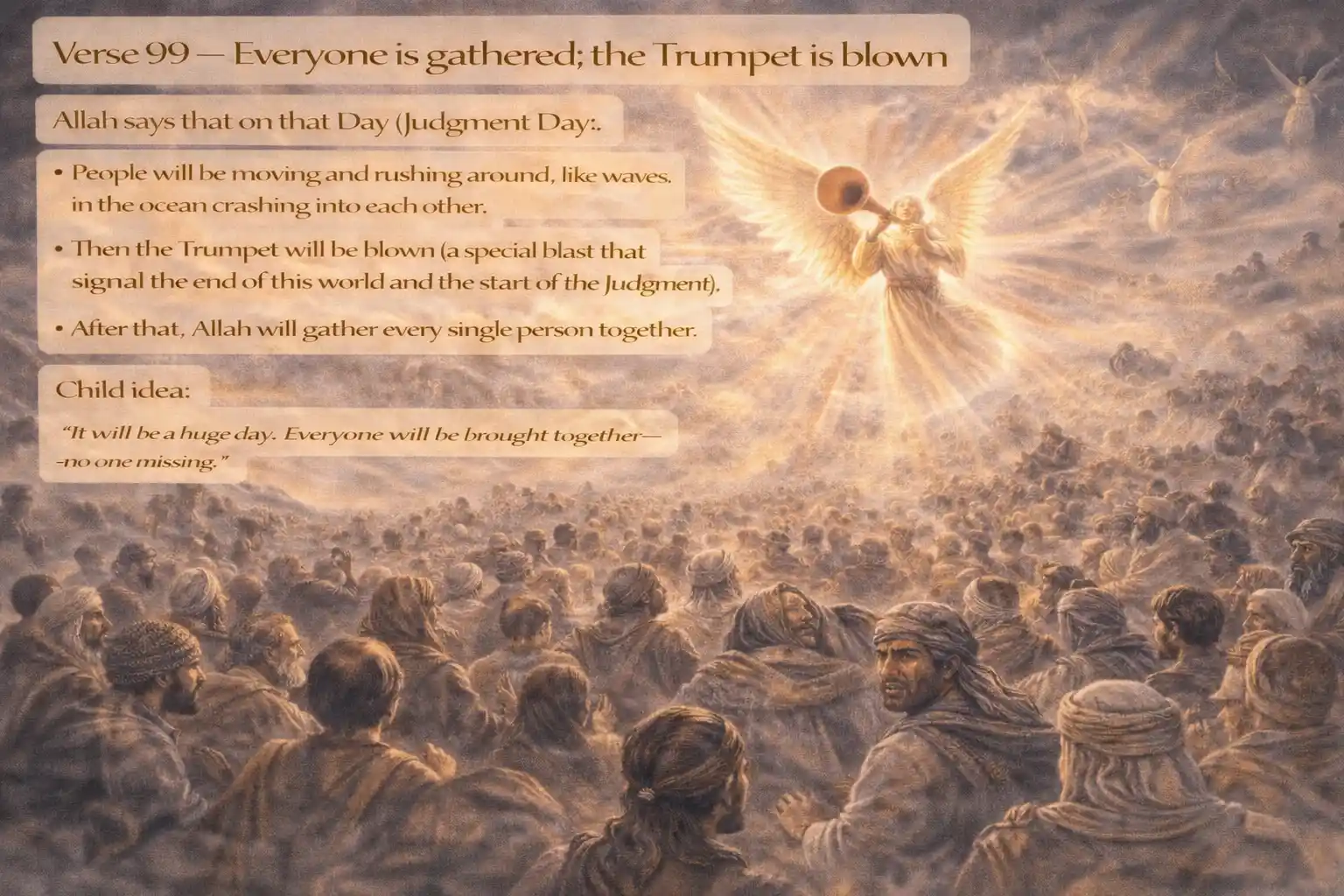
- 18:99 — Everyone is gathered; the Trumpet is blown
Allah describes the huge scene of Judgment Day: crowds, the Trumpet, and everyone being gathered.
What happens
- On Judgment Day, people will be moving around in a huge crowd, like waves pushing into each other.
- Then the Trumpet will be blown (a special blast Allah commands).
- After that, Allah will gather every single person together—no one missing.
- This day is so big that nobody can hide or escape.
- Everyone will stand together for the final judgment.
“It will be a massive day. Everyone will be brought together, all at once.”
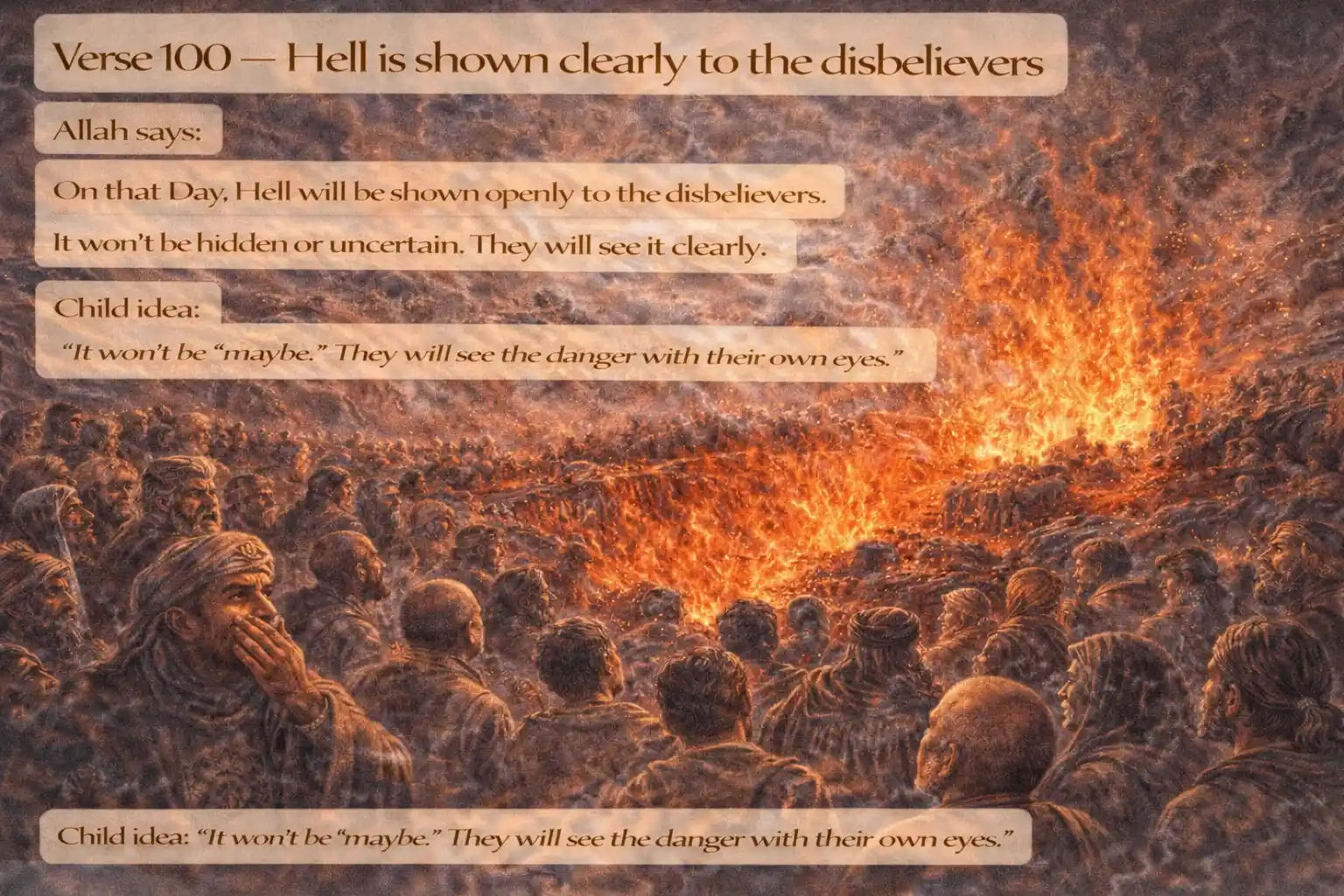
- 18:100 — Hell is shown clearly to the disbelievers
Allah says that Hell will be shown openly—no confusion, no hiding.
What happens
- On that Day, Hell will be shown openly to the disbelievers.
- It won’t be hidden or uncertain—they will see it clearly.
- Truth becomes completely clear on that Day.
- No one will be able to pretend they didn’t know.
“It won’t be ‘maybe.’ They will see the danger with their own eyes.”
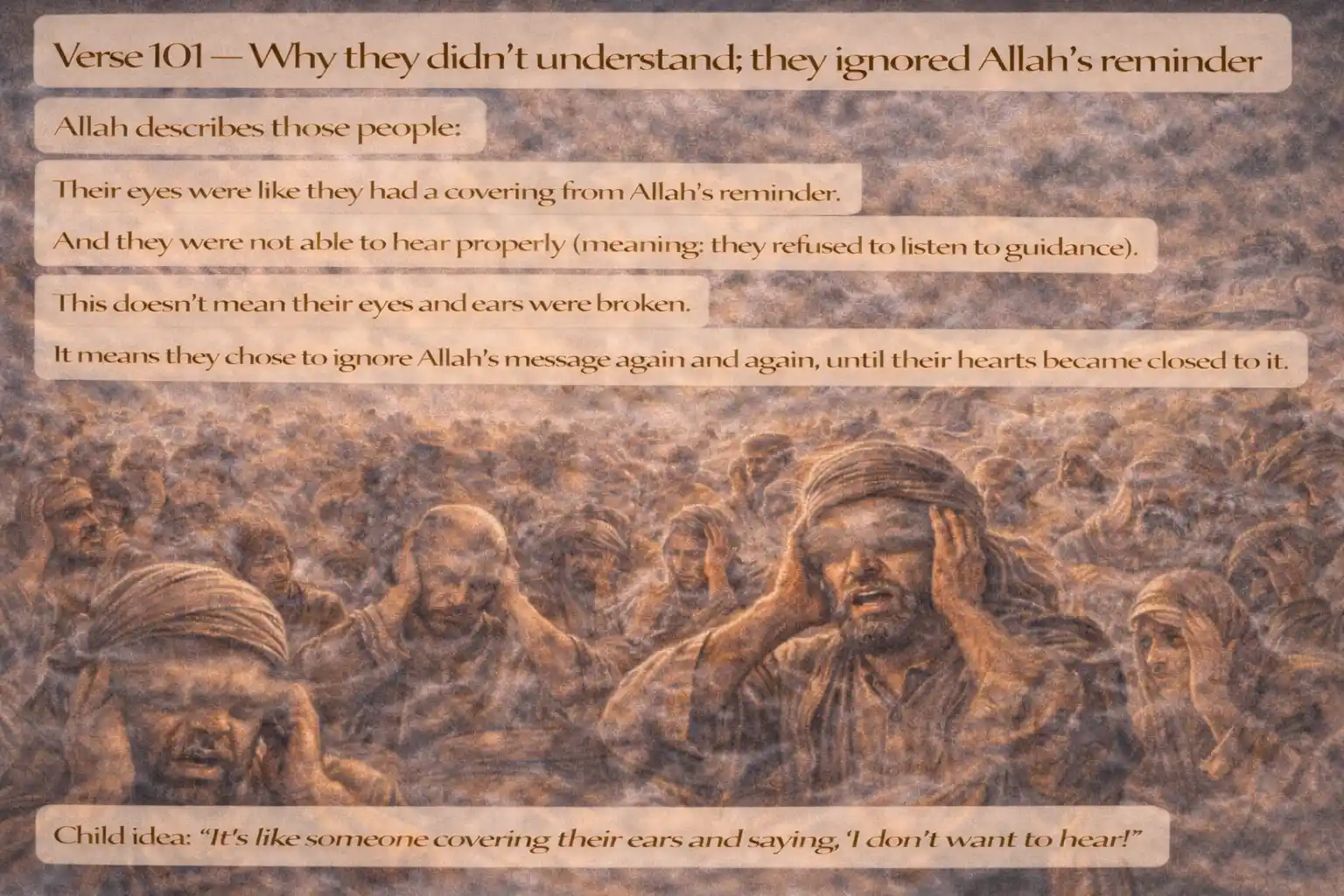
- 18:101 — Why they didn’t understand: they ignored Allah’s reminder
Allah explains that they kept ignoring guidance until they became closed to it.
What Allah describes
- Their eyes were like they had a covering from Allah’s reminder.
- They were not able to hear properly (meaning: they refused to listen to guidance).
- This does not mean their eyes and ears were broken.
- It means they chose to ignore Allah’s message again and again, until their hearts became closed to it.
- When someone keeps rejecting truth on purpose, they can become spiritually “blocked.”
“It’s like someone covering their ears and saying, ‘I don’t want to hear!’”
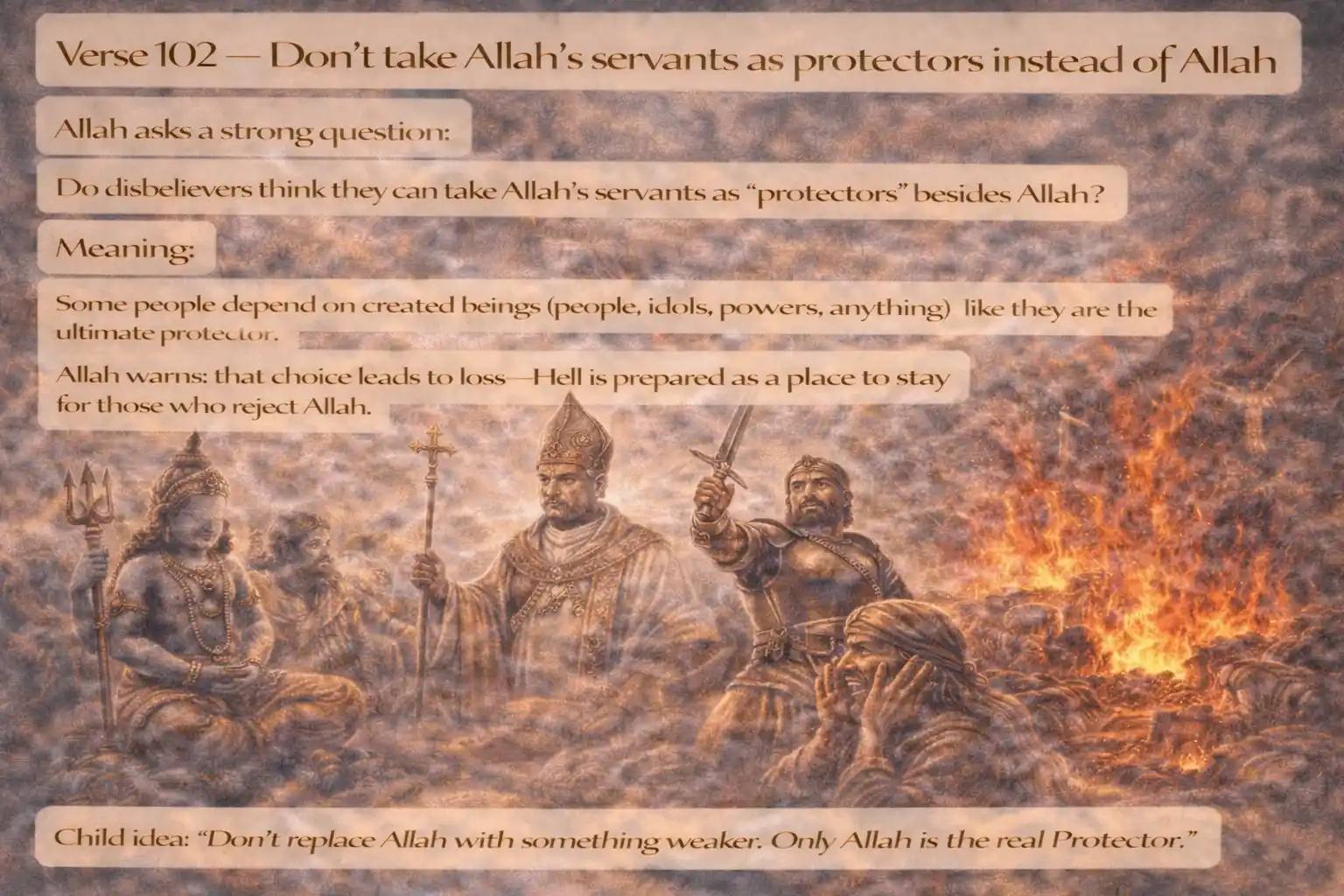
- 18:102 — Don’t take Allah’s servants as protectors instead of Allah
Allah warns: don’t replace Allah with weaker “protectors.”
What Allah asks
- Do disbelievers think they can take Allah’s servants as “protectors” besides Allah?
- Some people depend on created beings (people, idols, powers, anything) like they are the ultimate protector.
- But created things are limited and can fail.
- Allah warns: rejecting Allah and relying on false protectors leads to loss—Hell is prepared for those who disbelieve.
“Don’t replace Allah with something weaker. Only Allah is the real Protector.”
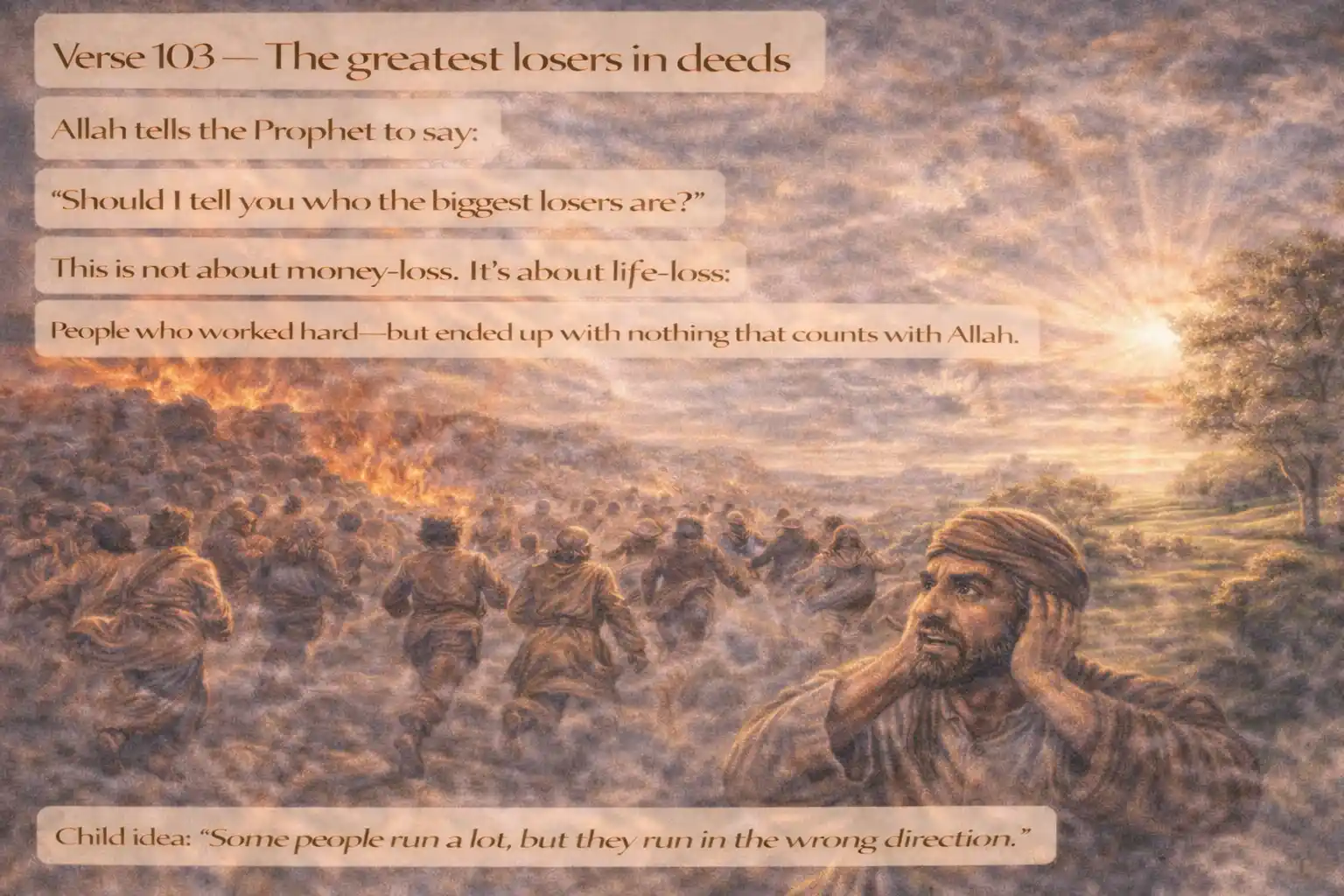
- 18:103 — The greatest losers in deeds
Allah asks a serious question: who are the biggest losers—not in money, but in life?
What Allah says to the Prophet to say
- “Should I tell you who the biggest losers are?”
- This is not about losing money.
- It is about people who worked hard—but ended up with nothing that counts with Allah.
“Some people run a lot, but they run in the wrong direction.”
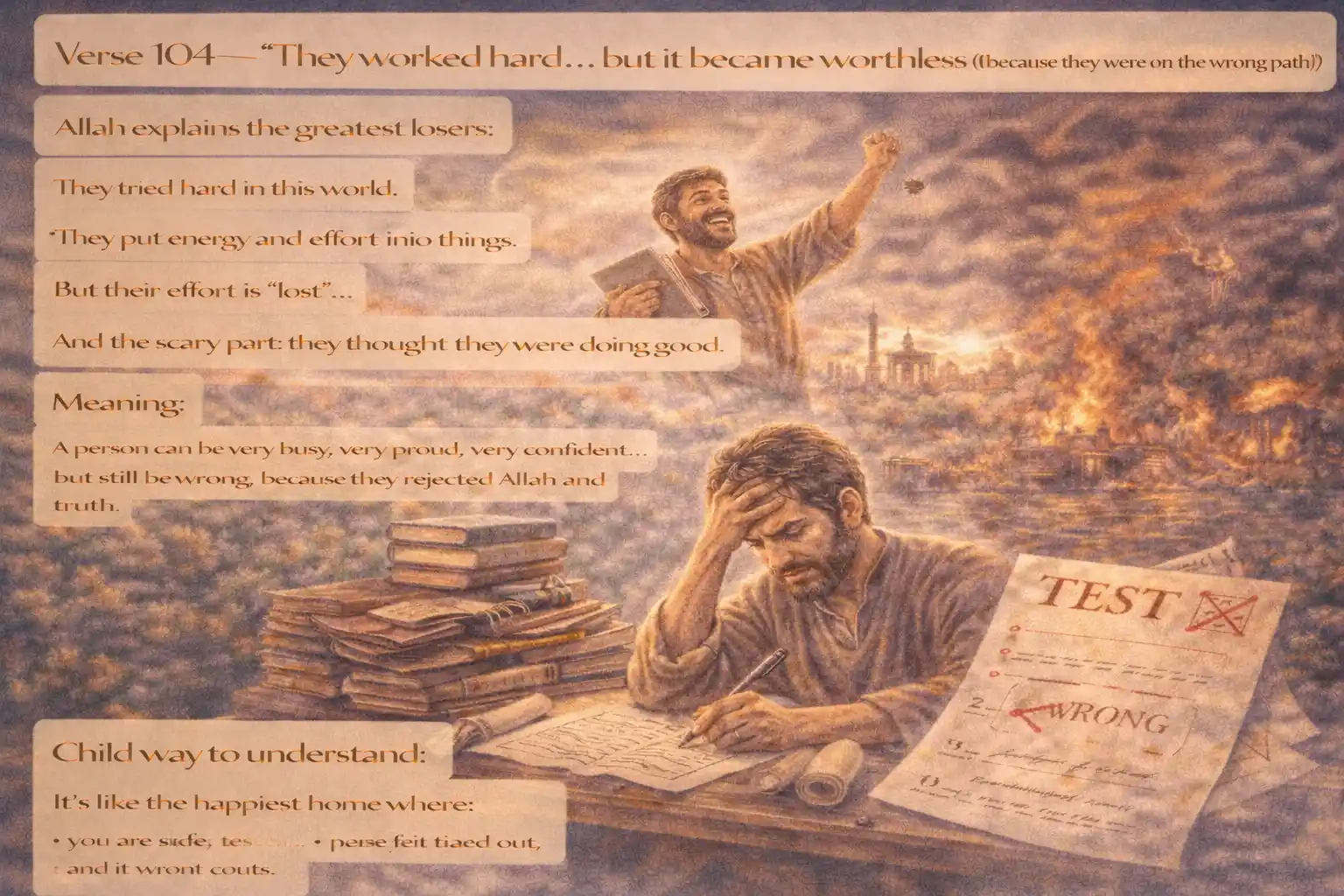
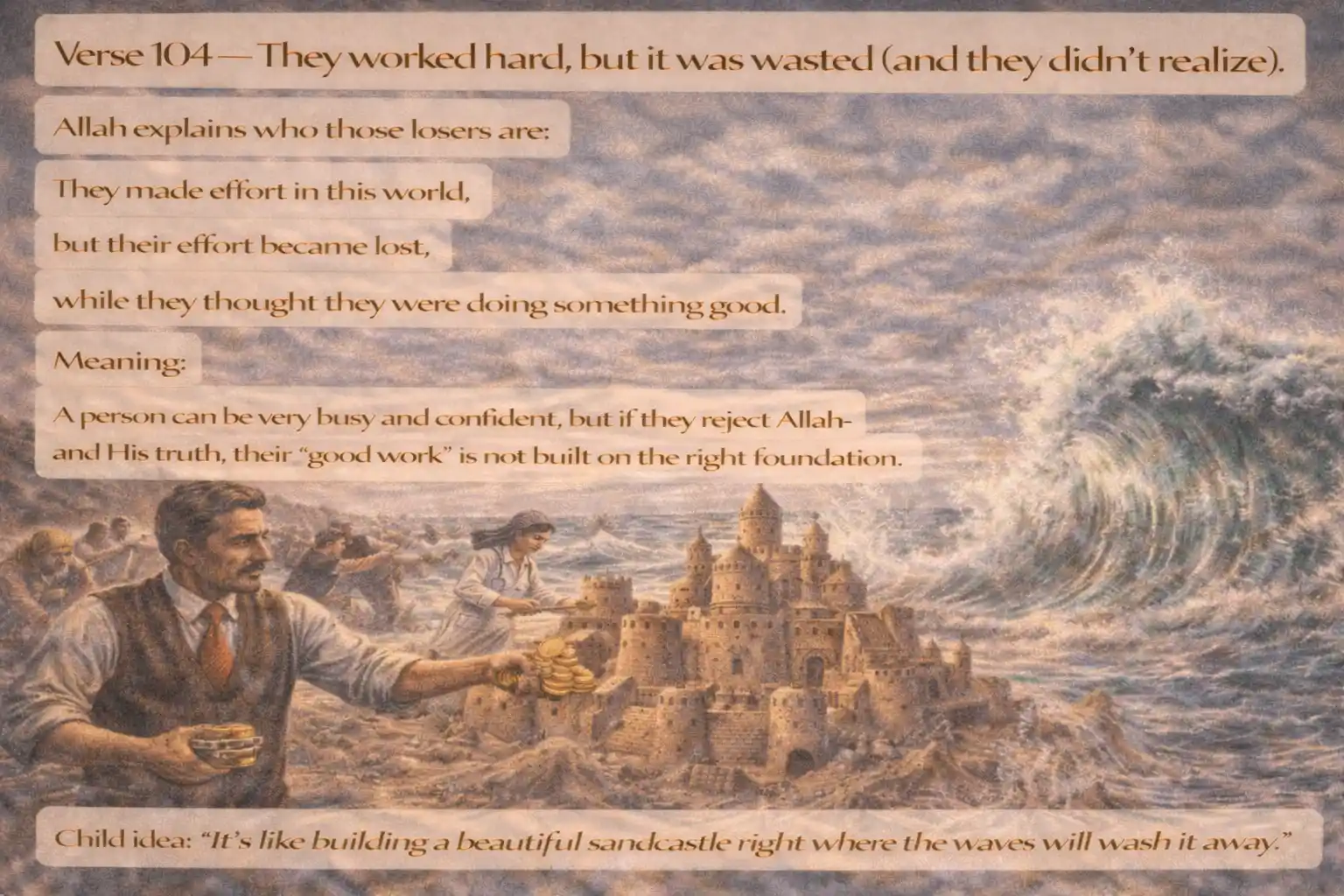
- 18:104 — They worked hard, but it was wasted (and they didn’t realize)
They were busy and confident, but their foundation was wrong.
Who are these people?
- They made effort in this world.
- But their effort became lost.
- While they thought they were doing something good.
- A person can be very busy and confident.
- But if they reject Allah and His truth, their “good work” is not built on the right foundation.
- So in the final judgment, it does not bring the reward they assumed.
“It’s like building a beautiful sandcastle right where the waves will wash it away.”
- 18:105 — Why their deeds have “no weight”
Allah explains why their deeds don’t count as valuable in the final scale.
What Allah says about them
- They disbelieved in the signs of their Lord.
- They disbelieved in meeting Him (Judgment Day).
- So their deeds become null (worthless in the final judgment).
- Allah gives them no weight on the Day of Resurrection.
- Their deeds do not count as valuable in Allah’s final scale,
- because they rejected the truth and the purpose of life.
“If someone throws away the truth, they throw away the value of their actions too.”
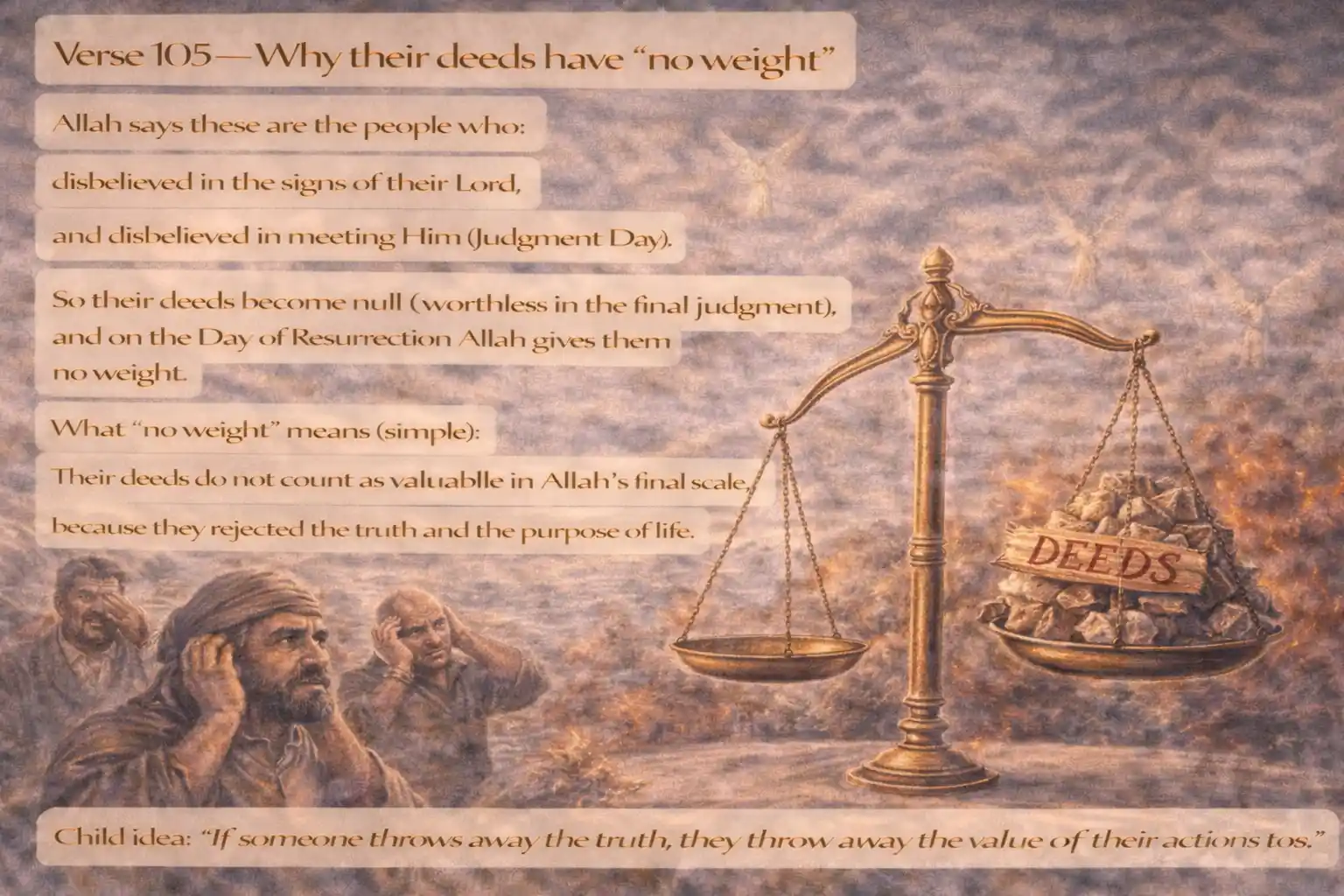
- 18:106 — Why Hell: because they mocked Allah’s signs and messengers
Allah explains the reason: rejection and mockery of truth.
Why is their recompense Hell?
- They disbelieved.
- They mocked Allah’s signs.
- They mocked Allah’s messengers.
- It wasn’t just a small mistake.
- It was rejection + arrogance + making fun of truth.
“They didn’t just ignore the warning—they laughed at it.”
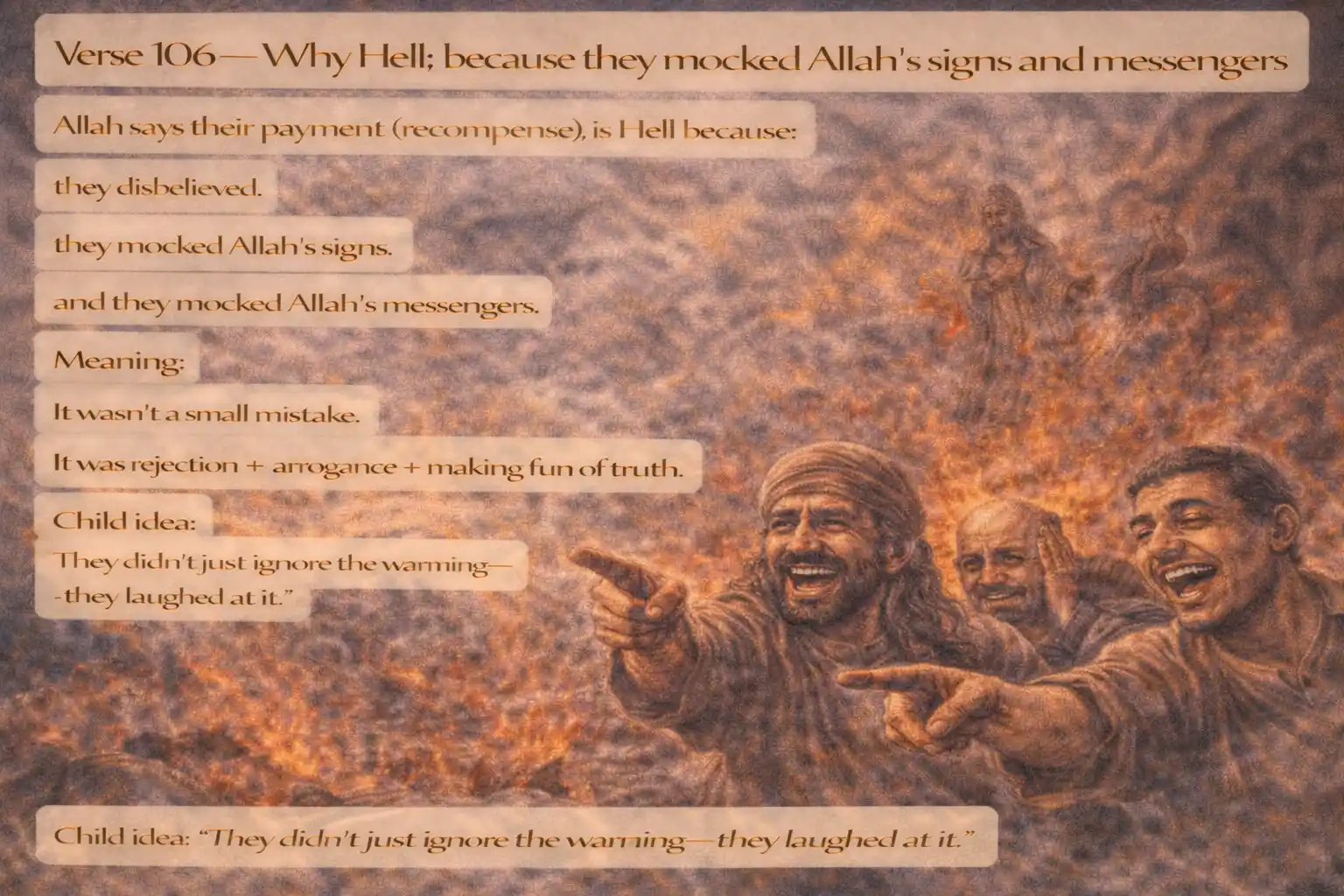
- 18:107 — Believers who do good get Paradise
Allah gives the opposite outcome for believers who do good.
What Allah promises
- Those who believe and do righteous deeds will be welcomed into Gardens of Paradise as hospitality.
- It is like Allah welcomes them like honored guests.
- They are received with kindness and honor.
“Allah will welcome them warmly, like special guests.”
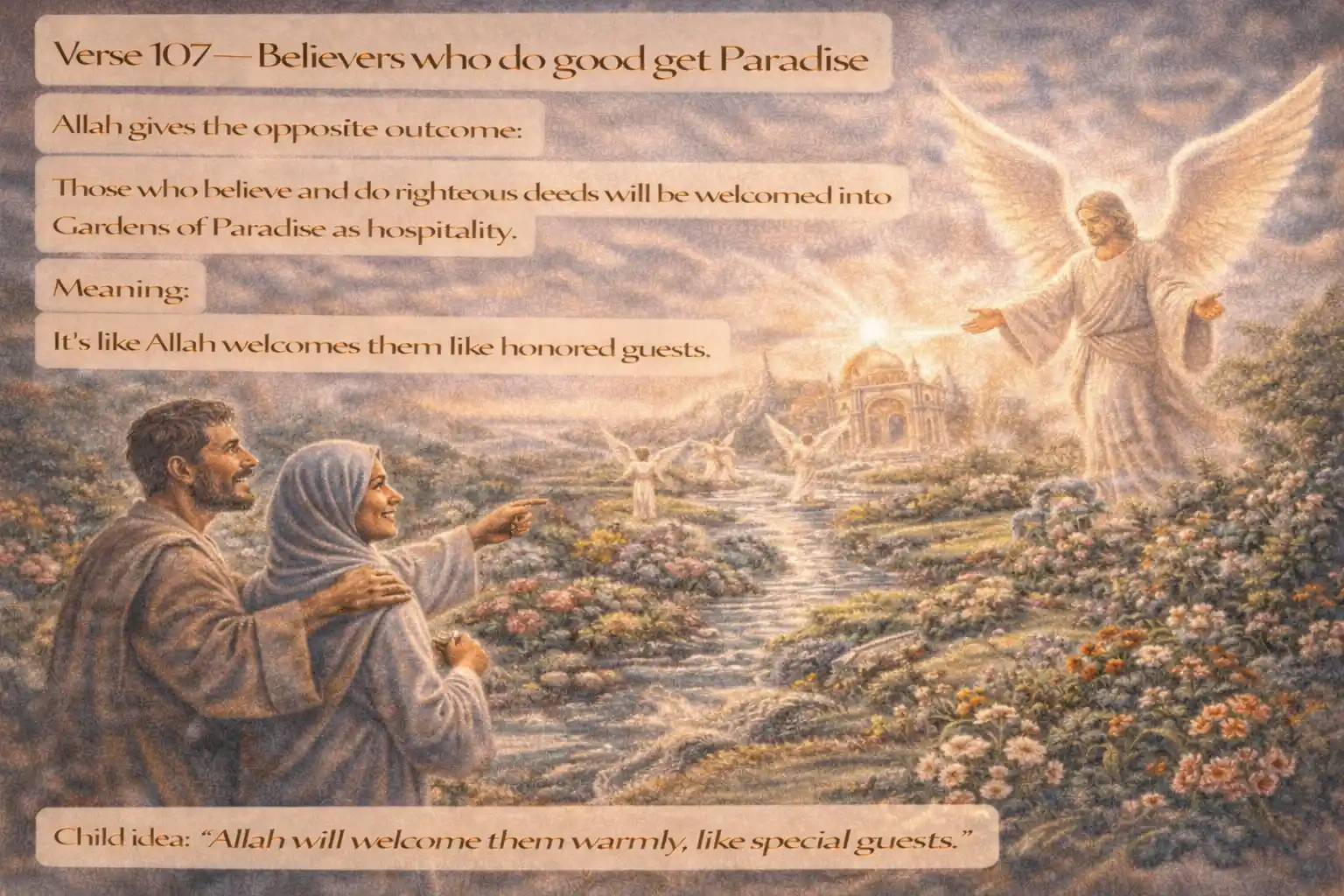
- 18:108 — They stay forever and don’t want to leave
Paradise is so perfect that nobody wants to leave.
What Allah says
- They will live there forever.
- They will not want anything else instead of it.
- Paradise is safe, satisfying, and full of peace.
- They won’t think: “I want a different place.”
- It is a perfect home—forever.
“It’s the perfect home—forever.”
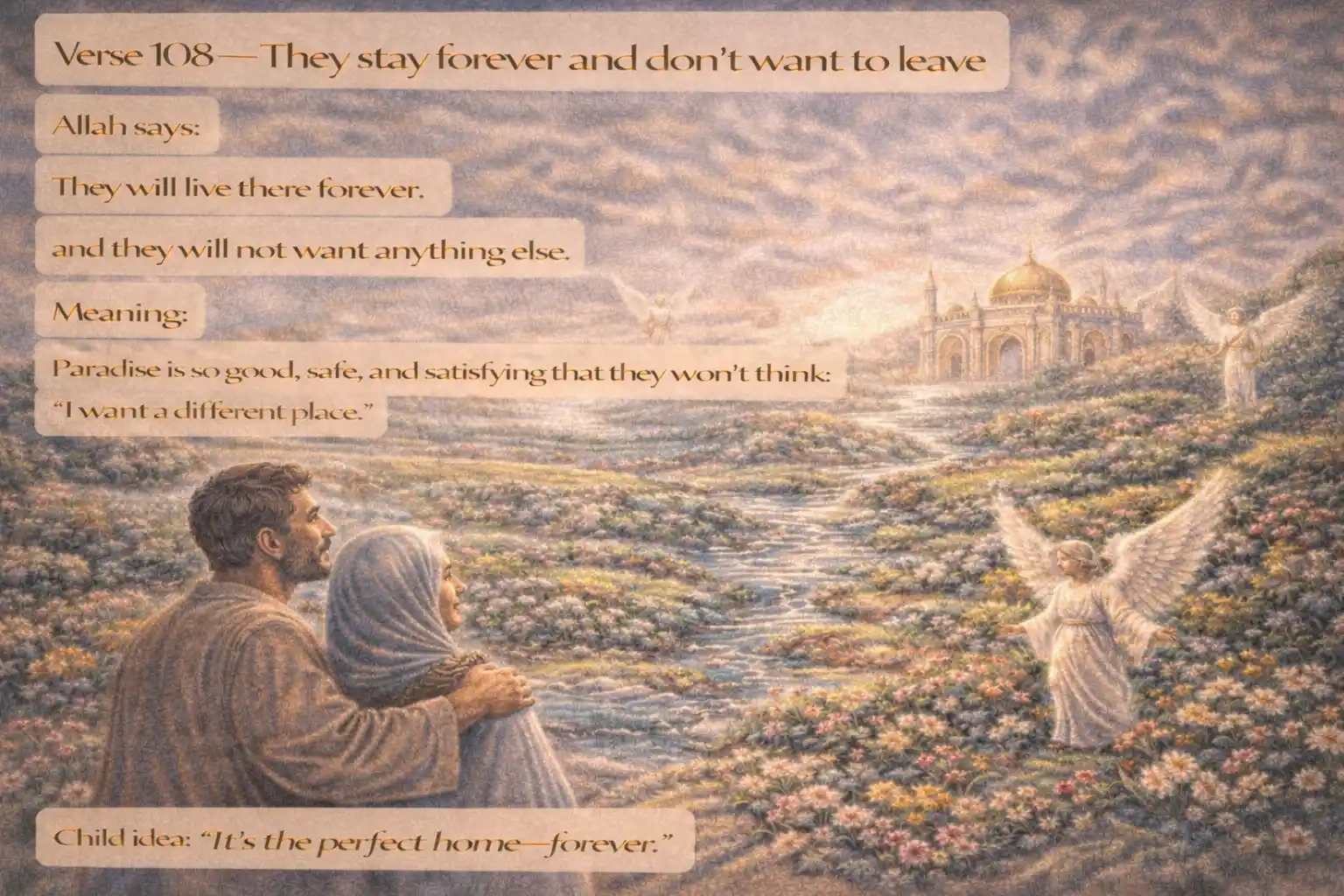
- 18:109 — Allah’s words are endless (even the ocean isn’t enough ink)
Allah gives an example showing how limitless His knowledge and words are.
The example
- If the entire sea were ink to write Allah’s words,
- the sea would run out before Allah’s words run out,
- even if another sea was added to help.
- Allah’s knowledge, wisdom, commands, and truth are far beyond what humans can finish writing.
- Humans have limits, but Allah has no limit.
“Allah’s knowledge is so huge that oceans of ink would finish first.”
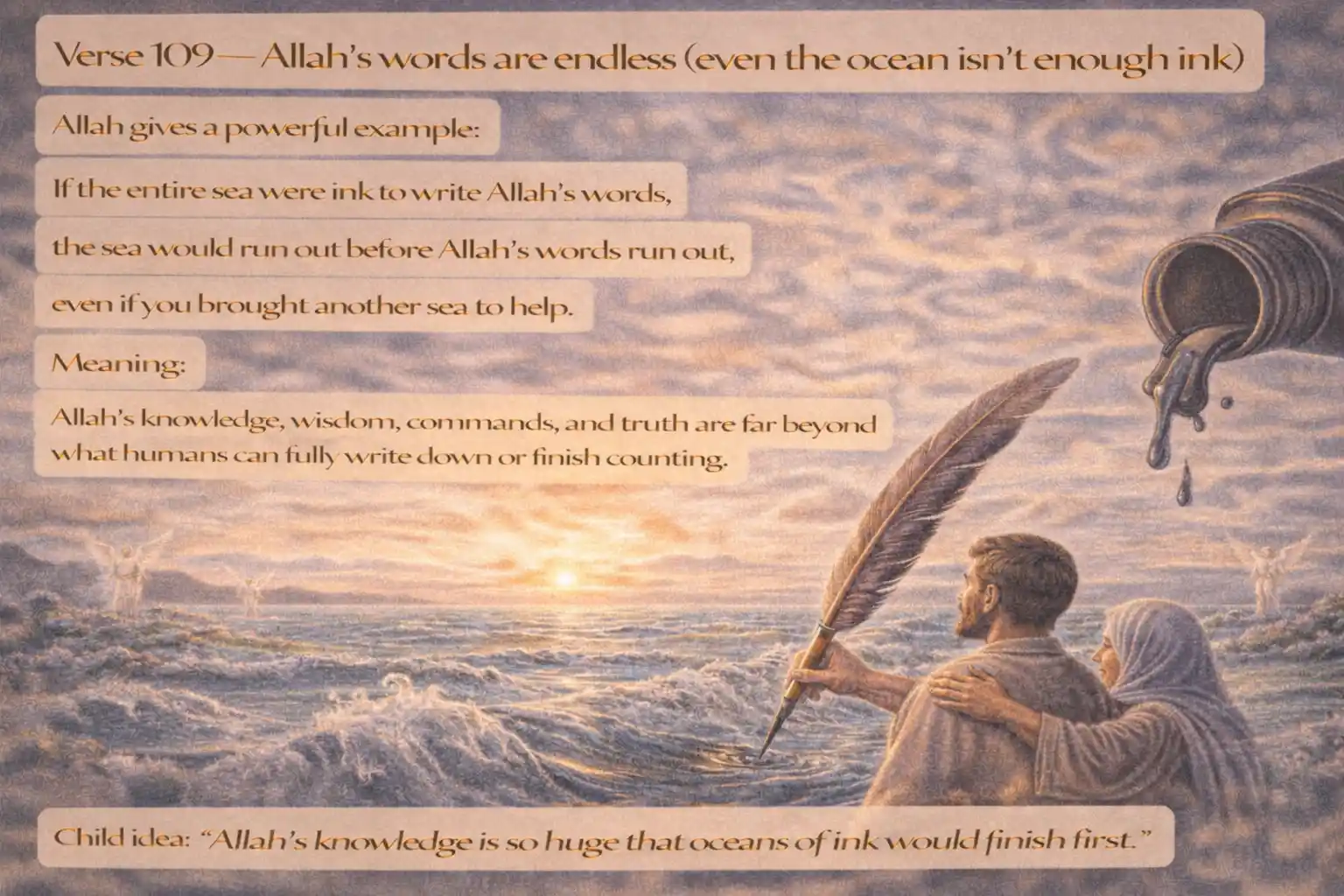
- 18:110 — The final instruction: do good and worship Allah alone
Allah ends Surah Al-Kahf with a clear message: sincere worship and righteous deeds.
What Allah tells the Prophet to say
- “I am only a human like you.”
- The difference is: revelation comes to him that your God is One God.
- So whoever hopes to meet Allah should:
- do righteous deeds
- and not associate anyone in worship with Allah.
- Be sincere with Allah.
- Do real good.
- Don’t mix worship of Allah with worship of anything else.
“If you want to meet Allah in a good way: do good, and worship Allah alone.”
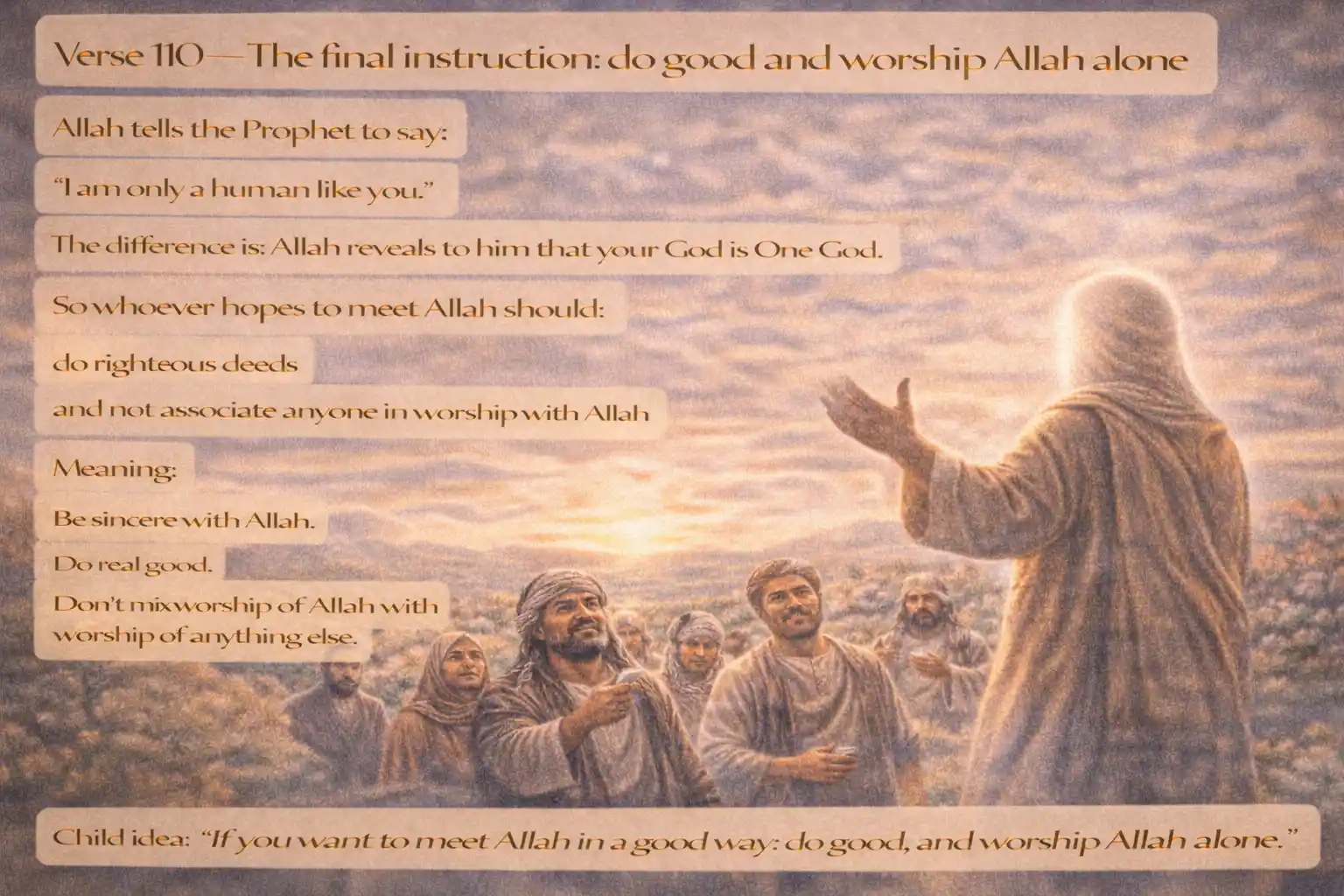
- This life is not the end.
- Judgment Day will come, and everyone will be gathered.
- Some people ignored Allah and mocked truth—so they lose.
- But people who believe, do good, and worship Allah alone will be welcomed into Paradise forever.