Surah An-Nahl (Chapter 16)

Qur'an-only explanation of Surah An-Nahl – warning against shirk, signs in creation, gratitude, and moral accountability.
Surah An-Nahl emphasises:
Tawheed Signs Gratitude Warning & Accountability
Verses 1–10
The certainty of Allah’s command, the mission of warning, and foundational signs in creation

1. The command of Allah will come to pass, so seek not to hasten it. Glorified be He and Exalted above what they associate (with Him).

2. He sends down the angels, with the Spirit of His command, upon whom He wills of His slaves, (saying): “Warn that there is no god except Me, so fear Me.”

3. He created the heavens and the earth with truth. Exalted is He above what they associate (with Him).

4. He created man from a drop of fluid, then behold, he is an open disputer.

5. And the cattle, He has created them, for you, in them there is warmth (clothing), and (other) benefits, and from them you eat.

6. And for you in them is beauty, when you bring them (home in the evening), and when you take them out (to pasture).

7. And they carry your loads to a land you could not reach except with great difficulty to yourselves. Truly, your Lord is indeed Kind, Most Merciful.

8. And (He created) horses and mules and donkeys that you may ride them, and as adornment. And He creates that which you have no knowledge.

9. And upon Allah is the straight path. And among them (side ways) are those deviating. And if He had willed, He could have guided you all.

10. He it is who sends down water from the sky, from it is drink for you, and from it (grows) foliage on which you pasture (your cattle).

Surah An-Naḥl (16:1–10) — Simple Explanation

16:1 — “The command of Allah will come to pass, so seek not to hasten it…”

A) What it says

Allah’s command and judgment will certainly happen, and people should not demand that it be rushed. Allah is perfectly above anything people associate with Him.

B) What it means (simple)

  • Allah’s final decision (especially judgment and outcomes) is guaranteed.
  • Some people mock and say, “If it’s true, bring it now.” The verse replies: do not rush Allah.
  • Allah is not like creation—He has no partners, no weakness, no human limits.

C) Real-life lesson

Truth and justice are not delayed because Allah is weak. They happen at the right time—by wisdom, not by human impatience.

16:2 — “He sends down the angels, with the Spirit of His command…”

A) What it says

Allah sends angels with “the Spirit” of His command (revelation) to whomever He wills, telling them to warn الناس: there is no god except Allah, so be mindful of Him.

B) What it means (simple)

  • Allah chooses messengers and gives them revelation through angels.
  • “The Spirit” means revelation that gives life to hearts—like life comes to the body through breath.
  • The core message is always: worship Allah alone, and take Him seriously (fear Him by avoiding wrongdoing).

C) Real-life lesson

Prophets were not inventing religion or guessing. They were delivering guidance from Allah to warn and guide people.

16:3 — “He created the heavens and the earth with truth…”

A) What it says

Allah created the heavens and the earth “with truth,” and He is exalted above what people associate with Him.

B) What it means (simple)

  • The universe is not meaningless and not random.
  • “With truth” means: created with purpose, order, and wisdom—built on reality, not chaos.
  • Because Allah created everything, attaching “partners” to Him is false and unjust.

C) Real-life lesson

The world is not an accident. It is a sign and a test—so life is meant to be taken seriously.

16:4 — “He created man from a drop of fluid, then behold, he is an open disputer.”

A) What it says

Humans begin from something extremely small and humble, yet later some become argumentative and arrogant.

B) What it means (simple)

  • Your origin is humble: a tiny drop.
  • Allah gives you life, mind, speech, and strength.
  • Yet some people use these gifts to argue against their Creator, as if they are self-made.

C) Real-life lesson

Remember your beginning. Humility and gratitude make sense; arrogance against Allah does not.

16:5 — “And the cattle… in them there is warmth… benefits… and from them you eat.”

Illustration for Qur'an 16:5

A) What it says

Allah created livestock for you, giving you warmth (clothing), many benefits, and food.

B) What it means (simple)

  • Livestock includes sheep, goats, cattle, camels, and similar animals.
  • “Warmth” refers to wool, hair, and hides used for clothing and protection from cold.
  • “Benefits” include milk, leather, trade, tools, work/transport, and daily utility.
  • “From them you eat” means meat and nourishment provided through them.

C) Real-life lesson

Everyday needs—clothing, food, materials—are not guaranteed by “nature alone.” They are provision Allah created through animals.

16:6 — “And for you in them is beauty, when you bring them home… and when you take them out…”

Illustration for Qur'an 16:6

A) What it says

Animals are not only useful—they also bring beauty and joy in daily life.

B) What it means (simple)

  • Seeing herds go out in the morning and return in the evening is calming and uplifting.
  • It signals life, blessing, effort paying off, and stability for a household/community.
  • Allah reminds you: emotional comfort and aesthetic beauty are also gifts.

C) Real-life lesson

Allah provides more than survival. He also gives beauty and peace in ordinary routines.

16:7 — “And they carry your loads to a land you could not reach except with great difficulty…”

Illustration for Qur'an 16:7

A) What it says

Animals carry heavy loads to distant places that would be extremely difficult for people to reach on their own. This is linked to Allah being Kind and Merciful.

B) What it means (simple)

  • Long travel and trade used to be very hard—especially with goods and supplies.
  • Pack animals made transport possible, faster, and far less exhausting.
  • This ease reflects Allah’s mercy—He makes life manageable, not impossible.

C) Real-life lesson

Convenience is not “normal by itself.” It exists because Allah created means that make human life workable.

16:8 — “Horses and mules and donkeys that you may ride… and as adornment…”

Illustration for Qur'an 16:8

A) What it says

Allah created riding animals for transport and also as adornment (beauty, dignity, culture). And He creates what you do not yet know.

B) What it means (simple)

  • Some animals are especially suited for riding and movement.
  • “Adornment” means they also carry beauty, dignity, and social value—not only utility.
  • “He creates what you have no knowledge of” means Allah’s creation is far beyond what you currently see or understand.
  • It also hints that humans will discover more over time—new things and new means.

C) Real-life lesson

Allah provides both function and beauty. And your knowledge is not the limit of what Allah has made.

16:9 — “And upon Allah is the straight path… and among them are deviating…”

A) What it says

Allah clarifies the straight path, yet there are side-paths that deviate. If Allah willed, He could have guided everyone.

B) What it means (simple)

  • The “straight path” is the way of truth: worship Allah alone, live justly, and follow what is right.
  • “Side paths” are wrong beliefs, ظلم (injustice), and following desires over truth.
  • Allah could force everyone to believe, but He chose a test: guidance is shown, and humans choose.

C) Real-life lesson

Truth can be clear, yet people can still choose wrong. That responsibility is part of the test of life.

16:10 — “He sends down water from the sky… drink for you… and foliage…”

Illustration for Qur'an 16:10

A) What it says

Allah sends rain: you drink it, and it grows vegetation that animals feed on.

B) What it means (simple)

  • Rain is direct mercy: it becomes drinking water.
  • It grows plants and foliage.
  • Animals eat those plants.
  • Then animals feed and support people—so the whole system sustains life.
Chain of provision: sky → water → plants → animals → human life

C) Real-life lesson

What looks “ordinary” (rain) is actually a massive sign of Allah’s care and control.

The big message tying all 10 verses together
  • Allah’s judgment and promises are certain—do not rush them with impatience.
  • Guidance comes from Allah through revelation, delivered to His messengers.
  • The universe is created with purpose and truth—not randomness.
  • Humans should stay humble and grateful (our beginning is small, our gifts are huge).
  • Allah built daily life with provision, beauty, and ease (animals, transport, comfort).
  • Allah shows the straight path clearly, but humans still choose—so accountability is real.
  • Even basic things like water are part of a perfectly designed mercy system.
Verses 11–20
Growth, cosmic order, diversity of signs, and the irrationality of worshipping what cannot create

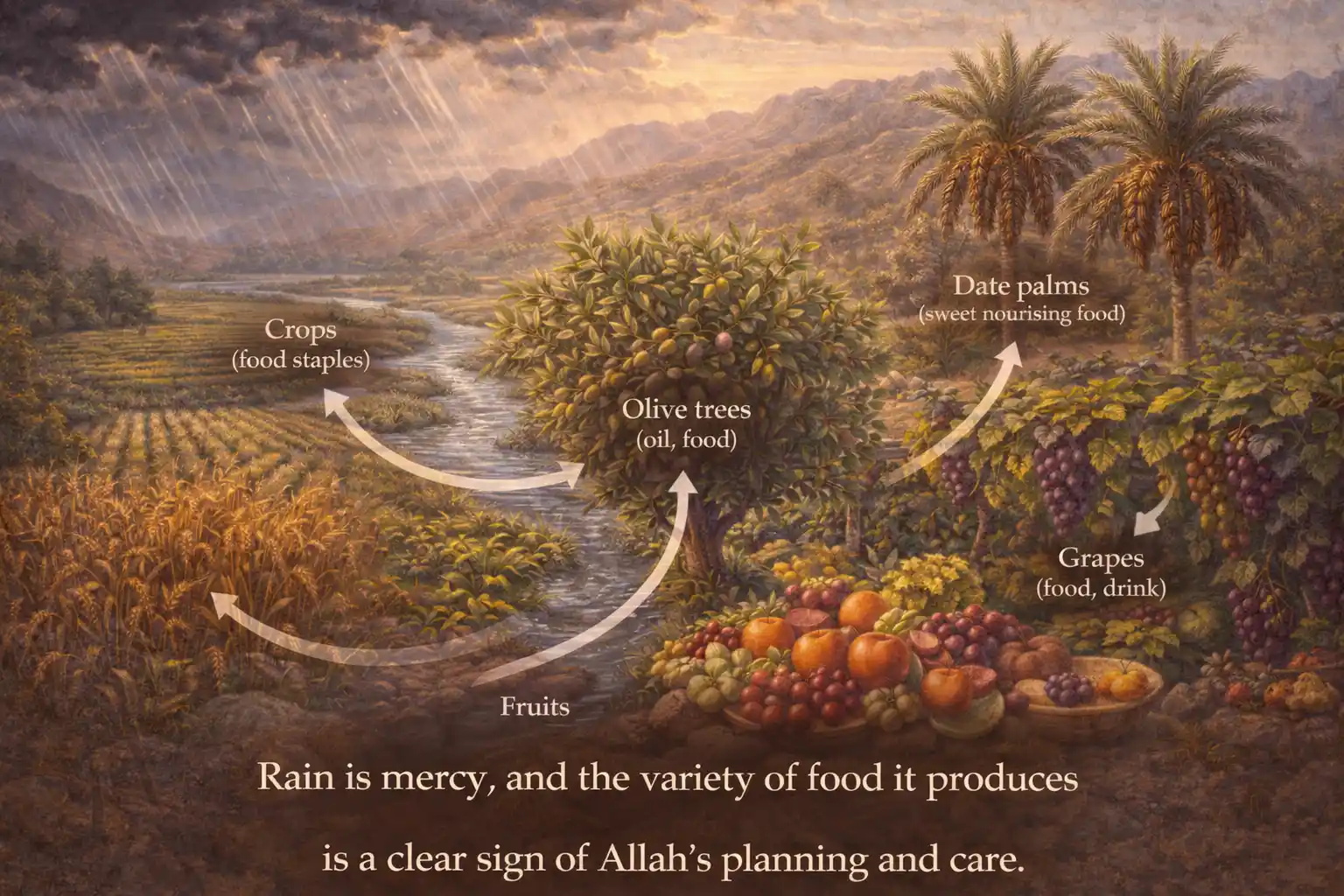
11. He causes to grow for you with it (water) the crops, and the olives, and the date palms, and the grapevines, and all kinds of fruit. Surely, in that is indeed a sign for a people who reflect.

12. And He has subjected for you the night, and the day, and the sun, and the moon. And the stars are made subservient by His command. Surely, in that are indeed signs for a people who understand.

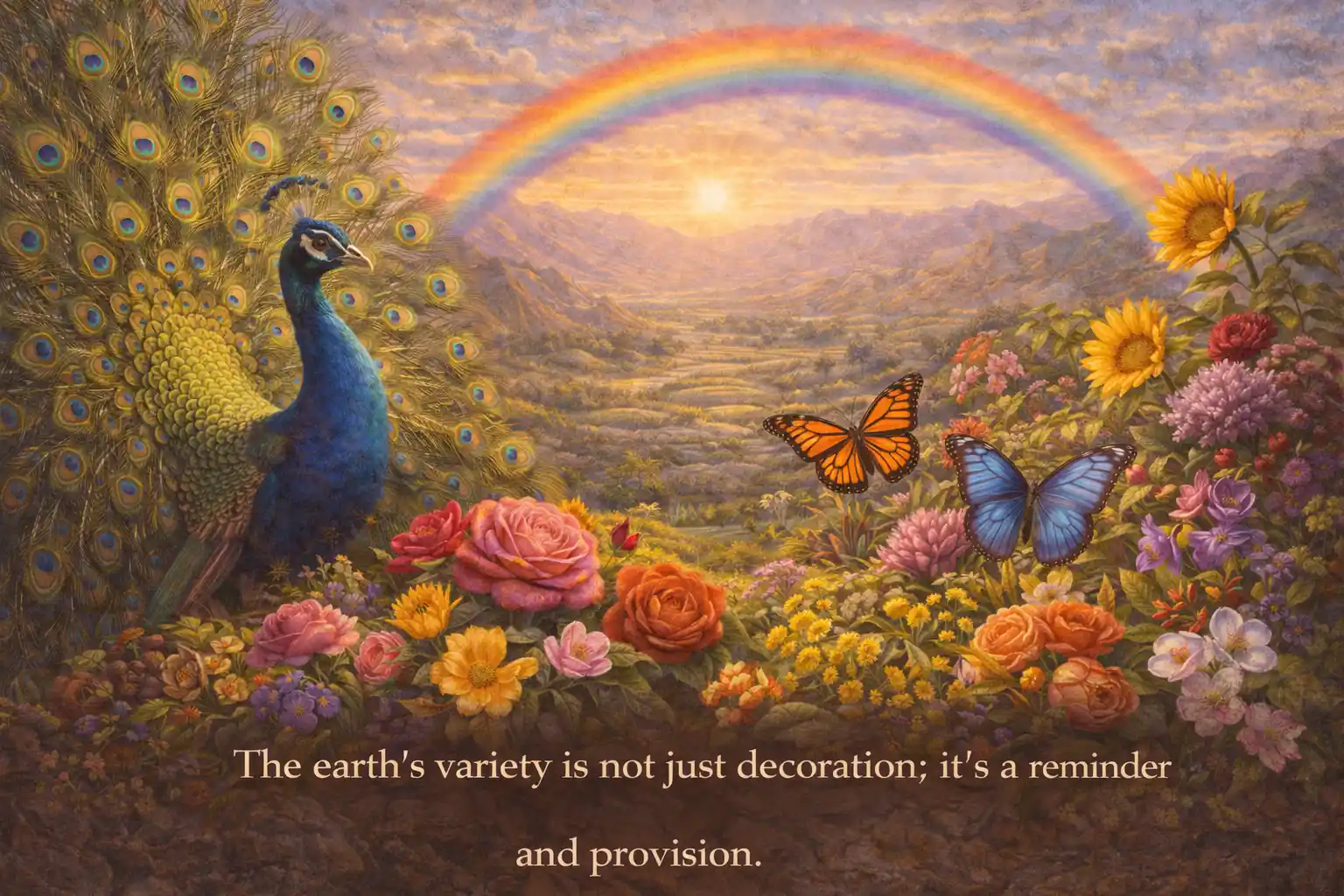
13. And that which He has scattered for you on the earth of diverse colors. Surely, in that is indeed a sign for a people who remember.

14. And He it is who has subjected the sea that you may eat from it tender meat, and bring forth from it ornaments which you wear. And you see the ships ploughing through it, and that you may seek of His bounty, and that you may be grateful.

15. And He has placed on the earth firm mountains lest it should shake with you, and streams and roads that you may be guided.

16. And landmarks, and by the stars they are guided.

17. Is He then who creates like him who does not create. Will you then not remember.

18. And if you should count the favors of Allah, you could not enumerate them. Surely, Allah is indeed Forgiving, Merciful.

19. And Allah knows what you conceal and what you proclaim.

20. And those whom they call upon other than Allah, they have not created anything, and they (themselves) are created.

Qur’an-Only Explanation (16:11–20) — Simple, Detailed

  • 16:11 — Water grows crops, olives, dates, grapes, and all kinds of fruit
    Illustration for Qur'an 16:11

“He causes to grow for you with it (water) the crops, and the olives, and the date palms, and the grapevines, and all kinds of fruit. Surely, in that is indeed a sign for a people who reflect.”

  • Simple meaning: The same rainwater becomes many different foods: basic crops, olives (oil/food), dates (nourishing fruit), grapes (food/drink), and countless other fruits.
  • Why this matters: From the same “water,” Allah brings out different plants with different tastes, colors, benefits, and seasons.
  • “A sign for people who reflect” means: If you pause and think, you see designed provision and planning—not chaos.
Simple takeaway:
Rain is mercy, and the variety of food it produces is a clear sign of Allah’s care and wisdom.

  • 16:12 — Night, day, sun, moon, and stars are “subjected” for you
    Illustration for Qur'an 16:12

“And He has subjected for you the night, and the day, and the sun, and the moon. And the stars are made subservient by His command. Surely, in that are indeed signs for a people who understand.”

  • What “subjected” means: Allah made these things usable and reliable for human life.
  • Night and day: You rest, you work, and time becomes organized.
  • Sun and moon: Light, warmth, seasons, calendars, and timekeeping.
  • Stars: Direction and navigation, especially for travelers.
  • “Signs for people who understand” means: People who use reason see stable order, precision, and timing in the universe.
Simple takeaway:
Your life depends on the predictable order of the universe—this points to a powerful Controller.

  • 16:13 — Diverse colors and varieties spread across the earth
    Illustration for Qur'an 16:13

“And that which He has scattered for you on the earth of diverse colors. Surely, in that is indeed a sign for a people who remember.”

  • Meaning: Allah spread countless forms of life and resources on earth—plants, animals, landscapes, foods, minerals, and materials.
  • “Diverse colors” includes: Beauty, variety, and usefulness—different types for different needs.
  • “A sign for people who remember” means: People who don’t forget Allah look at the world and remember the Giver, not just the gift.
Simple takeaway:
The earth’s variety is not just decoration; it’s provision and a reminder.

  • 16:14 — The sea: food, ornaments, ships, trade, and gratitude
    Illustration for Qur'an 16:14

“And He it is who has subjected the sea that you may eat from it tender meat, and bring forth from it ornaments which you wear. And you see the ships ploughing through it, and that you may seek of His bounty, and that you may be grateful.”

  • Food: “Tender meat” refers to fish and seafood.
  • Ornaments: Pearls, coral, and valuables used for jewelry.
  • Travel and trade: Ships move through the water carrying people and goods.
  • Seeking His bounty: Earning a living through fishing, shipping, trade, exploration, and work connected to the sea.
  • Why mention gratitude: The correct response is appreciation and humility, not pride.
Simple takeaway:
The sea is not only dangerous water—Allah made it a source of food, wealth, and travel.

  • 16:15 — Mountains, streams, and roads so you can live and be guided
Illustration for Qur'an 16:15

“And He has placed on the earth firm mountains lest it should shake with you, and streams and roads that you may be guided.”

  • Mountains: The verse emphasizes that Allah made the earth stable and habitable enough for human life.
  • Streams: Water for drinking, farming, and towns—life grows around water.
  • Roads: Routes for travel and trade so people can reach places and not get lost.
Simple takeaway:
Allah shaped the earth for human life: stability, water sources, and pathways.

  • 16:16 — Landmarks and stars for navigation
Illustration for Qur'an 16:16

“And landmarks, and by the stars they are guided.”

  • On land: Landmarks like mountains, valleys, rivers, and known routes help people navigate.
  • In the sky: Stars help travelers know direction, especially at night or over long distances.
  • Result: Movement, trade, visits, migration, and organized life become possible.
Simple takeaway:
Even navigation is part of Allah’s mercy—He gave signs on land and in the sky.

  • 16:17 — Can the One who creates be like the one who does not create?

“Is He then who creates like him who does not create. Will you then not remember.”

  • This is a logic question: Allah creates and provides everything.
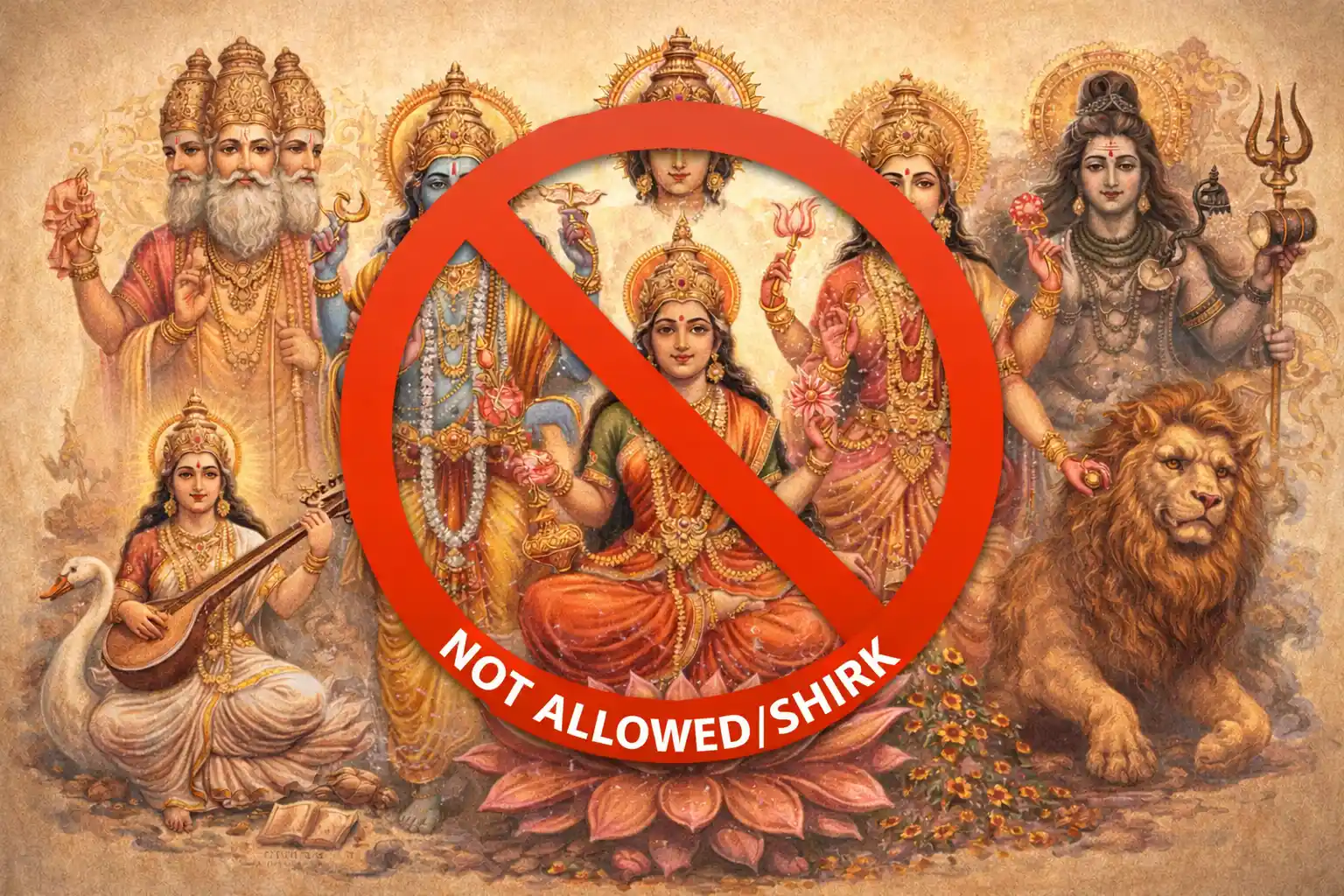
  • False gods create nothing: Idols and anything worshipped besides Allah cannot create even the smallest thing.
  • The conclusion: They cannot be equal—worship belongs to the Creator.
Simple takeaway:
Worship should go to the Creator, not to things that cannot create even one atom.

  • 16:18 — You could never count Allah’s favors

“And if you should count the favors of Allah, you could not enumerate them. Surely, Allah is indeed Forgiving, Merciful.”

  • Meaning: Blessings are not only “big things” like food and water, but also everyday gifts: health, sleep, air, digestion, safety, family, and protection from harms you never saw.
  • Why you can’t count them: Many blessings are constant, hidden, or unnoticed—so the total is beyond counting.
  • Why “Forgiving, Merciful” is mentioned: People often fail to thank Allah properly or misuse blessings—yet Allah still forgives and continues mercy.
Simple takeaway:
Blessings are too many to count, and Allah is merciful even when people are ungrateful.

  • 16:19 — Allah knows what you hide and what you show

“And Allah knows what you conceal and what you proclaim.”

  • Allah knows the inside: private thoughts, hidden intentions, motives, secrets.
  • Allah knows the outside: what you publicly say and do.
  • Why this matters: You cannot fool Allah with appearances—accountability is real.
Simple takeaway:
Allah sees the inside and outside—so be sincere, not just “publicly good.”

  • 16:20 — Those called upon besides Allah create nothing—and they themselves are created

“And those whom they call upon other than Allah, they have not created anything, and they (themselves) are created.”

  • Meaning: Anything people worship besides Allah—idols, saints, spirits, beings, forces—did not create anything.
  • They are created: They are dependent and powerless without Allah’s permission.
  • The conclusion: Worship does not make sense for what is created and dependent. Worship belongs to the One who is not created and who created everything.
The main message of 16:11–20 (very simple):
Allah shows provision (rain and food), order (night/day and celestial timing), guidance (roads, landmarks, stars), accountability (Allah knows hidden and open), and logic (the Creator is not equal to the created).
Verses 21–30
Allah’s oneness, arrogance, carrying burdens, death, and the contrast with the muttaqeen

21. (They are) dead, not living. And they do not perceive when they will be raised.

22. Your god is One God. Then those who do not believe in the Hereafter, their hearts refuse (to know), and they are arrogant.

23. Undoubtedly, that Allah knows what they conceal and what they proclaim. Indeed, He does not love the arrogant.

24. And when it is said to them: “What is it that your Lord has sent down.” They say: “Legends of the former people.”

25. That they may bear their burdens (of their sins) in full on the Day of Resurrection, and of the burdens of those whom they mislead without knowledge. Behold, evil is that which they bear.

26. Certainly, those before them plotted, so Allah came at their building from the foundations, then the roof fell upon them from above them, and the punishment came to them from where they did not perceive.

27. Then on the Day of Resurrection, He will disgrace them and will say: “Where are My those (so called) partners, for whose sake you used to oppose (guidance).” Those who were given knowledge will say: “Indeed, disgrace this day, and evil are upon the disbelievers.”

28. Those whom the angels take in death, (while) they are doing wrong to themselves. Then, they will make full submission (saying): “We were not doing any evil.” Yes, indeed, Allah is Knower of what you used to do.

29. So enter the gates of Hell, to abide for ever therein. Then evil indeed is the lodging of the arrogant.

30. And (when) it is said to those who fear (Allah): “What is it that your Lord has sent down.” They say: “Good.” For those who do good in this world there is a good (reward), and the home of the Hereafter is better. And excellent indeed is the abode of the righteous.

Qur’an-Only Explanation (16:21–30)

  • 16:21 — False gods are “dead, not living”
Illustration for Qur'an 16:21

“(They are) dead, not living. And they do not perceive when they will be raised.”

  • This is about the false “gods” people worship besides Allah (idols, statues, objects, invented deities).
  • They are not alive: no mind, no awareness, no power, no ability to respond.
  • They do not even know when the Resurrection will happen—because they know nothing at all.
Simple takeaway: If something is dead and unaware, it cannot guide you, help you, or deserve worship.

  • 16:22 — Allah is One, but rejecting the Hereafter often comes from arrogance

“Your god is One God. Then those who do not believe in the Hereafter, their hearts refuse (to know), and they are arrogant.”

  • The truth is clear: Allah alone is the one true God.
  • Some people reject the Hereafter (Judgment Day) because accepting it would mean accountability.
  • So their hearts “refuse” not from lack of evidence, but because they do not want to submit or change.
  • That inner refusal is called arrogance: “I will not bow to the truth.”
Simple takeaway: Denying the Hereafter is often not “lack of proof”—it is refusing responsibility.

  • 16:23 — Allah knows the hidden and the open, and He does not love arrogance

“Undoubtedly, Allah knows what they conceal and what they proclaim. Indeed, He does not love the arrogant.”

  • Allah knows what people hide inside: intentions, pride, secret rejection, secret plans.
  • Allah also knows what they show openly: words, claims, mockery, excuses, public actions.
  • Arrogance is hated because it means rejecting truth when it comes and looking down on others.
Simple takeaway: You can hide from people, but not from Allah—so arrogance is a losing game.

  • 16:24 — Some people dismiss revelation by calling it “old stories”

“When it is said to them: ‘What has your Lord sent down?’ They say: ‘Legends of the former people.’”

  • When the Qur’an is presented, instead of thinking honestly, they label it: “myths,” “old tales,” “ancient stories.”
  • This is not a sincere argument; it is a shortcut to stop themselves and others from listening.
  • It is a form of mockery: rejecting the message without engaging with it.
Simple takeaway: Some people do not answer the message—they insult it to avoid facing it.

  • 16:25 — A person carries their own sins, and extra sins for misleading others

“That they may bear their burdens in full on the Day of Resurrection, and of the burdens of those whom they mislead without knowledge…”

  • On Judgment Day, people carry their own sins fully—nothing is missing.
  • If they misled others (through teaching, promoting, normalizing, pressuring, or spreading falsehood), they carry additional sin.
  • This does not erase the other person’s responsibility, but it adds blame to the one who invited and pushed the wrong.
  • Allah calls that load “evil” because it is heavy and destructive.
Simple takeaway: Misleading others is not “just my opinion”—it can multiply your accountability.

  • 16:26 — Schemes can look strong, but Allah can collapse them from the foundation
Illustration for Qur'an 16:26

“Certainly, those before them plotted, so Allah came at their building from the foundations, then the roof fell upon them…”

  • This refers to earlier people who used planning and “schemes” to defeat truth and block guidance.
  • Allah describes His response like a building ruined from its base—then it collapses from above.
  • The message is: their system looked secure, but Allah can break it in a way they never expected.
Simple takeaway: A person may think their plan is unbreakable—Allah can bring it down suddenly and easily.

  • 16:27 — On the Day of Judgment, false “partners” will not appear to help

“Then on the Day of Resurrection, He will disgrace them and will say: ‘Where are My partners…?’”

  • On Judgment Day, Allah exposes the reality publicly: the “partners” they claimed do not exist as helpers.
  • This question is not because Allah needs information—Allah already knows.
  • It is to show everyone that their worship was empty and their opposition to guidance had no excuse.
  • Those given knowledge will confirm: disgrace and punishment are upon those who rejected truth.
Simple takeaway: False gods will not come to save anyone—false beliefs collapse in front of everyone.

  • 16:28 — At death, excuses fail: Allah knows exactly what people did
Illustration for Qur'an 16:28

“Those whom the angels take in death (while) they are doing wrong to themselves… they will say: ‘We were not doing any evil.’”

  • When death arrives, angels take the souls of those who wronged themselves (through disbelief and wrongdoing).
  • Even then, they try to deny: “We were not doing anything wrong.”
  • The response is clear: Allah knows exactly what you used to do—no denial can erase reality.
Simple takeaway: Self-deception ends at death. When truth is revealed, excuses stop working.

  • 16:29 — The gates of Hell are the outcome of arrogant rejection
Illustration for Qur'an 16:29

“So enter the gates of Hell, to abide forever therein. Then evil indeed is the lodging of the arrogant.”

  • Because of arrogant rejection and wrongdoing, they are commanded to enter Hell.
  • “Gates” suggests categories and levels—people enter according to what they earned.
  • Allah repeats the root problem: arrogance is not small; it is a major reason people reject guidance.
Simple takeaway: Arrogance is spiritually deadly—because it makes a person refuse truth even when it is clear.

  • 16:30 — The people of taqwa recognize revelation as “good,” and they win in both worlds

“And when it is said to those who fear Allah: ‘What has your Lord sent down?’ They say: ‘Good.’ … and the home of the Hereafter is better…”

  • Allah contrasts the arrogant with the God-fearing (those who have taqwa).
  • When asked about revelation, they answer honestly: “Allah sent down good.”
  • Allah promises them good in this life (guidance, stability, blessing, inner peace) and better in the Hereafter (lasting reward).
  • The final statement emphasizes: the home of the righteous is excellent.
Simple takeaway: Two responses to revelation: arrogant people mock it; sincere people accept it—and succeed in both worlds.

The core message of 16:21–30

  • False gods are powerless and unaware.
  • Allah is One, and the Hereafter is real.
  • Arrogance is a main disease that blocks faith.
  • Mocking revelation can mislead others and multiply sin.
  • Allah can collapse false “systems” suddenly.
  • At death and Judgment, excuses collapse.
  • The people of taqwa accept revelation as good—and their final home is far better.
Verses 31–40
Gardens for the pure, warning against denial, and Allah’s decisive command “Be”

31. Gardens of Eden which they will enter, beneath which rivers flow, they will have therein whatever they wish. Thus does Allah reward the righteous.

32. Those whom the angels take in death, (while) in a state of purity. They say: “Peace be upon you. Enter the Garden because of what you used to do.”

33. Do they (the disbelievers) await except that the angels should come to them, or your Lord's command should come to pass. Thus did those before them. And Allah wronged them not, but they used to wrong themselves.

34. So that the evils, of what they did, overtook them, and that which they used to ridicule surrounded them.

35. And those who associate (others with Allah) say: “If Allah had willed, we would not have worshipped anything other than Him. (Neither) we, nor our fathers. Nor would we have forbidden anything without His (command).” Thus did those before them. So is there (anything) upon the messengers except clear conveyance.

36. And certainly, We raised in every nation a messenger, (saying): “Worship Allah and avoid the Evil One.” Then among them were those whom Allah guided, and among them were those upon whom the straying was justified. So travel in the land then see how was the end of those who denied.

37. (Even) if you (Muhammad) are eager for their guidance, still Allah assuredly does not guide those whom He sends astray. And they will have no helpers.

38. And they swear by Allah their most binding oaths (that) Allah will not resurrect him who dies. Yes, it is a promise (binding) upon Him in truth, but most of mankind do not know.

39. That He may make clear to them that wherein they differ, and that those who disbelieved may know that indeed they were liars.

40. Indeed, Our word unto a thing, when We intend it, is only that We say unto it: “Be” And it is.

Qur’an-Only Explanation (16:31–40)

  • 16:31 — Gardens of Eden, rivers flowing, and whatever they wish
Illustration for Qur'an 16:31

“Gardens of Eden which they will enter, beneath which rivers flow, they will have therein whatever they wish. Thus does Allah reward the righteous.”

  • Allah promises Paradise for the righteous: those who believe, obey, repent, and try to live rightly.
  • “Gardens” means perfect life: beauty, safety, peace, and comfort.
  • “Rivers flow beneath” means constant life and freshness—never-ending ease.
  • “Whatever they wish” means: no fear, no shortage, no disappointment, no pain or loss.

Simple takeaway: Paradise is the final reward for sincere righteousness.

  • 16:32 — Angels take the righteous in purity and greet them with peace

“Those whom the angels take in death, (while) in a state of purity. They say: ‘Peace be upon you. Enter the Garden because of what you used to do.’”

  • This is the opposite of wrongdoers who die in fear and denial.
  • “In purity” means: sincere faith, trying to live cleanly, repenting, not living in rebellion against Allah.
  • The angels greet them with peace, not terror.
  • “Enter the Garden because of what you used to do” means their deeds were not perfect, but they were sincere, obedient, and repentant—so Allah rewards them.

Simple takeaway: A righteous life leads to a peaceful death and a welcoming outcome with Allah.

  • 16:33 — Delaying belief until angels or punishment comes is too late

“Do they await except that the angels should come to them, or your Lord's command should come to pass… Allah wronged them not, but they used to wrong themselves.”

  • Some people keep postponing faith as if they are waiting for a dramatic sign.
  • But when punishment comes, excuses no longer help.
  • “Allah wronged them not”: Allah sent signs, messengers, time, and clear guidance.
  • “They wronged themselves”: they chose denial, arrogance, and sin.

Simple takeaway: Rejecting guidance harms the person who rejects—Allah is not unjust to them.

  • 16:34 — Their own evil deeds and mockery return upon them

“So that the evils, of what they did, overtook them, and that which they used to ridicule surrounded them.”

  • What they did comes back on them: their actions have consequences.
  • They mocked the warnings—then the warnings become their reality.
  • “Surrounded them” means there is no escape; the truth closes in on them completely.

Simple takeaway: Mocking truth can feel “safe” in this life, but it can become a trap later.

  • 16:35 — “If Allah willed, we wouldn’t do it” is not a valid excuse

“If Allah had willed, we would not have worshipped anything other than Him… Thus did those before them. So is there upon the messengers except clear conveyance.”

  • They try to blame Allah for their choices: “If Allah didn’t want it, we wouldn’t do it.”
  • But Allah gave humans mind, warnings, guidance, and the ability to choose.
  • The messengers’ duty is clear delivery of the message—not forcing belief.

Simple takeaway: People cannot blame Allah for sins when guidance was already made clear.

  • 16:36 — Every nation received the same core message: worship Allah and avoid falsehood

“We raised in every nation a messenger: ‘Worship Allah and avoid the Evil One.’ … travel in the land and see the end of those who denied.”

  • Allah did not leave humanity without guidance; messengers came to all nations.
  • The core message was consistent: worship Allah alone and avoid the Evil One (false gods, Shayṭān, and false paths).
  • Some accepted and were guided; others rejected and earned the result.
  • History shows a pattern: denial leads to ruin—so reflect on past outcomes.

Simple takeaway: Guidance was universal, and denial has repeated consequences across history.

  • 16:37 — You cannot force guidance into a heart that keeps rejecting

“Even if you are eager for their guidance, Allah does not guide those whom He sends astray. And they will have no helpers.”

  • Allah consoles the Prophet: you can strongly want people to believe, but you cannot force it.
  • When Allah “lets someone go astray,” it is not random injustice—this happens after repeated, stubborn rejection.
  • Such people end up without helpers because they refused truth again and again.

Simple takeaway: Guidance is accepted by a willing heart; stubborn rejection leads to being left to one’s choice.

  • 16:38 — Denying resurrection does not cancel Allah’s true promise

“They swear… Allah will not resurrect him who dies. Yes, it is a promise upon Him in truth…”

  • Some people confidently claim there is no resurrection.
  • Allah replies: resurrection is a true promise, not a guess.
  • Many people deny it because they judge only by what they see now, not by truth.

Simple takeaway: Resurrection is real even if people deny it loudly.

  • 16:39 — The Hereafter makes the truth clear and exposes lies

“That He may make clear to them that wherein they differ, and that those who disbelieved may know that indeed they were liars.”

  • Judgment Day settles disputes: what is truth, who was right, what was guidance.
  • Those who denied will realize they were lying—either to others or to themselves.

Simple takeaway: The Hereafter is when the truth becomes undeniable to everyone.

  • 16:40 — “Be, and it is”: Allah’s power is effortless

“Our word unto a thing, when We intend it, is only that We say unto it: ‘Be’ And it is.”

  • Allah does not struggle like humans do.
  • No tools, no delay, no exhaustion—when Allah wills something, it happens.
  • This directly answers doubts about resurrection: it is easy for Allah.

Simple takeaway: Resurrection is effortless for Allah—His command is absolute.

The main message of 16:31–40 (very simple):
The righteous are promised Paradise and are greeted with peace at death. Many reject and delay until it is too late, then they face the results of what they mocked. People cannot blame Allah for their choices—messengers delivered the truth clearly. Every nation received the same call: worship Allah alone and avoid falsehood. Resurrection is real, and Allah’s power is absolute: “Be,” and it is.

Verses 41–50
Hijrah and trust, Allah’s signs in creation, and universal prostration

41. And those who emigrated for (the cause of) Allah after they had been wronged, We will surely settle them in this world in a good (place). And surely the reward of the Hereafter is greater, if only they could know.

42. Those who remain steadfast, and put their trust in their Lord.

43. And We sent not (as Our messengers) before you except men to whom We inspired. So ask those who possess knowledge if you do not know.

44. With clear proofs and Books. And We have sent down unto you (O Muhammad) the reminder (the Quran) that you may make clear to mankind what is sent down to them, and that they might reflect.

45. Then, do those who plot evil deeds feel secure that Allah will not cause the earth to swallow them, or the punishment will not come upon them from where they perceive not.

46. Or that He would not seize them in the midst of their going to and fro, so there can be no escape for them.

47. Or that He would not seize them with a gradual wasting (of life and wealth). But indeed, your Lord is Kind, Merciful.

48. Have they not seen at what Allah has created among things, (how) their shadows incline to the right and to the left, making prostration to Allah, and they are in utter submission.

49. And to Allah makes prostration whatever is in the heavens and whatever is on the earth, of living creatures, and the angels, and they are not arrogant.

50. They fear their Lord from above them, and they do what they are commanded. AsSajda

Surah An-Naḥl (16:41–50) — Simple, Detailed Explanation

  • 16:41 — Those who emigrated for Allah after being wronged
Illustration for Qur'an 16:41

“And those who emigrated for (the cause of) Allah after they had been wronged…”

  • What happened to them?
    Some believers were oppressed (hurt, threatened, punished) because they believed in Allah.
  • What did they do?
    They left their homes for Allah’s sake—to protect their faith and practice truth freely.
  • Allah promises two rewards:
    • Reward 1 (in this world): Allah will “settle them in a good place” — meaning:
      • a safer life,
      • new stability,
      • better opportunities,
      • dignity after hardship,
      • a community where they can live their faith.
    • Reward 2 (in the Hereafter): The reward of the Hereafter is far greater than any comfort in this life.
Simple takeaway:
If you sacrifice for truth after being oppressed, Allah does not waste your sacrifice—He rewards you here and even more in the next life.

  • 16:42 — Who are these people?

“Those who remain steadfast, and put their trust in their Lord.”

  • Steadfast means:
    • they don’t quit when things get hard,
    • they stay patient and firm on what is right.
  • They trust their Lord means:
    • they do their best, then rely on Allah’s help and judgment,
    • they don’t rely only on people, money, or power.
Simple takeaway:
Real faith is not only words—it shows when you stay strong under pressure and rely on Allah.

  • 16:43 — Messengers before you were men with revelation

“And We sent not before you except men to whom We inspired…”

  • Point 1: Every messenger before Muhammad was a human being (not an angel, not a god).
  • Point 2: Allah guided them by revelation (inspiration from Allah).
  • “Ask people of knowledge if you do not know” means:
    • if you are unsure, don’t guess and don’t mock,
    • go ask those who genuinely know and can explain.
Simple takeaway:
Islam is not a “mystery religion.” If you don’t know, ask and learn—don’t speak blindly.

  • 16:44 — Clear proofs, Books, and the Qur’an as a reminder

“With clear proofs and Books… and We have sent down unto you the Reminder…”

  • Earlier messengers came with:
    • clear proofs (evidence, signs),
    • and Books (revelation).
  • The Qur’an is called “the Reminder” because it:
    • reminds people of truth,
    • wakes up the conscience,
    • corrects forgetfulness and arrogance.
  • Why was the Qur’an sent?
    • so the Prophet can explain clearly what Allah revealed,
    • and so people can reflect (think seriously, not react emotionally).
Simple takeaway:
The Qur’an is meant to be understood and reflected on—not treated like background noise.

  • 16:45–47 — Warning to those who plot evil
  • 16:45 — Do they feel secure?
    Do they think they are safe just because they feel powerful? Allah can punish them suddenly—like the earth swallowing them, or punishment coming from where they never expected.
  • 16:46 — Seized while moving around
    Even while they travel and go about life—work, routines, plans—Allah can stop them. They cannot run from Allah.
  • 16:47 — Seized gradually
    Sometimes punishment is slow, not sudden:
    • health slowly breaks down,
    • wealth drains,
    • relationships collapse,
    • fear and stress increase,
    • life becomes smaller and harder.
    Then Allah says: “Your Lord is Kind, Merciful.” Meaning: Allah warns before punishing, gives time to repent, and even gradual consequences can be a wake-up call.
Simple takeaway:
No evil plan is “safe.” Allah can stop it suddenly or slowly—and mercy is that He warns you first.

  • 16:48 — Shadows “prostrating” to Allah

“Have they not seen… how their shadows incline to the right and to the left…”

  • What is the sign?
    Shadows move right and left as the sun changes.
  • Why call it “prostration”?
    Because it shows perfect submission: nature follows Allah’s laws automatically—without rebellion.
Simple takeaway:
Nature shows obedience without rebellion—so humans should stop acting like they are above Allah.

  • 16:49 — Everything in heaven and earth prostrates to Allah
Qur'an 16:49 illustration

“And to Allah makes prostration whatever is in the heavens and whatever is on the earth…”

  • Every creature is under Allah’s control:
    • animals,
    • birds,
    • humans (willingly or unwillingly),
    • and angels.
  • Angels are highlighted: they are never arrogant.
Simple takeaway:
Allah is not one “option” among many—everything already belongs to Him and submits to Him.

  • 16:50 — Angels fear Allah and obey

“They fear their Lord from above them, and they do what they are commanded.”

  • Angels have real awareness: they fear their Lord (deep respect and awe).
  • They always obey: they do what Allah commands—no rebellion, no pride.
Simple takeaway:
If angels—who are pure—fear Allah and obey, then humans should not be arrogant and careless.

Core message of 16:41–50:
Allah rewards those who sacrifice for truth after oppression—now and later. True believers stay patient and rely on Allah. Messengers were human beings guided by revelation—so ask and learn if you don’t know. The Qur’an is meant to be explained and reflected on. Evil planners are not safe—Allah can seize them suddenly or gradually. The whole creation submits to Allah—even shadows follow His system. Angels obey Allah without arrogance—humans should not be proud and rebellious.
Verses 51–60
Pure monotheism, gratitude, and exposing false attributions to Allah

51. And Allah said: “Do not take for yourselves two gods. He (Allah) is only One God. So you fear only Me.”

52. And to Him belongs what is in the heavens and the earth, and religion is His for ever. Will you then fear other than Allah.

53. And whatever of blessings you have, it is from Allah. Then, when harm touches you, so unto Him you cry for help.

54. Then, when He has removed the harm from you, behold, a group among you attribute partners with their Lord.

55. So they deny that which We have bestowed on them. So enjoy yourselves for a while, then soon you will know.

56. And they assign, to what they do not know (false deities), a portion of that which We have provided them. By Allah, you will indeed be asked about what you used to invent.

57. And they assign daughters for Allah. Be He glorified. And for themselves what they desire.

58. And when news is brought to one of them (of the birth) of a female, his face becomes dark, and he is filled with grief.

59. He hides himself from the people because of the evil of that which he has been informed. (Asking himself), shall he keep her with dishonor, or bury her in the ground. Certainly, evil is whatever they decide.

60. For those who do not believe in the Hereafter is an evil similitude. And for Allah is the highest similitude. And He is the All Mighty, the All Wise.

Qur’an-Only Explanation (16:51–60)

  • 16:51 — Allah is One: do not split worship
Qur'an 16:51 illustration

“Do not take for yourselves two gods. He is only One God. So you fear only Me.”

  • Allah is saying: do not treat life like it has “multiple bosses.”
  • Do not make different “ultimate authorities” in your heart (a god of money, a god of luck, a god of people’s approval, a god of fear).
  • There is only one true God: Allah.
  • So the deepest fear (awe, obedience, accountability) must be directed to Allah alone.
Simple takeaway: You cannot serve two “ultimate authorities.” Worship and obedience belong to Allah alone.

  • 16:52 — Everything belongs to Allah, so fearing others above Him makes no sense

“To Him belongs what is in the heavens and the earth… Will you then fear other than Allah?”

  • Everything belongs to Allah: the sky, the earth, people, animals, your life, your body, your time.
  • “Religion is His forever” means Allah’s right to be obeyed is permanent—He does not lose power, weaken, or die.
  • So Allah asks a logical question: if He owns and controls everything, why treat anything else as more feared than Him?
Simple takeaway: If Allah owns and controls all things, it makes no sense to treat anything else as more important than Him.

  • 16:53 — Every blessing is from Allah; in crisis people naturally call on Him

“Whatever blessings you have, it is from Allah. Then when harm touches you, unto Him you cry for help.”

  • Any good you enjoy ultimately comes from Allah: health, food, safety, money, intelligence, opportunities.
  • When a real crisis hits (fear, illness, danger), people instinctively call on Allah—even many who usually ignore Him.
  • This shows a truth inside the human heart: deep down, people know who the real Helper is.
Simple takeaway: People forget Allah in comfort, but in danger they remember the true Source of help.

  • 16:54 — After being rescued, some people give credit to others
Qur'an 16:54 illustration

“When He has removed the harm… a group among you associate partners with their Lord.”

  • After Allah saves them, some people turn around and credit something else:
  • “It was my charm.” “It was my saint.” “It was luck.” “It was my connections.” “It was the idol.”
  • This is ingratitude: they ran to Allah in trouble, then deny Him when relief comes.
Simple takeaway: Some people only remember Allah when desperate, then forget Him when life becomes easy.

  • 16:55 — Enjoyment is temporary; accountability is coming

“So they deny that which We have bestowed on them… enjoy yourselves for a while, then soon you will know.”

  • Allah warns: if you respond to blessings with denial and arrogance, you may enjoy life briefly—but it will not last.
  • “Soon you will know” means: reality will catch up—death, judgment, consequences.
  • It is like being given a gift and then insulting the giver: there will be a reckoning.
Simple takeaway: Temporary comfort is not proof you’re safe. Accountability is coming.

  • 16:56 — Invented religion: giving Allah’s provision to “unknown” powers
Qur'an 16:56 illustration

“They assign… to what they do not know… a portion of what We provided them… you will indeed be asked…”

  • People used to dedicate parts of their crops, wealth, or food to false gods:
  • “This share is for the idol.” “This is for the shrine.” “This is for the saint.”
  • Allah calls those deities “what they do not know” because they have no proof those beings have power.
  • They are following superstition, tradition, and guesswork.
  • Allah says they will be questioned for what they invented about Him.
Simple takeaway: Don’t attribute Allah’s blessings to imagined powers. You will answer for false religious claims.

  • 16:57 — Hypocrisy: they hated daughters, yet attributed “daughters” to Allah

“They assign daughters for Allah… and for themselves what they desire.”

  • Some people claimed (falsely): “Angels are Allah’s daughters.”
  • Allah is glorified above human-like family ideas: no children, no gender, no biology.
  • The hypocrisy is exposed: they disliked daughters for themselves, yet dared to attribute “daughters” to Allah.
Simple takeaway: They insulted Allah with claims they wouldn’t even accept for themselves.

  • 16:58 — The Qur’an exposes the ugliness of despising girls
Qur'an 16:58 illustration

“When news is brought… of the birth of a female, his face becomes dark, and he is filled with grief.”

  • This describes an ignorant culture that felt shame and anger when a daughter was born.
  • The Qur’an shows this is not “honor.” It is injustice and arrogance.
Simple takeaway: Hating daughters is a sign of ignorance and a corrupt heart.

  • 16:59 — Considering burying a daughter alive is called “evil”
Qur'an 16:59 illustration

“He hides himself… shall he keep her with dishonor or bury her… Certainly, evil is what they decide.”

  • Some men felt so embarrassed they would hide from people.
  • Some even considered burying the baby alive.
  • Allah clearly calls this decision evil—morally disgusting and unjust.
  • This is not just history: it teaches a principle—any society that treats girls as “less” is doing wrong.
Simple takeaway: Despising daughters and harming them is evil. Allah condemns it.

  • 16:60 — Denying the Hereafter corrupts morals; Allah is perfect and deserves the highest belief

“For those who do not believe in the Hereafter is an evil similitude… and for Allah is the highest similitude.”

  • “Evil description” means their thinking becomes morally twisted:
  • They insult Allah with false claims, hate what Allah created, and live without accountability.
  • “Allah has the highest description” means Allah is perfect: no flaws, no injustice, no weakness, no need.
  • Allah ends by reminding: He is All-Mighty (no one escapes His justice) and All-Wise (His commands have deep purpose).
Simple takeaway: When people deny the Hereafter, morals collapse. Allah is perfect and deserves pure belief and reverence.

The core message of 16:51–60 (very simple):
Allah is One and deserves worship alone. Everything you have is from Allah—so be grateful consistently, not only in crises. Do not invent religion or assign Allah’s blessings to false powers. Hypocrisy is exposed when people insult Allah with what they hate for themselves. The Qur’an condemns despising daughters and calls harming them evil. Belief in the Hereafter matters because it keeps people morally honest and accountable.
Verses 61–70
Allah’s forbearance, Qur’an clarifies disputes, and signs in rain, cattle, fruit, and bees

61. And if Allah were to seize mankind for their wrong doing, He would not leave on it (the earth) a living creature, but He reprieves them to an appointed term. Then when their term comes, neither can they delay an hour nor can they advance it.

62. And they assign to Allah that which they dislike (for themselves), and their tongues assert the lie that the better things will be theirs. Assuredly, theirs will be the Fire, and that they will be abandoned to it.

63. By Allah, We did indeed send (messengers) to the nations before you, but Satan made their deeds fair seeming to them. So he is their patron this day, and theirs will be a painful punishment.

64. And We have not sent down the Book (the Quran) to you except that you may make clear unto them that in which they differ, and (as) a guidance, and a mercy for a people who believe.

65. And Allah sends down water from the sky, then He revives the earth therewith after its death. Surely, in this is indeed a sign for a people who listen.

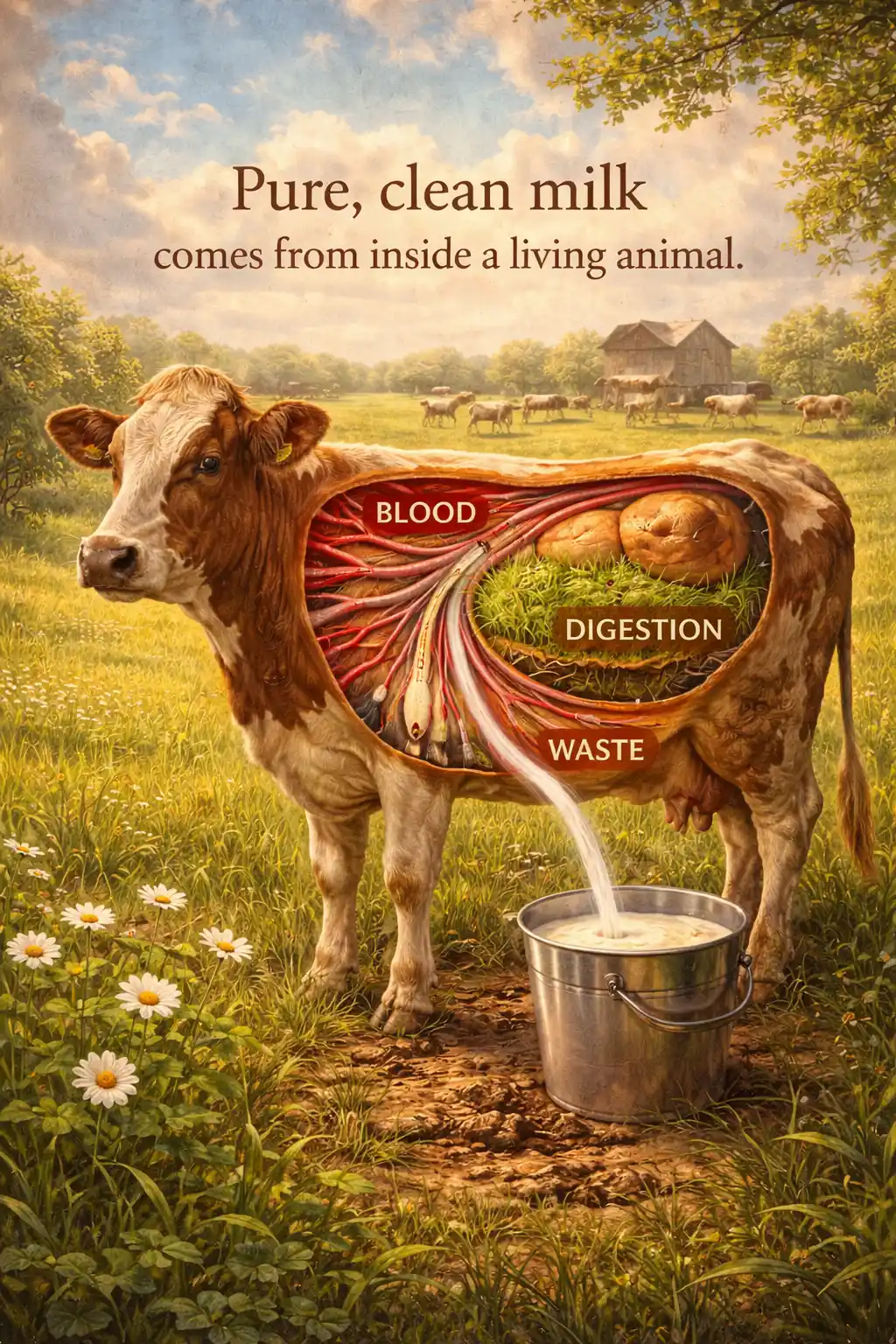
66. And indeed, in the cattle there is a lesson for you. We give you to drink of that which is in their bellies, between excretions and the blood, pure milk, palatable to the drinkers.

67. And from the fruits of date palm and grapevines, you derive intoxicants out of them, and a good provision. Certainly, therein is indeed a sign for a people who have wisdom.

68. And your Lord inspired to the bee, (saying): “Set up hives in the mountains, and in the trees, and in that which they erect (the trellises).”

69. “Then eat of all the fruits, and follow the ways of your Lord, made smooth (for you).” There comes forth from their bellies a drink of varying colors, wherein is healing for mankind. Certainly, in this is indeed a sign for a people who give thought.

70. And Allah has created you, then He causes you to die, and among you is he who is brought back to a feeble age, so that he will not know a thing after having known (much). Indeed, Allah is All Knowing, All Powerful.

Surah An-Naḥl (16:61–70) — Very Simple Explanation

  • 61) If Allah punished everyone immediately, nothing would survive
Qur'an 16:61 illustration

“If Allah were to seize mankind for their wrongdoing, He would not leave on it a living creature… but He reprieves them to an appointed term…”

  • Humans do a lot of wrong—openly and secretly.
  • If every wrong act was punished instantly, life on earth would collapse (people, animals, everything would be affected).
  • So Allah gives time:
    • time to repent,
    • time to change,
    • time for truth to reach people.
  • But the delay is not forever. Everyone has a fixed “term”:
    • your personal death,
    • and ultimately the final judgment.
  • When that time comes, it cannot be delayed or brought forward even by one hour.
Simple takeaway:
Allah’s delay is mercy and a chance to return— لكن the deadline is real.

  • 62) They attribute to Allah what they hate, then claim they deserve the best

“They assign to Allah that which they dislike… and their tongues assert the lie that the better things will be theirs…”

  • Some people said insulting things about Allah—things they would not accept for themselves.
  • Example from earlier verses: they hated daughters, yet claimed “Allah has daughters.”
  • Then they still claimed: “We will get the best in the next life.”
  • Allah calls this a double crime:
    • insulting Allah with false claims,
    • and promising themselves reward while refusing truth.
  • The verse warns: their end is the Fire, and they will be left to it (no protector, no excuse).
Simple takeaway:
You cannot insult Allah, reject guidance, then pretend Paradise is guaranteed.

  • 63) Satan makes evil look “beautiful” so people feel proud of sin
Qur'an 16:63 illustration

“We did indeed send messengers to nations before you, but Satan made their deeds fair-seeming to them…”

  • Many nations did not fail because they lacked messengers—messengers came.
  • The problem: Satan “decorated” their wrongdoing:
    • he makes sin look normal,
    • makes arrogance look like confidence,
    • makes rejection look like intelligence,
    • makes shameful things feel “cool” or “progressive.”
  • So they continue happily—until reality hits.
  • Satan becomes their “patron” (meaning: they followed him, so that is what they chose).
  • Result: painful punishment.
Simple takeaway:
One of Satan’s biggest tricks is not forcing sin—it’s making sin look harmless and attractive.

  • 64) The Qur’an was sent to clarify disputes and guide people

“We have not sent down the Book to you except that you may make clear to them what they differ about, and as guidance and mercy…”

  • People differ about:
    • who Allah is,
    • what worship is,
    • right and wrong,
    • the Hereafter,
    • truth vs falsehood.
  • The Qur’an comes to clarify these issues—not to confuse.
  • For believers, it is:
    • guidance (shows the straight path),
    • mercy (protects you from misguidance and destruction).
Simple takeaway:
The Qur’an is meant to explain, guide, and save—not to be ignored.

  • 65) Rain revives dead earth—this is a clear sign if you “listen”
Qur'an 16:65 illustration

“Allah sends down water… then He revives the earth after its death…”

  • You see dry ground—dead, cracked, lifeless.
  • Then rain comes and suddenly:
    • plants grow,
    • life returns,
    • everything changes.
  • Allah points to this as a sign of resurrection:
    • If Allah can revive dead earth, Allah can revive dead people.
  • “People who listen” means: not just hearing with ears, but letting the lesson enter the heart.
Simple takeaway:
Rain is living proof that bringing life back is easy for Allah.

  • 66) Milk: a “clean” drink comes from inside a living animal
Verse 16:66 illustration

“In the cattle there is a lesson… pure milk… between excretions and blood…”

  • Inside the animal, there are messy things:
    • waste,
    • blood,
    • digestion.
  • Yet Allah brings out something pure, clean, and pleasant: milk.
  • This is a “lesson” because it shows:
    • precision,
    • design,
    • mercy (milk as nutrition),
    • Allah’s control over hidden processes you can’t see.
Simple takeaway:
Even inside what looks “messy,” Allah can produce something pure and beneficial.

  • 67) Dates and grapes: people can misuse blessings or use them rightly
Verse 16:67 illustration

“From dates and grapes you derive intoxicants and a good provision… a sign for people of wisdom.”

  • Allah gives fruits that can become:
    • good food and drink (provision),
    • or be turned into intoxicants (misuse).
  • The blessing is from Allah, but humans choose how to use it.
  • “People who have wisdom” learn:
    • use Allah’s gifts in a clean, beneficial way,
    • not in a way that destroys mind and morals.
Simple takeaway:
The same blessing can be used for good or for harm—wisdom is choosing the good.

  • 68–69) The bee: guided to build, collect, and produce healing honey
Verses 16:68–69 illustration

“Your Lord inspired the bee… set up hives… eat of fruits… follow the ways… from their bellies comes a drink of varying colors, wherein is healing…”

  • Bees do complex work:
    • build precise hives,
    • gather nectar,
    • follow routes,
    • cooperate in an organized system.
  • Allah says this is not random—He “inspired” them (meaning: built this guidance into them).
  • From bees comes honey:
    • different colors,
    • different tastes,
    • and healing benefit for people.
  • This is a sign for those who think deeply.
Simple takeaway:
Even tiny creatures show Allah’s planning—and He places healing in what He creates.

  • 70) Life cycle: creation, death, and old age prove Allah’s power and knowledge
Verse 16:70 illustration

“Allah created you, then causes you to die… some are brought back to a feeble age… Allah is All-Knowing, All-Powerful.”

  • Your life is not self-made:
    • you were created,
    • you will die.
  • Some people reach very old age and become weak again:
    • memory fades,
    • strength fades,
    • independence fades.
  • This shows humans are not “gods” and not in full control.
  • Allah ends by reminding:
    • He knows everything,
    • He has power over every stage of life.
Simple takeaway:
Your life stages prove you are dependent—and Allah is the One in full control.
The big message of 16:61–70 (very simple):
Allah delays punishment out of mercy, but a fixed time is coming. People must stop insulting Allah and lying to themselves about reward. Satan’s trick is making wrong look right, but the Qur’an came to clarify truth and guide. Allah shows signs everywhere: rain revives dead land, milk comes out pure from inside animals, fruits are blessings that can be used wisely or misused, bees are guided to produce honey with healing, and human life itself—creation, death, and old age—proves Allah’s complete knowledge and power.
Verses 71–80
Provision hierarchy, family structure, false “providers”, and the signs in birds and shelter

71. And Allah has preferred some of you above others in provision. Then, those who are preferred do not hand over their provision to those (slaves) whom their right hands possess, so they become equal (partners) in it. Is it then the bounty of Allah that they deny.

72. And Allah has made for you wives from among yourselves, and has made for you, from your wives, sons and grandsons, and has made provision of good things for you. Is then in falsehood that they believe, and in the bounty of Allah that they disbelieve.

73. And they worship besides Allah that which has no control over provision for them, (with) anything from the heavens and the earth, nor are they able.

74. So do not make up any similitudes for Allah. Indeed, Allah knows and you know not.

75. Allah sets forth a parable (of two men), a slave owned (by another), he has no power over anything, and (the other one) on whom we have bestowed from Us a good provision, so he spends thereof secretly and openly. Can they be equal. Praise be to Allah. But most of them do not know.

76. And Allah sets forth a parable of two men, one of them dumb, he has no power over anything, and he is a burden to his master. Whichever way he (master) directs him, he brings no good. Is he equal with him who enjoins justice, and he (himself) is on a straight path.

77. And to Allah belongs the unseen of the heavens and the earth. And the matter of the Hour is not but as a twinkling of the eye, or even nearer. Indeed, Allah is Able to do all things.

78. And Allah has brought you out from the wombs of your mothers, (while) not knowing anything, and He made for you hearing, and sight, and hearts that you might give thanks.

79. Do they not see the birds held (flying) in the midst of the sky. None holds them except Allah. Surely, in that are indeed signs for a people who believe.

80. And Allah has made for you in your homes an abode, and has made for you dwelling (tents) from the skins of the cattle, which you find light (to carry) on the day when you travel, and on the day when you camp. And of their wool, and their fur, and their hair, (are) furnishings and commodities for a while.

Surah An-Naḥl (16:71–80) — Very Simple Explanation

  • 71) Different provision, and a simple question that exposes shirk
Verse 16:71 illustration

Verse idea: Allah gives people different levels of wealth and provision. Yet those who have more usually do not willingly share it so fully that they become equal with those under their authority. So why accept “partners” with Allah in worship if you dislike “partners” in your own wealth?

  • Allah openly shows that people are not equal in money, opportunities, and resources.
  • Then Allah asks a logic question:
    • You may not want to make others equal partners in your own provision.
    • So why accept giving Allah’s rights (worship, devotion, ultimate reliance) to others as “partners”?
  • Core point: It exposes inconsistency:
    • People protect what is their own,
    • but then they “share” what belongs only to Allah (worship) with idols/saints/other beings.
Simple takeaway:
If you dislike partners in your own property, how can you accept “partners” with Allah in worship?

  • 72) Family and good provision, then the question: why deny the Giver?
Verse 16:72 illustration

Verse idea: Allah made spouses from your own kind, gave children and grandchildren, and provided good things—so why believe falsehood and reject Allah’s favors?

  • Allah reminds you of the most personal gifts:
    • marriage companionship,
    • children and grandchildren (continuation, family, support),
    • good food and provision.
  • Then Allah challenges:
    • Why accept false beliefs while enjoying real gifts from Allah?
Simple takeaway:
You live inside Allah’s gifts every day—so don’t replace truth with falsehood.

  • 73) Why worship what cannot even provide?
Verse 16:73 illustration

Verse idea: People worship things besides Allah that cannot control any provision from the sky or earth and have no power.

  • Provision (rain, crops, health, opportunities, safety) is not controlled by:
    • idols,
    • charms,
    • dead objects,
    • invented deities.
  • Those things cannot create, own, or send anything.
Simple takeaway:
It makes no sense to worship what cannot provide or control anything.

  • 74) Don’t make “comparisons” for Allah
Verse 16:74 illustration

Verse idea: Don’t invent examples or descriptions for Allah. Allah knows, you do not.

  • Humans often try to fit Allah into human categories:
    • like a human king,
    • like a father,
    • like a force,
    • like creation.
  • Allah warns: your comparisons are limited and faulty.
  • Allah’s reality is beyond your guesses.
Simple takeaway:
Don’t speak about Allah based on imagination—stick to what Allah truly reveals.

  • 75) Parable 1: powerless slave vs. generous provider
Verse 16:75 illustration

Verse idea: Compare a slave with no control over anything, to a person Allah provided for who gives openly and secretly. Are they equal?

  • Allah teaches by a clear comparison:
    • One has no ownership and no power to give.
    • The other has provision and can benefit others.
  • The message behind it:
    • Allah is the One who owns, provides, and gives.
    • False gods are like the powerless one: they don’t own provision and don’t control benefit.
Simple takeaway:
The One who provides and has power cannot be equal to what is powerless.

  • 76) Parable 2: useless dependent vs. person of justice on a straight path
Verse 16:76 illustration

Verse idea: Compare a person who cannot speak and is a burden, to someone who commands justice and is on a straight path. Are they equal?

  • Again, Allah uses a comparison people understand:
    • One produces no guidance or benefit.
    • The other gives direction, justice, and clarity.
  • The deeper lesson:
    • False gods offer no real guidance or moral authority.
    • Allah’s guidance leads to justice and straightness.
Simple takeaway:
Guidance and truth cannot be equal to helplessness and confusion.

  • 77) The unseen and the Hour: Allah can bring it instantly

Verse idea: Allah owns the unseen. The coming of the Hour is as quick as a blink—or even closer. Allah is able to do all things.

  • The unseen (future, hidden realities, exact time of Judgment Day) belongs to Allah alone.
  • When Allah decides the Hour comes, it will not “slowly build up” by human expectation.
  • It can happen suddenly—faster than you imagine.
Simple takeaway:
Don’t think Judgment is “far” or “slow.” For Allah, it is easy and instant.

  • 78) You knew nothing, then Allah gave hearing, sight, and hearts
Verse 16:78 illustration

Verse idea: Allah brought you out of your mother’s womb knowing nothing, then gave you hearing, sight, and hearts so you might give thanks.

  • A newborn has no knowledge, no skills, no understanding.
  • Allah gave the tools of life:
    • hearing (learning through listening),
    • sight (learning through seeing),
    • hearts (understanding, reflection, moral awareness).
  • These gifts are meant to lead to gratitude and recognition of Allah.
Simple takeaway:
Your ability to learn and understand is a gift—gratitude should follow.

  • 79) Birds in the sky: who holds them up?
Verse 16:79 illustration

Verse idea: Birds are held in the sky—none holds them except Allah.

  • Birds fly with wings, air currents, and instincts.
  • But who created:
    • the laws of air and lift,
    • the bird’s body design,
    • its instincts and navigation?
  • Allah is pointing to a daily miracle people ignore.
Simple takeaway:
Even “ordinary” flight is a sign of Allah’s control and design.

  • 80) Homes, tents, wool, fur, hair—comfort and tools for life
Verse 16:80 illustration

Verse idea: Allah made homes for stability, portable shelters from animal skins for travel, and furnishings and useful goods from wool/fur/hair.

  • Allah provides settled living (houses).
  • Allah also provides travel living (tents that are light to carry).
  • And from livestock, Allah provides materials for:
    • clothing,
    • bedding,
    • carpets,
    • storage,
    • trade goods.
  • “For a while” reminds you: these worldly comforts are temporary.
Simple takeaway:
Allah built your life with shelter, mobility, and comfort—use it gratefully and responsibly.
The big message of 16:71–80:
Allah is the only true Provider and Controller. Shirk is irrational: people worship what can’t provide or help. Allah teaches with simple examples anyone can understand. The Hour can come suddenly. Your senses, your learning, nature’s signs, and your daily comforts are all reasons to recognize Allah and give thanks.
Verses 81–90
Protection, clear conveyance, denial of favors, witnesses, and a complete clarifying Book

81. And Allah has made for you, of that which He has created, shade (from the sun). And He has made for you resorts in the mountains. And He has made for you garments to protect you from the heat, and coats (of armor) to protect you from your (mutual) battle. Thus does He perfect His favor upon you, that you might submit (to Him).

82. So if they turn away (O Muhammad), then only upon you is to convey (the message) in a clear way.

83. They recognize the favor of Allah, then they deny it. And most of them are disbelievers.

84. And the Day when We shall raise from each nation a witness, then permission will not be granted (to put forward excuses) to those who disbelieved, nor will they be allowed to repent.

85. And when those who did wrong will see the punishment, then it will not be lightened for them, nor will they be reprieved.

86. And when those who associated partners (with Allah) will see those partners of theirs, they will say: “Our Lord, these are our partners whom we used to call besides you.” But they will throw back at them (their) word (and say): “Surely, you indeed are liars.”

87. And they will offer unto Allah submission that day, and will have vanished from them what they used to invent.

88. Those who disbelieved and hindered (others) from the path of Allah, for them We will increase punishment over punishment, for that they used to spread corruption.

89. And the Day when We shall raise from each nation a witness against them from amongst themselves, and We shall bring you (O Muhammad) as a witness against these. And We have sent down to you the Book as clarification for all things, and a guidance, and a mercy, and good tidings for those who have submitted (to Allah).

Surah An-Nahl 89

90. Indeed, Allah enjoins justice and kindness, and giving (their due) to near relatives, and forbids lewdness, and abomination, and rebellion. He admonishes you that you may take heed.

Qur’an-Only Explanation (16:81–90)

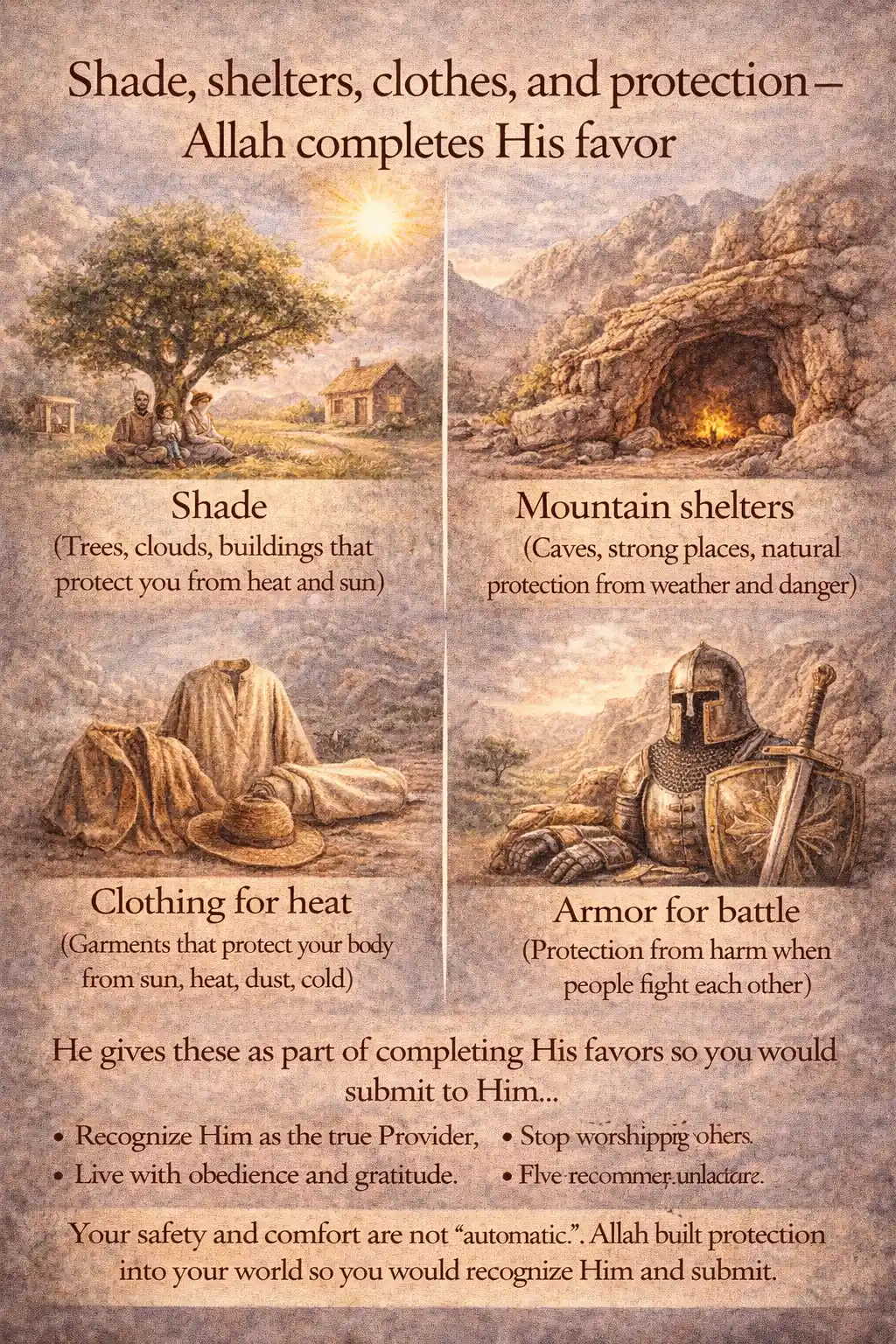
  • 16:81 — Shade, shelters, clothes, and protection: Allah completes His favor
Verse 16:81 illustration

Allah reminds you of everyday protections that make life safer and possible.

  • Shade: trees, clouds, buildings—anything that protects you from the sun and heat.
  • Mountain shelters: strong places like caves and natural protection from weather and danger.
  • Clothing: garments that protect your body (heat, sun, dust, cold).
  • Armor: protection when people fight each other.
  • Allah says He gives these as part of completing His favors on you—so you recognize Him and submit with gratitude.

Simple takeaway: Your safety and comfort are not “automatic.” Allah built protection into your world so you would recognize Him and submit.


  • 16:82 — If they turn away, the messenger’s duty is only clear delivery

If people refuse after hearing the truth, the Prophet is not responsible to force them.

  • The job is to convey clearly: make the message understandable and honest.
  • Guidance cannot be forced into someone’s heart.

Simple takeaway: The messenger’s duty is clear delivery. The listener’s duty is honest response.


  • 16:83 — They recognize Allah’s favors, then deny them

Some people know blessings are real, but they refuse to acknowledge the Giver.

  • They benefit from life, health, food, safety, rain, family, shelter…
  • But they deny Allah through ingratitude, arrogance, or giving credit to others instead of the Creator.
  • This denial is not “lack of information,” but refusal and rejection.

Simple takeaway: They enjoy the gifts, but deny the Giver.


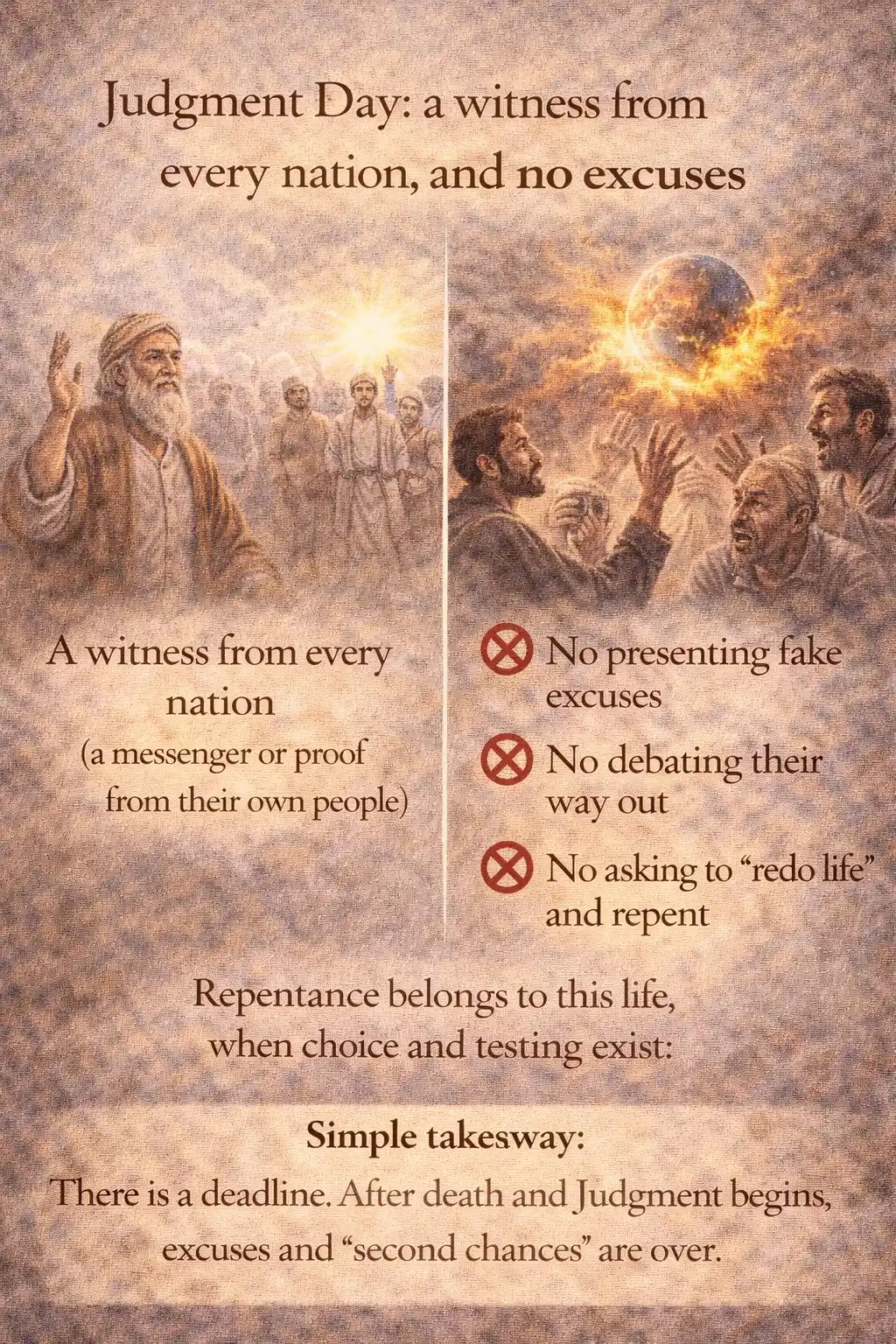
  • 16:84 — Judgment Day: witnesses from every nation, and no excuses
Verse 16:84 illustration

On that Day, a witness from each nation will stand against denial.

  • Allah raises a witness from every nation (a messenger or proof from their own people).
  • Disbelievers will not be allowed to “argue their way out,” present fake excuses, or demand a second chance.
  • Repentance belongs to this life—when the test still exists.

Simple takeaway: There is a deadline. After death and Judgment begins, excuses and “redo life” are over.


  • 16:85 — When wrongdoers see punishment, it won’t be reduced or delayed

When the reality is seen, it becomes final.

  • It will not be lightened.
  • They will not be given extra time.
  • Because time and warnings were already given in worldly life.

Simple takeaway: When reality arrives, it is final—no delay, no bargaining.


  • 16:86 — They will point to their “partners,” and those partners will reject them
Verse 16:86 illustration

Shirk collapses publicly.

  • The worshippers will say: “These were our partners we used to call besides You.”
  • But those “partners” will reject them and expose the lie—there was no permission, no power, and no proof.
  • The worshippers had invented claims and followed them.

Simple takeaway: What you worship besides Allah will not save you. It will abandon you.


  • 16:87 — They will submit then, and their inventions will vanish
Verse 16:87 illustration

At that point, only truth remains.

  • They will submit to Allah—but it will be submission under compulsion, not choice.
  • All inventions disappear: excuses, false beliefs, fake intercessors, and made-up religious claims.
  • Nothing stands except the truth.

Simple takeaway: Forced submission at the end is useless—submission must be chosen in this life.


  • 16:88 — Extra punishment for those who blocked others and spread corruption
Verse 16:88 illustration

It is not only personal disbelief—it's also harming others.

  • Punishment increases for people who disbelieve and stop others from guidance.
  • Examples of “hindering”:
    • mocking truth to scare people away,
    • spreading lies and propaganda,
    • using power to prevent learning and reflection.
  • “Corruption” includes harming society: injustice, oppression, moral ruin, and spreading chaos.

Simple takeaway: If you misguide others and spread corruption, you carry heavier responsibility.


  • 16:89 — Witnesses again, and the Qur’an as clarification, guidance, mercy, and good news

Allah describes the proof and the purpose of revelation.

  • Again: a witness from each nation.
  • And the Prophet is a witness over his people.
  • Then Allah describes the Qur’an:
    • Clarification: it makes truth vs falsehood understandable.
    • Guidance: it shows the straight path.
    • Mercy: it protects people from misguidance if they accept it.
    • Good news: it promises reward for those who submit to Allah.

Simple takeaway: The Qur’an is not decoration—it is a clear guide and mercy for those who accept it.


  • 16:90 — A major summary verse: what Allah commands and forbids

This verse lays down a clear moral foundation for society and personal life.

  • Allah commands:
    • Justice: fairness, honesty, giving people their rights.
    • Kindness (ihsān): doing more good than the bare minimum—gentleness, forgiveness, generosity.
    • Giving to relatives: supporting family and not abandoning your own.
  • Allah forbids:
    • Lewdness: shameless sexual immorality and open indecency.
    • Abomination: major filthy sins that poison morals and society.
    • Rebellion/injustice: oppression, transgression, arrogance, harming others.
  • Allah teaches this so people will wake up and take heed.

Simple takeaway: Allah’s way is justice + kindness + family duty, and avoiding immorality + evil + oppression.


  • The main message of 16:81–90
  • Allah reminds you of His protections and favors so you submit and stay grateful.
  • The messenger delivers clearly; people are responsible for their response.
  • Many enjoy blessings but deny Allah—yet Judgment Day will remove excuses.
  • Shirk collapses: “partners” abandon their worshippers, and inventions vanish.
  • Those who block others and spread corruption carry heavier punishment.
  • The Qur’an is clarification, guidance, mercy, and good news for those who submit.
  • Allah summarizes the moral path: justice, kindness, family support—and avoiding immorality, evil, and oppression.
Verses 91–100
Covenants, truthfulness, consequences of deception, and refuge from Satan

91. And fulfill the covenant of Allah when you have covenanted, and break not the oaths after you have confirmed them, and indeed you have appointed Allah as a surety for yourselves. Indeed, Allah knows what you do.

92. And do not be like her who unravels her yarn, after it has become strong, into pieces. You take your oaths as (means of) deception among yourselves, lest a nation may be more numerous than another nation. Allah only tries you thereby. And He will certainly make clear to you, on the Day of Resurrection, that wherein you used to differ.

93. And if Allah had willed, He could have made you (all) one nation, but He sends astray whom He wills and guides whom He wills. And you shall certainly be asked of what you used to do.

94. And do not make your oaths as (means of) deception among yourselves, lest a foot may slip after having been firm, and you may have to taste the evil (consequences) because of hindering (others) from the path of Allah. And yours should be a great punishment (in Hereafter).

95. And do not barter the covenant of Allah for a small gain. Indeed, that which is with Allah is better for you, if you only knew.

96. Whatever is with you, will be exhausted, and whatever is with Allah will remain. And We will certainly pay those who are steadfast, their recompense according to the best of what they used to do.

97. Whoever acts righteously, among male or female, while he (or she) is a believer. Then indeed, We will give a good life to him (or her). And We shall pay them their recompense to the best of what they used to do.

98. So when you recite the Quran, seek refuge with Allah from Satan the outcast.

99. Indeed, there is for him no authority over those who believe and put trust in their Lord.

100. His authority is only over those who make a friend of him, and those who ascribe partners to Him (Allah).

Qur’an-Only Explanation (16:91–100)

  • 16:91 — Fulfill your covenant with Allah, and don’t break sworn promises

“Fulfill the covenant of Allah when you have covenanted… and break not the oaths after you have confirmed them… Allah knows what you do.”

  • A covenant is a serious commitment (a promise, agreement, oath).
  • If you swear using Allah’s name, you are making Allah a witness over your words.
  • This means oaths are not casual speech; they are accountable actions.
  • Allah ends it by reminding: He already knows what you do, so no “hidden” betrayal escapes.
Simple takeaway:
If you promise and swear by Allah, breaking it is not “small.” Allah is witnessing it.

  • 16:92 — Don’t be like someone who destroys their own strong work (the yarn example)

“Do not be like her who unravels her yarn after it has become strong… You take your oaths as deception…”

  • Allah gives a visual example: a person works hard to make strong thread, then undoes it into pieces.
  • Meaning: don’t build trust with promises, then destroy it by betrayal.
  • Some people use oaths as a tool of deception (politics, business, alliances, social relationships).
  • “Lest a nation may be more numerous than another” points to people breaking promises when a stronger side appears—chasing power and advantage.
  • Allah says this becomes a test: will you remain truthful when it costs you, or betray when it profits you?
  • Allah will clarify on the Day of Resurrection what people truly differed about—no confusion remains then.
Simple takeaway:
Don’t build a strong rope of trust—then tear it apart for temporary advantage.

  • 16:93 — Allah could have made everyone one nation, but you will be questioned for your choices

“If Allah had willed, He could have made you one nation… and you shall certainly be asked of what you used to do.”

  • Allah has the power to make everyone the same—but He allowed real choice and real testing.
  • Guidance is shown; people respond; and their response has consequences.
  • The key point in the verse is responsibility: you will be questioned about what you did.
Simple takeaway:
Differences exist as a test, but you are accountable for what you chose and did.

  • 16:94 — Don’t use oaths as tricks; your “foot may slip” after being firm

“Do not make your oaths deception… lest a foot may slip after having been firm…”

  • When people turn promises into manipulation, it can look “smart” short-term.
  • But the verse warns of a sudden fall: trust collapses, reputation breaks, relationships and society destabilize.
  • The verse also links deception to hindering others from Allah’s path: when people lie and betray while using Allah’s name, it can push observers away from truth.
  • So the sin is heavier: it harms both the liar and the people they mislead or discourage.
Simple takeaway:
Using oaths as manipulation can destroy your integrity and can push others away from truth.

  • 16:95 — Don’t trade Allah’s covenant for a small gain

“Do not barter the covenant of Allah for a small gain…”

  • “Small gain” includes money, status, influence, safety, popularity, business advantage.
  • Allah is saying: don’t sell your truth and promise for something temporary.
  • What is with Allah is better—meaning lasting value, not short-lived profit.
Simple takeaway:
No worldly benefit is worth betraying Allah’s covenant.

  • 16:96 — What you have ends; what is with Allah remains

“Whatever is with you will be exhausted, and whatever is with Allah will remain…”

  • Everything human-held runs out: wealth, strength, time, opportunities, even life itself.
  • Allah’s reward does not expire.
  • Allah promises the steadfast will be paid according to the best of what they used to do.
Simple takeaway:
Don’t ruin your soul for something that will disappear anyway.

  • 16:97 — Good deeds with faith (male or female) bring a good life, and the best reward later

“Whoever acts righteously, male or female, while a believer—We will give a good life…”

  • Allah makes it explicit: righteousness applies equally to men and women.
  • “A good life” can include inner peace, stability, dignity, clean conscience, and blessing—while life may still include tests.
  • Then Allah promises the Hereafter reward will be given according to the best of what they used to do.
Simple takeaway:
Faith + good action leads to a good life now (in real quality), and the best reward later.

  • 16:98 — When reciting Qur’an, seek refuge with Allah from Satan

“When you recite the Qur’an, seek refuge with Allah from Satan the outcast.”

  • The Qur’an guides, corrects, and exposes falsehood.
  • Satan tries to block benefit by distraction, negativity, boredom, twisting meanings, or pushing you to quit.
  • So Allah teaches a practical step: begin by asking Allah’s protection.
Simple takeaway:
Start Qur’an with protection, because Satan tries to block its benefit.

  • 16:99 — Satan has no authority over believers who trust their Lord

“He has no authority over those who believe and put trust in their Lord.”

  • Satan can whisper and invite, but he cannot force control over a heart that truly believes and relies on Allah.
  • Trust in Allah cuts off Satan’s ability to dominate your decisions.
Simple takeaway:
Satan cannot force you—trust in Allah breaks his grip.

  • 16:100 — Satan’s influence is over those who befriend him and those who commit shirk

“His authority is only over those who take him as an ally, and those who ascribe partners to Allah.”

  • Satan’s “authority” grows where people repeatedly accept his path and make him their guide.
  • Shirk is mentioned because it breaks the foundation of loyalty to Allah and opens the door to deception.
  • In other words: Satan becomes strong over people who keep choosing him and abandoning Allah’s guidance.
Simple takeaway:
Satan’s control grows only where people keep choosing him and abandoning Allah’s guidance.
The big message of 16:91–100 (very simple):
Keep your promises—especially when Allah’s name is used—and don’t use oaths as tricks. Don’t sell truth for temporary gain; what you have ends, but Allah’s reward remains. Whoever does good with faith receives a good life and a greater reward later. When reading Qur’an, seek Allah’s protection, because Satan mainly wins through deception—not force.
Verses 101–111
Revelation, accusations against the Qur’an, persecution, steadfastness, and full justice

101. And when We change a revelation in place of (another) revelation, and Allah knows best what He sends down, they say: “You (O Muhammad) are only a fabricator.” But most of them do not know.

102. Say: “The Holy Spirit (Gabriel) has brought it down from your Lord with truth, that it may make firm (the faith of) those who believe, and a guidance and good tidings for those who submitted (to Allah).”

Surah An-Nahl 102

103. And certainly, We know that they say: “It is only a human being who teaches him.” The tongue of him at whom they falsely hint is foreign, and this (the Quran) is clear Arabic tongue.

104. Indeed, those who do not believe in the revelations of Allah, Allah will not guide them, and for them will be a painful punishment.

105. Only they invent falsehood, who do not believe in Allah's revelations. And it is they who are the liars.

106. Whoever disbelieves in Allah after his belief, except him who is forced thereto and whose heart is still content with faith. But as for those who open their breasts to disbelief, upon them is wrath from Allah. And for them will be a great punishment.

107. That is because they love the life of the world over the Hereafter, and that Allah guides not the people who disbelieve.

108. They are those, Allah has set a seal upon their hearts, and their hearing (ears), and their sight (eyes). And it is they who are the heedless.

109. No doubt, it is they, in the Hereafter, they will be the losers.

110. Then indeed, your Lord, for those who emigrated after they had been persecuted, and then fought and were steadfast, indeed, your Lord after that is (for them) Oft Forgiving, Most Merciful.

111. On the Day when every soul will come pleading for itself, and every soul will be repaid in full for what it did, and they will not be wronged.

Surah An-Nahl 111

16:101–111 — Simple Explanation

101) When Allah replaces one revelation with another, they accuse the Prophet of “making it up”

Verse idea

Sometimes Allah revealed a ruling or instruction, then later revealed a new one in its place.

What disbelievers said

“If it changes, then Muhammad must be inventing it.”

Simple meaning

Allah is the One sending revelation. Allah can teach people step-by-step.

Changing a ruling is not “confusion”—it can be a planned stage of guidance.

Like a teacher: first you learn basic rules. Later the teacher upgrades the lesson. That does not mean the teacher is lying. It means the lesson is being delivered in stages.

Simple takeaway: Allah updates guidance by wisdom, but some people use the change as an excuse to reject.

102) The Qur’an is brought by the Holy Spirit (Jibrīl/Gabriel) to strengthen believers

Verse idea

Allah tells the Prophet to answer: the Qur’an is not from Muhammad. It is delivered by Gabriel from Allah.

Why was it sent?

  • To make believers firm (strengthen their faith)
  • Guidance (show the right path)
  • Good news (promise reward for those who submit to Allah)

Simple takeaway: The Qur’an is true revelation, brought by Gabriel, meant to strengthen and guide sincere people.

103) They claim “a human teaches him” — but the Qur’an is clear Arabic

Verse idea

Disbelievers tried another accusation: “A person is teaching Muhammad.”

Allah’s reply (simple logic)

The person they hint at has a foreign/non-Arabic tongue. But the Qur’an is clear, powerful Arabic.

Simple meaning

If the alleged “teacher” is not an Arabic master, how could the Qur’an come out in unmatched Arabic clarity and style?

Simple takeaway: Their accusation doesn’t fit the facts. The Qur’an’s language is clear Arabic, not copied from a foreign speaker.

104) Whoever refuses Allah’s signs won’t be guided, and will face punishment

Simple meaning

Guidance requires a willing heart. If someone stubbornly rejects Allah’s revelations, they block guidance from themselves.

Result: painful punishment.

Important point (very simple): Allah does not force guidance into a heart that insists on denial.

Simple takeaway: Rejecting truth closes the door to guidance.

105) The real liars are the ones who reject Allah’s revelations

Verse idea

They called the Prophet a liar. Allah flips it back: the ones who don’t believe in Allah’s revelations are the true inventors of lies.

Simple meaning

They make up excuses and false narratives to avoid submitting to truth.

Simple takeaway: Falsehood is produced by people who refuse revelation, not by the messenger delivering it.

106) A major rule: forced words of disbelief don’t count if the heart stays faithful

This verse is very important and very balanced

Case 1: A person is forced (under threat/torture)

  • They may be forced to say something.
  • But their heart still believes.
  • Allah excuses them.

Case 2: A person chooses disbelief willingly

  • They “open their chest” to it (accept it happily).
  • This is not forced—this is preference.
  • That brings Allah’s anger and severe punishment.

Simple takeaway: Allah judges by truth and intention: forced speech is not the same as willing betrayal of faith.

107) Why do they choose disbelief? Because they love this world more than the Hereafter

Simple meaning

Some people reject the Hereafter because it would mean:

  • accountability
  • self-control
  • moral limits
  • humility

They prefer:

  • comfort now
  • desires now
  • status now

Simple takeaway: The root problem is not lack of evidence—it is love of dunya over eternal truth.

108) “Sealed hearts” — they become spiritually locked

Verse idea

Allah says their hearts, hearing, and sight are sealed.

Simple meaning (very important)

This describes a final stage of stubborn rejection:

  • They repeatedly reject truth,
  • mock it,
  • refuse correction,
  • until they lose the ability to benefit from reminders.

It’s like a person who lies so much that they start believing their own lies—eventually they can’t see clearly anymore.

Simple takeaway: When someone constantly rejects truth, they can become spiritually numb and heedless.

109) In the Hereafter, they will be the real losers

Simple meaning

They may “win” temporarily in this life (money, popularity, power), but the real outcome is the Hereafter.

Simple takeaway: The biggest loss is losing the Hereafter.

110) Allah’s mercy for the persecuted believers who emigrated and remained steadfast

Verse idea

Allah now mentions a different group—the sincere believers who suffered:

  • they were persecuted,
  • they migrated for Allah,
  • they struggled and stayed patient.

Allah says: He is Oft-Forgiving and Most Merciful to them.

Simple takeaway: Allah does not forget people who suffer for truth and remain firm—He forgives and rewards them.

111) Judgment Day: every soul will argue for itself, and everyone will be repaid fairly

Verse idea

On that Day:

  • each person will be focused on their own case,
  • no one can carry your excuses for you,
  • and every deed will be paid back fully.

“They will not be wronged” means

  • no injustice
  • no unfair punishment
  • no missing good deeds

Simple takeaway: Judgment Day is complete fairness: you stand for yourself, and Allah repays perfectly.


The core message of 16:101–111 (in one simple summary)

Allah reveals guidance with wisdom, sometimes step-by-step, and disbelievers use that as an excuse to accuse the Prophet. Allah clarifies the Qur’an is true revelation brought by Gabriel, in clear Arabic, not taught by a foreign person. Persistent rejection comes from loving worldly life over the Hereafter, and it can harden the heart until a person becomes heedless. Yet Allah has mercy on those who suffer for faith and remain steadfast. And in the end, every person will stand alone before Allah and be repaid with perfect justice.

v>
Verses 112–128
A societal parable, lawful provision, honesty in “halal/haram”, Abraham’s model, and ethical da‘wah

112. And Allah sets forth a parable, a township that was secure, well content, its provision coming to it in abundance from every side, but it denied the bounties of Allah, so Allah made it taste the extreme of hunger and fear because of what they used to do.

113. And indeed, there had come to them a messenger from among themselves, but they had denied him, so the punishment seized them while they were wrong doers.

114. Then eat of the lawful good food which Allah has provided for you, and thank the bounty of Allah if it is He whom you worship.

Surah An-Nahl 114

115. He has only forbidden you carrion, and blood, and swine flesh, and that over which the name of other than Allah has been invoked. Then one who is obliged to do so, without disobedience, and not going to excess, then indeed, Allah is Oft Forgiving, Most Merciful.

Surah An-Nahl 115

116. And do not say, about what your own tongues put forth falsely. “This is lawful, and this is forbidden,” so that you invent a lie against Allah. Indeed, those who invent lie against Allah will not prosper.

Surah An-Nahl 116

117. A brief enjoyment (will be theirs), and they will have a painful punishment.

118. And to those who are Jews, We have forbidden that which We have mentioned to you (O Muhammad) before. And We wronged them not, but they used to wrong themselves.

Surah An-Nahl 118

119. Then indeed, your Lord, for those who do evil in ignorance, then repent after that and do righteous deeds, indeed your Lord, thereafter, is Oft Forgiving, Most Merciful.

120. Indeed, Abraham was a whole community (by himself), obedient to Allah, exclusively devoted. And he was not of those who associated (others with Allah).

121. Thankful for His bounties. He (Allah) chose him, and He guided him to a straight path.

122. And We gave him good in the world. And certainly, in the Hereafter, he shall be among the righteous.

123. Then, We inspired you (O Muhammad, saying): “Follow the religion of Abraham, exclusively devoted. And he was not of those who associated (others with Allah).”

124. The Sabbath was only prescribed for those who differed in it. And indeed, your Lord will judge between them on the Day of Resurrection about that wherein they used to differ.

125. Call (O Muhammad) to the way of your Lord with wisdom and good instruction, and argue with them in a way that is better. Indeed, your Lord knows best of him who has gone astray from His way, and He is best Aware of those who are guided.

126. And if you punish, then punish with the like of that wherewith you were afflicted. And if you endure patiently, that is indeed the best for those who are patient.

127. And endure you patiently (O Muhammad), and your patience is not but from Allah. And grieve not over them, and be not in distress because of what they plot.

128. Indeed, Allah is with those who fear (Him) and those who do good.

Qur’an-Only Explanation (16:112–128) — Simple, Detailed

  • 112 — A safe town became hungry and fearful

What it says (simple):
Allah gives an example of a town that had safety, comfort, and food coming to it in abundance from everywhere. But they denied Allah’s blessings, so Allah made them taste severe hunger and fear.

Why Allah says this:
To teach a rule of life: when people turn blessings into arrogance, denial, oppression, or corruption, blessings can be removed—not because Allah is unfair, but because people destroy the moral foundation that keeps societies stable.

Example (easy):
A country is stable and wealthy. People become proud and ungrateful. ظلم (injustice) spreads, morals collapse, leaders exploit, crime rises, trust breaks, and the economy weakens. Even if they used to live comfortably, people start feeling unsafe and struggling.

Takeaway:
Blessings are not “guaranteed forever.” Gratitude + obedience protects blessings.

  • 113 — A messenger came, they rejected, then punishment came

What:
A messenger came from among them (so they could understand him), but they denied him. Then punishment seized them while they were wrongdoers.

Why:
Allah is showing they were not punished “randomly.” They received warning first, then still chose denial and wrongdoing.

Example:
People are warned again and again: “Stop ظلم, stop corruption, return to truth.” They mock the warning and continue—then consequences arrive.

Takeaway:
Allah sends guidance first. Rejecting it repeatedly has consequences.

  • 114 — Eat halal and good, and be grateful

What:
Eat from the lawful good things Allah provided, and thank Allah’s bounty if you truly worship Him.

Why:
Blessings are not only to “enjoy.” They are a test: will you use them cleanly and thankfully, or arrogantly and sinfully?

Example (gratitude in action):

  • saying Alhamdulillah,
  • using food/money/health in halal ways,
  • not harming others,
  • not wasting,
  • not becoming proud.
Takeaway:
Halal enjoyment + gratitude is the correct relationship with blessings.

  • 115 — What is forbidden + the emergency exception

What is forbidden (named clearly):

  • carrion (dead animals not properly slaughtered),
  • blood,
  • pig flesh,
  • meat dedicated to other than Allah (slaughtered in another name).

Emergency exception:
If someone is forced by real necessity (survival), not rebelling, and not exceeding what they need—Allah forgives.

Why:
Allah protects people from impurity/harm and shows mercy: Islam is not “die to follow a rule.” Necessity is different from choice.

Takeaway:
Allah forbids harmful things, but necessity is treated with mercy.

  • 116 — Don’t invent halal/haram and blame Allah

What:
Don’t say “this is halal” and “this is haram” from your own tongue, then claim it is Allah’s law. That is lying about Allah.

Why:
Making up religious rules creates confusion, oppression, and fake “religion.” It becomes a way to control people through superstition or personal interests.

Example:
Someone says: “Allah forbids prawns,” or “Allah forbids X,” with no proof—then judges people for it. That is dangerous because it turns personal/cultural opinions into “Allah’s command.”

Takeaway:
Only Allah has the right to declare what is truly halal and haram.

  • 117 — Short enjoyment now, painful punishment later

What:
Those who invent lies about Allah may enjoy briefly, but painful punishment awaits.

Why:
Dunya is temporary. Some people use religion for power, ego, or money and think they “won.” Allah says: it is only a brief enjoyment.

Takeaway:
Temporary success is not safety. The real outcome is the Hereafter.

  • 118 — Extra restrictions for Jews were not ظلم

What:
Allah says: some extra restrictions were given to the Jewish community (mentioned earlier). Allah did not wrong them; they wronged themselves.

Why (simple):
Meaning: some restrictions came as consequence/discipline after persistent disobedience—not because Allah is unfair.

Easy example:
Like a child who keeps disobeying: rules become stricter as discipline, not ظلم.

Takeaway:
When people insist on wrongdoing, consequences and stricter rules can come—without Allah doing ظلم.

  • 119 — Repentance after ignorance: Allah forgives

What:
Whoever does evil in ignorance, then repents and follows it with righteous deeds—Allah is Forgiving and Merciful.

Why:
Allah’s goal is not to “trap people.” The goal is that people return, clean themselves, and change.

Takeaway:
Your past does not have to define you. Real repentance + change is accepted.

  • 120–123 — Abraham as the model of pure worship

120 — “Abraham was a whole community” (by himself):
Abraham stood so firmly on truth that it’s like he was an entire nation of faith alone. Truth is not measured by majority.

121 — Thankful for Allah’s bounties:
He recognized blessings and responded with gratitude and obedience—so Allah chose him and guided him.

122 — Good in this world, and righteous in the Hereafter:
Allah rewards sincerity in both worlds.

123 — Follow Abraham’s religion:
The core message: pure devotion to Allah alone, no shirk.

Takeaway:
Abraham is the model: pure worship, gratitude, and firmness even when alone.

  • 124 — The Sabbath was prescribed for those who differed about it

What (simple):
The Sabbath became a rule for those who argued and differed about it. Allah will judge between them on the Day of Resurrection about what they disputed.

Why:
When people fight over truth, twist commands, or disobey, a rule can become a clear test and a judgment point.

Takeaway:
Disputes don’t escape Allah. Allah judges what people argued over and how they behaved.

  • 125 — Call to Allah with wisdom and best manners

What:
Invite to Allah with wisdom, good instruction, and argue in the best way.

Why:
Truth is not delivered properly through ego, insults, and anger. People understand better when the message is clear and respectful.

Example:
Instead of: “You’re stupid,” you say: “Let’s look at what Allah says and reason carefully.”

Takeaway:
How you speak matters. Truth + good method.

  • 126 — Justice is allowed; patience is better

What:
If you punish, punish only equal to what was done to you (no excess). But if you endure patiently, that is better for the patient.

Why:
This blocks ظلم and revenge spirals. Justice is permitted, but patience is spiritually higher.

Takeaway:
No transgression. Fairness is the minimum; patience is the higher path.

  • 127 — Be patient; don’t be crushed by their plots

What:
Be patient—and your patience is from Allah. Don’t grieve and don’t feel trapped by what they plot.

Why:
The Prophet’s job is clear delivery, not emotional destruction from people’s rejection.

Takeaway:
Do your duty, trust Allah, and don’t panic over opponents.

  • 128 — Allah is with those who fear Him and those who do good

What:
Allah supports those with taqwa (God-consciousness) and ihsan (doing good with sincerity).

Takeaway:
If you want Allah’s support: taqwa + doing good.

The main message of 16:112–128 (one simple summary):
A society can lose safety and provision when it denies Allah and rejects guidance. Allah commands halal living, gratitude, and honesty—especially not inventing religion. He opens the door of repentance, gives Abraham as the model of pure worship, and teaches the Prophet to call with wisdom. Justice is allowed, patience is better, and Allah supports those who fear Him and do good.
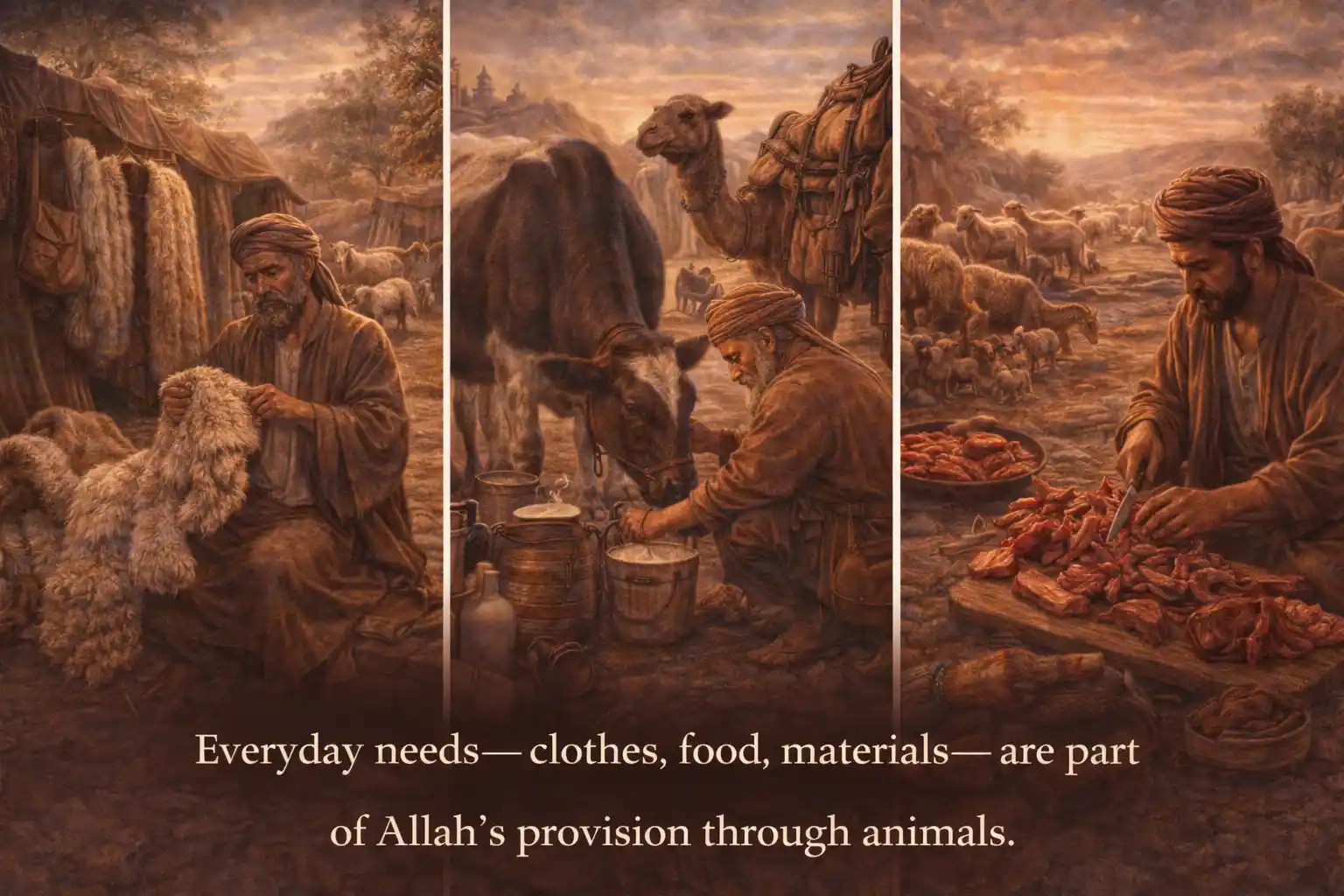
on when it denies Allah and rejects guidance. Allah commands halal living, gratitude, and honesty—especially not inventing religion. He opens the door of repentance, gives Abraham as the model of pure worship, and teaches the Prophet to call with wisdom. Justice is allowed, patience is better, and Allah supports those who fear Him and do good.