Surah Yunus (10) emphasizes that the Qur'an is a wise Book, that Allah alone governs creation, and that guidance is based on clear revelation – not inherited customs or invented beliefs. It shows how people react differently to the same signs: some humble themselves, others turn away until punishment or regret.
- This page keeps to the Qur'an itself and rational reflection – no hadith authority added on top.
- Each block groups a set of verses and explains how they connect to Tawheed, accountability, and real trust in Allah.
1. Alif. Lam. Ra. These are verses of the wise Book.
2. Is it astonishing for mankind that We have revealed to a man (Muhammad) from among them, (saying): “Warn mankind and give good tidings to those who believe that they shall have a firm footing with their Lord.” The disbelievers say: “Indeed, this is an evident sorcerer.”
3. Indeed, your Lord is Allah, who created the heavens and the earth in six days, then He established Himself upon the Throne, governing all affairs. No intercessor (can plead with Him) except after His permission. That is Allah, your Lord, so worship Him. Will you then not receive admonition.
4. To Him is your return all together. The promise of Allah in truth. Indeed, it is He who begins the creation, then He repeats it, that He may reward those who believed and done righteous deeds in justice. And those who disbelieved, theirs will be a boiling drink and painful punishment for what they used to disbelieve.
5. It is He who made the sun a radiance and the moon a light, and measured out its stages, that you may know the number of the years, and the reckoning (of time). Allah did not create this but in truth. He explains in detail the revelations for people who have knowledge.
6. Indeed, in the alternation of the night and the day, and what Allah has created in the heavens and the earth, are indeed signs for a people who fear (Allah).
7. Indeed, those who hope not their meeting with Us, and are content with the life of the world, and are satisfied with it. And those who are neglectful of Our revelations.
8. Those, their abode will be the Fire because of what they used to earn.
9. Indeed, those who believe and do righteous deeds, their Lord will guide them because of their faith. Rivers will flow beneath them in the Gardens of Delight.
10. Their call therein will be: “Glory be to You, O Allah.” And their greeting therein will be: “Peace.” And the conclusion of their call will be: “Praise to Allah, Lord of the worlds.”
Explanation (1–10)
These opening verses introduce the Qur'an as a wise Book, explain who Allah is as the Lord of creation, and clearly separate the destiny of those satisfied with this world only and those who truly believe and act righteously.
- Verse 1: The letters Alif Lam Ra are followed immediately by the statement that these are verses of a wise Book. The focus is not on mystical letters, but on the Book itself being full of wisdom.
-
Verse 2: People find it strange that:
- Revelation comes to a human being from among themselves.
- His job is twofold: warn all people and give good news to believers of a firm standing with their Lord.
- Disbelievers dismiss this as “sorcery,” showing that some reject not because of lack of proof, but because of arrogance.
-
Verse 3: The reality of Allah:
- He created the heavens and the earth in six “days” (stages).
- He then “established Himself on the Throne” – meaning He is in full authority, managing all affairs.
- No intercession is possible except by His permission. So all supposed “middle-men” without His permission are false.
- Since He alone is Lord, He alone must be worshipped.
-
Verse 4: Everyone returns to Him:
- He begins creation, then repeats it in resurrection.
- The purpose is to reward those who believed and did good with justice.
- Those who reject face boiling drink and painful punishment – a direct result of their disbelief, not injustice.
-
Verses 5–6: Cosmic signs:
- The sun and moon are precisely measured so that humans can calculate years and time – this is deliberate design, not accident.
- Night/day alternation and all creation in the heavens and earth are signs for people who have awareness and fear of Allah.
- So the Qur'an constantly links natural phenomena to spiritual reflection.
-
Verses 7–8: The people of dunya only:
- They don’t expect to meet Allah, are fully satisfied with this worldly life, and are heedless of His signs.
- Such people are not “innocent”; they choose to ignore guidance.
- Their final home is the Fire, due to what they earned themselves.
-
Verses 9–10: The people of faith:
- Those who believe and do good are guided by their Lord because of their faith – faith is not just a label, it has consequences.
- They are in gardens with rivers beneath, which symbolizes continuous life and nourishment.
- Their speech in Jannah reflects pure Tawheed: they glorify Allah, greet with peace, and end with praise to “Lord of the worlds.”
11. And if Allah were to hasten evil for mankind, just as they seek to hasten good, their term would have been decreed for them. So We leave those who expect not the meeting with Us, to wander blindly in their transgression.
12. And when affliction touches man, he calls upon Us, reclining on his side, or sitting, or standing. Then when We have removed from him his affliction, he goes his way as though he had not called upon Us because of the affliction that touched him. Thus it seems fair to the transgressors that which they used to do.
13. And indeed, We destroyed the generations before you, when they wronged, and their messengers came to them with clear proofs, and they would not believe. Thus do We recompense the people who are criminals.
14. Then We appointed you as successors in the land after them, that We might see how you would act.
15. And when Our revelations are recited to them as clear evidence, those who hope not for their meeting with Us, say: “Bring a Quran other than this, or change it.” Say (O Muhammad): “It is not for me to change it on my own accord. I follow not but that which is revealed unto me. Indeed, I fear, if I were to disobey my Lord, the punishment of a Great Day.”
16. Say: “If Allah had so willed, I would not have recited it to you, nor would He have made it known to you. Surely, I have lived amongst you a lifetime before this. Have you then no sense.”
17. So who does greater wrong than he who invents a lie against Allah, or denies His revelations. Indeed, the criminals will not be successful.
18. And they worship other than Allah that which neither hurts them nor benefits them, and they say: “These are our intercessors with Allah.” Say: “Would you inform Allah of that which He knows not in the heavens, nor in the earth.” Glory be to Him, and High Exalted above all that they associate (with Him).
19. And mankind were not but one community, then they disagreed. And if it had not been for a word that had already gone forth from your Lord, it would have been judged between them regarding that wherein they disagree.
20. And they say: “Why is not sent down to him a sign from his Lord.” Say, (O Muhammad): “The unseen is only for Allah, so wait you. Indeed, I am with you among those who wait.”
Explanation (11–20)
These verses expose human double standards towards Allah, remind us of earlier destroyed nations, and answer the demand that the Qur'an should be changed or supported by extra “signs.”
-
Verses 11–12: Human inconsistency:
- People want good things to come quickly, but if Allah punished them as quickly as they want good, they would be finished.
- Those who deny the meeting with Allah are left to wander in their rebellion – this is a kind of punishment in this life.
- In hardship, humans call upon Allah in all positions (lying, sitting, standing), but once relief comes, many behave as if they never asked Him.
- This self-deception makes their wrong actions look “normal” or “fair” to them.
-
Verses 13–14: History as a warning:
- Previous generations were destroyed because they wronged themselves by rejecting clear proofs through messengers.
- Now the current community is made successors in the land – not as a privilege only, but as a test: Allah watches how they act.
-
Verses 15–16: Demanding a different Qur'an:
- Those who do not expect to meet Allah demand that the Prophet bring “another Qur'an” or change it to suit them.
- The Prophet is told to declare that he cannot alter revelation; he only follows what is revealed. Disobedience would bring punishment on him as well.
- He reminds them: he lived among them for a lifetime before revelation, known as honest and not a fabricator. If this message was his own invention, they would have noticed the change in character and pattern.
-
Verse 17: Two worst crimes:
- Inventing a lie against Allah (claiming He said something He did not say).
- Denying His true revelations.
- Such people will never truly succeed, even if they appear powerful for a while in this world.
-
Verse 18: False intercessors:
- People worship things that cannot harm or benefit them, then claim: “These are our intercessors with Allah.”
- The Qur'an responds: are you teaching Allah something He doesn’t know in the heavens and earth?
- Meaning: if Allah did not authorize such intercession, then it is pure invention.
- Allah is far above all partners and imagined middle-men.
-
Verse 19: One community, then division:
- Originally, humanity was one community, then differences and divisions appeared.
- If Allah had not already decreed to delay final judgment to the Day of Resurrection, the disputes would be settled immediately by punishment.
-
Verse 20: Request for extra signs:
- People demand a special “sign” from Allah on their terms.
- The Prophet is told to say that the unseen belongs to Allah alone – He decides what sign, when, and to whom.
- So everyone is told to wait and see the outcome; the Prophet will also wait, trusting Allah’s timing.
21. And when We cause mankind a taste of mercy after adversity had afflicted them, behold, they have some plotting against Our revelations. Say: “Allah is more swift in plotting.” Certainly, Our messengers (angels) write down that which you plot.
22. He it is who makes you travel through the land and the sea, until when you are in the ships, and they sail with them with a fair breeze, and they rejoice therein, there comes to them a stormy wind, and the waves come upon them from all sides, and they think that they are surrounded therein. (Then) they call upon Allah, making their faith pure for Him, (saying): “If You deliver us from this, we shall surely be of the thankful.”
23. Then when He has delivered them, behold, they rebel in the earth wrongfully. O mankind, your rebellion is only against your own selves. An enjoyment of the life of the world, then unto Us is your return, then We shall inform you of what you used to do.
24. The example of the life of the world is only as water that We send down from the sky, then by its mingling arises the produce of the earth, which men and cattle eat. Until when the earth has taken on its ornaments and is beautified, and its people think that they have powers of disposal over it, there reaches to it Our command by night or by day, so We make it a harvest clean mown, as if it had not flourished the day before. Thus do We explain the revelations for a people who give thought.
25. And Allah calls to the abode of peace, and He guides whom He wills to a straight path.
26. For those who do good is the best (reward) and more. Neither darkness nor ignominy shall cover their faces. Those are the companions of the Garden. They will abide therein forever.
27. And those who have earned evil deeds, the recompense of an evil deed is the like thereof, and ignominy will cover them. No defender will they have from Allah. It will be as if their faces are covered with pieces from the night, so dark (they will be). Those are the companions of the Fire. They will abide therein forever.
28. And the day (when) We will gather them all together, then We will say to those who ascribed partners (unto Us): “Stand back, you and your (pretended) partners (of Allah).” Then We will separate, one from the other. And their partners will say: “It was not us that you used to worship.”
29. “So sufficient is Allah for a witness between us and you, that We indeed were unaware of your worship of us.”
30. Thereupon, every soul shall experience (the recompense of) that which it did in the past, and they will be brought back to Allah, their rightful Lord, and lost from them is that which they used to invent.
Explanation (21–30)
This passage shows how people behave after relief comes, how worldly life is like temporary rain, and how on the Day of Judgment all false “partners” will disown the worshippers who invented them.
- Verse 21: After Allah gives mercy following hardship, some people respond with more schemes against His signs. Allah says His “plot” (His counter-plan) is faster and more powerful, and the angels are recording what people devise.
-
Verses 22–23: The ship example:
- In comfort and good breeze, people enjoy and feel secure.
- When storms surround them and they think destruction is certain, they suddenly make their faith pure for Allah alone and beg Him sincerely.
- Once He saves them, many go back to rebellion and wrong.
- Rebellion harms no one but the rebel: it is a short enjoyment of this world, then a return to Allah for a full report of deeds.
-
Verse 24: Parable of worldly life:
- Rain falls, the earth becomes beautiful and green, humans and animals enjoy the crops.
- When people feel in control of the land, Allah’s command can come suddenly, by night or by day.
- The same lush field becomes a harvested, wiped-out plain, “as if it had not flourished the day before.”
- This is how worldly success is: it looks stable, but can vanish quickly. The wise person learns from this.
-
Verse 25: Allah calls to the “abode of peace”:
- This is a calm, safe life with Allah – in this world (inner peace) and in the next (Jannah).
- Guidance to the straight path is by Allah’s will, but the Qur'an elsewhere shows He guides those who want truth and use their mind.
-
Verses 26–27: Two types of faces:
- Those who do good get the best reward and “more” – classical understanding is: Paradise plus seeing their Lord’s pleasure and honor.
- No humiliation covers their faces, they are honored.
- Those who earned evil have a repayment exactly like their deeds, plus humiliation like pieces of night over their faces, and no protector against Allah.
- Both groups are permanent in their final homes: Garden or Fire.
-
Verses 28–29: False gods disown their worshippers:
- On the Day of gathering, shirk-people and their “partners” (idols, saints, symbols) are separated.
- The “partners” say: we didn’t ask you to worship us; we were unaware of this worship.
- They declare that Allah alone is sufficient as a witness between them and their followers.
-
Verse 30: Final reality:
- Every soul faces what it did – no escape, no shifting blame.
- They are brought back to Allah, the true Lord and Owner, not the imaginary partners.
- All the things they invented and relied on (false gods, intercessors, stories) vanish; nothing remains except truth and deeds.
31. Say (O Muhammad): “Who provides for you from the sky and the earth, or who owns hearing and sight, and who brings forth the living from the dead, and brings forth the dead from the living, and who disposes the affairs.” They will say: “Allah.” Then say: “Will you not then fear (Allah).”
32. Such then is Allah, your Lord in truth. So what else is there, after the truth, except error. How then are you turned away.
33. Thus is the word of your Lord proved true against those who disobeyed, that they will not believe.
34. Say: “Is there of your (Allah's so called) partners, any who originates the creation, then repeats it.” Say: “Allah originates the creation, then He repeats it. How then, are you being turned away.”
35. Say: “Is there of your (Allah's so called) partners, any who guides to the truth.” Say: “Allah guides to the truth. Is then He, who guides to the truth, more worthy to be followed, or he who guides not unless he is guided. Then, what is (the matter) with you. How do you judge.”
36. And most of them follow not but conjecture. Indeed, conjecture can be of no avail against the truth, at all. Indeed, Allah is All Aware of what they do.
37. And this Quran is not such as could be produced (by anyone) other than Allah. But (it is) a confirmation of that which was before it, and an explanation of the Book, there is no doubt wherein, from the Lord of the worlds.
38. Or do they say: “He (Muhammad) has invented it.” Say: “Then bring forth a surah like it, and call upon (for help) whomsoever you can, besides Allah, if you are truthful.”
39. Nay, but they have denied that which they could not comprehend in knowledge, and has not (yet) come to them its interpretation. Thus did deny those before them. Then see how was the end of the wrong doers.
40. And among them are those who believes in it, and among them are those who do not believe in it. And your Lord is Best Aware of the corrupters.
Explanation (31–40)
This section is a logical challenge to the people: if they admit Allah controls everything, why do they still follow others, and how can they reject a Book they cannot match?
-
Verse 31: A series of questions:
- Who provides from the sky and the earth?
- Who owns hearing and sight?
- Who brings the living from the dead and the dead from the living?
- Who manages all affairs?
- Verse 32: If Allah is the true Lord who actually does all these things, then anything else is pure misguidance. There is no “third option”: after truth there is only error. Being turned away from the truth means being turned away from what you already know deep down.
- Verse 33: Because of their stubborn disobedience, the word of your Lord (His decree) becomes true over them that they will not believe. They had chances, evidence and reminders, but they insisted on rejecting.
-
Verse 34: Another question:
- Do any of their so-called partners start creation and then repeat it?
- The answer again is no – only Allah begins and repeats creation.
- So turning away from the One who created and can resurrect is irrational.
-
Verse 35: A question about guidance:
- Do any of their partners guide to the truth?
- Allah is the One who guides to the truth through revelation and signs.
- Who deserves to be followed: the One who guides, or those who cannot guide at all unless they themselves are guided?
- This exposes the contradiction of following powerless “saints”, idols or systems while claiming to believe in Allah.
- Verse 36: Most people are not following evidence, but conjecture – guesses, stories, culture, habits, inherited religion. Guessing cannot replace truth. Allah knows exactly what they do, He is not confused by their words or labels.
-
Verse 37: The Qur’an:
- Could not be produced by anyone besides Allah.
- Confirms what was revealed before (same core message of tawḥīd and accountability).
- Explains “the Book” – clarifies guidance and law.
- Has no doubt in it; it is from the Lord of all worlds, not a human project.
-
Verse 38: If they still claim the Qur'an is invented, they are challenged:
- Produce one surah like it.
- Call anyone you like for support besides Allah – poets, jinn, idols, scholars, all combined.
- If they cannot do it, their claim is false. The challenge is open and universal.
-
Verse 39: The real reason for denial:
- They reject what they cannot fully grasp or control.
- The full interpretation of the Qur’an (how everything will play out, unseen realities) has not yet come to them.
- Past nations did the same: denied first, understood later, when punishment or reality came – but then it was too late.
-
Verse 40: People respond differently:
- Some believe in the Qur’an and follow it.
- Others refuse.
- Allah knows best who is corrupt, even if they present themselves as religious, traditional, or respectable.
41. And if they deny you, then say: “For me are my deeds, and for you are your deeds. You are disassociated of what I do, and I am disassociated of what you do.”
42. And among them are those who listen to you. So can you make the deaf to hear, even though they apprehend not.
43. And among them are those who look towards you. So can you guide the blind, even though they see not.
44. Indeed, Allah does not wrong mankind at all, but mankind wrong themselves.
45. And the day (when) He will gather them, (it will seem) as if they had not stayed (in the world) but an hour of the day. They will recognize each other. Ruined indeed will be those who denied the meeting with Allah, and they were not guided.
46. And whether We show you (O Muhammad) some of that which We promise them, or We cause you to die, still unto Us is their return, then Allah is a witness over what they are doing.
47. And for every nation is a messenger. Then when their messenger comes, it will be judged between them with justice, and they will not be wronged.
48. And they say: “When will this promise be (fulfilled), if you are truthful.”
49. Say: (O Muhammad): “I have no power for myself to harm, nor to benefit, except that which Allah wills. For every nation there is a term (appointed). When their term is reached, then neither can they delay (it) an hour, nor can they advance.”
50. Say: “Do you see, if His punishment should come to you by night or by day, what (part) of it would the criminals seek to hasten.”
Explanation (41–50)
-
Verse 41: The Prophet is told to make the matter clear and clean:
- Everyone is responsible for their own deeds.
- If they deny, he is not bound to them; he does his duty, they do theirs.
- This removes the idea that one group’s disbelief can “pull down” the messenger or the believers – each soul carries what it earns.
-
Verses 42–43: Two images are used:
- Some “listen” but are like the deaf – they hear sounds, but they do not understand or accept.
- Some “look” but are like the blind – they see the Prophet and the signs, but they do not get the guidance.
- The Prophet cannot force understanding into a heart that refuses; guidance belongs to Allah and to those who genuinely want it.
-
Verse 44: Very important principle:
- Allah never wrongs people – He does not punish anyone without proof, without message, or without justice.
- People wrong themselves by rejecting clear signs, ignoring reason, and following desires over revelation.
-
Verse 45: On the Day of Gathering:
- This worldly life will seem as short as a part of a day – like a quick shift at work, or a short meeting.
- People will still recognize each other (so it is not a dream or fantasy; it is real existence with memory).
- Truly ruined are those who denied meeting Allah and never prepared for it; they had life, signs and time but refused guidance.
-
Verse 46: The Prophet is reassured:
- Whether he lives to see some of the promised events or not, everyone will still return to Allah.
- Allah Himself is witness over what people are doing – the Prophet’s job is to convey, not to control outcomes.
-
Verse 47: Every nation has a messenger:
- No nation is left without warning and clarification.
- When their messenger comes and the message is clear, judgment is based on justice.
- No one will be able to claim: “We didn’t know,” or “We were punished unfairly.”
-
Verse 48: The skeptics ask mockingly: “When will this promise be?”:
- They want to see the punishment immediately, as if they control Allah’s timing.
- This is not a sincere question; it is sarcasm and arrogance.
-
Verse 49: The Prophet clarifies his limits:
- He has no power to harm or benefit himself, except what Allah wills.
- Every nation has a fixed term; when it comes, no one can delay or bring it forward even one hour.
- This destroys the idea that saints, prophets, or leaders control destiny – only Allah does.
-
Verse 50: A final question to the criminals:
- If Allah’s punishment comes suddenly, by night or by day, what part of it would they want to hurry?
- The point: They claim to be “impatient” for the punishment, but in reality, no criminal would want any part of it to arrive sooner.
- Their demand to “hasten” the punishment is just mockery and ignorance, not bravery.
51. Is it then, when it has befallen, you will believe in it. What, now (you believe). And indeed, you have been hastening it on.
52. Then it will be said to those who had wronged: “Taste the enduring punishment. Have you been recompensed except for what you used to earn.”
53. And they ask information of you (O Muhammad) (saying): “Is it true.” Say: “Yes, by my Lord, indeed it is truth. And you cannot escape.”
54. And if each soul who had wronged had all that is on the earth, it would offer it in ransom (it will not be accepted). And they will feel remorse when they see the punishment. And the judgment between them will be with justice, and they will not be wronged.
55. No doubt, surely to Allah belongs whatever is in the heavens and the earth. No doubt, surely the promise of Allah is true. But most of them do not know.
56. It is He who gives life and causes death, and to Him you will be returned.
57. O mankind, there has indeed come to you an advice from your Lord, and a healing for what (disease) is in the breasts, and a guidance and a mercy for the believers.
58. Say: “In the bounty of Allah and in His mercy, so in that let them rejoice.” It is better than what (the riches) they accumulate.
59. Say: (O Muhammad), “Have you seen what Allah has sent down for you of provision, then you have made of it unlawful and lawful.” Say: “Has Allah permitted you, or do you invent a lie against Allah.”
60. And what think those who invent lies against Allah on the Day of Resurrection. Indeed, Allah is full of bounty to mankind, but most of them are not grateful.
Explanation (51–60)
-
Verses 51–52: Belief after seeing the punishment is too late:
- They used to “hasten” the punishment, mocking the warning.
- When it finally comes, they suddenly want to believe – but now it is not accepted.
- The punishment is only a repayment for what they themselves earned – not injustice from Allah.
-
Verse 53: People ask the Prophet: “Is it really true?”:
- He is told to answer with an oath: “Yes, by my Lord, it is truth.”
- They are reminded clearly that they cannot escape Allah – there is no hiding place, no protection, no running away.
-
Verse 54: The value of the earth becomes nothing:
- If every wrongdoer owned everything on earth, he would try to pay all of it as ransom to escape punishment – but it would not be accepted.
- Regret comes when they see the punishment with their own eyes, but regret at that time is useless.
- Judgment is perfectly just – no one is wronged even by the weight of an atom.
-
Verses 55–56: Foundation of belief:
- Everything in the heavens and the earth belongs to Allah – He alone truly owns and controls.
- His promise is absolutely true, but most people live as if it is not real.
- He alone gives life and causes death, and everyone will return to Him, not to idols, saints, or any other power.
-
Verse 57: Four descriptions of the Qur’an:
- Advice (maw‘izah) from your Lord – it warns, reminds and corrects.
- Healing for what is in the hearts – diseases like doubt, arrogance, jealousy, hypocrisy, fear of people.
- Guidance – it shows the straight path in belief, worship, and behaviour.
- Mercy for the believers – they gain peace, clarity and hope by following it.
-
Verse 58: What should we really celebrate:
- Real joy should be in Allah’s bounty and mercy – especially His guidance and revelation.
- This is better than all the money and worldly assets people store, count and guard.
- The verse shifts the mindset: wealth is temporary; guidance is the true treasure.
-
Verses 59–60: Playing with halal and haram:
- People enjoy Allah’s provision, but then start deciding on their own what is lawful and unlawful, without any proof from Him.
- Either Allah permitted it, or they are inventing lies against Him – there is no third option.
- Those who invent lies about Allah (claiming “Allah said” when He did not) should think seriously about their situation on the Day of Resurrection.
- Even while they lie and are ungrateful, Allah is still bountiful to mankind in this world – but most do not recognize His favors.
61. And (O Muhammad) you are not (engaged) in any matter, and you do not recite any (portion) of the Quran, and you (mankind) do not do any deed, except that We are witness over you when you are engaged therein. And not absent from your Lord is (so much as) the weight of an atom on the earth, nor in the heaven, nor smaller than that, nor greater, except (it is written) in a clear Book.
62. No doubt, indeed the friends of Allah (are those), no fear (shall come) upon them nor shall they grieve.
63. Those who believed and used to fear (Allah).
64. For them are good tidings in the life of the world and in the Hereafter. The words of Allah shall not change. That is indeed the supreme success.
65. And let not their talk grieve you (O Muhammad). Indeed, honor (due to power) belongs to Allah entirely. He is the All Hearer, the All Knower.
66. No doubt, surely to Allah belongs whoever is in the heavens and whoever is on the earth. And those who call upon others besides Allah do not (actually) follow (His so-called) partners. They follow only conjecture, and they do nothing but falsify.
67. He it is who made for you the night that you may rest therein, and the day giving sight. Indeed, in that are signs for a people who listen.
68. They say: “Allah has taken (unto Him) a son.” Glory be to Him. He is self-sufficient. To Him belongs whatever is in the heavens and whatever is on the earth. You have no authority for this (claim of a son). Do you say about Allah that which you do not know.
69. Say: “Indeed, those who invent a lie against Allah will not be successful.”
70. An enjoyment in this world, then to Us will be their return, then We shall make them taste the severe punishment because they used to disbelieve.
Explanation (61–70)
-
Verse 61 – Allah’s knowledge over every detail:
- Nothing the Prophet does, nothing from the Qur’an he recites, and nothing any human does is hidden from Allah.
- Even what is smaller than an atom, in the earth or in the heavens, is known and recorded in a “clear Book” (the complete record with Allah).
- This removes the idea that Allah is “far” or unaware; He is fully aware of every action and intention.
-
Verses 62–64 – Who are the “friends of Allah” (awliyaa’):
- Allah Himself defines His “friends”: they are the ones who believe and have taqwa (are conscious and fearful of Him).
- For such people: no fear of the future and no grief over the past in the ultimate sense.
- They have good news:
- In this world: peace of heart, guidance, a good ending, support in difficulty.
- In the Hereafter: true success, security and reward.
- “The words of Allah shall not change” – His promise to them is fixed and cannot be cancelled by anyone.
-
Verse 65 – Comfort to the Prophet:
- The Prophet is told not to be saddened by what the disbelievers say.
- Real honor and power belongs to Allah alone, not to those who speak loudly or mock the truth.
- Allah hears all speech and knows all motives; nothing they say is ignored or forgotten.
-
Verses 66–67 – False partners vs. signs of the Creator:
- Everything in the heavens and the earth belongs to Allah; no one else has real ownership or control.
- Those who call on other “partners” besides Allah are only following guesses and made-up claims.
- Night and day themselves are signs:
- Night gives rest and recovery.
- Day gives light, movement and work.
-
Verses 68–69 – Refuting the idea that Allah has a son:
- Some people claim that Allah has “taken a son.” The Qur’an replies strongly:
- “Glory be to Him” – He is far above such human-like needs and limits.
- He is self-sufficient and owns everything; He doesn’t need lineage, helpers or successors.
- They have no authority, no evidence, no revealed proof for this claim – it is just words without knowledge.
- Anyone who invents lies about Allah – such as claiming He said something He did not say, or has partners or children – will not be successful in the end.
- Some people claim that Allah has “taken a son.” The Qur’an replies strongly:
-
Verse 70 – Temporary enjoyment vs. final return:
- Those who lie about Allah may live a comfortable life for a short time – this is only a temporary enjoyment.
- Eventually, everyone returns to Allah, and then reality appears: they taste severe punishment because of their deliberate disbelief.
- The verse reminds that we should not be deceived by the short-term success of people who speak wrongly about Allah.
71. And recite to them the news of Noah, when he said to his people: “O my people, if it is hard on you, my staying (here) and my reminding (you) of the signs of Allah, then I have put my trust in Allah. So resolve upon your course of action and (call upon) your partners. Then, let not your course of action be obscure to you. Then carry it out against me, and do not give me respite.”
72. So if you turn away, then I have not asked you for any payment. My payment is only from Allah. And I am commanded to be of those who surrender (unto Him).
73. Then they denied him, so We saved him and those with him in the Ark. And We made them inherit (the earth), and We drowned those who denied Our signs. See then how was the end of those who were warned.
74. Then We sent after him messengers to their people, so they came to them with clear proofs. But they would not believe in that which they denied before. Thus do We seal the hearts of those who transgress.
75. Then We sent after them Moses and Aaron to Pharaoh and his chiefs with Our signs, but they behaved arrogantly and were a criminal people.
76. So when there came to them the truth from Us, they said: “Indeed, this is clear sorcery.”
77. Moses said: “Do you say about the truth when it has come to you: ‘Is this sorcery’? And the sorcerers will not succeed.”
78. They said: “Have you come to us to turn us away from that (faith) upon which we found our fathers, and that you two may have greatness in the land. And we shall not believe in you two.”
79. And Pharaoh said: “Bring to me every learned sorcerer.”
80. So when the sorcerers came, Moses said to them: “Throw down whatever you will throw.”
Explanation (71–80)
-
Verses 71–72 – Nuh’s open challenge and sincerity:
- Nuh tells his people: if his presence and reminding them of Allah’s signs is too hard for them, he is not afraid – he has put his trust in Allah.
- He challenges them to gather themselves and their “partners” and execute their plan against him, openly and clearly, without hiding anything – showing he fears only Allah.
- He also reminds them that he never asked for money or worldly payment; his reward is with Allah alone, and he is only obeying Allah by being among those who submit (Muslimīn).
-
Verse 73 – Outcome of rejecting Nuh:
- When they denied Nuh despite all warnings, Allah saved him and those with him in the Ark.
- They were then made successors on the earth, while the rejectors of the signs were drowned.
- Allah invites us to “see” how the end of those who were warned turned out – it is a lesson for every later nation.
-
Verse 74 – Pattern repeated with later messengers:
- After Nuh, Allah sent more messengers to their own peoples with clear signs.
- But people persisted in the same attitude: when they had once denied, they refused to believe even when truth was clarified.
- As a consequence of persistent rebellion, their hearts are sealed – meaning they themselves locked their hearts by stubborn rejection, and Allah leaves them to that choice.
-
Verses 75–76 – Musa and Harun vs Pharaoh’s arrogance:
- Then Allah sent Musa and Harun to Pharaoh and his chiefs with divine signs.
- Instead of humility, Pharaoh’s elites showed arrogance and criminal behavior.
- When the truth came, they labelled it “clear sorcery,” using accusations instead of honest evaluation.
-
Verse 77 – Musa exposes their excuse:
- Musa responds: are you calling the truth “sorcery” just because it challenges your position.
- He states a principle: sorcerers will never truly succeed – falsehood may impress temporarily but has no lasting victory against truth.
-
Verse 78 – Attachment to tradition and power:
- Pharaoh’s people accuse Musa of wanting to divert them from the religion of their forefathers (blind tradition).
- They also suspect that Musa and Harun just want “greatness in the land” – projecting their own power-obsessed mentality onto the prophets.
- They declare stubbornly that they will never believe in the two of them, showing their refusal is about pride, not evidence.
-
Verses 79–80 – Calling the sorcerers:
- Pharaoh calls all expert sorcerers, thinking he can defeat truth by staging a public contest.
- When they arrive, Musa invites them to throw whatever they wish – full transparency. He does not fear their tricks because he relies on Allah, not on showmanship.
- This sets the stage for the famous confrontation where Allah makes truth clearly overcome false magic.
81. Then when they had thrown down, Moses said: “That which you have brought is sorcery. Certainly, Allah will make it vain. Certainly, Allah does not set right the work of corrupters.”

82. And Allah will establish the truth by His words, even if the criminals dislike it.
83. So no one believed in Moses, except (some) offspring among his people, because of the fear of Pharaoh and their chiefs, lest they should persecute them. And indeed Pharaoh was a tyrant in the land. And indeed, he was of those who transgressed (all bounds).
84. And Moses said: “O my people, if you have believed in Allah, then put your trust in Him, if you have surrendered (unto Him).”
85. So they said: “In Allah we put our trust. Our Lord, do not make us a trial for wrongdoing people.”
86. “And save us by Your mercy from the disbelieving people.”
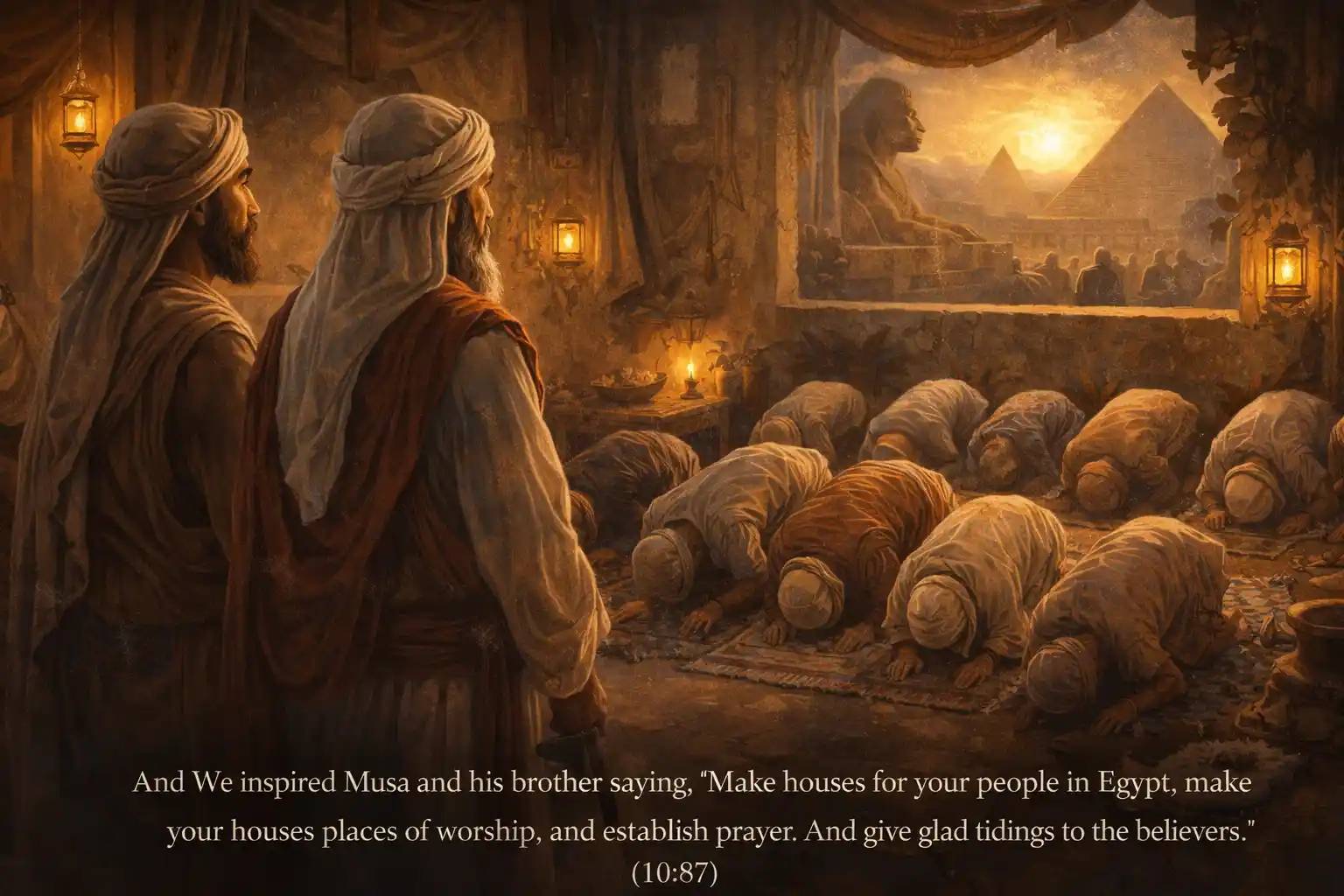
87. And We inspired to Moses and his brother, (saying): “Appoint houses for your people in Egypt, and make your houses as places for worship, and establish prayer. And give glad tidings to the believers.”
88. And Moses said: “Our Lord, indeed You have given Pharaoh and his chiefs splendor and wealth in the life of the world, our Lord, that they may lead (people) astray from Your path. Our Lord, destroy their wealth and harden their hearts so that they may not believe until they see the painful punishment.”
89. He (Allah) said: “Verily, the prayer of you both has been answered. So keep to the straight path, and follow not the path of those who do not know.”
90. And We led the Children of Israel across the sea. Then Pharaoh and his hosts pursued them in rebellion and enmity. Until, when the drowning overtook him, he said: “I believe that there is no god but Him in whom the Children of Israel believe, and I am of those who surrender (unto Him).”
Explanation (81–90)
-
Verses 81–82 – Sorcery vs. truth:
- After the magicians throw their ropes and staffs, Musa declares their act is only sorcery.
- He states a principle: Allah will nullify corrupt work and will not support deeds that spread فساد (corruption).
- Allah promises to establish truth by His words, even if criminals hate it – truth is not at the mercy of majority or power.
-
Verse 83 – A small group believes despite fear:
- Only a smaller group (“offspring/young ones”) from Musa’s people believe, because Pharaoh’s tyranny and threats scare most others.
- Pharaoh is described as a tyrant who exceeds all bounds – political power used to block faith and oppress believers.
-
Verses 84–86 – Tawakkul and dua of the believers:
- Musa calls his people: if they truly believe, they must place their trust in Allah, not in worldly protections.
- They answer beautifully: they affirm their trust and ask Allah not to make them a “fitnah” (test / humiliation / example) for wrongdoing people.
- They ask to be saved, by Allah’s mercy, from the disbelieving people – combining trust, patience, and prayer.
-
Verse 87 – Hidden worship and preparing the community:
- Allah instructs Musa and Harun to make houses for their people in Egypt and turn these into places of prayer (like secret mosques).
- They are commanded to establish salah and to give glad tidings – even under oppression, building a praying, hopeful community is essential.
-
Verses 88–89 – Dua against Pharaoh’s misuse of blessings:
- Musa recognises that Pharaoh’s wealth and splendor are being used to mislead people from Allah’s path.
- He asks Allah to destroy their wealth and harden their hearts so they will not believe until they see the painful punishment – a request that their arrogance be fully exposed and justice be manifest.
- Allah responds that the dua of both Musa and Harun has been accepted, and instructs them to remain firm and not follow the ignorant – guidance plus patience.
-
Verse 90 – Crossing the sea and Pharaoh’s last-minute “belief”:
- Allah enables Bani Isra’il to cross the sea safely, while Pharaoh and his army chase them in arrogance and hostility.
- When drowning overtakes him, Pharaoh finally claims belief in the God of the Children of Israel and says he is among those who submit.
- The timing shows that a “belief” forced by obvious destruction, after a lifetime of rebellion, is not the same as sincere faith while one still has choice.
91. Now (you believe), and indeed you had disobeyed before, and were of the corrupters.
92. So this day We shall deliver you in your body, that you may be a sign for those after you. And indeed, many among mankind are heedless of Our signs.

93. And indeed, We settled the Children of Israel in a blessed dwelling place, and We provided them with good things. So they differed not until the knowledge had come to them. Indeed, your Lord will judge between them on the Day of Resurrection in that in which they used to differ.

94. So if you (O Muhammad) are in doubt about that which We have revealed to you, then ask those who have been reading the Book before you. The truth has certainly come to you from your Lord, so be not of those who doubt.
95. And be not you of those who deny the revelations of Allah, for then you shall be among the losers.
96. Indeed, those upon whom the word of your Lord has been justified, they will not believe.
97. Even if every sign should come to them, until they see the painful punishment.
98. So why was there not a (single) township (among those We warned) that believed so its belief benefited it, except the people of Jonah. When they believed, We removed from them the punishment of disgrace in the life of the world, and We gave them comfort for a while.
99. And if your Lord willed, those on earth would have believed, all of them together. Will you (O Muhammad) then compel mankind, until they become believers.
100. And it is not for a soul to believe, except by the permission of Allah. And He has set uncleanness upon those who will not understand.
Explanation (91–100)
-
Verses 91–92 – Pharaoh’s late “faith” and preserved body:
- Pharaoh’s declaration of belief comes only when drowning overtakes him. Allah rejects this last–second claim because it follows a life of rebellion and فساد (corruption).
- Allah preserves his body as a visible sign for later generations – political power, wealth, and arrogance end in humiliation and serve as a warning.
-
Verse 93 – Bani Isra’il blessed, then divided after knowledge:
- The Children of Israel are settled in a blessed land with good provision – a favour from Allah.
- They only begin to differ after clear knowledge comes, showing that division often comes from arrogance and jealousy, not ignorance.
- Final judgment between them is reserved for the Day of Resurrection – humans cannot claim absolute ownership of truth beyond what Allah has revealed.
-
Verses 94–95 – Reassurance to the Prophet and warning against doubt:
- The Prophet is told that if he were hypothetically in doubt, he could ask the People of the Book who still recite earlier scriptures that confirm the same God and message.
- In reality, the verse is a strong reassurance: the truth has already come from Allah, so he must not be among the doubters or those who deny Allah’s verses.
- This is also a warning to anyone who receives clear revelation: rejecting it makes a person from the خاسرين (losers).
-
Verses 96–97 – Those sealed by Allah’s word:
- Some people’s arrogance reaches a point where the word of punishment becomes binding on them – they simply will not believe.
- No amount of signs or miracles will help them, until they actually see the painful punishment – by then, faith will not benefit them.
-
Verse 98 – The unique example of the people of Jonah:
- Among the towns that were warned, only the people of Yunus (Jonah) collectively believed in time, and their belief benefited them.
- Because they repented before the punishment fully descended, Allah removed from them the disgrace in this world and granted them ease for a while.
- This shows that sincere collective repentance can avert worldly punishment, unlike Pharaoh’s repentance at the moment of death.
-
Verses 99–100 – No compulsion in belief and Allah’s permission:
- Allah states that if He willed, all people on earth would believe. This means the Prophet is not sent to force hearts to believe; his duty is to convey the message.
- Iman (faith) only occurs by Allah’s permission – meaning within the laws Allah set, granting guidance to those who seek truth sincerely.
- Those who refuse to use عقل (understanding) are left with “رجس” (inner uncleanness, confusion and misguidance) because of their own stubbornness.
101. Say: “Behold all that is in the heavens and the earth.” And of no avail will be signs and warners to a people who do not believe.
102. Then do they wait for (anything) except like the days of those who passed away before them. Say: “Wait then, indeed, I am with you among those who are waiting.”
103. Then We will save Our messengers and those who have believed. Thus, it is incumbent upon Us to save the believers.
104. Say (O Muhammad): “O mankind, if you are in doubt of my religion, then (know that) I do not worship those whom you worship besides Allah. But I worship Allah who causes you to die. And I have been commanded to be of the believers.”
105. And that (O Muhammad), direct your face toward the religion, as by nature upright, and do not be of those who associate partners (to Allah).
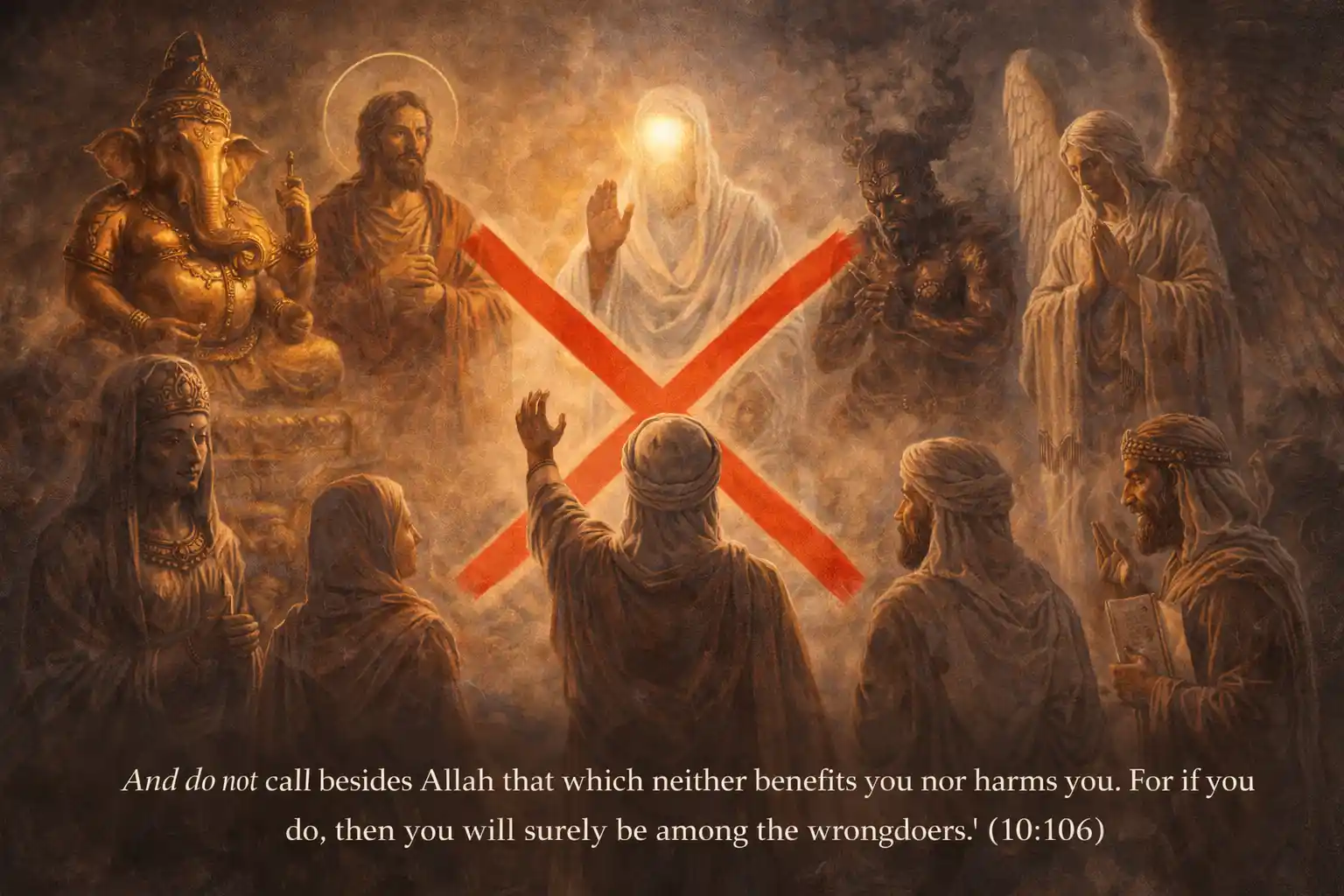
106. And do not call upon, besides Allah, that which neither benefits you, nor harms you. For if you did, so indeed, you would then be of the wrongdoers.
107. And if Allah afflicts you with adversity, then there is none who can remove it except Him. And if He intends for you good, then there is none who can repel His bounty. He causes it to reach whomever He wills of His slaves. And He is the Oft Forgiving, Most Merciful.
108. Say (O Muhammad): “O mankind, the truth has indeed come to you from your Lord. Then whoever is guided, so he is guided only for (the good of) his own self. And whoever goes astray, so he goes astray only to his own (loss). And I am not a custodian over you.”
109. And (O Muhammad) follow that which is revealed to you, and remain patient until Allah gives judgment. And He is the Best of those who judge.
Explanation (101–109)
-
Verses 101–102 – Signs all around and the fate of deniers:
- Allah tells the Prophet to tell people to look carefully at everything in the heavens and the earth: the entire creation is a continuous “ayah” (sign).
- But signs and warners do not benefit those who have already decided to reject, because their problem is not lack of evidence but lack of willingness.
- They are warned that what they are “waiting” for is the same kind of outcome that struck previous nations who denied their messengers.
-
Verse 103 – A constant sunnah: Allah saves the believers:
- Allah’s pattern in history is clear: He saves His messengers and those who truly believe with them.
- This is a promise and a responsibility Allah has taken on Himself – ultimately, sincere believers are rescued, either in this life, the next, or both.
-
Verses 104–105 – Public declaration of pure worship:
- The Prophet is commanded to speak openly to all mankind: if they doubt his path, they should know he does not worship their false gods.
- He worships only Allah, the One who gives death (and life), and he is ordered to be among the believers, firm and clear.
- “Direct your face toward the religion” means to commit fully, sincerely and uprightly, without turning towards shirk, customs, or man-made authority in religion.
-
Verse 106 – No calling on others besides Allah:
- Allah forbids the Prophet (and by extension the Ummah) from calling upon anything besides Him – whether idols, saints, prophets, jinn, angels, or any unseen power.
- These things have no real power to benefit or harm; relying on them would be ظلم (wrongdoing) and shirk.
-
Verse 107 – Harm and benefit are only in Allah’s hand:
- Any hardship that reaches a person is by Allah’s permission, and only He can remove it.
- Any good that reaches a person cannot be blocked by anyone when Allah has willed it.
- This destroys the idea that “holy men,” “awliyā,” or “intercessors” control our destiny – all control is with Allah, who is also Forgiving and Merciful.
-
Verse 108 – Truth has come; responsibility is individual:
- The Prophet announces that the truth from Allah has already arrived – Qur’an is complete proof.
- Whoever accepts guidance benefits only himself; whoever refuses harms only himself. No one carries someone else’s burden.
- The Prophet is not a jailer or controller over people; his job is to convey the message, not force hearts.
-
Verse 109 – Follow revelation and be patient:
- The Prophet is ordered to follow only what is revealed – not people’s desires, not inherited stories, not pressure from society.
- He is told to remain patient until Allah judges between him and his opponents; Allah’s judgment is the best and final.
- For us, this means: hold fast to the Qur’an, do not rush for worldly approval, and trust Allah’s timing and justice.