- The text under each verse number is a meaning-based English rendering of the ayah.
- Under it is a
linked to other Qur'an principles (no hadith used). - Special focus on contracts, halal/haram, intercession, shirk, scholars, sects and innovations.
- All authority is from the Qur'an itself (e.g., 6:114, 17:36, 45:6). No extra “sacred” books.
1. O you who believe, honour your obligations and agreements. Grazing livestock are made lawful for you, except what has been clearly forbidden to you. Do not treat hunting as lawful while you are in a state of pilgrimage. Indeed, Allah rules as He wills.
2. O you who believe, do not violate Allah’s symbols, nor the sacred months, nor the sacrificial animals, nor the garlands placed on them, nor those heading to the Sacred House seeking Allah’s bounty and pleasure. When you are released from the state of pilgrimage, then you may hunt. And do not let hatred of a people, who blocked you from the Sacred Mosque, lead you to aggression. Help one another in righteousness and mindfulness of Allah, and do not help one another in sin and transgression. And fear Allah; indeed, Allah is severe in punishment.
3. Forbidden to you are: carrion, blood, swine flesh, and whatever has been dedicated to other than Allah; and (the animals) that died by strangling, or a violent blow, or a fall, or by being gored, and what wild beasts have partly eaten—except what you are able to slaughter (properly)—and what is sacrificed on stone altars, and that you seek judgment by divining arrows. That is grave disobedience. Today those who disbelieve have despaired of your religion, so do not fear them, but fear Me. Today I have perfected your religion for you, completed My favour upon you, and approved Islam for you as your way of life. But whoever is forced by severe hunger, without inclining to sin, then surely Allah is All-Forgiving, Most Merciful.
4. They ask you what has been made lawful for them. Say: Lawful for you are all good and wholesome things, and what you have trained hunting animals to catch for you, teaching them as Allah has taught you. So eat from what they catch for you, and mention Allah’s name over it, and fear Allah. Surely, Allah is swift in taking account.
5. Today all good and pure things have been made lawful for you. The food of those given the Book is lawful for you, and your food is lawful for them. And (lawful for you in marriage are) chaste believing women, and chaste women from those given the Book before you, when you give them their bridal gifts, desiring marriage, not illicit sex or secret lovers. And whoever rejects faith, then his deeds are rendered void, and in the Hereafter he will be among the losers.
Explanation (5:1–5)
-
5:1 – Fulfilling contracts is a core part of īmān:
Allah starts this surah by calling the believers and ordering:
- “Fulfil your contracts/obligations.”
- Your covenants with Allah (tawḥīd, prayer, zakāh, etc.),
- Agreements with people: marriage, business deals, promises, treaties.
Principle: Contracts + clear divine limits come first. Cultural “haram lists” that have no Qur'an proof are not part of these contracts. -
5:2 – Respecting sacred symbols and avoiding revenge-based injustice:
Allah mentions several things not to violate:
- Allah’s symbols (like ḥajj rituals),
- The sacred months,
- The marked sacrificial animals and their garlands,
- Pilgrims heading to the Sacred House seeking Allah’s favour.
Then He sets a rule for all Muslim behaviour:- Cooperate in righteousness and taqwā.
- Do NOT cooperate in sin and transgression.
You can’t justify haram by saying “my group / madhhab / sheikh said so.” If it is sin or injustice, you don’t help with it, even if your sect or family pushes you. -
5:3 – Clear food prohibitions + “Today I perfected your religion” in the middle of halal/haram:
Allah lists what is haram to eat:
- Carrion (dead animals not properly slaughtered),
- Blood,
- Pork,
- Anything dedicated to other than Allah,
- Animals that died by strangling, fierce blows, falling, being gored, or eaten by beasts (unless you reach them alive and slaughter),
- Sacrifices made on stone altars (idol rituals),
- Using divining arrows to decide (superstitious gambling for rulings).
- “Today I have perfected your religion for you, completed My favour upon you, and approved Islam as your dīn.”
- This perfection statement is inside a verse about halal and haram.
- It means the system of law – including what is allowed and forbidden – is already complete.
- Add permanent haram/halal rules that contradict or go beyond what Allah has clearly set,
- Then claim “this is from the Prophet” to override the Qur'an.
- A person is forced by extreme hunger,
- Does not intend sin or rebellion,
-
5:4 – Good things + trained hunting animals:
People ask the Prophet what is allowed. Allah answers:
- All good and wholesome things are lawful.
- The catch of trained hunting animals (dogs, birds, etc.) is also lawful, as long as Allah’s name is remembered and they are properly trained.
- Allah’s law is not meant to suffocate life,
- But to keep it clean from shirk, filth and cruelty.
“My madhhab says… my favourite scholar says…” instead of “Allah says in the Qur'an…” -
5:5 – Food of the People of the Book and marriage:
Allah declares:
- All good and pure things are lawful.
- The food of the People of the Book (Jews and Christians) is lawful for you, and your food is lawful for them.
- Chaste believing women, and chaste women from the People of the Book, are lawful to marry when given their proper bridal gifts, seeking marriage not secret zina.
- This ayah shows a level of openness and interaction—eating each other’s food, marrying chaste women among them—
- But always within the clear halal framework of the Qur'an (no secret affairs, no prostitution, no worship mixing).
- If someone rejects faith after this guidance, all their previous deeds are ruined; labels alone cannot save them.
Religion here is practical: keep the contracts, respect sacred limits, eat what is clean, avoid what is clearly haram, and don’t invent new haram/halal from yourself.
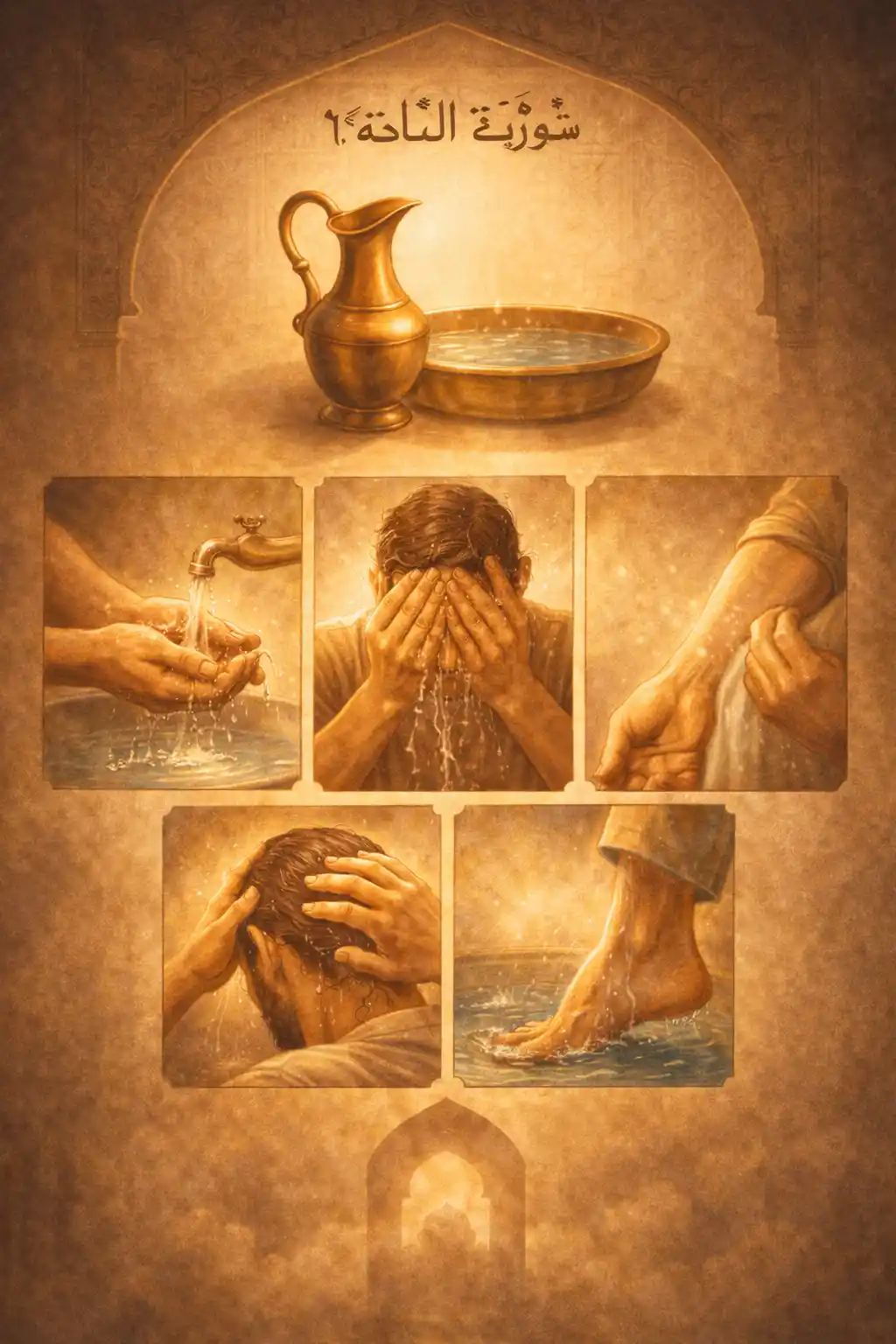
6. O you who believe, when you stand for the prayer, wash your faces and your hands up to the elbows, and wipe your heads, and wash your feet up to the ankles. And if you are in a state of major impurity, then purify yourselves fully. But if you are ill, or on a journey, or one of you has come from relieving himself, or you have been intimate with women, and you do not find water, then turn to clean earth and wipe your faces and your hands with it. Allah does not intend to place any hardship upon you, but He intends to purify you and to complete His favour upon you so that you may be grateful.
7. And remember Allah’s favour upon you and His covenant with which He bound you, when you said: “We hear and we obey.” And fear Allah. Indeed, Allah is All-Knowing of what is in the chests.
8. O you who believe, be steadfast for Allah, as witnesses in justice, and let not the hatred of a people lead you away from being just. Be just; that is nearer to mindfulness of Allah. And fear Allah; surely Allah is All-Aware of what you do.
9. Allah has promised those who believe and do righteous deeds that they will have forgiveness and a great reward.
10. But those who disbelieve and deny Our verses, they are the companions of the blazing Fire.
Explanation (5:6–10)
-
5:6 – Wudu and tayammum: purification without hardship:
Allah gives a clear, simple description of how to prepare for ṣalāh:
- Wash the face,
- Wash the hands/arms up to the elbows,
- Wipe over the head,
- Wash the feet up to the ankles.
But when water genuinely cannot be used (sickness, travel, no water available), Allah replaces it with:- Tayammum – using clean earth to wipe the face and hands.
Allah does not want hardship for you; He wants to purify you and complete His favour.This means:- Purification is a spiritual and practical preparation, not a torture ritual.
- Any later rule that turns wudu into something extreme, obsessive or impossible is against this Qur’anic spirit.
-
5:7 – Remembering the covenant: “We hear and we obey”:
Allah reminds the believers:
- He gave them special favour,
- They agreed to His covenant by saying “We hear and we obey.”
- “We hear and obey our imām, our sheikh, our madhhab,” even if it clashes with the Qur'an,
-
5:8 – Justice even towards those you hate:
Allah again starts with “O you who believe” and commands:
- Stand firmly for Allah as witnesses in justice.
- Do not let hatred of any people push you into injustice.
- You cannot twist rulings or lie just because the other side is non-Muslim, from another sect, or someone who wronged you.
- Justice is closer to taqwā than emotional revenge.
“As long as it benefits ‘our group’ (Sunni, Shia, Sufi, Salafi, school, tribe), it’s fine.”
No. If it is injustice, it is against this verse, even if a scholar tries to justify it. -
5:9 – Simple trade: īmān + good deeds = forgiveness and great reward:
Allah’s promise is very clear:
- Those who believe and do righteous deeds get:
- Forgiveness,
- And a huge reward.
- Buying special amulets,
- Following a particular sect name,
- Clinging to a sheikh as “automatic intercessor.”
- Those who believe and do righteous deeds get:
-
5:10 – Disbelief in the verses has consequences:
Those who:
- Disbelieve,
- And deny Allah’s clear verses,
11. O you who believe, remember Allah’s favour upon you when some people intended to stretch out their hands against you, but He held back their hands from you. And fear Allah, and in Allah let the believers put their trust.
12. And Allah certainly took a covenant from the Children of Israel, and We appointed twelve leaders among them. And Allah said: “Indeed, I am with you. If you establish the prayer and give the poor due and believe in My messengers and support them, and lend Allah a goodly loan, I will surely remove from you your evil deeds and admit you to gardens beneath which rivers flow. But whoever among you disbelieves after that has surely strayed from the right way.”
13. But because they broke their covenant, We cursed them and made their hearts hard. They distort words from their proper places, and they forgot a portion of what they were reminded of. And you will not cease to discover betrayal from most of them, except a few of them. But pardon them and overlook. Indeed, Allah loves the doers of good.
14. And from those who say, “We are Christians,” We took their covenant. But they forgot a portion of what they were reminded of, so We caused enmity and hatred among them until the Day of Resurrection. And Allah will inform them of what they used to do.
15. O People of the Book, there has come to you Our messenger, making clear to you much of what you used to hide from the Scripture, and overlooking much. There has come to you from Allah a light and a clear Book.
16. By it Allah guides those who seek His pleasure to the ways of peace, and brings them out from darknesses into the light by His permission, and guides them to a straight path.
17. They have certainly disbelieved who say, “Allah is the Messiah, son of Mary.” Say: “Who then has any power against Allah, if He intended to destroy the Messiah, son of Mary, and his mother and everyone on the earth all together?” To Allah belongs the dominion of the heavens and the earth and whatever is between them. He creates what He wills. And Allah is Powerful over all things.
18. The Jews and the Christians say: “We are the children of Allah and His beloved ones.” Say: “Then why does He punish you for your sins? Rather, you are human beings from among those He has created. He forgives whom He wills and punishes whom He wills. And to Allah belongs the dominion of the heavens and the earth and whatever is between them, and to Him is the final return.”
19. O People of the Book, certainly Our messenger has come to you, making things clear for you after an interval without messengers, lest you say: “There came to us no bringer of good tidings and no warner.” But there has certainly come to you a bringer of good tidings and a warner. And Allah is Powerful over all things.
Explanation (5:11–19)
-
5:11 – Protection you didn’t even see:
Allah reminds the believers of a time when:
- Some people wanted to attack them,
- But Allah “held back their hands”.
- Fear Allah,
- Put your trust in Him, not in personalities, saints, imams or “holy” families.
-
5:12 – The original covenant: pray, give, support the messengers:
With the Children of Israel, Allah:
- Took a covenant and set twelve leaders,
- Promised His support if they:
- Established prayer,
- Gave zakāh,
- Believed in all His messengers,
- Supported them,
- “Lent Allah a goodly loan” – meaning spending sincerely in His path.
- Removal of sins,
- Entry into gardens beneath which rivers flow.
-
5:13 – What happens when a community breaks its covenant:
Because many among them:
- Broke the covenant,
- They were cursed and their hearts became hard,
- They distort words from their proper places,
- They forgot a portion of what they were reminded of.
“Distorting words” is not only changing the text; it includes twisting the meaning. Today Muslims can do the same if they bend Qur'an meanings to fit sect beliefs or hadith claims.Still, Allah tells the Prophet to:- Pardon and overlook,
- Because Allah loves the muḥsinīn (those who do good).
-
5:14 – Christians also forgot part of their reminder:
Those who say “We are Christians” also:
- Had a covenant,
- Forgot part of what they were reminded to follow,
- Ended up with enmity and hatred among themselves until the Day of Resurrection.
-
5:15–16 – A light and a clear Book that exposes hidden changes:
Allah addresses the People of the Book:
- The messenger now makes clear what they used to hide from Scripture,
- And ignores some things (not every hidden issue needs to be dragged out),
- A “light” and a “clear Book” have now come from Allah.
- Guides those who seek His pleasure,
- Leads them to the paths of peace,
- Brings them from darkness into light (compare with 14:1, 14:5),
- Guides them to a straight path.
-
5:17 – Refuting “Allah is the Messiah, son of Mary”:
Those who claim that:
- “Allah is the Messiah, son of Mary”
- If Allah wished to destroy the Messiah, his mother, and everyone on earth, who could stop Him?
- Jesus, a prophet, can control Allah’s will,
- Any human being is “God in flesh.”
-
5:18 – “We are Allah’s children and beloved ones” – false religious entitlement:
Jews and Christians say:
- “We are Allah’s children and beloved ones.”
- If that is so, why does He punish you for your sins?
- You are human beings from among those He created.
- He forgives whom He wills and punishes whom He wills.
Saying “We are Ahl as-Sunnah”, “We are the saved sect”, or “We belong to such-and-such imam” does not guarantee safety. Deeds and sincere obedience to Allah’s Book do. -
5:19 – No excuse left after the Qur'an and this messenger:
Allah tells the People of the Book:
- The messenger has come after a gap in messengers,
- So they cannot say: “No bringer of good news or warner came to us.”
- The proof has arrived,
- The guidance is clear,
- There is no excuse based on “we didn’t know.”
- “Our scholars said… our sect says… we just followed our parents,”
20. And when Musa said to his people: “O my people, remember Allah’s favour upon you when He placed among you prophets, and made you kings, and gave you what He had not given to anyone among all the worlds.”
21. “O my people, enter the Holy Land which Allah has prescribed for you, and do not turn back on your heels, or you will become losers.”
22. They said: “O Musa, there is a strong, overpowering people in it, and we will never enter it until they leave it. So if they leave it, then we will surely enter.”
23. Two men from among those who feared Allah, whom Allah had favoured, said: “Enter upon them through the gate. For when you enter it, you will be victorious. And upon Allah put your trust, if you are truly believers.”
24. They said: “O Musa, indeed we will never enter it, ever, as long as they remain in it. So go, you and your Lord, and fight. We will sit here.”
25. He said: “My Lord, I have no power except over myself and my brother, so separate us from the defiantly disobedient people.”
26. He said: “Then indeed it is forbidden to them for forty years; they will wander in the land, lost. So do not grieve over the defiantly disobedient people.”
Explanation (5:20–26)
-
5:20 – Favour doesn’t mean automatic safety:
Musa reminds his people:
- Allah placed prophets among them,
- Made them like “kings” (with freedom, resources, dignity),
- Gave them blessings not given to other nations.
Having the Qur'an, masjids, scholars and an “Islamic identity” is a favour, not a guarantee. You can still destroy yourself by refusing Allah’s clear commands. -
5:21 – The command: enter the Holy Land:
Musa tells them:
- “Enter the Holy Land which Allah has prescribed for you,”
- “Do not turn back, or you will be losers.”
- A direct command from Allah,
- Connected to their covenant and trust in Him.
-
5:22 – Excuses built on fear of people:
Their reply:
- “There is a strong people there,”
- “We will never enter until they leave.”
- Put the fear of people above the command of Allah,
- Turned a test of trust into a negotiation with Allah’s command.
- Afraid of community, family, or sect if they follow the Qur'an fully,
- So they stay in disobedience, hiding behind excuses.
-
5:23 – The minority who actually believe:
Two men who truly feared Allah and were blessed by Him said:
- “Enter through the gate, and you will be victorious,”
- “Put your trust in Allah, if you are believers.”
- They don’t only talk about belief,
- They act when Allah says move,
- They rely on His promise more than visible power of the enemy.
The true “saved group” is not a sect label; it is those who, when the truth from Allah is clear, actually obey it, even if they are a tiny minority. -
5:24 – Arrogant refusal: “You and your Lord, go fight”:
Their shocking answer:
- “We will never enter as long as they are there.”
- “You and your Lord go and fight; we will sit here.”
- Total lack of respect for Allah’s command,
- Blaming Allah and His messenger instead of themselves,
- Wanting victory without sacrifice.
- Won’t leave haram,
- Won’t stand up for justice,
- Won’t break from inherited false practices and innovations.
-
5:25 – Musa separates himself from the defiantly disobedient:
Musa says:
- “I only control myself and my brother,”
- “So separate us from the defiantly disobedient people.”
- Disowns their rebellion,
- Does not try to defend them,
- Asks Allah to distinguish between those who obey and those who persist in defiance.
- Yourself,
- Those under your care (within your ability),
-
5:26 – Consequence: 40 years of wandering:
Allah decrees:
- The land is forbidden to them for forty years,
- They will wander in the land, lost,
- Musa is told not to grieve over the defiantly disobedient.
- The punishment is in this world: humiliation, delay, wandering without progress.
- They physically move, but spiritually and politically they are stuck.
- Refuses Allah’s Book,
- Clings to inherited sectarianism and blind following,
- Is then stuck in humiliation and chaos for generations, wondering why they are not moving forward.
27. And recite to them the true story of Adam’s two sons, when they offered a sacrifice. It was accepted from one of them, but not accepted from the other. He said: “I will surely kill you.” The first said: “Allah only accepts from those who are mindful of Him.”
28. “If you stretch your hand towards me to kill me, I will not stretch my hand towards you to kill you. Indeed, I fear Allah, the Lord of all worlds.”
29. “I want you to bear my sin and your own sin, and so you will be among the companions of the Fire. Such is the repayment of the wrongdoers.”
30. But his soul urged him on to kill his brother, so he killed him, and became among the losers.
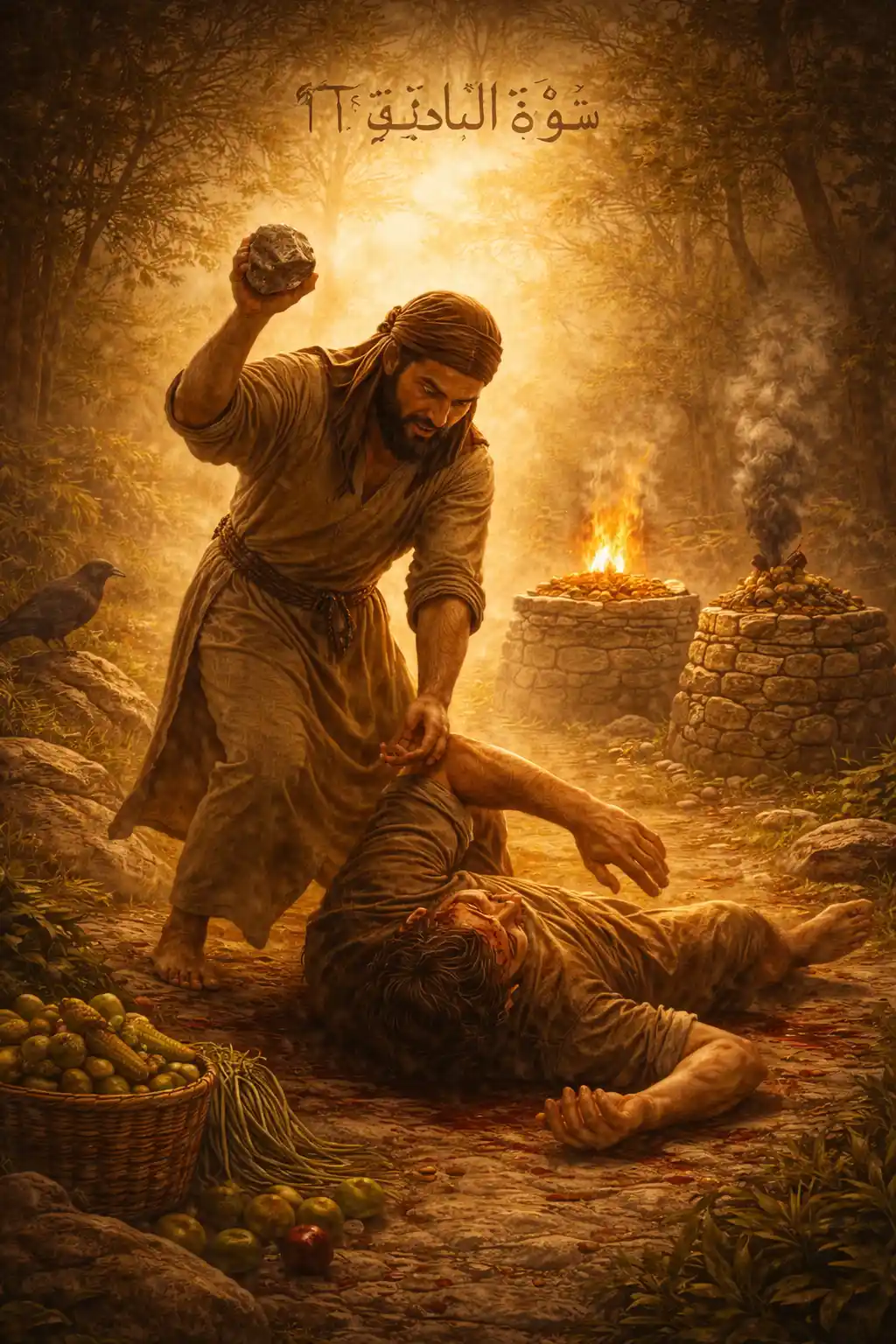
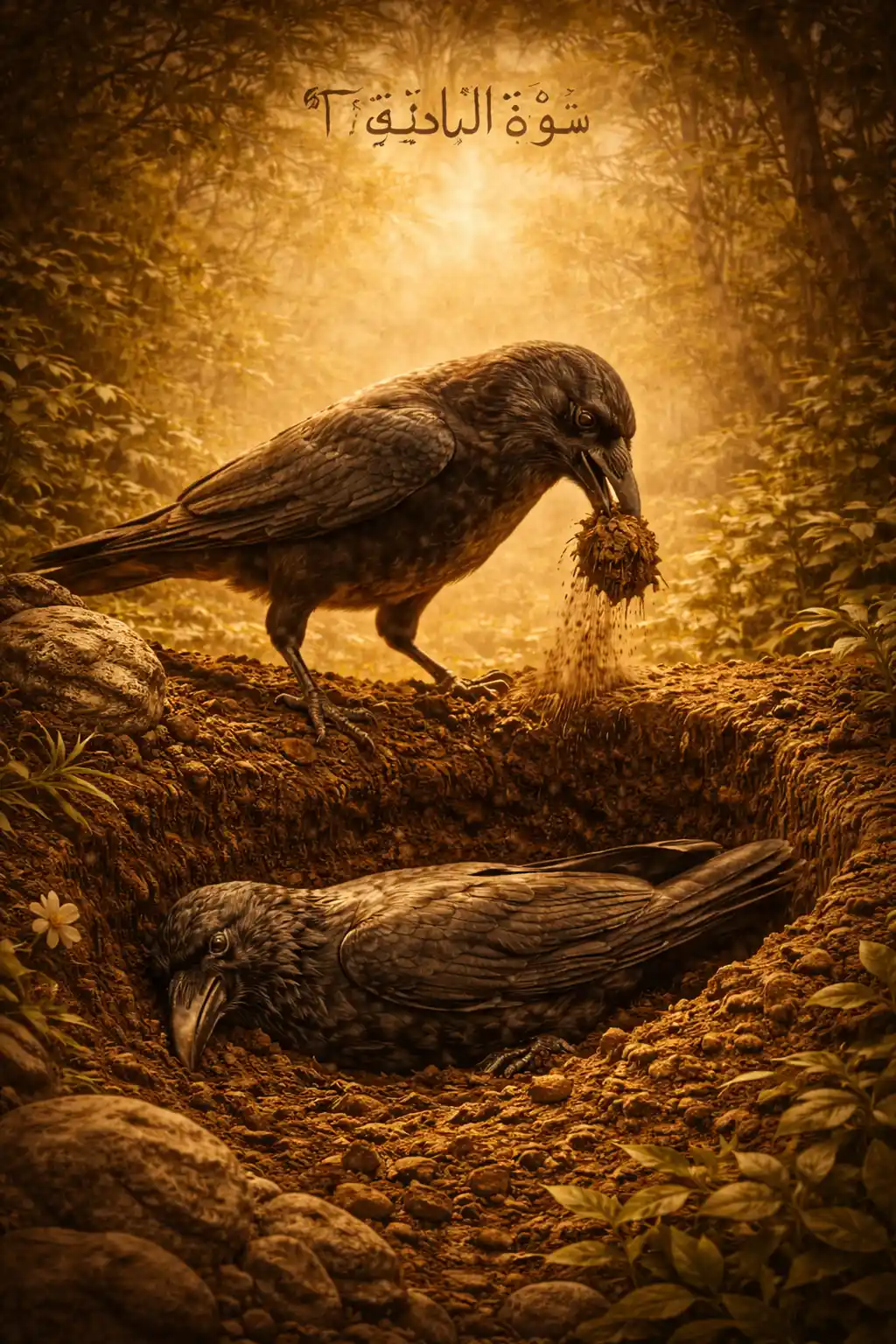
31. Then Allah sent a crow scratching in the earth to show him how to hide the body of his brother. He said: “Woe to me! Am I unable to be like this crow and hide the body of my brother?” And he became of those who are filled with regret.
32. Because of that, We decreed upon the Children of Israel that whoever kills a person—unless it be in retaliation for murder, or for spreading corruption in the land—it is as if he has killed all mankind; and whoever saves a life, it is as if he has saved all mankind. Yet Our messengers came to them with clear proofs, then indeed many of them, after that, still exceeded all bounds on the earth.
33. The only recompense of those who wage war against Allah and His messenger and strive in the land to spread corruption is that they be killed, or crucified, or that their hands and feet be cut off from opposite sides, or that they be exiled from the land. That is a disgrace for them in this world, and in the Hereafter they will have a great punishment.
34. Except for those who repent before you overpower them; then know that Allah is All-Forgiving, Most Merciful.
Explanation (5:27–34)
-
5:27 – Accepted sacrifice and Taqwā, not status:
Adam’s two sons both offered a sacrifice:
- One was accepted,
- The other was rejected.
- “Allah only accepts from those who have taqwā.”
- Acceptance is based on God-consciousness and sincerity, not bloodline or group label.
- A person can be outwardly “religious” but filled with jealousy and hate, and Allah rejects that.
-
5:28–29 – Refusal to commit murder & shifting the burden of sin:
The innocent brother says:
- He will not respond with violence even if the other tries to kill him.
- He fears Allah, the Lord of the worlds.
- His own sin + the sin of murdering an innocent,
- Ending up in the Fire as repayment for wrongdoing.
- If the brother insists on oppression, then he alone will carry its burden.
You are responsible for your actions. No saint, imam, “peer” or sheikh can carry your deliberate injustice for you. -
5:30–31 – Murder, regret and the crow:
The killer:
- Follows his desire and kills his brother,
- Immediately becomes one of the losers.
- He feels shame that even a bird has more sense than him,
- He is filled with regret—but only after the crime.
- Commit injustice, theft, or even kill reputations with lies,
- Then regret when the damage is clear—but the deed is already written.
-
5:32 – One life equals “all of mankind” in weight:
Because of that story, Allah decreed for the Children of Israel that:
- Whoever kills a single person (without just cause) is as if he killed all humanity.
- Whoever saves a single life is as if he saved all humanity.
- Legal retaliation for murder (after proper process),
- Or dealing with someone who spreads major, violent corruption in the land.
- Human life is sacred; you can’t play with it because of sect, race, madhhab, or politics.
- This completely destroys terrorist logic that “one life” is cheap if they think it serves their cause.
-
5:33 – Punishment for those who wage war and spread corruption:
The verse talks about people who:
- Wage war against Allah and His messenger (i.e. against the public order based on Allah’s law),
- Work actively to spread violent corruption (banditry, terror, large-scale crime).
- Execution,
- Crucifixion,
- Cutting hands and feet from opposite sides,
- Exile from the land.
This is about serious public crimes and violent corruption, not simple sins. No group can use this ayah to justify killing people just because they disagree or follow another madhhab.In this world, it is a humiliation for them; the next world has even greater punishment. -
5:34 – Mercy still open before capture:
An exception:
- If such criminals repent before being captured,
- They can find Allah Forgiving and Merciful.
- Even people deeply involved in crime can still turn back,
- Repentance is between them and Allah; human legal consequences may still apply, but Allah can forgive in the Hereafter.
35. O you who believe, fear Allah and seek the means of nearness to Him, and strive in His path so that you may succeed.
36. Indeed, those who disbelieve—if they had all that is in the earth, and the like of it with it, to ransom themselves from the punishment of the Day of Resurrection, it would not be accepted from them, and for them is a painful punishment.
37. They will want to come out of the Fire, but they will not be able to come out of it, and for them is a lasting punishment.
38. And the male thief and the female thief—cut off their hands as a recompense for what they earned and as a deterrent from Allah. And Allah is All-Mighty, All-Wise.
39. But whoever repents after his wrongdoing and reforms, then indeed Allah turns to him in forgiveness. Indeed, Allah is All-Forgiving, Most Merciful.
40. Do you not know that to Allah belongs the dominion of the heavens and the earth? He punishes whom He wills and forgives whom He wills. And Allah is Powerful over all things.
Explanation (5:35–40)
-
5:35 – How to seek “wasīlah” (nearness):
Allah commands the believers:
- Have taqwā – constant awareness and fear of displeasing Him.
- Seek the means of nearness to Him (al-wasīlah).
- Strive in His path so that you may succeed.
- Taqwā,
- Striving in Allah’s cause with sincere deeds He loves,
- Obeying His commands and avoiding His limits.
- “Seek dead saints as a wasīlah,”
- “Call upon sheikhs, imams or prophets as middle-men,”
- “Buy special du‘ā books or amulets as a shortcut.”
Closeness to Allah = Belief, taqwā, sincere obedience, and striving for His sake – not attaching yourself to human “intercessors” or invented rituals. -
5:36–37 – No ransom can buy your way out if you rejected the truth:
For those who:
- Persist in disbelief and denial,
- Refuse Allah’s guidance knowingly,
- Everything on earth plus its like to ransom themselves on the Day of Judgment,
- Face a painful punishment,
- Will want to escape the Fire,
- But will not be able to leave it, and the punishment is continuous.
- Some special ritual, saint, or “deal” can cancel deliberate disbelief after clear evidence,
- Or that Allah will be “forced” to forgive because of group membership or slogans.
-
5:38 – The legal limit (ḥadd) for theft:
Allah gives a strong worldly punishment:
- The male thief and the female thief: their hands are cut as a recompense for what they earned,
- It is also a deterrent (exemplary punishment) from Allah.
- This is a public legal ruling, not personal revenge.
- It presumes:
- A just Islamic system,
- Proper investigation and evidence,
- No oppression, no discrimination.
- It protects society, especially the poor, from becoming permanent victims of crime.
-
5:39 – Repentance and reform re-open the door:
Even after such a serious crime:
- If the person repents honestly,
- And reforms their behaviour,
- Turns to them in forgiveness,
- Is All-Forgiving, Most Merciful.
- Earthly legal consequences do not block Allah’s mercy in the Hereafter,
- Someone known as “a thief” can become a beloved servant of Allah if they truly change.
“I’m already too bad, I might as well continue.”
The Qur'an keeps the gate of tawbah open even after major crimes. -
5:40 – Allah owns punishment and forgiveness absolutely:
Allah reminds:
- To Him belongs the dominion of the heavens and the earth.
- He punishes whom He wills and forgives whom He wills.
- He is Powerful over all things.
- No prophet, imam, sheikh or saint controls forgiveness.
- No “holy family” can guarantee Jannah to themselves or to followers.
- Justice and mercy both belong to Allah alone, and He uses them with full knowledge and wisdom.
- Trading religion for money or loyalty (“follow me, I’ll save you”),
- Inventing intercessors that the Qur'an never authorised.
41. O Messenger, let not those grieve you who rush into disbelief – from those who say “We believe” with their mouths while their hearts do not believe, and from among the Jews who eagerly listen to lies and to others who have not yet come to you. They distort words from their proper places, saying: “If you are given this, take it; but if you are not given it, then beware.” Whoever Allah wills to test, you can do nothing for him against Allah. They are the ones whose hearts Allah does not intend to purify. For them is disgrace in this world, and in the Hereafter a great punishment.
42. They are avid listeners to falsehood and devourers of the unlawful. So if they come to you, judge between them or turn away from them. If you turn away from them, they cannot harm you at all. But if you judge, then judge between them with justice. Indeed, Allah loves those who are just.
43. But how is it that they come to you for judgment, while they have the Torah in which is the judgment of Allah, yet afterwards they turn away? Such people are not truly believers.
44. Indeed, We sent down the Torah, in which was guidance and light. The prophets who had submitted themselves judged by it for the Jews, as did the scholars and rabbis, by that which they were entrusted of the Book of Allah, and they were witnesses to it. So do not fear the people but fear Me, and do not sell My verses for a small price. Whoever does not judge by what Allah has revealed – then it is they who are the disbelievers.
45. And We prescribed for them in it: a life for a life, an eye for an eye, a nose for a nose, an ear for an ear, a tooth for a tooth, and for wounds there is retaliation. But whoever gives it up as charity, it is an expiation for him. Whoever does not judge by what Allah has revealed – then it is they who are the wrongdoers.
46. And We sent, following in their footsteps, Jesus son of Mary, confirming what was before him of the Torah. And We gave him the Gospel, in which was guidance and light, confirming what was before it of the Torah, and as guidance and instruction for those who are mindful of Allah.
47. So let the people of the Gospel judge by what Allah has revealed in it. Whoever does not judge by what Allah has revealed – then it is they who are the defiantly disobedient.
Explanation (5:41–47)
-
5:41 – Hypocrites and “scripture shoppers”:
Allah tells the Messenger not to be saddened by:
- Those who rush into disbelief even while claiming “we believe” with their tongues only,
- Some from the Jews who love listening to lies and to people outside the Prophet’s community,
- Those who distort words from their proper places and say: “If you are given this ruling, accept it. If not, then be careful.”
- People who only accept the judgement that matches their desires,
- And reject the verse or fatwa if it goes against them.
- Are being tested,
- Allah does not intend to purify their hearts as long as they insist on this behaviour,
- They have disgrace here and great punishment later.
True faith is not “pick and choose”. You don’t fish for Qur'an verses or rulings that suit your sect or ego and ignore the rest. -
5:42 – Justice is required even when people themselves are corrupt:
These people:
- Love falsehood,
- Eat unlawful gain (bribes, corrupt money etc.).
- He is free to judge or refuse to involve himself.
- If he refuses, they cannot harm him.
- If he does judge, he must judge with justice.
- We are not obliged to get dragged into every corrupt dispute.
- But if we do judge, it must be based on fairness and Allah’s guidance, not group bias or sect loyalty.
-
5:43–44 – They already have revelation, but still run to other judges:
Allah criticises them:
- They have the Torah with Allah’s judgement inside it,
- But they still come to the Prophet only hoping he will rule in their favour,
- Then they turn away from his verdict if it doesn’t suit them.
- He sent down the Torah as guidance and light,
- Prophets, rabbis and scholars were supposed to judge by that Book,
- They were entrusted with it and were witnesses over it.
- “Do not fear the people, fear Me.”
- “Do not sell My verses for a small price.”
Whoever does not judge by what Allah has revealed – they are the disbelievers.For us:- If Muslims have the Qur'an but still prefer:
- Tribal custom,
- Sect rules,
- Fatwas that clearly contradict verses,
-
5:45 – Justice and forgiveness in retaliation law:
The Torah contained:
- Life for life,
- Eye for eye, nose for nose, ear for ear, tooth for tooth,
- For wounds, measured retaliation.
- Forgiveness and giving up that right as charity,
- Which would count as an expiation for the victim.
- Firm on justice,
- But always leaves room for mercy and reconciliation.
Whoever does not judge by what Allah has revealed – they are the wrongdoers.Whether Jew, Christian or now Muslim, the standard is the same: obey revelation, not desires. -
5:46–47 – Jesus and the Gospel also commanded judgement by revelation:
Allah:
- Sent Jesus (ʿĪsā) son of Mary,
- He confirmed the Torah that came before him,
- Was given the Gospel with guidance and light,
- Which also confirmed the Torah and guided the God-fearing.
- The People of the Gospel are commanded to judge by what Allah revealed in it.
Whoever does not judge by what Allah has revealed – they are the defiantly disobedient.Pattern over and over:- Torah – guidance and light → must be followed.
- Gospel – guidance and light → must be followed.
- Qur'an – final, guarding and confirming previous revelation → must be followed.
- “Judge by what your sect says even if it clashes with the Book,”
- “Judge by your sheikh’s stories instead of the verses.”
48. And We have sent down to you the Book in truth, confirming what came before it of the Scripture, and as a guardian over it. So judge between them by what Allah has revealed, and do not follow their desires away from the truth that has come to you. For each of you We have made a law and a clear way. If Allah had willed, He could have made you one community, but He tests you in what He has given you. So compete with one another in good deeds. To Allah is your return all together, and He will inform you concerning that over which you used to differ.
49. And judge between them by what Allah has revealed, and do not follow their desires. And beware of them, lest they turn you away from part of what Allah has sent down to you. But if they turn away, then know that Allah only intends to afflict them for some of their sins. And indeed, many of the people are defiantly disobedient.
50. Is it the judgement of the days of ignorance that they seek? But who is better in judgement than Allah for a people who are sure in faith?
Explanation (5:48–50)
-
5:48 – Qur'an = confirmer + guardian (muhaymin) over previous scriptures:
Allah tells the Prophet:
- The Qur'an is sent down in truth,
- It confirms what was originally revealed in earlier Scriptures (Torah, Gospel),
- And it is a muhaymin – a guardian, overseer, and criterion over them.
- The Qur'an checks what people claim is “Torah” or “Gospel” today.
- Whatever agrees with Qur'an’s pure tawḥīd and justice is true; what clashes is human alteration.
- “Judge between them by what Allah has revealed.”
- “Do not follow their desires, turning away from the truth that came to you.”
The final reference and guardian is the Qur'an itself – not sect books, madhhab manuals, hadith collections, or stories that contradict its principles. -
Different laws, one Lord, one test:
Allah says:
- To each community He gave a law (sharī‘ah) and a clear way (minhāj).
- If He wanted, He could have made everyone one single nation with identical outward law.
- Instead, He uses these differences as a test to see: are you loyal to Him, or to tribe/sect/ego?
- “So compete in good deeds.”
- Compete in who has more fancy turbans,
- Compete in who has more invented rituals or saints,
- Compete in who can insult other sects more.
- All will return to Allah,
- He will clarify all the arguments and sect differences (no need for blind fanaticism now).
-
5:49 – Repeated command: judge only by what Allah revealed, not desires:
The command is repeated again (emphasis):
- Judge by what Allah has revealed.
- Do not follow their desires.
- Beware of them turning you away from even part of what Allah revealed.
- Pressure from other religious groups,
- Pressure from corrupt Muslims, rulers, or scholars,
- Pressure from social customs and culture.
If we allow sect ideologies, peer pressure, or later books to cancel parts of the Qur'an, we fall into the same crime this verse warns about.If they still turn away from Allah’s Book, then:- Allah is punishing them for some of their sins,
- Many people are openly defiantly disobedient.
-
5:50 – Two options: Allah’s judgement or Jahiliyyah:
Allah asks a very sharp question:
- Do they want the judgement of Jāhiliyyah (pre-Islamic ignorance)?
- There is no one better in judgement than Allah,
- For a people who are truly convinced and certain in faith.
- Tribal or nationalistic laws that ignore Allah’s Book,
- Sect rules that contradict Qur'an but are still defended as “our tradition,”
- Superstitious rulings coming from dreams, peers, saints or “inspirations” instead of verses.
- Allah’s law is always superior, even if it clashes with family culture or sect habits.
51. O you who believe, do not take the Jews and the Christians as close allies; they are allies of one another. And whoever among you takes them as allies is surely one of them. Indeed, Allah does not guide the wrongdoing people.
52. You see those in whose hearts is a disease rushing towards them, saying: “We fear that a turn of fortune may strike us.” But perhaps Allah will bring conquest or a command from Him, and then they will be, regarding what they concealed within themselves, regretful.
53. And the believers will say: “Are these the ones who swore by Allah their strongest oaths that they were with you?” Their deeds have become worthless, and they have become losers.
54. O you who believe, whoever among you turns back from his religion – Allah will soon bring a people whom He loves, and who love Him; humble towards the believers, firm against those who reject; they strive in the way of Allah, and do not fear the blame of any critic. That is the favour of Allah; He grants it to whom He wills. And Allah is All-Encompassing, All-Knowing.
55. Your ally is only Allah, and His messenger, and those who believe – those who establish prayer and give the poor due while they are humbly obedient.
56. Whoever takes Allah, His messenger, and those who believe as allies – then indeed, the party of Allah, they are the ones who will be victorious.
57. O you who believe, do not take as allies those who take your religion in mockery and play – from among those who were given the Scripture before you, and the disbelievers. And fear Allah, if you are truly believers.
Explanation (5:51–57)
-
5:51 – “Do not take the Jews and the Christians as close allies” – what does this actually mean?
The verse is about:
- Political / religious loyalty and dependence in a context of conflict,
- Forming tight alliance with groups who are united against Islam.
- Be unjust or cruel to Jews or Christians,
- Refuse basic kindness, fairness, or everyday cooperation.
- Kindness and justice towards non-Muslims who do not fight you or expel you from your homes (see 60:8–9),
- Marriage to chaste women from the People of the Book (5:5).
- Making them your reference and loyalty in religion and power,
- Submitting your deen and identity to a hostile bloc,
- Letting their agendas override Allah’s Book.
- If a “Muslim” does that, they are counted as part of that camp in Allah’s view.
-
5:52–53 – Hypocrites chasing worldly safety:
You see people with a “disease in their hearts”:
- They rush to align with the powerful non-Muslim bloc,
- They justify it by saying: “We fear a change of circumstances,” meaning, “If they become stronger, we will be safe with them.”
- Fear of people instead of fear of Allah,
- Building identity on survival and status instead of truth.
- He might bring victory or a command,
- Then these “pragmatic” people will be exposed and regret their hidden intentions.
- “Are these the same people who used to swear they were with us?”
- Their deeds are wiped out; they lose both dunya and ākhirah.
- Claim Islam,
- But their real loyalty is to whatever seems powerful at the time – regimes, groups, or systems that oppose Allah’s deen.
-
5:54 – If you turn away, Allah replaces you:
Allah warns:
- If some believers turn back from the religion,
- Allah will bring another people:
- Allah loves them and they love Allah.
- They are humble and gentle with believers.
- They are firm and dignified in front of rejectors of truth (they don’t humiliate themselves).
- They strive in Allah’s path.
- They do not fear the blame of anyone when it comes to the truth.
- “Our nation / sect / group is chosen, no matter what we do.”
We need Allah; He does not need us. If one community betrays the Qur'an, Allah can raise another that truly lives it – with love for Him, courage and balance. -
5:55–56 – Who are our true allies? The real “Party of Allah”:
Allah defines the alliance:
- Your ally (walī) is Allah,
- His messenger,
- And the believers who:
- Establish ṣalāh,
- Give zakāh,
- Are humbly obedient (not arrogant show-offs).
- Whoever takes Allah, His messenger and the true believers as allies,
- They are the Party of Allah (ḥizb Allāh),
- And they are the ones who will succeed.
- No tribe name,
- No madhhab name,
- No “Sufi order” or “political party” name.
- Their connection to Him,
- Obedience to the messenger’s message (the Qur'an),
- Living īmān in prayer, zakāh, humility and struggle for His sake.
-
5:57 – Don’t ally with those who mock your dīn:
Believers are told:
- Do not take as close allies the ones who:
- Make your religion a joke,
- Turn your faith into entertainment and mockery,
- Whether they are from earlier Scripture people or open disbelievers.
- Instead: fear Allah if you are truly believers.
- Not giving intimate loyalty and dependence to people who openly insult and make fun of your deen,
- Not making them your reference, leaders, or inner circle in matters of belief and values.
- Justice,
- Basic kindness,
- Peaceful dealings and contracts.
- Do not take as close allies the ones who:
58. And when you call to prayer, they take it as mockery and play. That is because they are a people who do not use reason.
59. Say, “O People of the Scripture, do you resent us for anything except that we believe in Allah, and in what has been sent down to us, and what was sent down before, and that most of you are defiantly disobedient?”
60. Say, “Shall I inform you of those who are in a worse position with Allah than that? Those whom Allah has cursed and with whom He is angry, and He made some of them apes and swine, and servants of false gods. Such are in a worse position and farthest astray from the right way.”
61. And when they come to you, they say, “We believe.” But they have entered with disbelief and they have gone out with it, and Allah knows best what they were concealing.
62. And you see many of them hastening to sin and aggression and eating what is unlawful. How evil is what they have been doing.
63. Why do the rabbis and religious scholars not forbid them from sinful speech and from eating what is unlawful? How evil is what they have been practicing.
64. And the Jews say, “The hand of Allah is chained.” Chained be their hands, and cursed be they for what they have said. Rather, both His hands are outstretched; He spends as He wills. And that which has been sent down to you from your Lord increases many of them only in insolence and disbelief. And We have cast among them enmity and hatred until the Day of Resurrection. Whenever they kindle a fire for war, Allah extinguishes it. And they strive to cause corruption on the earth, and Allah does not love the corrupters.
65. And if the People of the Scripture had believed and had been mindful of Allah, We would surely have removed from them their bad deeds and admitted them to Gardens of delight.
66. And if they had upheld the Torah and the Gospel, and what was sent down to them from their Lord, they would have eaten from above them and from beneath their feet. Among them is a community that is moderate, but many of them – evil indeed is what they do.
Explanation (5:58–66)
-
5:58 – Mocking the call to prayer = no respect for Allah:
When the believers call to ṣalāh:
- Some people from the People of the Book and disbelievers treat it as a joke,
- They make fun of the adhān and the act of worship itself.
- They are a people who do not use their minds in the right way,
- They don’t reflect seriously on why humans need to worship and submit to their Creator.
- People (Muslim or not) laugh at ṣalāh, hijāb, or Qur'an recitation,
- Turn religion into memes and entertainment.
-
5:59 – What do they really hate?
Allah tells the Prophet to say:
- “O People of the Scripture, do you dislike us except because we:
- Believe in Allah,
- Believe in what was sent down to us (Qur'an),
- And what was sent before (original Torah and Gospel),
- And because many of you are defiantly disobedient?”
- The real problem is not race or politics only,
- The real clash is between those who obey revelation and those who knowingly rebel against it.
- People who want the Qur'an to be the standard,
- And people (even “Muslim” by name) who defend their sect or desires over Allah’s words.
-
5:60–61 – Examples of those who earned Allah’s anger:
Allah tells the Prophet to describe people worse in position:
- Those whom Allah cursed and became angry with,
- Some were transformed (in a past nation) into apes and pigs,
- Others became worshippers and servants of false gods (ṭāghūt).
- Deliberate rebellion after clear signs can lead to humiliation in this world and the next.
- They come to the Prophet claiming “we believe,”
- But they enter in disbelief and go out in disbelief,
- Allah knows what they hide; their “īmān” is just a face-mask.
Saying “we believe” with the tongue means nothing if the heart insists on rejecting what Allah actually revealed. -
5:62–63 – Corrupt behaviour + silent scholars:
Allah describes many of them:
- They rush to sin and aggression,
- They eat unlawful gain (interest, bribes, cheating people),
- What they are doing is extremely evil.
- Why don’t the rabbis and religious scholars stop them?
- See sinful speech and unlawful income,
- But stay quiet or even support it,
- So they share in the crime by their silence.
If “scholars,” “muftis” or “shaykhs” see clear violations of Qur'an – interest, injustice, shirk, sect-worship, lies about the Prophet – and they stay silent to please people or keep their job, they are acting like the rabbis who refused to forbid evil. -
5:64 – Blaming Allah, loving war & spreading corruption:
Some said:
- “The hand of Allah is chained,” meaning: Allah is stingy or has stopped giving.
- May their hands be chained and may they be cursed for such words.
- In reality, Allah’s “hands” are wide open: He gives freely as He wills.
- Increases many of them only in rebellion and disbelief because they refuse to accept it.
- Allah has put hatred and enmity among them until the Day of Resurrection,
- Whenever they light a fire for war, Allah extinguishes it,
- They constantly try to spread corruption on earth,
- Allah does not love corrupters.
- Any community that:
- Speaks bad of Allah,
- Rejects His revelation,
- Lives on corruption and continuous war-mongering.
-
5:65–66 – What would happen if they actually kept the Book?
Allah opens a door of hope:
- If the People of the Book believed and had taqwā,
- He would erase their bad deeds,
- And admit them into Gardens of bliss.
- If they had upheld the Torah and the Gospel and what was sent from their Lord,
- They would have eaten from above them and from beneath their feet – meaning:
- Barakah, provision and strength,
- Material and spiritual success.
- Among them is a community that is fair and moderate,
- But many of them do very evil deeds.
If we truly upheld the Qur'an – in justice, honesty, anti-shirk, and anti-corruption – we would see blessing “from above and below.” But when we abandon Allah’s Book for sect books, nationalism, or blind following, we taste humiliation and division, exactly like the communities described here.
67. O Messenger, convey that which has been sent down to you from your Lord. And if you do not, then you have not conveyed His message. And Allah will protect you from the people. Indeed, Allah does not guide the disbelieving people.
68. Say, “O People of the Scripture, you have nothing to stand upon until you uphold the Torah, and the Gospel, and what has been sent down to you from your Lord.” And what has been sent down to you from your Lord increases many of them in insolence and disbelief. But do not grieve over the disbelieving people.
69. Indeed, those who believe, and those who are Jews, and the Sabians, and the Christians – whoever believes in Allah and the Last Day and does righteous deeds – no fear shall be upon them, nor shall they grieve.
70. We certainly took the covenant of the Children of Israel and We sent to them messengers. Every time a messenger came to them with what their souls did not desire, a group they denied, and another group they killed.
71. And they thought there would be no trial, so they became blind and deaf. Then Allah turned to them in forgiveness; yet again many of them became blind and deaf. And Allah is All-Seeing of what they do.
72. They have certainly disbelieved who say, “Allah is the Messiah, son of Mary,” while the Messiah said, “O Children of Israel, worship Allah, my Lord and your Lord.” Indeed, whoever associates partners with Allah – Allah has forbidden Paradise for him, and his refuge is the Fire. And there are no helpers for the wrongdoers.
73. They have certainly disbelieved who say, “Allah is the third of three.” And there is no god except One God. If they do not stop from what they are saying, then a painful punishment will surely afflict those among them who disbelieve.
74. Will they not turn in repentance to Allah and seek His forgiveness? And Allah is All-Forgiving, Most Merciful.
75. The Messiah, son of Mary, is no more than a messenger. Messengers have passed on before him. And his mother was a woman of truth. They both used to eat food. See how We make the signs clear to them; then see how they are deluded.
76. Say, “Do you worship besides Allah that which has no power to harm you or benefit you? And Allah is the All-Hearing, All-Knowing.”
77. Say, “O People of the Scripture, do not exceed the limits in your religion beyond the truth, and do not follow the desires of a people who went astray before and led many astray and strayed from the right way.”
78. Those who disbelieved among the Children of Israel were cursed by the tongue of David and of Jesus son of Mary. That was because they disobeyed and used to transgress.
79. They used not to forbid one another from the wrongdoing that they did. How evil was that which they used to do.
80. You see many of them taking those who disbelieve as allies. How wretched is that which they have sent ahead for themselves, that Allah has become angry with them. And in the punishment they will abide.
81. And if they had believed in Allah and the Prophet, and in what has been sent down to him, they would not have taken them as allies. But many of them are defiantly disobedient.
Explanation (5:67–81)
-
5:67 – The Messenger must convey everything, no half-message:
Allah addresses the Prophet directly:
- “Convey what has been sent to you from your Lord.”
- If he did not convey, it would be as if he had not conveyed the message at all.
- Allah promises to protect him from the people.
- The Prophet’s mission was to deliver the Qur'an fully, not hide verses to please people.
- We cannot claim he “kept secret teachings” outside the Qur'an as foundations of dīn.
The complete, protected message that he conveyed is the Qur'an. Anything later that contradicts it is not part of that guaranteed message. -
5:68 – People of the Book have no solid ground without upholding their books:
Allah tells the Prophet to say:
- “You have nothing to stand upon until you uphold the Torah, the Gospel, and what was sent down from your Lord.”
- Claiming a scripture is useless if you don’t actually follow it.
- The Qur'an coming now should have led them to more guidance, but many only increased in stubbornness.
- Not to grieve over those who insist on disbelief – he must deliver, they must choose.
- If we “believe” in the Qur'an but don’t uphold it – in law, morality, anti-shirk, anti-innovation – our “claim” is empty.
-
5:69 – Universal principle: belief, Hereafter, and deeds:
Allah lays a rule which is repeated in other places:
- Whoever (from believers, Jews, Sabians, Christians):
- Believes in Allah,
- Believes in the Last Day,
- And does righteous deeds,
- They will have no fear and no grief in the true, ultimate sense.
- Once the Qur'an comes to a person clearly, “believing in Allah” means accepting this final guidance.
- The verse highlights that salvation always depended on real faith and real righteousness – not on labels.
-
5:70–71 – Rejecting messengers and then assuming no consequences:
Allah reminds:
- He took a covenant from the Children of Israel,
- He sent many messengers to them,
- Whenever a messenger came with something they disliked, they:
- Denied some,
- Killed others.
- “No fitnah, no trial will touch us,”
- So they became blind and deaf spiritually.
- Allah forgave,
- But many went back again to blindness and deafness.
Arrogance that “we are the chosen Ummah, nothing will happen to us” while ignoring revelation leads to the same pattern: repeated warnings, then humiliation. -
5:72–73 – Clear correction of Christian beliefs about Jesus:
Allah states directly:
- They disbelieved who say “Allah is the Messiah, son of Mary.”
- Jesus himself told the Children of Israel: “Worship Allah, my Lord and your Lord.”
- Whoever commits shirk (associating partners),
- Paradise is forbidden for him,
- His final home is the Fire,
- He will have no helpers there.
- They disbelieved who say “Allah is the third of three (Trinity).”
- Allah confirms there is only One God.
- If they do not stop, a painful punishment awaits those who insist on such disbelief.
- Give prophets, imams, saints divine qualities,
- Call on them in du‘ā as if they control harm and benefit,
- Treat them as “shortcuts” to Allah.
-
5:74–76 – Tawbah is still open, and Jesus is human:
Allah asks:
- Why don’t they repent to Allah and seek His forgiveness?
- Allah remains All-Forgiving, Most Merciful for those who turn back sincerely.
- The Messiah, son of Mary, is only a messenger.
- Many messengers came before and passed away.
- His mother was a truthful woman.
- They both used to eat food – they were human and depended on Allah.
Anyone who needs food, sleep, and air is not God. God is the One who provides, not the one who depends.Allah then asks:- Do you worship besides Allah what cannot harm or benefit you?
- While Allah alone is All-Hearing, All-Knowing.
- Call upon “pious men”,
- Ask dead imams for help,
- Think a sheikh can manage their destiny.
-
5:77 – Do not exceed the limits in religion; don’t follow previous deviants:
Allah tells the Prophet to say:
- O People of the Scripture, do not go to extremes beyond the truth,
- Do not follow the desires of people who went astray before, misled many, and left the straight path.
- Turning a messenger into a god,
- Turning scholars into infallible authorities,
- Inventing worship acts Allah never authorised.
- People exaggerate the status of prophets, saints or sect leaders,
- And defend innovations and stories more than the Qur'an itself.
-
5:78–79 – Cursed for disobedience and for not stopping each other:
Those who disbelieved among the Children of Israel were:
- Cursed through the tongue of David and Jesus son of Mary,
- Because they disobeyed and constantly crossed limits.
- They did not forbid one another from the wrong they were doing.
- They normalized evil by silence.
When Muslims see open shirk, corruption, lies about Allah or the Prophet, and remain quiet, they risk the same curse – because they allow evil to spread unhindered. -
5:80–81 – Alliance with disbelievers vs true īmān:
Allah says:
- Many of them (from the corrupted People of the Book) take hardened disbelievers as close allies.
- This alliance brings on them Allah’s anger and eternal punishment if they die in that state.
- If they truly believed in Allah, the Prophet, and what was sent down,
- They would not take those hostile to the dīn as intimate allies and protectors.
- But many are defiantly disobedient.
- This is about deep loyalty and dependence, not basic dealings.
- It reflects the same theme: who you ally with shows what you really believe.
82. You will surely find that the most intense of the people in enmity towards those who believe are the Jews and those who associate partners with Allah. And you will surely find the nearest of them in affection to those who believe to be those who say, “We are Christians.” That is because among them are priests and monks, and because they are not arrogant.
83. And when they hear what has been sent down to the Messenger, you see their eyes overflowing with tears because of the truth they have recognized. They say, “Our Lord, we believe, so record us among the witnesses.”
84. “And why should we not believe in Allah and in the truth that has come to us, and we hope that our Lord will admit us with the righteous people?”
85. So Allah rewarded them for what they said with gardens beneath which rivers flow, abiding therein forever. And that is the reward of the doers of good.
86. But those who disbelieved and denied Our signs – they are the companions of the Hellfire.
87. O you who believe, do not forbid the good things which Allah has made lawful for you, and do not transgress. Indeed, Allah does not love the transgressors.
88. And eat of what Allah has provided for you, lawful and good, and fear Allah in whom you are believers.
89. Allah will not take you to account for useless (unintentional) words in your oaths, but He will take you to account for what you intended in your oaths. So its expiation is the feeding of ten poor people from the average of that with which you feed your families, or clothing them, or freeing a slave. But whoever does not find (the means), then a fast of three days. That is the expiation for your oaths when you have sworn. And guard your oaths. Thus does Allah make clear to you His verses, that you may be grateful.
90. O you who believe, indeed wine, gambling, stone altars (for idols), and divining arrows are filth from the work of Satan, so avoid it that you may succeed.

91. Satan only wants to cause between you enmity and hatred through wine and gambling and to hinder you from the remembrance of Allah and from prayer. So will you not then desist?
92. And obey Allah and obey the Messenger and beware. But if you turn away, then know that upon Our Messenger is only the clear conveyance.
93. There is no blame upon those who believe and do righteous deeds for what they have eaten (in the past), if they now fear Allah, and believe, and do righteous deeds, then fear Allah and believe, then fear Allah and do good. And Allah loves the doers of good.
Explanation (5:82–93)
-
5:82–85 – Who is most hostile and who is nearest in love?
Allah describes typical patterns at that time:
- Most intense in enmity towards the believers:
- Many from the Jews of that era,
- And those who commit shirk (idolaters / polytheists).
- Nearest in affection to the believers:
- Those who say “We are Christians”,
- Because among them are humble priests and monks who are not arrogant.
- Their eyes overflowed with tears,
- They recognized the truth,
- They said: “Our Lord, we believe. Register us among the witnesses.”
- “Why should we not believe in Allah and in the truth that has come to us?”
- They hoped to be joined with the righteous in the Hereafter.
- Rewarded them with gardens beneath which rivers flow,
- Eternal stay in those gardens,
- This is the reward of those who do iḥsān (excellent deeds).
- Those who refused and rejected the signs are people of Hell.
The Qur'an does not judge people by label alone (“Jew”, “Christian”, “Muslim”), but by: truthfulness, humility, and reaction to revelation. Whoever opens their heart to the Qur'an with sincerity can be close and beloved to Allah. - Most intense in enmity towards the believers:
-
5:87–88 – Do not make halal into haram by exaggeration:
Believers are warned:
- Do not forbid the good and pure things Allah made lawful,
- Do not become extremists who invent new harams without Qur'anic proof,
- Do not transgress the limits – Allah does not love transgressors.
- Enjoy what Allah provided that is ḥalāl and ṭayyib (lawful and good),
- While maintaining taqwā – being mindful of Allah as believers.
- Monk-style extreme deprivation as “holiness”,
- Innovative “religious” bans that Allah did not legislate,
- Culture-based harams passed off as dīn.
- Following Allah’s actual limits,
- Not inventing new chains on yourself or others.
-
5:89 – Oaths: when they count and how to fix them:
Allah draws a line:
- He does not hold you accountable for laghw: unintentional, casual, or habitual phrases like “Wallāhi” with no real intention.
- He does hold you accountable for serious, intended oaths.
- The kaffārah (expiation) is one of the following:
- Feeding ten poor people from the average of what you feed your households, or
- Clothing ten poor people, or
- Freeing a slave.
- If you genuinely cannot afford any of that:
- Fast for three days.
- Guard your oaths, don’t swear carelessly.
- These clarifications are so you can be grateful – the system is structured, not chaotic.
-
5:90–91 – Absolute clarity on alcohol and gambling:
Allah declares:
- Wine/intoxicants (khamr),
- Gambling (maysir),
- Stone altars for idols (anṣāb),
- Divining arrows / superstitious lots (azlām),
- Filth (rijs),
- From the work of Satan,
- To be avoided entirely if you want success.
- Satan wants to create enmity and hatred through alcohol and gambling,
- He wants to block you from remembering Allah,
- He wants to block you from ṣalāh.
- “Will you not then stop?”
Qur'anic command to avoid intoxicants and gambling completely because they destroy community, worship, and clarity of mind.Any attempt to “halal-ify” them directly goes against this text. -
5:92 – Obedience and the limit of the Messenger’s responsibility:
Again, believers are reminded:
- Obey Allah,
- Obey the Messenger (i.e. the message he is conveying),
- Be cautious and careful (ittaqū).
- The Messenger’s job is only to convey clearly.
- He is not responsible for forcing guidance on hearts.
- Islam is based on clear evidence and choice,
- No human being controls anyone else’s guidance after the message is delivered.
-
5:93 – No blame for past consumption before clear ruling and taqwā:
Allah comforts early believers who:
- Had drunk alcohol or eaten things before the rulings came in full,
- Then moved into true īmān and taqwā.
- No sin on those who believe and do righteous deeds for what they consumed in the past,
- As long as they now:
- Fear Allah,
- Believe,
- Do righteous deeds,
- Then keep increasing in taqwā,
- And keep striving to do good (iḥsān).
- Growth in taqwā is a process,
- Past mistakes are forgiven if you truly shift your life towards Him.
- Allah loves the muḥsinīn – those who strive for excellence in faith and actions.
94. O you who believe, Allah will surely test you with some game animals that are within reach of your hands and your spears, so that Allah may make known those who fear Him unseen. So whoever transgresses after that – for him is a painful punishment.
95. O you who believe, do not kill game while you are in the state of ihram. And whoever among you kills it deliberately, then the penalty is a sacrifice of livestock equivalent to what he killed, judged by two just men among you, to be delivered to the Ka‘bah; or an expiation of feeding needy people; or an equivalent fast – so that he may taste the consequence of his action. Allah has pardoned what is past, but whoever returns to it, Allah will exact retribution from him. And Allah is Mighty, Owner of retribution.
96. Lawful for you is the game from the sea and its food as provision for you and for travellers, but unlawful to you is the game of the land for as long as you are in ihram. And fear Allah to whom you will be gathered.
97. Allah has made the Ka‘bah, the Sacred House, a means of stability for the people, and also the sacred months, the sacrificial animals and the animals with garlands. That is so you may know that Allah knows whatever is in the heavens and whatever is on the earth, and that Allah is Knowing of all things.
98. Know that Allah is severe in punishment, and that Allah is Forgiving, Merciful.
99. The Messenger’s duty is only to convey. And Allah knows whatever you reveal and whatever you conceal.
100. Say, “The evil and the good are not equal, even if the abundance of evil impresses you.” So fear Allah, O people of understanding, that you may succeed.
101. O you who believe, do not ask about things which, if they were made clear to you, would distress you. But if you ask about them while the Qur'an is being sent down, they will be made clear to you. Allah has overlooked that, and Allah is Forgiving, Forbearing.
102. A people before you asked such questions, then they came to reject them (when the consequences became binding).
103. Allah has not appointed any such things as a bahīrah, or a sā’ibah, or a waṣīlah, or a ḥām. But those who disbelieve invent lies about Allah, and most of them do not use reason.
104. And when it is said to them, “Come to what Allah has sent down and to the Messenger,” they say, “Sufficient for us is that upon which we found our forefathers.” Even though their forefathers knew nothing and were not guided?
105. O you who believe, upon you is your own selves. Those who go astray will not harm you if you are guided. To Allah is your return all together, and He will inform you of what you used to do.
106. O you who believe, when death approaches any of you, then the testimony for bequests is between you: two just men from among you, or two others from outside if you are travelling in the land and the disaster of death strikes you. You shall detain them after the prayer, and let them both swear by Allah: “We will not sell this testimony for any price, even if it concerns a close relative, and we will not hide the testimony of Allah. Indeed, if we did so, we would be among the sinners.”
107. But if it is found that they both have deserved a sin (by false testimony), then two others will stand in their place from among those who have the rightful claim against them, and they shall swear by Allah, “Our testimony is truer than their testimony, and we have not transgressed; otherwise, we would indeed be among the wrongdoers.”
108. That is closer to making them give the testimony in its true form, or to fear that oaths might be rejected after they have sworn. And fear Allah and listen. And Allah does not guide the defiantly disobedient people.
Explanation (5:94–108)
-
5:94 – The test of easy temptation:
Allah tells the believers that they will be tested by:
- Game animals coming very close and easy to catch,
- At a time when they are restricted (in ihram).
- To expose who truly fears Allah even when no one else is watching,
- To show who controls desire when the sin is “right there and easy.”
- Faces a painful punishment.
Allah often tests us by putting a haram opportunity within easy reach – money, desire, shortcuts. The real believer is the one who remembers Allah when sin is convenient. -
5:95–96 – Rules of hunting in ihram, and mercy in alternatives:
While in ihram:
- Land hunting is forbidden,
- Sea food and sea hunting remain allowed for you and travellers.
- They must offer a livestock animal similar in value, judged by two fair Muslims, sacrificed at the Ka‘bah, or
- Feed poor people, or
- Fast an equivalent number of days.
- Makes the person “taste” the consequence of ignoring Allah’s limits,
- Yet still provides structured ways to repair the breach.
- Overlooked what was in the past (before the ruling),
- But if someone repeats the sin knowingly, the matter becomes serious.
-
5:97–99 – Sacred symbols and the Messenger’s role:
Allah made:
- The Ka‘bah a centre of stability and safety for people,
- The sacred months and sacrificial animals as signs of His religion.
- Remind people that Allah’s knowledge covers all that is in the heavens and earth,
- Show His system is deliberate, not random.
- Allah’s punishment is severe, but He is also Forgiving and Merciful,
- The Messenger’s responsibility is only to convey, not to control hearts.
- What we show in public,
- And what we hide inside.
-
5:100 – Don’t be fooled by the quantity of falsehood:
Allah says:
- Good and evil are not equal,
- Even if the huge amount of evil around you looks attractive, popular, or powerful.
- Fear Allah,
- Follow quality (truth), not quantity (majority behaviour).
- Blindly following “everyone does it”,
- Measuring truth by numbers, fashion, or tradition.
-
5:101–102 – Dangerous questions that bring hardship:
Believers are warned:
- Don’t ask about things that – if Allah clarifies them – will make your life harder,
- Especially while revelation is still coming, because the answer will become binding law.
- Already forgiven and overlooked many details He did not legislate,
- Out of mercy and forbearance.
- Asked too many unnecessary questions,
- Then, when the strictness came as a result, they themselves rejected and rebelled.
Not every hypothetical needs a ruling, and we are not allowed to invent difficulty where Allah left ease. The religion is complete; adding layers of man-made restrictions leads to the same disaster as those before us. -
5:103 – Exposing man-made “sacred” animal customs:
Allah denies that He ever legislated:
- Bahīrah, sā’ibah, waṣīlah, ḥām – special labels Arabs used:
- To mark certain camels or animals as “untouchable” or “sacred” based on superstitions,
- With invented rules about who could ride, milk, or sacrifice them.
- Were lies attributed to Allah,
- Showed that many people don’t use their minds when it comes to inherited rituals.
- When people invent “holy” objects, rituals, or taboos with no Qur'anic basis,
- Then attach Allah’s name to them.
- Bahīrah, sā’ibah, waṣīlah, ḥām – special labels Arabs used:
-
5:104 – “We follow our forefathers” excuse destroyed:
When people are called:
- “Come to what Allah has revealed and to the Messenger,”
- “What we found our fathers upon is enough for us.”
- Even if their forefathers knew nothing and were not guided?
- The excuse of sticking to a sect, madhhab, or religious culture just because it is inherited,
- The idea that “tradition = truth” automatically.
Every belief and practice has to stand under the light of revelation and reason. “Our scholars / parents did it” is not a valid proof if it contradicts the Book. -
5:105 – Focus on your own guidance, not chasing every deviant:
Allah tells believers:
- “Upon you is yourselves.”
- Those who go astray cannot harm you if you are truly guided.
- Ignore injustice or never advise others,
- Abandon enjoining good and forbidding evil.
- Your main responsibility is to secure your own guidance,
- Don’t let the deviance of others drag you away from the Qur'an,
- In the end, all of you return to Allah, and He will inform everyone of what they did.
-
5:106–108 – Extremely serious rules about testimony at the time of death:
Allah lays a careful procedure:
- When death approaches and a will is being made on a journey,
- Two trustworthy men should act as witnesses,
- If no Muslims are present, two non-Muslims (“from outside”) can testify.
- They are held after a prayer – a moment of solemnity and fear of Allah,
- They swear by Allah that:
- They will not sell their testimony for any price,
- They will not favour family,
- They will not hide any part of the truth.
- That they lied or betrayed,
- Then two other witnesses from the rightful heirs stand up,
- They swear that their testimony is more truthful and that they have not transgressed.
- This makes witnesses more afraid to lie,
- They know that their oaths can be challenged and exposed,
- It pushes them to give testimony properly the first time.
- Fear Allah and listen to His commands,
- Allah does not guide rebellious people who knowingly break these rules.
The Qur'an treats testimony about money, inheritance, and death as a sacred trust. Lying in these moments is not just “worldly cheating” – it is playing with the limits of Allah, and it can destroy entire families and your own ākhirah.
109. The Day when Allah will gather the messengers and say, “What response did you receive?” They will say, “We have no knowledge. Indeed, it is You alone who are the Knower of all the unseen.”
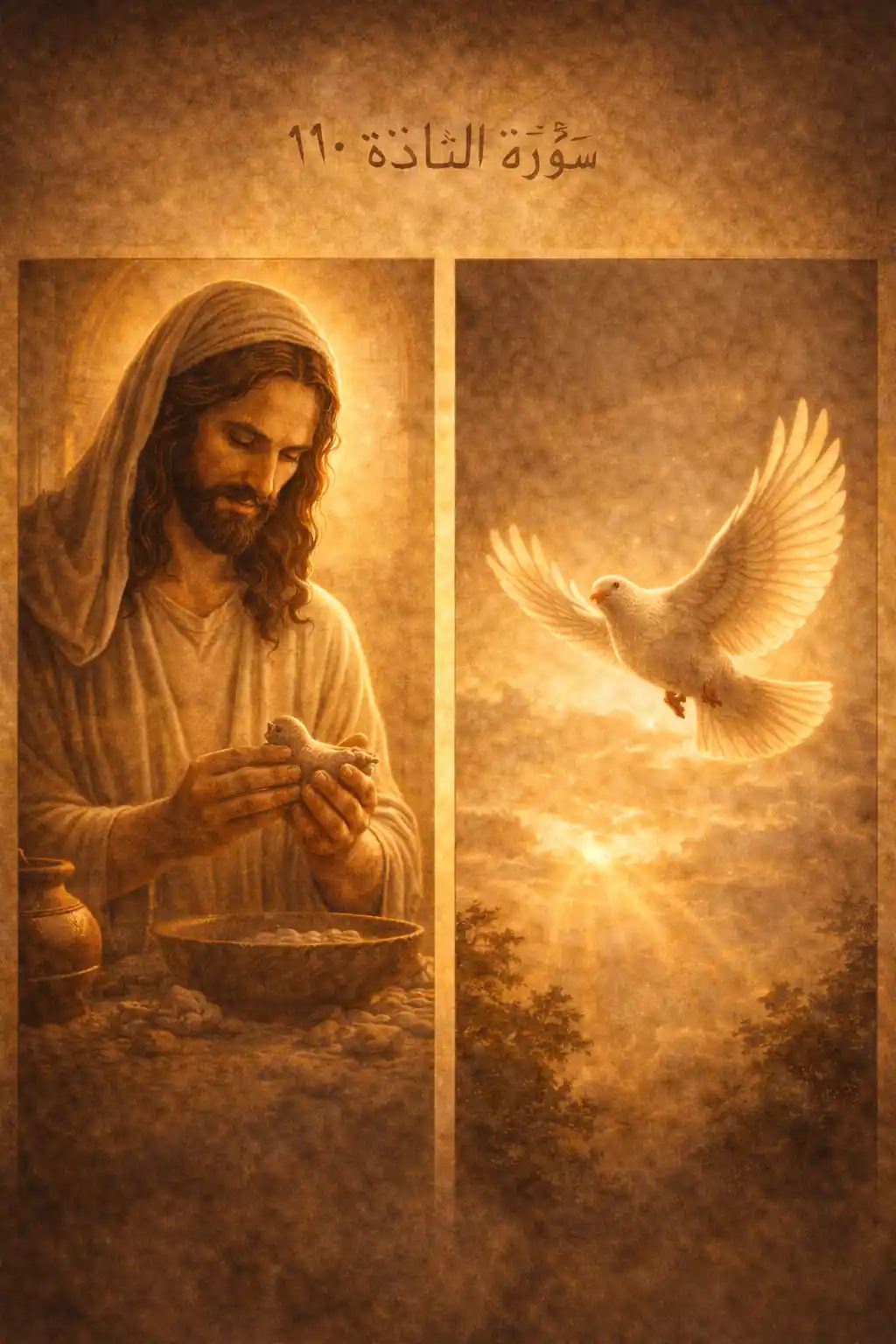
110. When Allah will say, “O Jesus, son of Mary, remember My favour upon you and upon your mother, when I supported you with the Holy Spirit so that you spoke to the people in the cradle and in maturity; and when I taught you the Book and wisdom, and the Torah and the Gospel; and when you shaped from clay something like the form of a bird by My permission, then you blew into it and it became a bird by My permission; and you healed the blind and the leper by My permission; and when you brought forth the dead by My permission; and when I restrained the Children of Israel from you when you came to them with clear proofs, and those who disbelieved among them said, ‘This is nothing but obvious magic.’”
111. And when I inspired the disciples, “Believe in Me and in My messenger,” they said, “We believe, so bear witness that indeed we are Muslims (those who submit).”
112. When the disciples said, “O Jesus, son of Mary, can your Lord send down to us a table spread from the heaven?” He said, “Fear Allah, if you are believers.”
113. They said, “We wish to eat from it, and that our hearts be reassured, and that we know you have told us the truth, and that we may be among its witnesses.”
114. Jesus, son of Mary, said, “O Allah, our Lord, send down to us a table spread from the heaven to be for us a festival for the first of us and the last of us, and a sign from You. And provide for us, for You are the best of providers.”
115. Allah said, “Indeed, I will send it down to you, but whoever disbelieves afterwards among you, I will punish him with a punishment that I will not inflict upon anyone among all the worlds.”
116. And when Allah will say, “O Jesus, son of Mary, did you say to the people, ‘Take me and my mother as two gods besides Allah’?” He will say, “Glory be to You! It is not for me to say what I have no right to. If I had said it, You would surely know it. You know what is within myself, and I do not know what is within Yourself. Indeed, You are the Knower of all the unseen.”
117. “I did not say to them except what You commanded me: ‘Worship Allah, my Lord and your Lord.’ And I was a witness over them so long as I was among them; but when You took me up, You were the Watcher over them, and You are, over all things, a Witness.”
118. “If You punish them, they are indeed Your servants; but if You forgive them, then indeed You are the All-Mighty, the All-Wise.”
119. Allah will say, “This is the Day when the truthful will benefit from their truthfulness. For them are gardens beneath which rivers flow, abiding therein forever. Allah is pleased with them, and they are pleased with Him. That is the great success.”
120. To Allah belongs the dominion of the heavens and the earth and whatever is in them. And He is Powerful over all things.
Explanation (5:109–120)
-
5:109 – Messengers do not control guidance or know the unseen:
On the Day of Resurrection:
- Allah gathers all the messengers and asks: “What response did you receive?”
- They reply with humility: “We have no knowledge. You alone know the unseen.”
- Messengers are not partners with Allah in knowledge of the unseen,
- They cannot guarantee who truly responded in their hearts,
- They did their duty of conveying, and Allah knows the real internal response.
Any belief that a prophet or “saint” is constantly aware of our thoughts, prayers, or hidden affairs contradicts this verse. Only Allah truly knows the unseen. -
5:110–111 – All miracles of Jesus were by Allah’s permission, not divinity:
Allah reminds Jesus of the favours given to him and his mother:
- He was supported with the Holy Spirit (Rūḥ al-Qudus),
- He spoke to people in the cradle and in maturity,
- He was taught the Book, wisdom, the Torah and the Gospel,
- He shaped a bird from clay and it became a living bird by Allah’s permission,
- He healed the blind and the leper by Allah’s permission,
- He brought the dead to life by Allah’s permission,
- Allah protected him from those who wanted to kill him.
- Miracles do not make him God; they show Allah’s power through him,
- Jesus is a honoured servant and messenger, not a partner with Allah.
- Were inspired by Allah to believe in Him and in His messenger,
- Declared, “We are Muslims (those who submit).”
-
5:112–115 – The table spread: asking for miracles is dangerous if hearts are weak:
The disciples ask:
- “Can your Lord send down a table spread from the heaven?”
- Reminds them: “Fear Allah, if you are believers.”
- To eat from it,
- To reassure their hearts,
- To strengthen certainty that Jesus spoke truth,
- To be witnesses over the sign.
- Calls on Allah directly as “our Lord”,
- Asks for a table spread from the heaven as:
- A festival (recurring celebration) for the first and last of them,
- A sign (āyah) from Allah,
- A provision from the Best Provider.
- He will send it down,
- But warns: whoever disbelieves afterwards will receive a unique, terrible punishment.
• Demanding supernatural signs after clear guidance is risky – if people still disbelieve after seeing them, their guilt is much heavier.
• This completely clashes with “easy ticket to Jannah” ideas (e.g., just saying certain words mechanically = guaranteed Paradise) while ignoring obedience. Allah expects real faith and responsibility, not cheap slogans. -
5:116–117 – Jesus denies any claim to divine status:
On the Day of Judgment, Allah will ask Jesus directly:
- “Did you tell people to take you and your mother as two gods besides Allah?”
- “Glory be to You!” (declaring Allah far above such a claim),
- “It is not for me to say what I have no right to,”
- If he had said it, Allah would know – nothing is hidden from Allah,
- Jesus admits he only knows what Allah allowed him to know,
- He repeats that Allah alone knows the unseen fully.
- He only said what Allah commanded: “Worship Allah, my Lord and your Lord.”
- He was only a witness over them while he lived among them,
- After Allah raised him, Allah was the One watching them directly.
- The idea that Jesus authorised his own worship,
- The idea that Mary has any share in divinity,
- Any belief that a messenger remains “in charge” of people after his time.
-
5:118 – Ultimate submission to Allah’s judgment:
Jesus ends by saying:
- If Allah punishes them, they are His servants,
- If He forgives them, He is the All-Mighty, All-Wise.
- Jesus doesn’t argue against Allah’s justice,
- Nor claim that his “intercession” will override Allah’s wisdom,
- He acknowledges that Allah can punish or forgive as He wills with full justice and wisdom.
The exaggerated “guaranteed salvation by attachment to X person” doctrine. Even a great messenger leaves the final decision entirely with Allah. -
5:119 – The day the truthful benefit from their truthfulness:
Allah declares:
- On that Day, truthfulness itself will benefit the truthful,
- They get gardens with rivers, eternal residence,
- Allah is pleased with them, and they are pleased with Him,
- This mutual pleasure is the greatest success.
- Truthful speech,
- Truthful beliefs (pure tawḥīd, no shirk),
- Truthful actions matching their claims.
-
5:120 – Final closure of the sūrah with pure Tawḥīd:
The surah ends by reminding:
- To Allah alone belongs the kingdom of the heavens and the earth and everything in them,
- He is fully capable over all things.
• All power, ownership, and authority belong to Allah alone.
• No prophet, imam, saint, scholar, or “holy family” shares this dominion with Him.
• Therefore, worship, dua, fear, hope, and reliance belong only to Him.