Directly under it is a clear explanation in simple language.
This surah focuses on justice, orphans, inheritance, women, family, hypocrisy
and fighting oppression. Where culture or sect practices clash with these verses,
the Qur'an takes priority.
All authority here is taken from the Qur'an itself (e.g. 6:114, 17:36, 45:6).
Reports outside the Qur'an are not used as independent sources of deen.
Verses 4:1–10
One human origin, sacred family ties, and a huge warning about orphans' wealth
1. O mankind, fear your Lord Who created you from a single soul, and He created from him his mate, and He has spread from them both a multitude of men and women. And fear Allah through Whom you ask your mutual (rights), and the wombs (kinship). Indeed, Allah is All Watcher over you.
Illustration for Qur’an 4:12. And give to the orphans their property, and do not exchange (your) bad things for (their) good ones, nor devour their property into your own property. Indeed, that is a great sin.
3. And if you fear that you will not deal justly with the orphan girls, then marry of the women who please you, two or three or four. But if you fear that you shall not be able to deal justly (with many), then (marry only) one, or those your right hands possess (legitimate maids). That is nearer (more suitable) that you may not incline (to injustice).
Illustration for Qur’an 4:2–34. And give the women (upon marriage) their bridal gifts with a good heart. But if they remit to you anything of it on their own, then enjoy it with pleasure and ease.
5. And do not give to the foolish your property, which Allah has made for you a means of support. And provide for them from it, and clothe them, and speak to them words of kindness.
6. And test the orphans until when they reach (the age) of marriage. So if you find in them sound judgment, then hand over to them their property. And devour it not excessively and in haste, lest they should grow up. And whoever (of the guardians) is rich, he should refrain (from taking wages). And whoever (of the guardians) is poor, let him take what is reasonable (for his work). Then when you hand over to them (the orphans) their property, make (the transaction) witnesses on them. And Allah is All Sufficient in taking account.
Illustration for Qur’an 4:67. For men is a share of what the parents and close relatives leave, and for women is a share of what the parents and close relatives leave, of that, be it small or large, a share ordained (by Allah).
8. And when the relatives and the orphans and the needy are present at the division (of the inheritance), then provide for them from it, and speak to them words of kindness.
9. And let those (executors of inheritance) fear as if they had left behind them weak offspring, and would fear for them. So let them fear Allah, and speak words of kindness and justice.
10. Indeed, those who devour the property of orphans unjustly, they swallow only a fire into their bellies. And they will be burned in a blazing fire.
Explanation (4:1–10)
One origin = equal human value (4:1):
Allah reminds all mankind (not just Muslims) that we come from
a single soul and its mate. All tribes, races and nations are from the
same root. So no group is “born superior”. From this, family ties
(wombs) and mutual rights are sacred, watched by Allah.
Orphans’ wealth is untouchable (4:2):
Orphans are completely vulnerable. Allah orders:
Give them their property.
Do not swap your bad assets for their good ones.
Do not mix their wealth into yours and eat from it.
This is called a great sin. Any “Islamic” culture where
relatives quietly consume orphans’ money is directly fighting this verse.
Verse 4:3 is about justice first, not “collecting wives” (4:3):
The context is orphan girls. If men fear they cannot be fair
towards orphan girls under their care, they should marry other women
(two, three or four) they can be just with.
The verse then warns: if you fear you can’t be just, then marry only one
(or use existing household help in a lawful way). So the condition is
clear: justice. Without justice, polygamy becomes injustice and
contradicts this ayah.
Bridal gift is a right, not a favour (4:4):
The woman’s mahr is given with a good heart, not grudgingly.
Only if she, by her own choice, gives some of it back, may the
husband enjoy that. This kills customs where families or husbands
“take back” mahr by pressure.
Property is a trust, not a toy (4:5):
Wealth is described as something Allah made as a means of support.
It should not be handed entirely to those who are
irresponsible (“foolish”), but guardians must still:
Provide for them from it,
Clothe them,
Speak kindly to them.
So financial guardianship is for protection, not control or insult.
Testing orphans and fair guardians’ wages (4:6):
Orphans are to be:
Tested until they reach marriage age,
If they show good judgment, their property must be returned.
Guardians must not rush to consume the wealth “before the child grows”.
If the guardian is rich, he should take nothing. If he is poor, he may
take a reasonable wage only. Witnesses should be present when
handing the wealth over – full transparency.
Men and women both have ordained shares (4:7–8):
Allah states clearly that both men and women have fixed shares
in inheritance, whether the estate is small or large. This was radical
in societies that cut women out. When other needy relatives are present
at the division, they should be given something and spoken to kindly.
This prevents a cold, greedy, “legal-only” mentality at the time of death.
Think of your own children when handling orphans’ rights (4:9):
Allah tells executors to imagine their own children being left weak and
exposed. How would they want people to act then? With that empathy,
they must speak and act with justice and kindness.
Eating orphans’ property = eating fire (4:10):
Allah translates the hidden crime into its real form:
whoever unjustly consumes orphan wealth is literally filling his stomach
with fire, heading for a blazing fire. No “Islamic” excuse or fatwa can
turn this into something light.
Key reminder:
The opening of An-Nisa sets the tone: one human origin, sacred kinship,
rights of women and orphans, and terrifying warnings about injustice in
wealth. Any culture or sect practice that abuses women, orphans or
inheritance is in direct conflict with these first ten verses, no matter
how “religious” it claims to be.
Verses 4:11–14
Children’s shares, parents’ shares, spouses’ shares, and the clear limits set by Allah
11. Allah commands you concerning (the inheritance for) your children.
For the male, the equivalent of the portion of two females.
But if there are daughters (only), two or more, then for them is two-thirds of the inheritance.
And if there is (only) one, then for her is the half.
And for his parents, to each one of them, a sixth of the inheritance if he had children.
But if he had no children and his parents are his heirs, then for his mother is one third.
But if he had brothers (and/or sisters), then for his mother is one sixth, after (the payment of) the bequest which he (may have) made, or debts.
Your parents and your children, you know not which of them is nearer to you in benefit.
(This is) an injunction from Allah. Indeed, Allah is Ever All Knower, All Wise.
12. And for you is half of that which your wives leave, if they have no child.
But if they have a child, then for you is one fourth of that which they leave, after (the payment of) the bequest which they (may have) made, or debts.
And for them (wives) is one fourth of that which you leave if you have no child.
But if you have a child, then for them is one eighth of that which you leave, after (the payment of) the bequest which you (may have) made, or debts.
And if a man or a woman has left neither ascendants nor descendants, and has a brother or a sister, then for each one of them is one sixth.
But if they are more than that, then they shall be sharers in one third, after (the payment of) the bequest which might have been made, or debts, (as long as the bequest is) causing no loss (to anyone).
(This is) a commandment from Allah. And Allah is Ever All Knowing, Most Forbearing.
13. These are the limits (set by) Allah. And whoever obeys Allah and His messenger, He will admit him to Gardens underneath which rivers flow, abiding forever therein. And that will be the great success.
14. And whoever disobeys Allah and His messenger and transgresses His limits, He will make him enter the Fire, to abide forever therein, and for him will be a humiliating punishment.
Explanation (4:11–14)
These are not “suggestions”, they are commands (4:11):
Allah explicitly says “Allah commands you concerning your children”.
This means the inheritance pattern is a divine law, not a cultural custom to override
with “family agreements” that cancel Qur’anic shares.
Children’s shares (4:11):
Sons and daughters together: each son gets the share of two daughters.
Daughters only, two or more: they share two-thirds of the estate.
Single daughter only: she gets half of the estate.
The male’s double share comes with the Qur’anic duty on men to spend and maintain
(4:34, and in general), not because his life is “worth more” than the woman’s.
Parents’ shares (4:11):
If the deceased has children: each parent gets one sixth.
If the deceased has no children and both parents inherit:
the mother receives one third (the rest goes to the father).
If the deceased has no children but has siblings:
the mother gets one sixth, after debts and any valid bequest.
Allah reminds us that we don’t know which of parents or children is “better” for us:
the point is to obey the command, not follow emotional preference.
Spouses’ shares (4:12):
Husband’s share from wife’s estate:
No children (for her): husband gets half.
She has a child: husband gets one fourth.
Wife’s share from husband’s estate:
No children (for him): wife (or wives collectively) get one fourth.
He has a child: wife (or wives collectively) get one eighth.
All of this is after paying off debts and fulfilling any valid bequest,
as long as the bequest is not used to harm rightful heirs.
Kalalah case (no parents, no children) – siblings (4:12):
If a man or woman dies leaving:
No ascendants (parents) and no descendants (children),
but has a single brother or a single sister (in this verse’s case): each gets one sixth.
If they are more than one, they share one third between them.
Again, this is after debts and any fair bequest are handled.
“Limits of Allah” are serious boundaries (4:13–14):
Allah calls these inheritance rules “His limits”.
Whoever obeys Allah and His messenger in these matters enters
gardens beneath which rivers flow – this is labelled as the great success.
Whoever disobeys and transgresses these limits is threatened with
entry into the Fire, forever, with a humiliating punishment.
So changing these shares out of culture, pressure, or “modern opinion” is not a small mistake;
it is stepping over a boundary that Allah Himself marked.
Key reminder:
These verses lock in the basic inheritance framework: children, parents, spouses and
certain siblings have ordained shares. No sect, scholar, family tradition,
“customary law”, or emotional decision is allowed to cancel or re-write what Allah has
fixed here. You can be generous on top of these shares, but you cannot replace
them with your own system and still claim to follow the Qur’an.
Verses 4:15–25
Early penalties, repentance, no forced inheritance of women, mahr as a firm pledge, and who is lawful to marry
15. And those who commit lewdness (sexual misconduct) of your women, then bring four witnesses against them from amongst you. And if they bear witness, then confine them to the houses, until death takes them or Allah ordains for them (another) way.
16. And the two (men or women) of you who commit it (sexual misconduct), then punish them both. But if they repent and correct themselves, then leave them alone. Surely, Allah is ever accepting repentance, Most Merciful.
17. The repentance accepted by Allah is only for those who do evil in ignorance, then repent soon afterwards, so it is those to whom Allah will turn in forgiveness. And Allah is ever All Knower, All Wise.
18. And repentance is not (accepted) of those who (continue to) do evil deeds, up until when death approaches upon one of them, he says: “Indeed, I repent now,” nor of those who die while they are disbelievers. It is those, We have prepared for them a painful punishment.
19. O you who believe, it is not lawful for you to inherit women by compulsion (against their will). And do not put constraint upon them that you may take away a part of that which you have given them, unless they commit open lewdness (sexual misconduct). And live with them in kindness. For if you dislike them, it may be that you dislike a thing and Allah has placed therein much good.
20. And if you intend to take a wife in place of (another) wife, and you have given to one of them a great amount (heap of gold), do not take (back) anything from it. Would you take it (back) by slander and a manifest sin?
21. And how could you take it (back) while one of you has gone in unto the other, and they have taken from you a firm pledge.
22. And do not marry of those women whom your fathers married, except what has already passed. Indeed, it was lewdness and hateful, and an evil way.
23. Forbidden to you are your mothers, and your daughters, and your sisters, and your father's sisters, and your mother's sisters, and your brother's daughters, and your sister's daughters, and your (foster) mothers who nursed you, and your (foster) sisters through nursing, and mothers of your wives, and your step daughters who are under your guardianship (born) of those women unto whom you have gone in. But if you have not gone in unto them, then it is no sin upon you (to marry their daughters). And (forbidden to you are) the wives of your sons who are from your own loins. And (forbidden to you is) that you take (marry) two sisters together, except what has already passed. Indeed, Allah is Oft Forgiving, Most Merciful.
24. And (already) married women (are forbidden to you), except those (slaves and captives) whom your right hands possess. (This is) a decree of Allah upon you. And lawful to you are all (others) beyond those, (provided) that you seek (them in marriage) with your property (bridal gifts), desiring chastity, not unlawful sexual activities. So with those of whom you enjoyed (in marriage), give them their bridal due as an obligation. And there is no sin on you in what you do by mutual agreement after the obligation (has been done). Indeed, Allah is ever All Knowing, All Wise.
25. And whoever is not able among you to afford to marry believing free women, then (he may marry) from those whom your right hands possess of believing slave girls. And Allah knows best about your faith. You are of one another, so marry them with the permission of their guardians, and give to them their bridal gifts in kindness, (them being) chaste, not committing unlawful sexual activities, nor taking secret lovers. But when they are sheltered (honorably married), then if they commit lewdness (unlawful sexual act), then for them is half of the punishment that which is (prescribed) for free women. This (permission to marry a slave girl) is for him who fears affliction (of committing sin) among you. And it is better for you that you have patience. And Allah is Oft Forgiving, Most Merciful.
Explanation (4:15–25)
Early penalty for sexual misconduct & “another way” (4:15–16):
At an early stage, women found guilty of serious sexual misconduct, proven by
four witnesses, were to be confined to their homes until death
or until Allah provided another way. Verse 24:2 later gives the fixed legal
punishment for zina, which is that “other way”. Here we see:
Strong proof is required (not gossip).
Both parties who commit the act are addressed (4:16).
If they repent and correct themselves, believers must leave them alone,
not keep chasing and humiliating them.
Real repentance vs last-second performance (4:17–18):
Ignorance here means acting without God-consciousness and care, even if the person “knew” the rule.
Accepted repentance: sin is done, realised, then repent soon
– not delay on purpose while continuing the sin.
Repentance at the moment of death (“now I repent”) after a life of stubbornness is not genuine.
Likewise, dying in conscious disbelief while refusing to turn back is not forgiven.
No inheriting women or torturing them to steal their rights (4:19):
Pre-Islam, women were “inherited” like property. This verse:
Outlaws inheriting women against their will.
Forbids harming, pressuring or restricting them just to take back their mahr or other rights
(unless they are clearly committing open sexual misconduct and a proper process is followed).
Commands: “live with them in kindness”.
Even if you dislike something in them, Allah may have placed great good in that relationship.
Forced marriages, “wife inheritance”, and emotional torture to force a woman to give up her rights
are all in direct conflict with this ayah.
Mahr is not refundable just because you changed your mind (4:20–21):
If a man wants to replace one wife with another:
Even if he gave his first wife a heap of gold, he has no right to take it back.
Trying to reclaim it by accusing, slandering or inventing a sin is called a
manifest sin.
Allah reminds him: you have been intimately together, and she took from you a firm pledge
(marriage contract and trust).
So “give back the mahr if you want khula” is not a licence for men to bully women into surrendering
their rights; it must be voluntary and fair.
Permanent mahram women – blood, foster and marital ties (4:22–23):
Allah lists women you can never marry:
Those your fathers married (stepmothers) – that path is called lewd, hateful and evil.
Your mothers, daughters, sisters, paternal and maternal aunts, nieces (brother’s and sister’s daughters).
Foster-mothers who breastfed you and foster-sisters – nursing creates a real kinship bar.
Mothers-in-law.
Step-daughters under your care, from wives you have consummated marriage with.
If there was no consummation, then you may marry those daughters.
Wives of your sons from your own loins.
Two sisters together at the same time (polygamy with two sisters is forbidden).
Past cases (“except what has already passed”) are not reopened, but going forward this list is fixed.
Married women are forbidden except prisoners of war (4:24):
General rule: married women are haram for you.
Exception: “those whom your right hands possess” – captured women whose previous
marital ties are considered broken by war and captivity in that context, not a licence for abuse.
Beyond this list, others are lawful only via marriage:
Seek them with bridal gifts (mahr).
Intention must be chastity, not fornication.
Once you have consummated the marriage, their mahr is due as an obligation.
After the basic obligation is paid, any adjustment by mutual agreement is allowed.
So this verse blocks “temporary play” contracts that pretend to be marriage while aiming purely at lust.
Slave women & the push toward patience and honour (4:25):
For those unable to afford marriage to free believing women:
They may marry believing slave women, with the permission of their guardians.
They must still pay mahr and treat them kindly.
The women must be chaste, neither fornicating nor taking secret lovers.
If, after becoming wives, they commit lewdness, their punishment is half of that of free women.
Allah says this is for those who fear falling into sin – but He also says
“it is better for you that you have patience”, hinting that avoiding
involvement in slavery is the higher choice when possible.
The verse recognises a reality of that time but pushes toward dignity, restriction of abuse,
and a path out of zina – not towards more exploitation.
Key reminder:
This passage crushes many cultural abuses: forcing women into marriage or keeping them as “inheritance”,
stealing mahr back through pressure, marrying relatives Allah clearly forbade, and using slavery or
“temporary contracts” to chase desire. The Qur'an’s pattern is clear: chastity, justice,
kindness, and clear limits. Any practice that opposes that, even if done in the name of
“Islam”, is actually against these ayat.
Verses 4:26–33
Allah wants clarity, repentance and ease – not exploitation, suicide or jealousy over His distribution
26. Allah wants to make clear to you, and to guide you to the ways of those who were before you, and accept your repentance. And Allah is All Knower, All Wise.
27. And Allah wants to accept your repentance, and those who follow vain desires want that you deviate (into) a tremendous deviation.
28. Allah wants to lighten (the burdens) from you, and man was created weak.
29. O you who believe, do not devour your possessions among yourselves wrongfully, except that it be a trade amongst you by mutual consent. And do not kill yourselves (one another). Indeed, Allah is Most Merciful to you.
30. And whoever commits that in aggression and injustice, then We shall cast him into the Fire. And that is ever easy for Allah.
31. If you avoid the major sins, which you are forbidden to do, We shall remove from you your lesser sins, and We shall admit you to a noble entrance.
32. And do not desire for that in which Allah has bestowed more to some of you over others. For men is a share of what they have earned. And for women is a share of what they have earned. And ask Allah of His bounty. Indeed, Allah is ever All Knower of all things.
33. And for everyone, We have appointed heirs of that (property) left by parents and near relatives. And to those with whom you have pledged your oath, give them their due portion. Indeed, Allah is ever a Witness over all things.
Explanation (4:26–33)
Allah wants clarity, guidance and repentance – not confusion (4:26–27):
These verses explain the whole “tone” of the laws in this surah:
Allah wants to make things clear for you.
He wants to guide you to a sound way like those who were rightly guided before.
He wants to accept your repentance.
In contrast, those who follow their desires want believers to deviate far away.
So any system that makes the deen unnecessarily complicated, heavy, or confusing,
while pushing people into blind following and innovations, is not aligned with this intent.
Law is built with human weakness in mind (4:28):
Allah openly states that:
He wants to lighten the burdens from you.
Humans have been created weak.
So a “religious” approach that constantly makes everything harder than what the Qur’an says,
and blocks every ease that Allah allowed, is actually opposing His mercy.
Business must be fair, life is sacred (4:29):
Two strong commands:
Do not consume wealth unjustly: no cheating, stealing, interest-based oppression, scams,
or fake contracts. Only trade by mutual consent is allowed.
Do not kill yourselves (or one another): suicide, murder, and reckless violence are all forbidden.
Allah describes Himself as Most Merciful in this verse, showing that the prohibitions
are for protection, not cruelty.
Aggressive injustice leads to the Fire (4:30):
Whoever goes ahead in aggression and wrongdoing despite these clear warnings is threatened
with the Fire, and Allah says this is easy for Him. So you cannot hide behind “culture”, “sheikh said”
or “everyone does it” when devouring people’s money or harming lives.
Avoid major sins → lesser sins are wiped, honourable entrance (4:31):
Allah gives a huge encouragement:
If you avoid what He classifies as major sins,
He will forgive and erase your minor sins,
And admit you to a noble entrance (honourable place in the Hereafter).
This shows that perfect sinlessness is not the expectation; the main focus is staying away from big, clear crimes
like shirk, murder, riba-oppression, zina, consuming orphan wealth, etc.
No jealousy over Allah’s distribution – focus on your own earning (4:32):
People are told not to:
Desire what Allah has favoured some with over others (wealth, status, strength, abilities).
Instead:
Men have a share of what they earn.
Women have a share of what they earn.
Everyone should ask Allah from His bounty, not stare at others’ blessings.
So both men and women are recognised as independent moral agents with their own earnings and rewards.
Any system that treats women as if their work and effort have no direct share is clashing with this ayah.
Heirs and contractual rights must be respected (4:33):
Allah says:
He has appointed heirs for everyone with respect to the property left by parents and near relatives
– inheritance is not chaos or guesswork; it is structured.
Those with whom you have made binding oaths/agreements must also be given their due share.
This covers formal contracts and covenants outside of blood relations. Allah ends by reminding us that
He is a Witness over everything – even if people try to hide their cheating in inheritance or contracts.
Key reminder:
These verses show that Allah’s law is built on clarity, mercy and realism:
humans are weak, so He lightens burdens; He protects wealth and life; He rewards
those who stay away from major sins; and He rejects envy over how He distributes
blessings. Our job is to obey these clear limits, respect contracts and heirs,
and keep turning back to Him for bounty – not to twist the system for our desires.
Verses 4:34–42
Men’s responsibility, handling conflict, kindness to all, miserliness, and the Day witnesses speak
34. The men are in charge of the women, by what Allah has bestowed to one of them over other, and because they spend of their property (to support women). So the righteous women are devoutly obedient, guarding in (husband's) absence that which Allah has (ordered to be) guarded. And those (women) from whom you fear rebellion, admonish them, and forsake them in beds, and strike them. Then if they obey you, then seek not against them means (of annoyance). Indeed, Allah is ever Most High, Most Great.
35. And if you fear a dissension between them twain (man and wife), then appoint an arbitrator from his family and an arbitrator from her family. If they (arbitrators) desire reconciliation, Allah will make (reconciliation) between them (man and wife). Indeed Allah is ever All Knower, Well Acquainted.
36. And worship Allah and ascribe not anything as partner to Him. And to parents do good, and to near relatives, and the orphans, and the needy, and the neighbor who is near of kin, and the neighbor who is a stranger, and the fellow traveler, and the wayfarer, and (the slaves) whom your right hands possess. Indeed, Allah loves not such as are proud, boastful.
Illustration for Qur’an 4:3637. Those who are miserly, and enjoin miserliness on people, and hide that which Allah has bestowed upon them of His bounty. And We have prepared for the disbelievers a humiliating punishment.
38. And those who spend their wealth to be seen by the people, and believe not in Allah, nor in the Last Day. And he to whom Satan is a companion, then evil (is he) as a companion.
39. And what have they (to lose) if they believed in Allah, and the Last Day, and spent of that which Allah has provided for them. And Allah is ever All Aware of them.
40. Indeed, Allah wrongs not even of the weight of an atom. And if there is a good deed, He will double it, and will give from His presence a great reward.
41. So how (will it be) when We bring from every nation a witness, and We bring you (O Muhammad) against these people as a witness.
42. That day, those who disbelieved and disobeyed the messenger will wish that the earth were leveled with them. And they will not (be able to) hide from Allah a single fact.
Explanation (4:34–42)
“Men are in charge” = responsibility and spending, not superiority (4:34):
The verse gives two reasons for men being qawwamūn (maintainers) over women:
Allah has given some advantages to some over others (physical strength, certain roles, etc.),
and because they spend from their wealth to support women.
So this is about duty and financial responsibility, not automatic honour,
value, or permission to act as a tyrant. Other verses demand mutual love and mercy (e.g. 30:21),
and justice for all.
Righteous wives and the three-step conflict plan (4:34):
Righteous women are described as:
Devoutly obedient (to Allah and to the marriage bond),
Guarding their chastity and their husband’s trust in his absence as Allah commanded.
When there is fear of clear rebellion (not small attitude issues), the steps are:
Admonish them – talk, advise, remind.
Forsake them in beds – a peaceful separation in the marital bed, a serious signal.
“Strike” them – this word is heavily restricted by the context of the Qur’an:
It comes after advice and separation, not as the first reaction.
It cannot contradict other verses about kindness, justice and not harming.
Many scholars understood it as a symbolic, non-injuring final warning – not
beating, not injury, not humiliation.
Once harmony returns (“if they obey you”), the husband is forbidden to look for new
ways to hurt or control them. Allah finishes the verse reminding that He is the Most High,
not the husband – so any abuse is rebellion against Allah.
Family arbitration before things break (4:35):
If there is serious fear of a permanent split:
One arbitrator comes from his family,
One arbitrator comes from her family.
If both genuinely want reconciliation, Allah says He will create a way for it.
This blocks secret, one-sided handling of problems and brings in people who know the couple.
Worship Allah alone and do good to everyone around you (4:36):
After family issues, Allah expands the circle. He commands:
No shirk – worship Allah alone.
Be good to: parents, close relatives, orphans, the needy, a close neighbour,
a stranger neighbour, the fellow traveler, the stranded traveler, and those under your authority.
This is a complete social program: the believer’s goodness must reach family, community,
travellers and even slaves/servants. Allah does not love the proud and boastful – so “religious arrogance”
is rejected.
Miserliness + making others stingy + hiding Allah’s gifts (4:37):
Condemned are those who:
Are themselves stingy,
Encourage others to be stingy,
Hide the blessings Allah gave them, instead of using or sharing them properly.
Such behaviour fits disbelief in the bigger picture and leads towards a humiliating punishment.
Charity to show off = empty in the sight of Allah (4:38–39):
Those who spend only to be seen by people, while not truly believing in Allah or the Last Day,
are doing a performance, not worship. Their real companion is Satan, and that is an evil companion.
Allah asks: what loss would they suffer if they simply believed and spent sincerely?
Allah is absolutely fair and multiplies good (4:40):
Two key principles:
Allah does not wrong anyone even the weight of an atom.
If there is a good deed, He doubles it and gives from Himself a great reward.
So on the Day of Judgment nothing good is lost, and nothing evil is exaggerated beyond what was truly done.
This should kill despair (“my good is wasted”) and hypocrisy (“I can cheat and escape”).
Witnesses from every nation & the Prophet as a witness (4:41–42):
On the Day:
A witness will stand from every nation,
And Muhammad will be a witness over his people.
Those who disbelieved and disobeyed will wish they could become dust and vanish – that the earth
would be leveled over them. They will not be able to hide a single fact from Allah.
All the hypocrisy, hidden oppression, and private sins will be exposed with perfect justice.
Key reminder:
These verses are often abused or taken out of balance. Allah is not giving men a free licence;
He is giving them responsibility and then surrounding that with arbitration, worship of Him alone,
kindness to all, a ban on miserliness and showing off, and a vivid reminder of the Day when no injustice,
especially in the home, will be hidden. Any “Islam” that turns this into a justification for oppression
is in direct conflict with these ayat.
Verses 4:43–59
Prayer & purification, distortions of earlier communities, trusts, justice and obeying Allah & His messenger
43. O you who believe, do not approach prayer while you are intoxicated, until you know what you are saying, nor when you are unclean (sexual discharge) except, when traveling on the road, until you have washed (your whole body). And if you are ill, or on a journey, or one of you comes from the call of nature, or you have been in contact with women (by sexual relations), and you do not find water, then seek clean earth and rub your faces and your hands (with it). Indeed, Allah is Oft Pardoning, Oft Forgiving.
44. Have you not seen, those who were given a portion of the book, purchasing error, and they wish that you should go astray from the (right) path.
45. And Allah knows best of your enemies. And Allah is Sufficient as a Guardian, and Allah is Sufficient as a Helper.
46. Among the Jews are those who change words from their context and they say: “We hear (you O Muhammad), and we disobey. And hear you (O Muhammad) as one who hears not.” And (they say) Raina (consider us but by) distorting with their tongues (sounding insult), and slandering religion. And if they had said: “We hear (you O Muhammad) and we obey. And hear you (O Muhammad), and look at us,” it would have been better for them, and more upright. But Allah has cursed them for their disbelief, so they believe not, except a few.
47. O you who have been given the Scripture, believe in what We have sent down (to Muhammad) confirming what is (already) with you, before We obliterate faces, then turn them on their backs, or curse them as We cursed people of (those who violated) the Sabbath. And the commandment of Allah must be carried out.
48. Indeed, Allah does not forgive that partners should be ascribed to Him. And He forgives what is other than that, for whom He wills. And whoever ascribes partners to Allah, he has indeed invented a tremendous sin.
49. Have you not seen those who claim themselves to be pure. Nay, but Allah purifies whom He wills, and they will not be wronged (even as much as) the husk on a date-stone.
50. See, how they invent a lie against Allah. And enough is that as a manifest sin.
51. Have you not seen those who were given a portion of the Scripture, they believe in superstitions and false deities. And they say about those (idolaters) who disbelieve that they are better guided in the (right) way than those who believe.
52. Those are the ones whom Allah has cursed. And he whom Allah curses, you will then not find for him any helper.
53. Or do they have a share in the dominion (of Allah). Then (had that been so), they would not give mankind even the speck on a date-stone.
54. Or do they envy mankind for what Allah has given them of His bounty. Then indeed, We bestowed upon the family of Abraham the Book and wisdom, and We bestowed upon them a great kingdom.
55. Then among them were some who believed in it, and among them were some who turned away from it. And sufficient is Hell for (their) burning.
56. Indeed, those who disbelieve in Our revelations, We shall drive them into the Fire. As often as their skins are burnt out, We shall change them with other skins, that they may taste the punishment. Indeed, Allah is ever All Mighty, All Wise.
57. And those who believe and do righteous deeds, We shall admit them to Gardens underneath which rivers flow, abiding therein forever. For them therein are pure companions, and We shall admit them into plenteous shade.
58. Indeed, Allah commands you that you render back the trusts to their owners, and when you judge between mankind, that you judge with justice. Indeed, excellent is that which Allah admonishes you. Truly, Allah is ever All Hearer, All Seer.
Illustration for Qur’an 4:5859. O you who believe, obey Allah, and obey the messenger (Muhammad), and those who are in authority among you. Then if you have a dispute concerning any matter, refer it to Allah and the messenger if you are (in truth) believers in Allah and the Last Day. That is better and more commendable in the end.
Explanation (4:43–59)
Prayer requires a clear mind and basic purity – with mercy and ease (4:43):
Believers are forbidden to come near prayer:
While intoxicated – until they know what they are saying.
While in major impurity (after sexual discharge), until they wash the whole body.
If there is no water (or illness, travel, etc.), Allah opens the door of tayammum:
wiping face and hands with clean earth. This fits the pattern: Allah wants prayer, remembrance,
and ease, not making you stuck when water is unavailable.
Some People of the Book buy misguidance and want others to stray (4:44–45):
A group from previous communities:
Had only a portion of the Book – they do not hold onto all of it.
“Purchase error” – they actively choose misguidance for worldly gain.
They want believers to go off the straight path as well.
Allah tells us He knows best who our real enemies are, and He is enough as Protector and Helper –
so we don’t need to follow their religious inventions to be “accepted”.
Changing words and playing with language to insult the deen (4:46–47):
Some people:
Twist the words of revelation from their proper places.
Use phrases like “we hear and disobey” or distort words (like “Raina”) to hide insults.
Allah shows what would have been better: “We hear and we obey”, plus respectful speech.
This is a warning not to play games with Qur’anic wording, or to hide disbelief behind “pious” language.
Those given the Scripture are called to believe in the Qur'an which confirms what they already have, before
a severe punishment (obliterated faces / curse) reaches them.
The biggest unforgivable sin if not repented: shirk (4:48):
Allah states a clear rule:
He does not forgive associating partners with Him if a person dies on that state.
He does forgive other sins for whom He wills.
So any practice that turns prophets, imams, saints, “sheikhs”, or “holy men” into
intercessors/partners that are relied upon like Allah is extremely dangerous.
The Qur’an-alone approach is exactly to avoid this trap: all worship, trust and final authority are for Allah.
Self-claimed purity vs real purity from Allah (4:49–50):
Some people claim “we are pure / special / chosen”. Allah says:
Purity belongs to those whom He purifies – through sincere faith and obedience.
Inventing lies about Allah (e.g. “we are guaranteed paradise because of our label”) is itself a clear sin.
The Qur'an constantly attacks this attitude – whether it is “we are saved just because we are Jews/Christians”
or “we are saved because we follow a certain sect or scholar”.
Believing in superstitions and false deities (4:51–52):
Some of the People of the Book:
Believe in superstition and false objects of worship (like charms, saints, spirits).
Even claim that idolaters are better guided than true believers.
Such people are under Allah’s curse; whoever Allah curses has no helper. This warns Muslims:
if we imitate those behaviours (saint worship, shrine culture, superstitions),
we fall into the same trap, even if we call it “Islamic”.
Envy of the favour given to the family of Abraham (4:53–55):
People with a sick heart may envy:
The prophethood, scripture and wisdom given to the family of Ibrāhīm,
The great kingdom given to some of them.
But when guidance comes, some believe and some turn away – and Hell is enough for those
who reject out of jealousy and stubbornness, not because of lack of evidence.
Detailed description: Fire vs Garden (4:56–57):
For those who disbelieve the ayat:
They are driven into the Fire.
When their skins are burned, Allah replaces them with new skins so they can feel the punishment again.
For those who believe and do righteous deeds:
They are admitted to gardens beneath which rivers flow, forever.
They have pure companions and generous shade.
This makes it clear: the Qur'an is not “all stories”; it draws a sharp line between outcomes.
Trusts and judging with justice (4:58):
Two massive commands:
Return trusts to their owners: anything placed with you (money, secrets, positions) must be given back correctly.
Judge with justice between people: no favouritism for family, tribe, sect, or “our sheikh”.
Allah calls this instruction excellent, and reminds you that He hears and sees everything –
including courtrooms, family decisions, community politics, and hidden deals.
Who to obey – and what “refer to Allah and the messenger” means (4:59):
The verse sets a hierarchy:
Obey Allah – i.e. His direct speech in the Qur'an.
Obey the messenger – the messenger’s job is to convey and implement that same Qur’an.
Those in authority among you – leaders, judges, etc., but their obedience is secondary and conditional.
When a dispute arises:
It must be referred back to Allah and the messenger.
In reality, that means: back to the Qur'an, the revelation the messenger brought and used as criterion.
For a Qur'an-only approach:
Important point: The messenger does not live on earth today; what remains
accessible to all is the Book he delivered. So “referring back to Allah and the messenger”
now means returning to the Qur'an itself, not elevating later hadith books, sect councils, or
“imams’ opinions” to the same level as Allah’s speech. Any claim that obedience to leaders or
scholars can override a clear Qur'anic verse is the exact opposite of this ayah.
Verses 4:60–70
Hypocrites running to false authorities, judging only by revelation & the reward of true obedience
60. Have you not seen those (hypocrites) who claim that they believe in that which has been sent down to you, and that which was sent down before you. They wish to go for judgment (in their disputes) to satanic authorities, while they have been ordered to reject them. And Satan wishes to lead them astray, a far away misleading.
61. And when it is said to them: “Come to what Allah has sent down and to the messenger (Muhammad),” you see the hypocrites turning away from you in aversion.
62. So how (would it be) when a catastrophe befalls them because of what their own hands have sent forth. Then they would come to you, swearing by Allah: “We intended nothing except goodwill and conciliation.”
63. Those are the ones whom Allah knows what is in their hearts. So turn aside from them, and admonish them, and speak to them a word to reach their very souls.
64. And We did not send any messenger except that he should be obeyed by Allah's permission. And if, when they had wronged themselves, they had come to you and asked forgiveness of Allah, and the messenger had asked forgiveness for them, they would have found Allah All Forgiving, Most Merciful.
65. But nay, by your Lord, they will not (truly) believe until they make you (O Muhammad) judge of what is in dispute among themselves, then find within themselves no discomfort from what you have judged, and submit with full submission.
66. And if We had decreed upon them: “Kill yourselves or leave your homes,” they would not have done it, except a few of them. And if they had done what they were instructed, it would have been better for them, and a firmer strengthening (in their faith).
67. And then We would have bestowed upon them from Us a great reward.
68. And We would have guided them to a straight path.
69. And whoever obeys Allah and the messenger, then they will be with those upon whom Allah has bestowed favor, of the prophets, and those steadfast in truthfulness, and the martyrs, and the righteous. And how excellent are these as companions.
70. Such is the bounty from Allah, and Sufficient is Allah as All Knower.
Explanation (4:60–70)
Claiming “we believe” but running to tāghūt courts (4:60–61):
These verses expose a type of hypocrite:
They claim to believe in the revelation given to Muhammad and earlier books.
But when they have disputes, they want judgment from satanic authorities (tāghūt) –
man-made systems and corrupt judges who oppose Allah’s law.
They were commanded to reject such false authorities, not run to them.
When invited to “come to what Allah has sent down and to the messenger”, they turn away.
In our time, the same attitude appears when people say “we are Muslims” but choose customs,
sect rules or human opinions over clear Qur’anic commandments whenever it suits them.
Excuses after disaster – but Allah knows the heart (4:62–63):
When their own choices bring calamity:
They rush back with oaths, saying: “We only wanted peace / reconciliation.”
Allah says He already knows what lies in their hearts – no excuse can fool Him.
The messenger is told:
Turn away from their fake games,
Still admonish them,
Speak words that go deep, reaching their very souls.
This is a model for da‘wah: do not chase hypocrites, but give reminders that cut through their lies.
Every messenger is sent to be obeyed – by Allah’s permission (4:64):
Allah states a universal rule:
No messenger is sent except to be obeyed by Allah’s permission.
For Muhammad (peace be upon him) that means:
Obey the message he brought – the Qur’an.
If people wrong themselves, they must turn back to Allah, admit their mistake, seek forgiveness,
and be willing to follow the revealed guidance properly.
The verse shows Allah’s mercy: if they had truly come, repented and sought forgiveness, they would have
found Him All-Forgiving, Most Merciful. Today, the way to “come to the messenger” is to come back to
the Book he delivered and submit to it honestly.
Real faith = taking the messenger as judge with full inner surrender (4:65):
Allah swears by Himself that:
They do not truly believe until they make the messenger the judge in their disputes,
Then they feel no discomfort in their hearts about his judgment,
And they submit with complete submission.
For us now, this means:
Key point: when the Qur’an gives a clear ruling, a believer cannot reject it and still
claim full faith. Our feelings, culture, sect, and favourite scholars must bow to the clear verse,
not the other way around.
If Allah had commanded something extremely hard, most would fail (4:66):
Allah says that if He had ordered them to kill themselves or leave their homes, only a few
would obey. This shows:
People struggle even with lighter commands, let alone impossible ones.
When they do obey what they are told, it:
Is better for them,
Strengthens their faith and character.
So obedience to revelation is not a loss; it is training that builds the believer.
Obedience brings reward and guidance (4:67–68):
If they had done what Allah instructed:
He would have given them a great reward from Himself,
And He would have guided them to a straight path.
Guidance is not random; it is tied to sincere obedience. The more we act on what we know,
the more Allah opens further clarity.
Whoever obeys Allah and the messenger joins the best company (4:69–70):
Those who truly obey:
Will be with the prophets,
The steadfast truthful,
The martyrs,
And the righteous.
Allah calls these companions excellent. This honour is described as:
“The bounty from Allah”,
And Allah is fully aware of who deserves it.
There is no promise here that a label (Sunni, Shia, Sufi, etc.) saves you by itself. The condition is:
obey Allah and the messenger – practically, obey the Qur’an in belief and action.
Key reminder:
This passage separates fake faith from real faith. Hypocrites say “we believe” but choose other authorities
when the Qur’an clashes with their desires. True believers refer disputes back to Allah and the messenger,
accept the Qur’anic judgment without resistance, and build their life on it. That is the path that leads to
the company of the prophets and the righteous – not blind following of sects, sheikhs or invented rules.
Verses 4:71–87
Preparedness, hypocritical attitudes, death’s certainty, reflecting on the Qur'an & responding to greetings
71. O you who believe, take your precautions, then go forth (on an expedition) in parties, or go forth all together.
72. And indeed, there is among you he who lingers behind, then if a disaster befalls you, he says: “Indeed, Allah has been gracious to me in that I was not present with them.”
73. And if a bounty comes to you from Allah, he would surely say, as if there had never been between you and him any affection: “Oh, I wish that I had been with them, then would I have achieved a great success.”
74. So let those fight in the cause of Allah who sell the life of this world for the Hereafter. And whoever fights in the cause of Allah, and is killed or gets victory, We shall bestow upon him a great reward.
75. And what is (the matter) with you that you fight not in the cause of Allah, and those weak among men, and the women, and the children who say: “Our Lord, take us out from this town the people of which are oppressors. And appoint for us from Yourself a protecting friend, And appoint for us from Yourself a helper.”
76. Those who believe, fight in the cause of Allah, and those who disbelieve, fight in the cause of evil ones. So fight against the friends of the devil. Indeed, the plot of Satan is ever weak.
77. Have you not seen those to whom it was said: “Withhold your hands, and establish prayer, and pay the poor due,” Then when fighting was ordained for them, behold, a party of them feared men as they feared Allah, or even greater fear. And they say: “Our Lord, why have You ordained upon us fighting. If only You had given us respite for a short period.” Say (O Muhammad): “The enjoyment of this world is little. And the Hereafter will be better for him who fears (Allah). And you will not be wronged (even as much as) the husk on a date-stone.”
78. Wherever you may be, death will overtake you, even if you are in lofty towers. And if some good reaches them, they say: “This is from Allah.” And if an evil befalls them, they say: “This is because of you (Muhammad).” Say: “All (things) are from Allah.” So what is (the matter) with these people that they do not seem to understand a word.
79. Whatever of good reaches you is from Allah, and whatever of evil befalls you, it is from yourself. And We have sent you (Muhammad) as a messenger to mankind. And Sufficient is Allah as a Witness.
80. He who obeys the messenger, has indeed obeyed Allah. And he who turns away, then We have not sent you (Muhammad) over them as a guard.
81. And they say: “(We pledge) obedience,” then when they have gone forth from you, a party of them spends the night in planning other than what you say. And Allah records what they plan by night. So turn aside from them, and put your trust in Allah. And Sufficient is Allah as a Trustee.
82. Do they not then reflect upon the Quran. And if it had been from other than Allah, they would have found therein much contradictions.
83. And when there comes to them some matter (news) of safety or fear, they spread it. And if they had referred it to the messenger, and to those of authority among them. So those who are competent to investigate it would have come to know about it (directly) from them. And if it was not for the grace of Allah upon you, and His mercy, you would have followed Satan, except a few.
84. So fight (O Muhammad) in the cause of Allah. You are not held responsible except for yourself, and encourage the believers. It may be that Allah will restrain the might of those who disbelieve. And Allah is stronger in might and stronger in inflicting punishment.
85. Whoever intercedes for a good cause, for him is the share there from. And whoever intercedes for an evil cause, for him is the burden there from. And Allah has power over all things.
86. And when you are greeted with a greeting, greet you with a better than it or return it. Indeed, Allah is Account Taker of all things.
87. Allah, there is no god except Him. He will surely gather you all on the Day of Resurrection, about which there is no doubt. And who is more truthful than Allah in statement.
Explanation (4:71–87)
Be prepared, not careless or half-hearted (4:71):
Believers are told to take precautions and then go out:
Either in groups (parties),
Or all together, depending on strategy.
This applies to any struggle: you don’t run emotionally; you prepare, plan and move in a disciplined way.
The selfish “lingerers” (4:72–73):
Among the believers are those who:
Hold back when effort is needed.
If disaster hits the fighters, they say: “Alhamdulillah, I wasn’t with them.”
But if victory and bounty come, they suddenly wish: “I wish I was there to get the reward.”
This exposes a mentality that only wants benefit without risk. The Qur'an is calling that out.
Who should fight? Those who prefer the Hereafter (4:74–76):
Allah defines the right mindset:
Those who are willing to sell this worldly life for the Hereafter.
Whoever fights in Allah’s cause and is killed or victorious gets a great reward.
Fighting is not for ego or nationalism. Verse 75 adds a powerful reason:
There are oppressed men, women and children crying out: “Our Lord, take us out from this town whose people are oppressors. Give us a protector and helper from Yourself.”
So fighting here is tied to:
removing oppression, defending the weak, and standing up for justice.
Verse 76 then draws a very clear line:
Believers fight in Allah’s cause.
Disbelievers fight for evil forces.
Any religious group claiming “jihad” but serving tyranny, sectarian hatred, or personal power is not on Allah’s side, no matter their slogans.
Fear of people vs fear of Allah (4:77):
Some were first told: “Hold back, establish prayer, pay zakah.” Later when fighting became required:
A group feared people as much or more than they feared Allah.
They complained: “Why did You prescribe fighting for us? Could You not delay it?”
Allah answers through the Prophet:
This worldly enjoyment is little.
The Hereafter is better for those who fear Allah.
No one will be wronged the weight of the skin on a date-stone.
So constantly looking for a way to escape every sacrifice shows a weak understanding of reality.
Death is guaranteed; blame games are pointless (4:78–79):
Key points:
Death will reach you wherever you are, even in towers and gated estates.
When some people get good, they say, “This is from Allah.”
When they suffer, they blame the Prophet: “This is because of you.”
Allah answers:
Everything is ultimately from Allah’s permission and creation.
But practically: the good that comes to you is from Allah’s mercy.
The evil that hits you is because of your own choices, sins and negligence.
Allah sent the messenger as a warner, not as the cause of people’s misfortune.
Obeying the messenger = obeying Allah (4:80–81):
Allah says:
Whoever obeys the messenger has truly obeyed Allah, because the messenger delivers Allah’s commands, not his own religion.
If people turn away, the messenger is not a guardian over their hearts – he only conveys.
Hypocrites say “we obey” in front of him, then secretly plan against what he said. Allah records their secret plotting. The Prophet is told:
Turn away from their hypocrisy,
Put your trust in Allah alone – He is sufficient as Trustee.
Today, obeying the messenger means obeying the Qur'an he brought, not whatever is attributed to him without proof in later books.
Qur'an’s internal consistency as proof of divine origin (4:82):
Allah challenges:
Why don’t they reflect deeply on the Qur'an?
If it were from anyone besides Allah, they would find many contradictions in it.
For a Qur'an-only approach, this ayah is central: the Book uses its own consistency as evidence of being from Allah, not chains of narrators or sect labels.
How to handle sensitive news (4:83):
When a piece of news about security or fear reaches them:
Some people immediately spread it everywhere (gossip, panic, rumours).
Allah says they should:
Refer it to the messenger and those in authority who can investigate and verify,
Then those qualified to understand would clarify the reality.
This is a Qur'anic principle against rumour culture and viral panic. Today, “referring it to the messenger” means checking against Qur'anic values (justice, truth, no oppression) and letting competent, responsible people verify facts.
Everyone is responsible for themselves (4:84–85):
The Prophet is told to fight in Allah’s cause and:
He is only responsible for himself,
He should encourage the believers.
Allah may restrain the power of the disbelievers. Then:
Whoever intercedes for a good cause gets a share of its reward.
Whoever intercedes for an evil cause carries part of its burden.
So pushing or defending a good project (justice, charity, Qur'an-based reform) brings reward; pushing evil (bid‘ah, injustice, sectarian hatred) brings sin even if you didn’t commit the act yourself.
Greeting etiquette – simple but serious (4:86):
When greeted:
Respond with a better greeting,
Or at least with an equal one.
This seems small but Allah ends by saying He is Account-Taker over everything. So even our basic manners are part of the deen.
Foundation sealed again: pure Tawhid and the Day of Gathering (4:87):
Allah declares:
There is no god except Him.
He will gather all of us on the Day of Resurrection – no doubt about it.
No one is more truthful in speech than Allah.
Any idea that “my shaykh/imam/saint will definitely save me no matter how I live” collapses here.
Only Allah decides on that Day, based on His truth – which He has already revealed in the Qur'an.
Key reminder:
This passage exposes lazy, cowardly and double-faced attitudes, while calling believers to courage,
justice, reflection on the Qur'an, and disciplined handling of information. It keeps bringing us
back to the same core: pure Tawhid, obedience to the revelation, and personal responsibility.
Any system that replaces this with blind loyalty to sects, rumours, or personalities is following
the path of those whom Allah describes here as hypocrites and followers of Satan’s weak plot.
Verses 4:88–100
How to treat hypocrites, conditions for fighting, killing believers by mistake & the duty and reward of migration
88. Then what is (the matter) with you (that you are divided into) two parties regarding the hypocrites. And Allah has reverted them (to disbelief) because of what they earned. Do you want to guide him whom Allah has sent astray. And he whom Allah sends astray, you will then never find for him any way (of guidance).
89. They wish that you should disbelieve, same as they have disbelieved, then you become equal (with them). So do not take from among them friends until they emigrate in the way of Allah. So if they turn back (to enmity), then seize them and kill them wherever you find them. And do not take from among them friends nor helpers.
90. Except those who seek refuge with a people, between you and whom there is a treaty (of peace). Or (those who) come to you, their hearts restraining from fighting you or fighting their own people. And if Allah had willed, He could have given them power over you, so that they would have fought you. So, if they withdraw from you, and they do not fight against you, and they offer you peace. Then Allah has not made for you a cause (that you fight) against them.
91. You will find others, who desire that they should have security from you, and security from their own people. Whenever they have opportunity to (cause) mischief, they fall back into it. So, if they do not withdraw from you, nor offer to you peace, nor restrain their hands, then seize them, and kill them wherever you overtake them. And those, We have given to you against them a clear warrant.
92. And it is not for a believer to kill a believer except by mistake. And whoever kills a believer by mistake, then the freeing of a believing slave, and payment of the blood money to his family (is required), unless they give (it up as) a charity. But if he (the slain) was from a people hostile unto you, and he was a believer, then (only) the freeing of a believing slave (is required). And if he (the slain) was from a people between you and them there is a treaty, then a compensation must be paid to his family, and the freeing of a believing slave (is required). Then whoever does not find (the means), then fasting for two consecutive months (is required). (Seeking) repentance from Allah. And Allah is All Knower, All Wise.
93. And whoever kills a believer intentionally, then his recompense is Hell to abide therein forever. And Allah’s wrath is upon him, and He has cursed him, and has prepared for him a great punishment.
94. O you who believe, when you go forth (to fight) in the cause of Allah, investigate carefully, and do not say to him who greets you peace: “You are not a believer.” Seeking the profits of the life of this world. For with Allah are plenteous spoils. Even thus (as he now is) were you before, then Allah conferred His favors on you, so investigate carefully. Indeed, Allah is ever Informed of what you do.
95. Not equal are those of the believers who sit (at home), except those who are disabled, and those who strive in the cause of Allah with their wealth and their lives. Allah has preferred those who strive with their wealth and their lives above those who sit, in ranks. And to each Allah has promised good. And Allah has bestowed on those who strive above those who sit a great reward.
96. Degrees of rank from Him, and forgiveness, and mercy. And Allah is ever Forgiving, Most Merciful.
97. Indeed, those whom the angels take (in death) while wronging themselves, they (the angels) will say: “In what (condition) were you.” They will say: “We were oppressed in the land.” They (the angels) will say: “Was not Allah's earth spacious that you could have migrated therein.” So for those, their habitation will be Hell, and an evil destination.
98. Except the weak among men, and the women, and the children, who are unable to devise a plan, nor are directed to a way.
99. As for such, it may be that Allah will forgive them. And Allah is ever Clement, Oft Forgiving.
100. And whoever emigrates in the cause of Allah, will find on the earth many dwellings and abundance, and whoever leaves his home, as an emigrant unto Allah and His messenger, then death overtakes him, his reward is then surely incumbent upon Allah. And Allah is ever Forgiving, Most Merciful.
Explanation (4:88–100)
Do not split into two camps over hypocrites (4:88–89):
The believers were becoming divided about a group of hypocrites:
Some wanted to treat them as true brothers.
Others recognised that they had returned to disbelief by their own actions.
Allah says He has turned them back due to what they themselves earned.
You cannot guide someone whom Allah has left astray after their repeated rejection.
These hypocrites want you to disbelieve so that you become equal with them.
Until they show real commitment (emigrating and standing with the believers),
Muslims are warned not to take them as close allies.
Context of fighting verses – NOT random violence (4:89–91):
These ayaat talk about wartime policy, with three clear categories:
Persistent enemies who turn back to fight the believers – if they return to open hostility,
they are treated as an enemy force in that conflict, not as innocent civilians.
Those under a peace treaty or who sincerely restrain themselves from fighting either side
and offer peace – there is no permission to fight them (“Allah has not made for you a cause against them”).
Those who play both sides, seeking safety from both but causing mischief whenever they can.
If they refuse peace and continue aggression, then they are treated as enemies in that war.
None of this allows random vigilantism; it is about an organised community in an actual state of war,
with clear rules, exceptions, and limits.
Killing a believer by mistake vs on purpose (4:92–93):
Allah draws a huge distinction:
Believers are never meant to kill believers deliberately.
If a believer is killed by mistake:
The killer must free a believing slave,
And pay blood money to the victim’s family (unless they forgive it).
The exact obligation changes depending on whether the victim’s people are hostile or under treaty, but the principle remains: there is both moral and financial responsibility.
If the killer cannot afford the required compensation, they must fast two consecutive months seeking Allah’s forgiveness.
If a believer is killed intentionally, the threat is extremely severe: Hell, Allah’s wrath and curse, and a great punishment.
The Qur’an is closing the door to “oops, my bad” excuses for deliberate killing of believers.
Do not rush to declare people disbelievers to get dunya (4:94):
When believers go out in Allah’s path, they are ordered to:
Investigate carefully,
Not say to someone who offers the greeting of peace, “You are not a believer,” just to seize their wealth or gain spoils.
Allah reminds them:
You yourselves used to be like that person before Allah guided you.
So the Qur’an strictly forbids using takfīr (calling someone non-believer) as a shortcut to material gain.
Those who strive and sacrifice are not equal to those who stay back (4:95–96):
Allah states:
Believers who sit back (without valid excuse) are not equal to those who struggle
with their wealth and lives.
There is an exception for those who are genuinely disabled – they are not blamed for sitting.
All believers are promised good, but those who strive have higher ranks, forgiveness and mercy.
This encourages effort and sacrifice, while still recognising the basic faith of those who cannot do as much.
Staying in a place of oppression when you can leave (4:97–99):
When angels take the souls of people who:
Were “wronging themselves” by living under open oppression,
While being capable of leaving to a place where they could practice properly,
the angels will ask: “What were you doing?” They answer: “We were oppressed in the land.”
The angels respond: “Wasn’t Allah’s earth spacious enough for you to migrate?”
For those who had ability to leave but chose to stay and compromise the deen,
the destination is Hell – a very strong warning.
However, Allah makes an exception:
The truly weak men, women and children who have no plan, no guidance and no way out.
For them, Allah may forgive; He is Clement and Forgiving. So the rule is:
if you can move away from oppression and shirk to live the deen, you must try.
If you genuinely cannot, Allah knows your limitation.
The reward of migration, even if death comes on the road (4:100):
Whoever migrates “in the cause of Allah”:
Will find many places and plenty on the earth – so you are not locked to one corrupt town.
If someone leaves home, sincerely migrating to Allah and His messenger, and dies on the way,
the reward is guaranteed with Allah.
This is pure mercy: Allah rewards the intention and the step taken, even if the person doesn’t reach the destination.
Key reminder:
These verses lay down strict limits around war, hypocrisy and killing. They forbid random violence, takfīr
for worldly gain, and passive acceptance of oppression when migration is possible. At the same time, Allah
recognises the weak, opens a door for repentance in accidental killing, and promises huge reward for those
who leave their comfort purely to live His guidance. Any group using these verses to justify chaos, sectarian
murder or terror is going directly against the balance and conditions that Allah Himself made clear.
Verses 4:101–113
Shortened prayer in fear, battle prayer, constant dhikr & judging with the Book without protecting betrayers
101. And when you travel in the land, then it is no sin on you that you shorten the prayers, if you fear that those who disbelieve may attack you. Indeed, the disbelievers are an open enemy to you.
102. And when you (O Muhammad) are among them, and lead the prayer for them, then let only a party of them stand with you (to pray), and let them take their arms. Then when they have performed their prostrations, let them take their positions in your rear, and let another party come that has not prayed, so let them pray with you. And let them take their precaution and their arms. Those who disbelieve wish, if you were negligent of your arms and your baggage, to attack you in a single rush. And it is no sin for you, if you are inconvenienced of rain, or you are ill, that you lay aside your arms. And take your precaution. Indeed, Allah has prepared for the disbelievers a humiliating punishment.
103. Then when you have finished the prayer, then remember Allah, standing, and sitting down, and (lying down) on your sides. And when you are in safety, then establish prayer. Indeed, the prayer is enjoined on the believers at fixed hours.
104. And do not weaken in pursuit of these people (the enemy). If you should be suffering then surely, they (too) are suffering (hardships), as you are suffering. And you hope from Allah that which they do not hope. And Allah is ever All Knowing, All Wise.
105. Indeed, We have sent down to you (O Muhammad) the Book (the Quran) in truth that you might judge between mankind by that which Allah has shown you. And be not an advocate for those who betray their trust.
106. And seek the forgiveness of Allah. Indeed, Allah is ever Oft Forgiving, Most Merciful.
107. And argue not on behalf of those who deceive themselves. Indeed, Allah does not love anyone who is a betrayer of his trust, sinful.
108. They seek to hide from men and seek not to hide from Allah. And He is with them when they plot by night, in speech that which He does not approve. And Allah is ever encompassing of what they do.
109. Here you are, you who have argued for them in the life of this world. But who will argue with Allah for them on the Day of Resurrection, or who will then be their defender.
110. And whoever does evil or wrongs himself, then seeks forgiveness of Allah, he will find Allah Oft Forgiving, Most Merciful.
111. And whoever earns sin, he earns it only against himself. And Allah is All Knowing, All Wise.
112. And whoever earns a fault or a sin, then throws (blames) it upon the innocent, then indeed, he has burdened himself with a slander and a manifest sin.
113. And if it was not for the favor of Allah upon you (Muhammad), and His mercy, a party of them had resolved to mislead you. And they mislead none except themselves, and no harm can they do to you in the least. And Allah has sent down to you the Book (the Quran) and wisdom, and has taught you that which you knew not. And the favor of Allah has ever been great upon you.
Explanation (4:101–113)
Shortening the prayer in travel and fear (4:101):
Allah allows believers to shorten the prayer when:
They are travelling in the land,
And there is a real fear of attack from disbelievers.
This shows that the law of prayer is firm, but Allah builds flexibility in times of danger.
The goal is not to abandon salah, but to keep it while adjusting the form to the situation.
Battle prayer – worship and security at the same time (4:102):
When the Prophet is physically present and leading them in war conditions, the method is:
One group prays with him while carrying their weapons.
After they prostrate and complete their part, they move back to guard.
Then the second group, who were guarding, comes and prays with him.
The whole time:
They keep their weapons close,
They stay cautious, because the enemy would love to catch them careless.
If they are sick or affected by rain, they may put their arms down – but even then, Allah repeats:
“Take your precaution.”
This is a balance: correct ibadah + real-world security.
Prayer at fixed times + continuous remembrance (4:103):
After describing the emergency form, Allah says:
When the prayer is finished, continue remembering Allah while standing, sitting, and lying down.
When you are in safety again, resume the normal establishment of prayer.
Then Allah states clearly:
“Indeed, the prayer is enjoined on the believers at fixed hours.”
Salah is not random or “whenever you feel like it”; it has appointed times that must be respected,
even though the form can be adjusted in special situations.
Do not get softer than your enemy – you have something they don’t (4:104):
Believers are told:
Don’t weaken in pursuing those who are actively attacking you.
Yes, you suffer pain and exhaustion – but the enemy suffers too.
The difference:
You have hope in Allah and the Hereafter.
They don’t have that same hope.
That spiritual advantage should make believers stronger, not weaker, when facing hardship.
Judging between people only by what Allah sent down (4:105):
Allah reminds the Prophet:
The Book (Qur’an) has been sent down in truth so that he may judge between people
by what Allah has shown him.
He must not be an advocate for those who betray their trust.
This means:
Judgement = by Qur’an’s standards, not tribal loyalty or personal emotion.
Even the messenger is commanded not to support traitors just because they belong to “his people”.
Never defend betrayers and self-deceivers (4:106–109):
Key points:
The Prophet is told to seek Allah’s forgiveness – showing humility, even though he judges by revelation.
Allah forbids arguing on behalf of those who cheat, steal or betray trusts.
Such people try to hide from humans, but forget that Allah is with them when they secretly plot.
Those who defend criminals in the dunya might “win” a case on earth, but:
Who will defend them on the Day of Resurrection?
Who will argue against Allah for them?
This is a warning against using clever arguments to cover injustice, especially in “Islamic” language.
Open door of forgiveness – but responsibility is personal (4:110–112):
Allah balances the warning with mercy:
Anyone who does evil or wrongs themselves, then honestly seeks Allah’s forgiveness, will find Him
Oft-Forgiving, Most Merciful.
Every sin a person earns is against themselves – no one else carries your guilt.
Whoever commits a fault or sin and then tries to throw the blame onto an innocent person has loaded
themselves with a huge slander and clear sin.
So:
Qur'anic justice principle: Admit your own mistakes, seek forgiveness, don’t lie,
don’t push blame onto others – especially not to protect “your group” or your image.
Allah’s favour on the Prophet: protection + the Book + wisdom (4:113):
Allah informs the Prophet:
If it wasn’t for Allah’s favour and mercy on him, a group would have tried to mislead him in judgment.
They only mislead themselves; they can’t harm him because Allah protects him.
Allah has sent down to him:
The Book (the Qur’an),
And “wisdom”,
And taught him what he did not know.
For a Qur'an-only perspective:
Important: The “wisdom” given to the Prophet is tied to the same revelation
and its correct application – not a separate law that contradicts the Qur’an. Any claimed “wisdom” or
“hadith” that goes against the clear Book cannot be from Allah. The favour on the Prophet is that Allah
protected him from being misled, gave him the perfect Book, and taught him how to judge justly with it.
Verses 4:114–136
When private meetings are good, the unforgivable sin of shirk, women’s rights, and standing firmly for justice and true belief
114. There is no good in most of their secret conversations except for those who enjoin charity, or kindness, or conciliation between mankind. And whoever does that, seeking the good pleasure of Allah, then We shall bestow on him a great reward.
115. And whoever opposes the messenger (Muhammad) after what has become manifest to him of the guidance (of Allah), and follows other than the way of believers. We will let him go to what he has turned to, and We will burn him in Hell, and evil it is as a destination.
116. Indeed, Allah does not forgive that partners should be associated with Him. And He forgives other than that to whom He wills. And he who associates partners with Allah, then he has certainly strayed to a far away misguidance.
117. They call upon instead of Him none but females (deities). And they call upon none but Satan, a persistent rebel.
118. Allah cursed him. And he said: “Surely I will take of Your slaves an appointed portion.”
119. “And surely I will lead them astray, and surely I will arouse desires in them, and surely I will command them so they will slit the ears of the cattle, and surely I will command them so they will change creation of Allah.” And whoever takes Satan for a friend instead of Allah, has certainly sustained a manifest loss.
120. He makes promises to them, and he arouses in them false desires. And Satan does not promise to them but deceptions.
121. For such, their habitation will be Hell, and they will not find from it an escape.
122. And those who believe and do righteous deeds, We shall admit them into Gardens underneath which rivers flow, wherein they will abide forever. A promise from Allah in truth. And who can be more truthful than Allah (in His) words.
123. Neither your desires, nor the desires of the People of the Book (which matter). Whoever does evil will be recompensed for it, and he will not find besides Allah any protecting friend, nor a helper.
124. And whoever does righteous deeds, of male or female, and is a true believer, then such will enter paradise and they will not be wronged (even as much as) the speck on a date-stone.
125. And who can be better in religion than one who surrenders his face (himself) to Allah, and he is doer of good, and follows the tradition of Abraham, the true in faith. And Allah did take Abraham as a friend.
126. And to Allah belongs whatever is in the heavens and whatever is on the earth. And Allah is ever encompassing all things.
127. And they ask you concerning women. Say: “Allah gives you a ruling about them, and that which has been recited to you in the Book concerning female orphans, to whom you give not that which is decreed for them, and (yet) you desire to marry them, and (concerning) the oppressed among children, and that you stand firm for orphans in justice.” And whatever you do of good, then indeed, Allah is ever All Aware of it.
128. And if a woman fears from her husband ill treatment, or desertion, then it is no sin upon them if they arrange between them an amicable settlement. And a settlement is better. And present in (human) inner selves is greed. And if you do good and fear (Allah), then indeed, Allah is ever Informed of what you do.
129. And you will never be able to deal with justice between wives, even if it is your ardent desire. So do not incline (toward one) with full attention, and leave her (the other) as hanging. And if you do good and fear (Allah), then indeed, Allah is ever Forgiving, Most Merciful.
130. And if they separate (by divorce), Allah will enrich each (of them) from His abundance. And Allah is ever All Encompassing, All Wise.
131. And to Allah belongs whatever is in the heavens and whatever is on the earth. And indeed, We instructed those who were given the Book before you, and (We instructed) you, that you fear Allah. And if you disbelieve, then indeed, to Allah belongs whatever is in the heavens and whatever is on the earth. And Allah is ever Rich, Owner of Praise.
132. And to Allah belongs whatever is in the heavens and whatever is on the earth. And Sufficient is Allah as a Defender.
133. If He wills, He can take you away, O people, and bring others (in your place). And Allah is ever All Potent over that.
134. Whoever desires the reward of this world, then (let him know that) with Allah is the reward of this world and the Hereafter. And Allah is ever All Hearer, All Seer.
135. O you who believe, be firmly standing for justice, as witnesses for Allah, even if (it be) against yourselves, or (your) parents, or (your) kindred. Whether it be (against) a rich or a poor, for Allah is nearer (and more worthy) to them both. So do not follow desire (of your heart), lest you keep away from justice. And if you distort (your witness) or refuse (to give it), then indeed, Allah is ever Informed of what you do.
136. O you who believe, believe in Allah, and His messenger (Muhammad), and the Book (the Quran) which He has sent down to His messenger, and the Scripture which He sent down before. And whoever disbelieves in Allah, and His angels, and His scriptures, and His messengers, and the Last Day, then he has certainly strayed to a far away misguidance.
Explanation (4:114–136)
When private meetings are good – and when they are corrupt (4:114):
Most secret meetings and WhatsApp groups are not good in Allah’s sight, unless they are clearly about:
Charity,
Kindness,
Making peace between people.
If the hidden talk is about gossip, attacking others, plotting, or building sect loyalty, it has no good.
But if the intention is sincerely to please Allah with charity and reconciliation, Allah promises a great reward.
Opposing the messenger and following another way (4:115):
After the guidance is clear:
Whoever opposes the messenger,
And chooses a path other than the way of true believers,
Allah leaves him to his chosen path and its consequences.
Today, the guidance of the messenger is preserved in the Qur’an. To oppose the messenger is to oppose
what Allah clearly revealed in the Book, while following sect paths and man-made systems instead. The verse warns:
you can choose that road, but it ends in a terrible destination.
The one sin Allah will not forgive if you die on it (4:116–121):
Allah repeats a key rule:
He does not forgive shirk (associating partners with Him) if a person dies insisting on it.
He may forgive other sins for whom He wills.
Those who call on other “gods”, saints, or spiritual figures besides Allah are, in reality:
Following the program of Satan, who vowed to take a portion of people,
Leading them astray, filling them with false desires,
Commanding them to distort Allah’s creation and natural way (including religious innovations and corrupt customs).
Satan’s promises are pure deception. Those who ally themselves with him instead of Allah gain nothing but loss and Hell with no escape.
Real success: belief + righteous deeds, not slogans (4:122–124):
In contrast:
Those who believe and do righteous deeds get eternal Gardens, a promise from Allah that is absolutely true.
Verse 123 smashes religious wishful thinking: not your desires nor the People of the Book’s desires matter.
Everyone who does evil will be repaid; no group label protects them. Verse 124:
Men and women are equally rewarded for their righteous deeds if they are true believers.
No one is wronged even as much as a speck on a date-stone.
So “I’m from X sect / X imam / X family” means nothing without real faith and action.
The best way of life – surrendering to Allah like Abraham (4:125–126):
The best religion is:
To fully surrender
Do good,
Follow the path of Abraham – pure monotheism with no partners.
Allah took Abraham as a friend, not because of a label, but because of sincere pure tawḥīd and obedience.
And Allah owns everything in the heavens and the earth, surrounding all things with His knowledge and power.
Ruling regarding women and orphans – justice, not exploitation (4:127):
People asked the Prophet about rulings concerning women. Allah answers:
The Qur’an has already spoken about female orphans who were being denied their rights,
Men wanted to marry these orphans while not giving them the full dowry and rights Allah decreed,
It also covers oppressed children and the command to stand firmly for orphans in justice.
Allah ends by reminding: whatever good you do, He knows it. So the focus is protecting vulnerable women and children,
not using “religion” as an excuse to take their wealth.
Repairing a broken marriage vs stubbornness (4:128–130):
When a wife fears:
Her husband’s cruelty,
Or desertion,
It is allowed for them to make a mutual settlement between themselves (for example, adjusting some rights to keep the marriage peaceful).
Allah states: settlement is better. He also reminds that greed exists in the soul, so both sides must fight their selfishness.
Verse 129 is very honest: you will never be able to be perfectly equal between multiple wives, even if you really try. But:
Do not lean completely to one and leave the other “hanging” – neglected, neither married properly nor divorced.
Do your best, do good and fear Allah – then He is Forgiving and Merciful.
If reconciliation truly fails, verse 130 says:
If they separate by divorce, Allah will enrich each from His abundance.
So divorce is not a “rebellion against God”; sometimes it is the clean solution after sincere attempts at peace.
Allah does not need us – we need Him (4:131–134):
These verses repeat:
To Allah belongs everything in the heavens and the earth.
Past communities and this Ummah were all commanded the same: fear Allah.
If we disbelieve, it doesn’t harm Him – He is Rich, Worthy of Praise.
He is sufficient as a Protector and can replace us with another people if He wills.
With Him is the reward of this world and the Hereafter; He hears and sees everything.
This kills the arrogance of thinking: “Allah needs my sect / my group / my imam.” No – Allah can erase us and bring another people.
Stand for justice even against yourself and your own family (4:135):
This is one of the strongest justice ayahs in the Qur’an:
Believers must stand firmly for justice as witnesses for Allah.
Even if the truth is against:
Yourself,
Your parents,
Your relatives,
The rich or the poor.
Allah is closer to all of them than you are. So:
Don’t follow personal desires when giving testimony,
Don’t twist or hide your witness.
Allah knows exactly what we do. This is the opposite of blind tribalism and sect fanaticism.
Complete belief – not picking and choosing (4:136):
Allah calls:
O you who believe, truly believe in:
Allah,
His messenger,
The Qur’an sent down to him,
The earlier Scriptures,
His angels,
All His messengers,
The Last Day.
Whoever disbelieves in any of these fundamentals has strayed far away. So you cannot:
Believe in some prophets and reject others,
Believe in Allah but deny the Last Day,
Claim “Qur’an only” but then ignore what the Qur’an itself says about angels, messengers and accountability.
The Qur’anic path is balanced: pure Tawhid, belief in all of Allah’s messengers and books, and rejection of all partners and invented sources of deen.
Key reminder:
This section joins three pillars: pure Tawhid (no shirk at all), real justice (even against yourself and your tribe), and
fair treatment of women, orphans and the weak. Sect names, madhhabs, and slogans cannot replace these basics. Any “Islam” that
allows secret plotting, unjust marriages, or blind loyalty against clear Qur'anic justice is following Satan’s program, not Abraham’s pure path.
Verses 4:137–176
Hypocrisy cycles, siding with disbelievers, mocking the Qur'an, the People of the Book & final kalalah inheritance ruling
137. Certainly, those who believe, then disbelieve, then (again) believe, then (again) disbelieve, then go on increasing in disbelief, Allah will never forgive them, nor will He guide them to the (right) way.
138. Give the tidings to the hypocrites that there is for them a painful punishment.
139. Those who take disbelievers for their friends instead of the believers. Do they seek honor with them. But indeed, the honor belongs to Allah entirely.
140. And it has already been revealed to you in the Book (this Quran) that, when you hear the verses of Allah being rejected and mocked at, then do not sit with them (who disbelieve and mock) until they engage in some other conversation. Indeed, you would then be like them (should you stay with them). Surely, Allah will gather hypocrites and disbelievers into Hell all together.
141. Those who wait (and watch) about you. So if there is a victory for you from Allah, they say: “Were we not with you.” And if there is a success for the disbelievers, they say (to them): “Did we not gain an advantage over you, and we protected you from the believers.” So Allah will judge between you on the Day of Resurrection. And never will Allah grant to the disbelievers a way (of success) against the believers.
142. Certainly, the hypocrites seek to deceive Allah, but it is He Who deceives them. And when they stand up for the prayer, they stand with laziness, and to be seen of people, and they do not remember Allah but little.
143. Swaying between this (and that), (belonging) neither to these (believers), nor to those (disbelievers). And he whom Allah sends astray, then you will never find for him a way.
144. O you who believe, do not take the disbelievers for friends instead of the believers. Do you wish to give Allah against yourselves a manifest proof.
145. Indeed, the hypocrites will be in the lowest depths of the Fire. And never will you find for them a helper.
146. Except those who repent and correct themselves, and hold fast to Allah, and make sincere their religion for Allah, then they will be with the believers. And Allah will bestow on the believers a great reward.
147. What would Allah do (gain) with your punishment, if you give thanks and believe (in Him). And Allah is ever All Appreciative (of good), All Knowing.
148. Allah does not like the public utterance of evil except by one who has been wronged. And Allah is ever All Hearer, All Knower.
149. Whether you publish a good deed, or conceal it, or forgive an evil, then indeed, Allah is ever Oft Forgiving, All Powerful.
150. Indeed, those who disbelieve in Allah and His messengers, and wish to make distinction between Allah and His messengers, and they say: “We believe in some and disbelieve in others,” and they wish to adopt a way in between.
151. It is they, they are the disbelievers in truth, and We have prepared for the disbelievers a humiliating punishment.
152. And those who believe in Allah and His messengers, and make no distinction between any of them. To such, He will give them their rewards. And Allah is ever Oft Forgiving, Most Merciful.
153. The people of the Scripture ask you to bring down upon them a book from the heaven. Then indeed, they had asked Moses even greater than that, when they said: “Show us Allah plainly.” So the storm of lightning seized them for their wrongdoing. Then they took the calf (for worship) even after clear evidences had come to them. Even then We forgave that. And We bestowed on Moses an evident authority.
154. And We raised over them the Mount for (taking) their covenant. And We said to them: “Enter the gate, prostrating.” And We said to them: “Transgress not in Sabbath.” And We took from them a firm covenant.
155. Then because of their breaking of their covenant, and their disbelieving in the revelations of Allah, and their killing of the prophets unjustly, and of their saying: “Our hearts are covered (sealed).” Nay, but Allah has set a seal upon them because of their disbelief, so they believe not except a few.
156. And because of their disbelief and of their uttering against Mary a great slander.
157. And because of their saying: “We indeed killed Messiah, Jesus, son of Mary, Allah's messenger.” And they killed him not, nor did they crucify him, but it appeared so unto them. And indeed, those who disagree concerning it are in doubt thereof. They have no knowledge of it but pursuit of a conjecture. And they killed him not for certain.
158. But Allah raised him up unto Himself. And Allah is ever All Mighty, All Wise.
159. And there is none from the people of the Scripture but that he will surely believe in him before his death. And on the Day of Resurrection he will be against them a witness.
160. Because of the wrongdoing of those who became Jews, We made unlawful for them (certain) good things that had been lawful to them (before), and because of their hindering many (people) from Allah's way.
161. And of their taking of usury while they were forbidden from it, and of their devouring people's wealth unjustly. And We have prepared for the disbelievers among them a painful punishment.
162. But those who are firm in knowledge among them, and the believers, they believe in that which has been sent down to you (Muhammad), and that which was sent down before you. And those who establish prayer, and those who pay the poor due, and believe in Allah and the Last Day. It is they to whom We shall bestow immense reward.
163. Indeed, We have revealed to you (Muhammad), as We revealed to Noah and the prophets after him. And We revealed to Abraham, and Ishmael, and Isaac, and Jacob, and the tribes, and Jesus, and Job, and Jonah, and Aaron, and Solomon, and We gave to David the Psalms.
164. And (We sent) the messengers whom We have indeed mentioned to you before, and the messengers whom We have not mentioned to you. And Allah spoke to Moses, a (direct) conversation.
165. Messengers as bearers of glad tiding and as warners, so that there might not be for mankind an argument against Allah after the messengers. And Allah is ever All Mighty, All Wise.
166. But Allah (Himself) bears witness that what He has sent down to you, He has sent it down with His Knowledge, and the angels bear witness. And Sufficient is Allah as a Witness.
167. Indeed, those who disbelieve and hinder (others) from the way of Allah, they have certainly strayed to a far away misguidance.
168. Indeed, those who disbelieve and do wrong, Allah will never forgive them, nor will He guide them to the (right) path.
169. Except the path of Hell, wherein they will abide forever. And that is ever easy for Allah.
170. O mankind, there has indeed come to you the messenger (Muhammad) with the truth from your Lord. So believe, (that is) better for you. And if you disbelieve, then indeed, to Allah belongs whatever is in the heavens and the earth. And Allah is ever All Knower, All Wise.
171. O People of the Scripture, do not commit excess in your religion, nor say about Allah except the truth. The Messiah, Jesus, son of Mary, was only a messenger of Allah, and His word, which He conveyed to Mary, and a spirit from Him. So believe in Allah, and His messengers, and do not say: “Three.” Desist, it is better for you. Allah is only One God. Exalted is He above that He should have a son. To Him belongs whatever is in the heavens and whatever is on the earth. And Sufficient is Allah as a Defender.
172. Never would the Messiah disdain to be a slave to Allah, nor the angels near (to Him). And whoever disdains from His worship, and is arrogant, so He shall assemble them all to Him.
173. Then, those who believed and did righteous deeds, He will give them in full their wages, and He will grant them more out of His bounty. But those who were disdainful and arrogant, He will punish them with a painful punishment. And they will not find for them, besides Allah, any protecting friend, nor helper.
174. O mankind, there has indeed come to you a convincing proof from your Lord, and We have sent down to you a manifest light.
175. So, those who believe in Allah, and hold fast to Him, He will admit them into His mercy from Him, and bounty, and He will guide them to Himself by a straight path.
176. They ask you a legal ruling. Say: “Allah gives you a ruling concerning a kindred who has neither descendants nor ascendants (as heirs). If a man dies, and he had no child, but he had a sister, then she shall have one half of what he has left behind. And he (brother) would inherit from her if she (died and) did not have a child. And if there are two sisters, then theirs are two thirds of what he has left behind. And if there are brothers (and sisters), men and women, then for the male, the equivalent of the portion of two females. Allah makes clear to you, lest you go astray. And Allah is All Knower of everything.”
Explanation (4:137–176)
Playing games with īmān (4:137–139):
Some people:
Believe, then disbelieve,
Then believe again, then disbelieve again,
Then keep increasing in disbelief and hypocrisy.
This is not honest struggle; this is playing with the deen. Allah says such people will not be forgiven or guided
because they chose to mock guidance. They also look for honor with disbelievers instead of believers, forgetting that
all real honor belongs to Allah.
Do not sit in gatherings where the Qur'an is mocked (4:140–141):
When Allah’s verses are denied or mocked:
You must not sit with such people until they change the topic.
If you stay, you are “like them” in guilt.
Hypocrites only “wait and see”: if believers win, they claim to be with them; if disbelievers gain, they claim
to have helped them. They want to win both sides. Allah will judge between everyone on the Last Day.
Signs of hypocrisy in worship (4:142–145):
Hypocrites:
Try to deceive Allah (impossible, but they think so),
Stand to pray lazily, only to be seen by people,
Remember Allah only a little,
Are stuck between belief and disbelief, belonging to neither side.
The warning is extremely strong: they are in the lowest depths of Hell, unless they repent.
The door of repentance is still open (4:146–147):
Despite these warnings:
Whoever repents, fixes their behavior, holds tight to Allah and makes the religion purely for Him,
Will be counted with the believers and receive a great reward.
Allah doesn’t “enjoy” punishing; if you truly give thanks and believe, He has no need to punish you.
Speech: when complaining is allowed, and when silence is better (4:148–149):
Publicly speaking evil (swearing, exposing faults) is generally disliked, except by someone who has been wronged
and is seeking justice. Even then, Allah hears and knows. On the other side:
Good deeds done publicly or secretly are both valid.
Forgiving a wrong can bring Allah’s forgiveness and power on your side.
Belief in all messengers – no “pick and choose” (4:150–152):
Some people say:
“We believe in some messengers and reject others.”
This is called disbelief in truth. Allah labels them as real disbelievers and warns of a humiliating punishment.
In contrast, those who believe in Allah and all His messengers, without making divisions, will receive full reward
and Allah’s forgiveness.
History of the People of the Book: repeated rebellion (4:153–162):
The People of the Book:
Demanded an impossible sign – to see Allah plainly – and were struck by lightning for their wrongdoing.
Worshipped the calf after clear proofs.
Had the mountain raised above them to enforce their covenant.
Were told to enter the gate in humility and not break the Sabbath.
Broke their covenants, disbelieved in Allah’s signs, killed prophets unjustly.
Slandered Mary with a huge lie.
Claimed: “We killed the Messiah, Jesus, son of Mary, Allah’s messenger.”
Allah corrects this:
They did not kill or crucify him; it was made to appear so.
They have no real knowledge about it, only conjecture.
Allah raised Jesus to Himself.
Yet, even among them are a minority who are firm in knowledge, pray, give zakah and truly believe – they will have a great reward.
Chain of messengers and no excuse left (4:163–167):
Allah revealed to:
Noah, Abraham, Ishmael, Isaac, Jacob, the tribes, Jesus, Job, Jonah, Aaron, Solomon and David (with the Psalms),
Many other messengers, some named, some not.
Moses was spoken to directly.
All of them were:
Bearers of good news and warners,
So that people have no argument against Allah after the messengers.
Now Allah Himself bears witness to the Qur'an and the angels testify as well. So those who still disbelieve and
push others away from Allah’s path have chosen far misguidance.
No forgiveness for stubborn oppressors, but the message remains mercy (4:168–175):
Those who:
Disbelieve and do wrong,
Will not be forgiven or guided, except to the path of Hell.
Yet again Allah calls:
O mankind, the messenger has come with the truth; believing is better for you.
If you disbelieve, the entire creation still belongs to Allah; you harm only yourselves.
O People of the Book, don’t exaggerate in religion, don’t say “three”; Allah is One, far above having a son.
Jesus and the angels are slaves of Allah, never ashamed to worship Him. Those who believe and do good get full reward plus extra bounty.
Those who are arrogant face painful punishment, with no friend or helper besides Allah.
Allah says:
A clear proof and a manifest light (the Qur'an) has come.
Those who believe and hold firmly to Allah are guided to a straight path, and entered into His mercy and bounty.
Final legal ruling: inheritance of the “kalālah” (4:176):
Kalālah = a person who dies leaving:
No children,
No parents as direct heirs.
The rule:
If a man dies without children and has one sister, she gets half of what he left.
If she dies childless, he (the brother) inherits all of what she left.
If there are two sisters, they together get two-thirds of what he left.
If there are brothers and sisters together, then each male gets the share of two females.
Allah says He makes this clear so that you do not go astray. The shares are not based on cultural custom,
but direct revelation from the One who knows everything.
Key reminder:
The end of this surah ties everything together: no shirk, no hypocrisy, no sect exaggeration, no injustice,
no mocking of revelation, and no man-made games with inheritance and law. Honor is only with Allah, guidance
is only by His Book, and salvation is only for those who believe sincerely, hold fast to Him, and follow the clear
straight path He has laid out in the Qur'an.



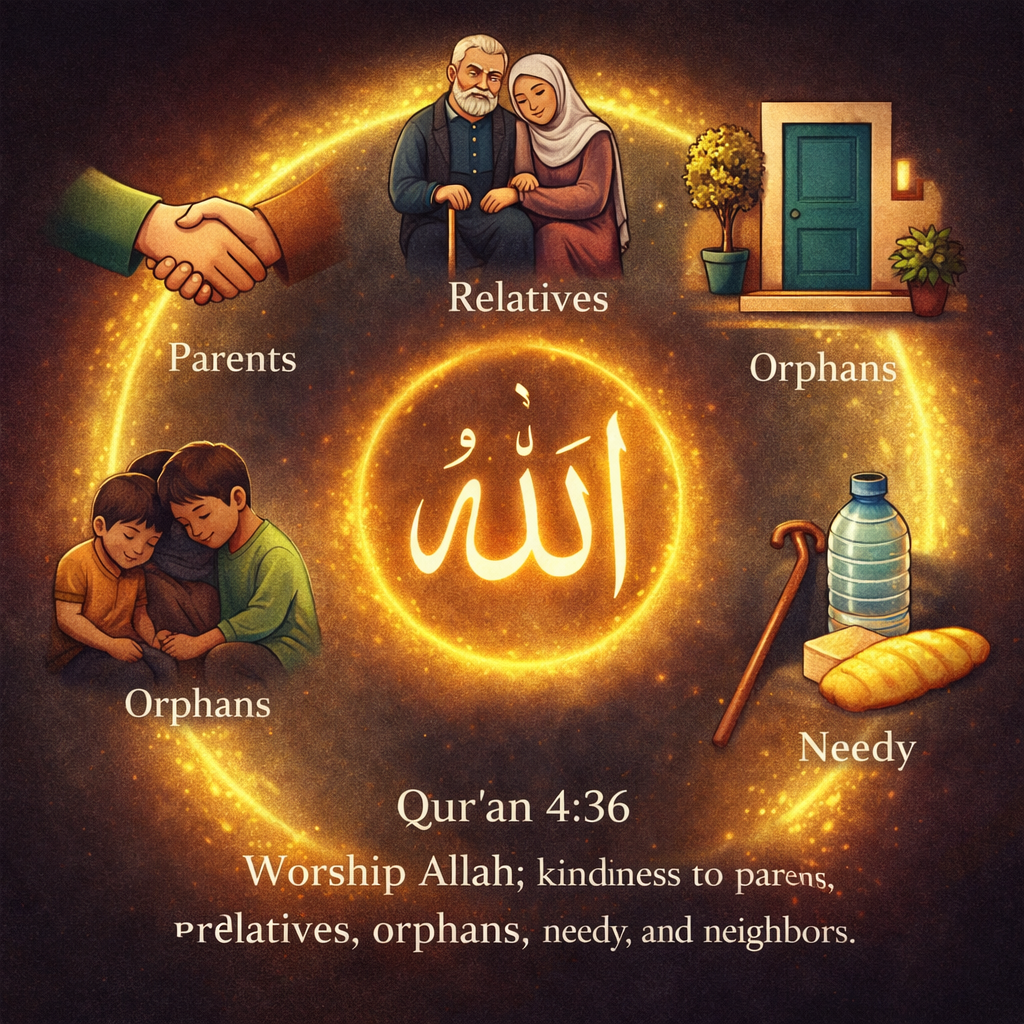

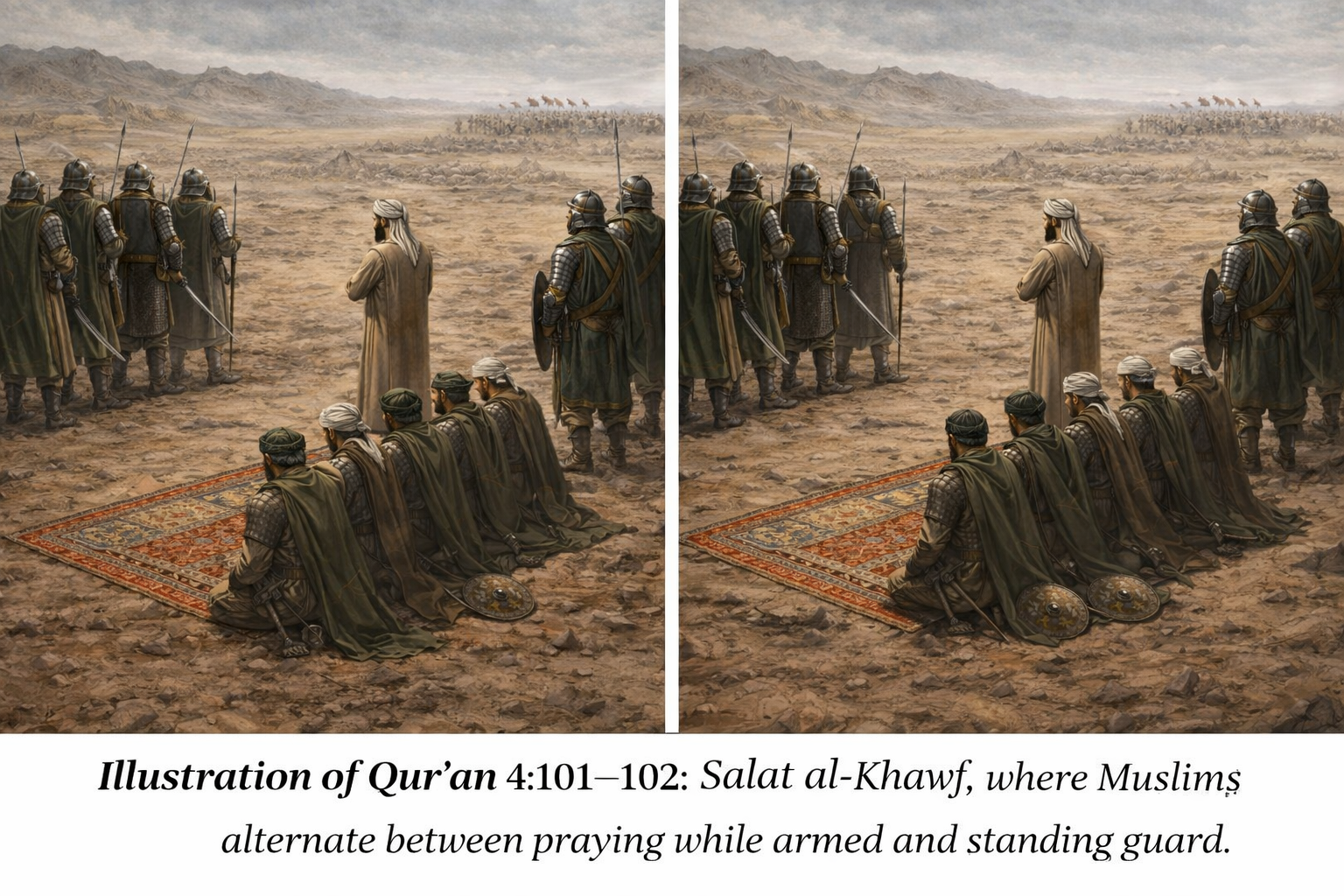 102. And when you (O Muhammad) are among them, and lead the prayer for them, then let only a party of them stand with you (to pray), and let them take their arms. Then when they have performed their prostrations, let them take their positions in your rear, and let another party come that has not prayed, so let them pray with you. And let them take their precaution and their arms. Those who disbelieve wish, if you were negligent of your arms and your baggage, to attack you in a single rush. And it is no sin for you, if you are inconvenienced of rain, or you are ill, that you lay aside your arms. And take your precaution. Indeed, Allah has prepared for the disbelievers a humiliating punishment.
103. Then when you have finished the prayer, then remember Allah, standing, and sitting down, and (lying down) on your sides. And when you are in safety, then establish prayer. Indeed, the prayer is enjoined on the believers at fixed hours.
104. And do not weaken in pursuit of these people (the enemy). If you should be suffering then surely, they (too) are suffering (hardships), as you are suffering. And you hope from Allah that which they do not hope. And Allah is ever All Knowing, All Wise.
105. Indeed, We have sent down to you (O Muhammad) the Book (the Quran) in truth that you might judge between mankind by that which Allah has shown you. And be not an advocate for those who betray their trust.
106. And seek the forgiveness of Allah. Indeed, Allah is ever Oft Forgiving, Most Merciful.
107. And argue not on behalf of those who deceive themselves. Indeed, Allah does not love anyone who is a betrayer of his trust, sinful.
108. They seek to hide from men and seek not to hide from Allah. And He is with them when they plot by night, in speech that which He does not approve. And Allah is ever encompassing of what they do.
109. Here you are, you who have argued for them in the life of this world. But who will argue with Allah for them on the Day of Resurrection, or who will then be their defender.
110. And whoever does evil or wrongs himself, then seeks forgiveness of Allah, he will find Allah Oft Forgiving, Most Merciful.
111. And whoever earns sin, he earns it only against himself. And Allah is All Knowing, All Wise.
112. And whoever earns a fault or a sin, then throws (blames) it upon the innocent, then indeed, he has burdened himself with a slander and a manifest sin.
113. And if it was not for the favor of Allah upon you (Muhammad), and His mercy, a party of them had resolved to mislead you. And they mislead none except themselves, and no harm can they do to you in the least. And Allah has sent down to you the Book (the Quran) and wisdom, and has taught you that which you knew not. And the favor of Allah has ever been great upon you.
102. And when you (O Muhammad) are among them, and lead the prayer for them, then let only a party of them stand with you (to pray), and let them take their arms. Then when they have performed their prostrations, let them take their positions in your rear, and let another party come that has not prayed, so let them pray with you. And let them take their precaution and their arms. Those who disbelieve wish, if you were negligent of your arms and your baggage, to attack you in a single rush. And it is no sin for you, if you are inconvenienced of rain, or you are ill, that you lay aside your arms. And take your precaution. Indeed, Allah has prepared for the disbelievers a humiliating punishment.
103. Then when you have finished the prayer, then remember Allah, standing, and sitting down, and (lying down) on your sides. And when you are in safety, then establish prayer. Indeed, the prayer is enjoined on the believers at fixed hours.
104. And do not weaken in pursuit of these people (the enemy). If you should be suffering then surely, they (too) are suffering (hardships), as you are suffering. And you hope from Allah that which they do not hope. And Allah is ever All Knowing, All Wise.
105. Indeed, We have sent down to you (O Muhammad) the Book (the Quran) in truth that you might judge between mankind by that which Allah has shown you. And be not an advocate for those who betray their trust.
106. And seek the forgiveness of Allah. Indeed, Allah is ever Oft Forgiving, Most Merciful.
107. And argue not on behalf of those who deceive themselves. Indeed, Allah does not love anyone who is a betrayer of his trust, sinful.
108. They seek to hide from men and seek not to hide from Allah. And He is with them when they plot by night, in speech that which He does not approve. And Allah is ever encompassing of what they do.
109. Here you are, you who have argued for them in the life of this world. But who will argue with Allah for them on the Day of Resurrection, or who will then be their defender.
110. And whoever does evil or wrongs himself, then seeks forgiveness of Allah, he will find Allah Oft Forgiving, Most Merciful.
111. And whoever earns sin, he earns it only against himself. And Allah is All Knowing, All Wise.
112. And whoever earns a fault or a sin, then throws (blames) it upon the innocent, then indeed, he has burdened himself with a slander and a manifest sin.
113. And if it was not for the favor of Allah upon you (Muhammad), and His mercy, a party of them had resolved to mislead you. And they mislead none except themselves, and no harm can they do to you in the least. And Allah has sent down to you the Book (the Quran) and wisdom, and has taught you that which you knew not. And the favor of Allah has ever been great upon you.